
The Philippines’ major outsourcing hubs are Metro Manila (the largest, for complex and executive work), Cebu (IT, KPO, and multilingual support), and Clark in Pampanga (scalable and low-disaster-risk), followed by Davao, Iloilo, and Bacolod. Metro Manila still holds most capacity, but growth is shifting to secondary cities that cost roughly 15–30% less.
Key Takeaways
- Three anchor hubs lead. Metro Manila (scale and complex work), Cebu (IT and multilingual), and Clark in Pampanga (scalable, disaster-resilient) form the core of the map.
- Manila dominates but is diversifying. About 60% of BPO office space sits in Metro Manila, but the industry’s 2028 roadmap targets at least 40% of the workforce outside the capital.
- Secondary cities cost 15–30% less. Davao, Iloilo, and Bacolod offer comparable talent at lower cost and better disaster resilience—part of why offshore programs save 60–75% versus onshore.
- Match the hub to the function and the risk. Voice, IT, and back-office cluster differently; a dual-site footprint (e.g., Manila plus Clark or Cebu) balances scale with business continuity.
What Are the Philippines’ Top Outsourcing Hubs?
Metro Manila, Cebu, and Clark are the three anchor hubs, followed by Davao, Iloilo, and Bacolod, with next-wave cities such as Baguio, Cagayan de Oro, Santa Rosa, and Dumaguete absorbing new growth. They differ by scale, specialization, cost, and disaster resilience—so the right hub depends on the work, not just the logo on the building.
The Philippine IT-BPM sector reached roughly US$40 billion in revenue and about 1.9 million workers, spread across a maturing map of locations. Grouped by island group—Luzon in the north, the Visayas in the center, and Mindanao in the south—the major hubs look like this:
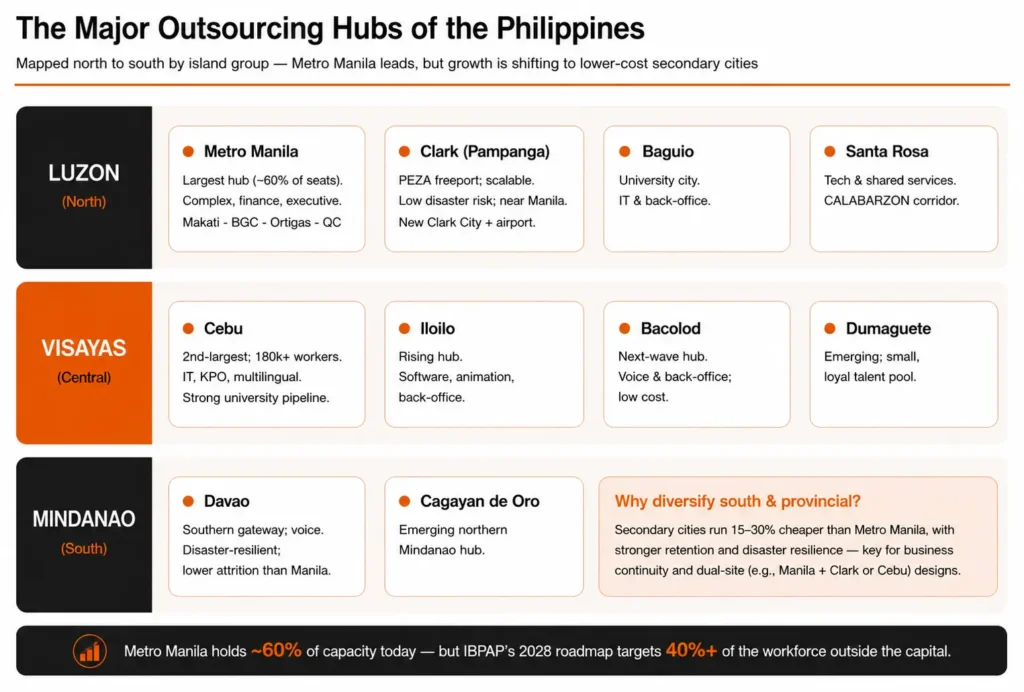
Major Philippine Outsourcing Hubs
| Hub | Island Group | Known For | Cost vs. Manila |
| Metro Manila | Luzon | Scale; complex, finance, and executive work | Baseline (highest) |
| Clark (Pampanga) | Luzon | Scalable, low-disaster-risk; near Manila | ~10% lower |
| Cebu | Visayas | IT, KPO, multilingual; 180k+ workers | ~10–15% lower |
| Iloilo | Visayas | Software, animation, back-office | ~10–15% lower |
| Bacolod | Visayas | Voice & back-office; next-wave | ~10–15% lower |
| Davao | Mindanao | Voice; disaster-resilient; lower attrition | ~10–15% lower |
Why Is Metro Manila Still the Primary Hub?
Because it has the deepest talent pool, the most mature infrastructure, and the scale for complex work. Metro Manila—spanning Makati, BGC, Ortigas, and Quezon City—holds the largest share of capacity and hosts the 10,000-plus-seat operations of global integrators. The trade-offs are the highest cost and the highest attrition.
Metro Manila is the financial and operational heart of Philippine outsourcing. Makati and Bonifacio Global City concentrate premium talent, executive-level roles, and complex finance and IT work; Ortigas and Quezon City add further scale. The largest global providers run their biggest sites here (and in Cebu), with operations exceeding 10,000 seats. That depth comes at a price: Manila carries the highest bill rates and the most job-hopping, which is precisely why many buyers now pair it with a lower-cost second site.
What Makes Cebu the Strongest Hub Outside Manila?
Cebu is the clear number-two: roughly 180,000+ IT-BPM workers, a deep university pipeline, and particular strength in IT, knowledge process outsourcing, and multilingual support (helpful for European and Asian markets). It pairs near-Manila capability with lower cost and strong regional resilience.
Cebu has matured from a voice-account overflow location into a full-fledged hub. Its universities—among them the University of San Carlos and Cebu Institute of Technology—feed a steady supply of graduates, and global names including Accenture, Teleperformance, and JPMorgan Chase operate there. Cebu is especially valued for IT and KPO work and for multilingual capability, while costing meaningfully less than Metro Manila and offering geographic separation from the capital for continuity planning.
Why Are Clark, Davao, and the Next-Wave Cities Growing Fastest?
Because they combine lower cost (10–15% below Manila) with disaster resilience and government support. Clark (Pampanga) is a PEZA freeport built for scalable, low-calamity-risk operations near Manila; Davao is Mindanao’s gateway with strong voice talent and lower attrition; and Iloilo, Bacolod, Baguio, and Cagayan de Oro are absorbing new growth as the industry pushes beyond the capital.
Clark, in Pampanga, is purpose-built for expansion: a PEZA freeport with modern infrastructure, the New Clark City development and Clark International Airport, low natural-disaster risk, and easy access to Metro Manila—ideal for scaling or for a resilient second site. Davao, on Mindanao, offers a large, educated workforce, clean governance, strong disaster resilience, and notably lower attrition than the capital, with office costs that can run far below Metro Manila’s. Around them, Iloilo (software, animation, back-office), Bacolod (voice and back-office), Baguio (a university city), Santa Rosa in Laguna (tech and shared services), and Cagayan de Oro (northern Mindanao) are the next-wave locations soaking up demand.
How Do I Choose the Right Hub for My Operation?
Match the hub to your function, cost target, talent depth, infrastructure needs, disaster resilience, and incentives. As a rule of thumb: Manila or Makati for complex, executive, or finance work; Cebu for IT and multilingual; Clark for scalable, resilient operations; and Davao, Iloilo, or Bacolod for cost-efficient voice and back-office.
- Function & Specialization
Complex/finance/executive → Manila/Makati; IT & multilingual → Cebu; voice & back-office → Davao, Iloilo, Bacolod.
- Cost
Provincial sites run ~10–15% below Manila; model fully loaded cost, not headline rates.
- Talent Depth
Manila and Cebu offer the deepest pools; smaller cities trade depth for better retention.
- Infrastructure & Connectivity
Established IT parks and submarine-cable access matter for uptime; Clark and Cebu score well.
- Disaster Resilience & Continuity
Favor lower-risk sites (Clark, Davao) and consider a dual-site footprint for business continuity.
- Incentives
PEZA zones and the CREATE MORE Act improve the economics of registered operations.
What Are the Risks, and How Do You De-Risk Hub Selection?
The main risks are over-concentration in Manila, wage inflation and attrition in the hottest markets, thinner talent depth in small cities, and single-site exposure to weather and infrastructure. De-risk by matching the hub to the work, diversifying across island groups, and running a dual-site footprint for continuity.
- Manila Over-Concentration
A capital-only footprint means top cost, top attrition, and weather exposure — diversify deliberately.
- Wage Inflation & Attrition
The busiest markets see the most job-hopping; secondary cities often retain staff better.
- Talent Depth in Small Cities
Emerging hubs offer loyalty and low cost but smaller pools — size the program to the market.
- Single-Site Risk
Typhoon and power exposure argue for a second site (e.g., Manila + Clark or Cebu) and a continuity plan.
Frequently Asked Questions
What Is the Biggest Outsourcing Hub in the Philippines?
Metro Manila — spanning Makati, BGC, Ortigas, and Quezon City — is the largest, holding roughly 60% of BPO office space and the biggest operations of global providers. It is best for complex, finance, and executive work, at the highest cost.
Which Philippine City Is Best for IT Outsourcing?
Cebu stands out for IT and knowledge-process work, thanks to a large, university-fed talent pool and multilingual capability. Makati and Santa Rosa (Laguna) also have strong tech depth.
Where Can I Outsource Most Cost-Effectively?
Secondary cities such as Davao, Iloilo, and Bacolod typically cost 15–30% less than Metro Manila for comparable work, with better staff retention — strong choices for voice and back-office at scale.
Is It Safe to Operate Outside Manila?
Yes. Clark and Davao in particular offer modern infrastructure and stronger disaster resilience than the capital. Many enterprises deliberately run a dual-site footprint (e.g., Manila plus Clark or Cebu) for continuity.
Why Is the Industry Expanding Beyond Metro Manila?
To lower cost, widen the talent pool, and reduce risk. The industry’s 2028 roadmap explicitly targets at least 40% of the workforce outside the capital, channeling growth to the Visayas and Mindanao.