
TL;DR: The Key Takeaway
Machine translation training outsourcing in the Philippines is evolving beyond simple linguistic validation. It has become a strategic imperative for achieving human-verified accuracy at scale, ensuring that AI-powered language models communicate with nuance, context, and unparalleled reliability.
Machine translation (MT) training outsourcing in the Philippines is the high-value process of utilizing human linguists to refine, “detoxify,” and culturally align Neural Machine Translation (NMT) and Large Language Models (LLMs). By 2026, the focus has shifted to “Linguistic Fidelity Lift,” where Filipino “AI Pilots” move beyond simple grammar checks to perform adversarial testing and idiomatic mapping, ensuring that automated translations are not just literal, but lifelike and brand-safe.
Executive Briefing
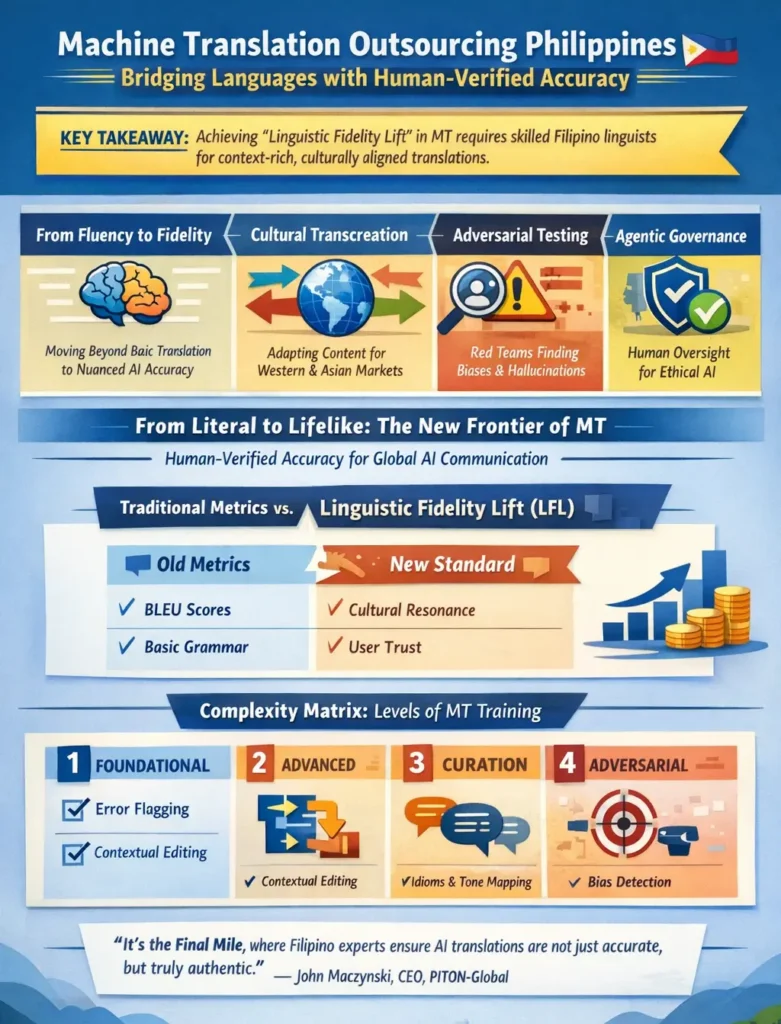
- From Fluency to Fidelity: Transition from basic readability to “Linguistic Fidelity Lift”—a metric measuring contextual accuracy, cultural resonance, and user trust.
- Cultural Transcreation: Leverage the Philippines’ unique cultural affinity with Western and Asian markets to validate idioms and “transcreate” marketing intent.
- Adversarial Training: Deploy “Red Teams” of Filipino linguists to identify model vulnerabilities, such as hallucinations or hidden biases, before they reach the end user.
- Agentic Governance: Utilize human-led monitoring to ensure AI agents stay “on-brand” and ethically aligned in real-time multilingual interactions.
- Fiscal Edge: Benefit from the 2026 CREATE MORE Act, which reduces corporate taxes to 20% and offers 100% deductions on power and AI-upskilling costs.
From Literal to Lifelike: The New Frontier of MT
The era of word-for-word translation is over. In 2026, the challenge for global enterprises is achieving “human-level” nuance in real-time. While Neural Machine Translation (NMT) has improved fluency, it still falters with sarcasm, industry-specific jargon, and local taboos.
The Philippines has moved into the “Final Mile” of translation—where human experts provide the critical verification that turns a robotic output into a natural conversation. This is not just editing; it is Cognitive Training. Filipino specialists act as the “Ground Truth” for LLMs, teaching the system the difference between a technical instruction and an idiomatic expression.
MT Evaluation Metrics: The Old vs. The New
Traditional metrics like BLEU scores are now considered “vanity metrics” because they only measure syntactic similarity. The modern standard focuses on the Linguistic Fidelity Lift (LFL).
| Metric Type | Traditional Metrics (The Old) | Human-Centric (The New – 2026) |
| Primary Focus | Grammatical similarity. | Cultural resonance & user trust. |
| Indicators | BLEU, METEOR, TER. | Comparative Editing (CE) & Acceptance (UA). |
| Process | Automated/Algorithmic. | Expert-led validation. |
| Value | Syntactic correctness. | Semantic & Pragmatic effectiveness. |
| Business Impact | Basic content access. | Brand loyalty & global market growth. |
Machine Translation Training Complexity Matrix
Not all translation tasks require the same level of human intervention. PITON-Global maps project needs against a specialized complexity matrix.
| Tier | Key Tasks | Required Cognitive Skills | Strategic Impact |
| 1: Foundational | Basic error flagging. | High English/Local proficiency. | Establishes grammatical baseline. |
| 2: Advanced | Comparative analysis. | Bilingual fluency & analytical skill. | Improves contextual accuracy. |
| 3: Curation | Idiom & tone mapping. | Deep cultural knowledge. | “Lifelike” naturalness & resonance. |
| 4: Adversarial | Bias & Red Teaming. | Critical thinking & AI mindset. | Robustness, safety, and brand protection. |
Intelligence Arbitrage: Bridging the “Context Gap”
The Philippine BPO sector has evolved from “labor arbitrage” to Intelligence Arbitrage. By tapping into a workforce that is inherently multilingual and culturally “Western-aligned,” global firms can achieve a level of linguistic judgment that is impossible through onshore automation alone.
“It’s no longer about simply processing vast amounts of text. The real value is in achieving a level of linguistic and cultural nuance that instills user trust. Our clients are turning to the Philippines for the sophisticated cognitive talent that can deliver that final, critical mile of human-verified accuracy.” — John Maczynski, CEO, PITON-Global
Filipino “Linguistic Engineers” do more than edit; they curate high-quality corpora. They clean legacy translation memories and “detoxify” data by flagging biased or offensive content, ensuring the AI model doesn’t learn harmful patterns.
Agentic Governance: The Safety Net for Language Models
As of 2026, AI “agents” are handling live negotiations and customer service. Agentic Governance is the human-in-the-loop framework that prevents these agents from going “rogue” in a foreign language. Filipino AI Pilots monitor these live outputs, identifying off-brand communication or hallucinations in real-time. This provides the safety net required for enterprises to deploy autonomous multilingual systems with confidence.
Expert FAQs
Why use the Philippines for MT training instead of native speakers in the target country?
The Philippines offers a unique “Hub Advantage.” A single site in Manila or Cebu can host teams proficient in English, Spanish, Japanese, and Mandarin, all working under a unified AI-governance framework. This centralized approach is 60–75% more cost-effective than fragmented onshore teams.
How does the “CREATE MORE” Act (RA 12066) benefit AI developers?
Passed in late 2024 and fully active in 2026, this law slashes Corporate Income Tax to 20% for export-oriented firms and allows for 100% deductions on power costs—critical for high-intensity GPU/AI operations.
Is AI replacing human translators in the Philippines?
No, the role has evolved. While basic translation is automated, the demand for Linguistic Engineers and AI Supervisors has created over 80,000 high-value jobs. Humans have moved from “typing” to “teaching” the models.
How does the Philippines ensure data sovereignty in 2026?
Leading BPOs now use Zero-Possession Data Environments. Sensitive data is processed in secure “sandboxes” where human trainers see only the segments they need, and no data is stored locally, ensuring compliance with global mandates like GDPR and the EU AI Act.