
On this page
- Key Takeaways
- What Are the Operational Benchmarks of a Ready Organization?
- How Do Philippine Cost Structures and Service Levels Compare Globally?
- What Are the Primary Risks and Strategic Tradeoffs?
- Perspective From the Field
- What Does a Calibrated Technical-Support Deployment Achieve?
- How Does PITON-Global Help You Navigate Provider Selection?
- What Else Should Procurement Leaders Know Before Outsourcing?
Determining readiness for call center outsourcing to the Philippines requires auditing three core vectors: process standardization, baseline transaction velocity, and cloud-tier data maturity. Organizations with stabilized, documented SOPs are structurally ready to shift from simple labor arbitrage to intelligence arbitrage — preserving brand empathy while reducing front-office overhead by 40–60%.
Key Takeaways
- Process maturity threshold: Workflows must have stable, written documentation; mapping broken internal processes to an offshore team only accelerates delivery friction.
- The shift to intelligence arbitrage: Leading 2026 frameworks use human specialists as exception-handling architects integrated alongside an automated software tier.
- Quantifiable financial realities: Fully-loaded structures drop from an onshore $26–$40 per hour to a compliant Philippine rate of $12–$18 per hour.
- Geopolitical & infrastructure security: Risk is mitigated by filtering for SOC 2 Type II certification, redundant undersea fiber loops, and multi-city failovers.
- Empathy is the moat: The strategic goal is protecting customer equity through high-empathy human engagement, not maximizing automated deflection.
- A proven ecosystem: The Philippine IT-BPM sector is projected to reach roughly $42 billion in 2026, with about 1.9 million digital professionals.
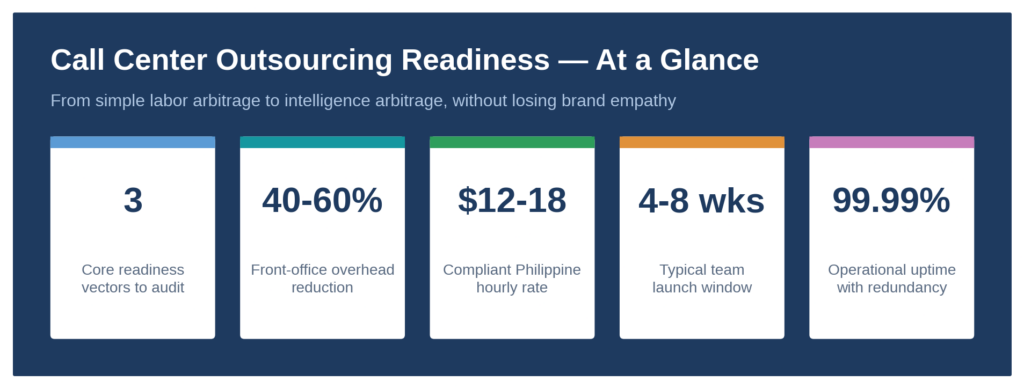
Figure 1. The readiness levers and benchmarks that define a calibrated deployment.
What Are the Operational Benchmarks of a Ready Organization?
A ready organization has workflows mature enough to distribute across an external delivery architecture without degrading service quality. Three non-negotiable baselines define it: sustained inbound transaction velocity (1,500–2,000 monthly interactions per channel), cloud and API maturity, and clean, documented FCR and CSAT trends to anchor SLA baselines.
Before initiating an offshore transition plan, enterprise leadership must execute an objective internal audit. True readiness means your workflows are mature enough to be distributed across an external delivery architecture without a degradation in service quality. Organizations that outsource prematurely — to escape internal system friction — simply export and amplify their operational inefficiencies.
The contrast is clearest at the level of a single customer ticket: an un-optimized internal silo routes it through manual triage and siloed queues toward delayed resolution, while a standardized offshore architecture routes it via API through automated quality gates to a specialist.
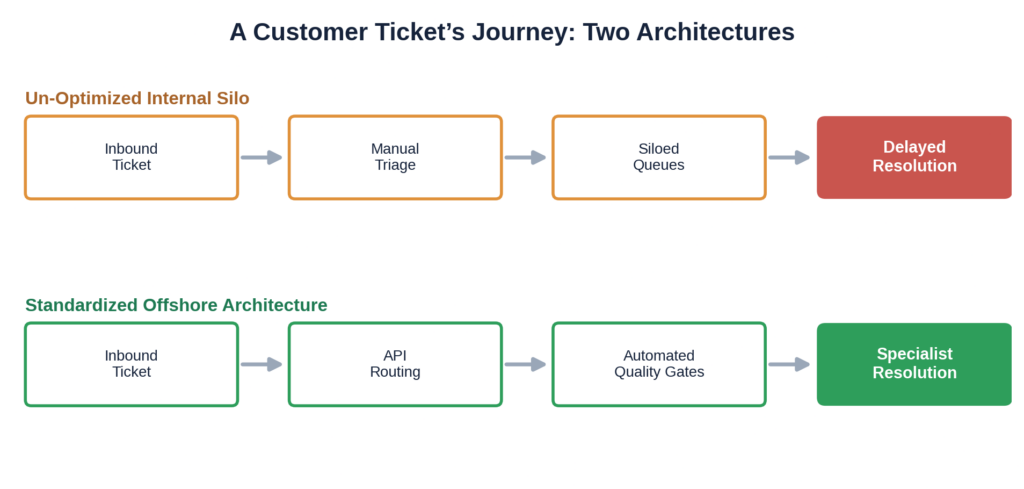
Figure 2. The same inbound ticket, handled by an un-optimized silo versus a standardized offshore architecture.
To establish an objective corporate readiness profile, evaluate your operations against three structural baselines.

Figure 3. The transaction-volume, technical, and performance-data thresholds for readiness.
Inbound Transaction Velocity
A sustained minimum of 1,500 to 2,000 monthly inbound interactions per channel — voice, chat, or email — is required to justify and stabilize a dedicated agent tier. Below that threshold, a shared or boutique arrangement is usually the better fit.
Cloud Architecture and API Maturity
Your CRM and ticketing platforms must offer secure, cloud-accessible endpoints capable of supporting concurrent remote-desktop environments without latency spikes. This is what makes a distributed team feel native rather than bolted on.
Documented Quality Performance Metrics
Historical data for core indicators — specifically First Contact Resolution (FCR) and Customer Satisfaction (CSAT) trends — must be clean and finalized so they can serve as contractual service-level-agreement (SLA) baselines from day one.
How Do Philippine Cost Structures and Service Levels Compare Globally?
The Philippine business case balances structural cost reduction against brand-equity retention. Compliant fully-loaded rates run $12–$18 per hour — roughly 45–70% below onshore — across three market tiers, from boutique specialists to Tier 1 enterprise providers with full SOC 2 Type II and ISO 27001 compliance.
Driven by a native English-speaking talent pool and intrinsic cultural alignment with Western enterprise markets, primary hubs like Manila and Cebu have advanced past simple call routing into specialized technical, financial, and digital care orchestration. The financial differential becomes clear when analyzing fully-loaded hourly rates across the three primary tiers of the market.

Figure 4. The three Philippine BPO market tiers, by rate, capability, and best fit.
Set against onshore US and UK fully-loaded support rates of roughly $26 to $40 per hour, even the Tier 1 enterprise band remains markedly lower while delivering complete compliance infrastructure.
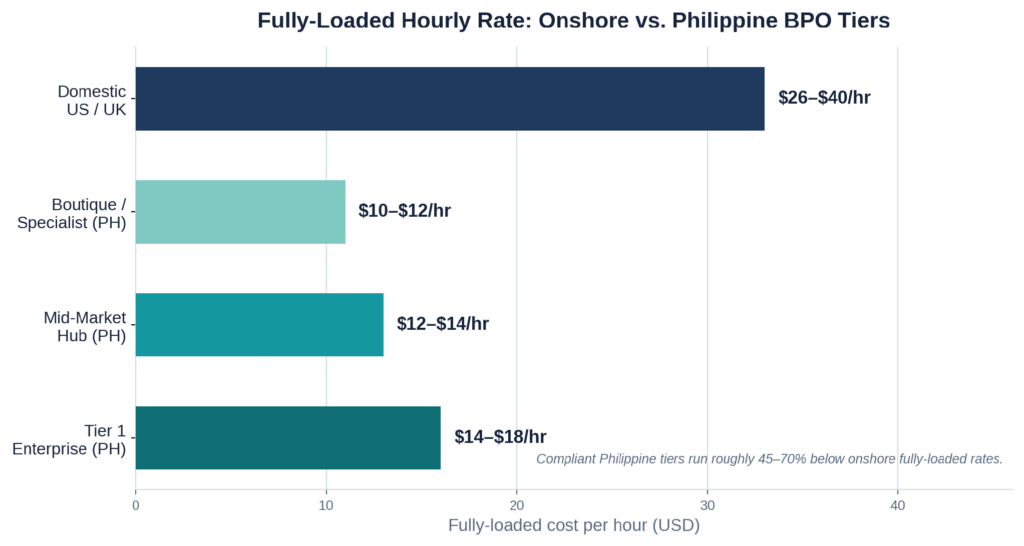
Figure 5. Onshore US/UK fully-loaded rates against the three compliant Philippine tiers.
What Are the Primary Risks and Strategic Tradeoffs?
An elite deployment balances cost pressure against three risk vectors that must be architected for from day one: the automation-fatigue trap, cross-border data-security boundaries, and infrastructure or business-continuity gaps. Each has a concrete mitigation — human routing of complex work, contractual privacy adherence, and redundant infrastructure.

Figure 6. The three risk vectors of a distributed deployment, with mitigations.
The Automation Fatigue Trap
Over-indexing on pure AI response layers can degrade customer lifetime value. Exceptional experiences use automated conversational tiers for routine tasks while routing high-acuity, complex issues to human specialists in the Philippines who act as empathetic problem solvers.
Cross-Border Data Security Boundaries
Transporting proprietary customer data across international borders creates compliance exposure. Organizations mitigate this by enforcing strict, contractual adherence to global privacy frameworks including HIPAA, GDPR, and PCI-DSS.
Infrastructure and Business Continuity Gaps
Regional weather patterns or localized telecom disruptions can threaten uptime. Top-tier readiness strategies source partners that maintain dual-source subsea fiber-cable links and multi-city facility footprints to guarantee 99.99% operational redundancy.
Perspective From the Field
In the current market landscape, a BPO partner’s enterprise value is no longer measured by how many physical seats they can rapidly fill, but by their ability to manage complex, judgment-critical workflows that automated systems alone cannot resolve. We have structurally migrated from simple labor arbitrage to intelligence arbitrage. The Philippines serves as a strategic operational moat where global brands protect their customer equity through high-empathy human engagement backed by highly optimized technical infrastructures.
— John Maczynski, CEO, PITON-Global
What Does a Calibrated Technical-Support Deployment Achieve?
An enterprise software group facing a 45% surge in complex technical requests deployed a hybrid model — automation for routine queries, Philippine specialists for tier-1 to tier-3 diagnostics. Resolution time fell 34% in 60 days, CSAT stabilized at 91% (up from 68%), and front-office operating costs dropped 48% annualized.

Figure 7. Quantifiable outcomes from a hybrid AI-plus-human technical-support deployment.
The Challenge
A rapidly scaling business-to-business (B2B) software provider faced an immediate 45% surge in complex technical-assistance requests, creating severe backlogs, driving customer satisfaction down to 68%, and producing unsustainable domestic staffing overhead.
The Selection Process
Working alongside PITON-Global, the organization bypassed broad broker directories and used an advisory-driven matrix. It evaluated twelve specialized providers — focusing strictly on verified engineering-support histories and secure API infrastructure — before shortlisting a mid-market provider in Manila.
The Solution
The team implemented a hybrid operational framework. An automated software layer handled basic password updates and simple routing, while a dedicated team of technical agents in the Philippines managed tier-1 to tier-3 diagnostic problems.
The Outcomes
- Average resolution time dropped 34% within the first 60 days.
- Customer satisfaction stabilized at 91%, up from 68%.
- Total front-office operating costs fell 48% annualized.
Lessons Learned
Technical training validation matters more than sheer seat capacity. Success depended entirely on the partner’s domain expertise and immediate alignment with the client’s internal software documentation.
How Does PITON-Global Help You Navigate Provider Selection?
PITON-Global is an advisory-led outsourcing consultancy, not a transactional broker. It maintains a vetted network of 100+ top-tier Philippine call-center and back-office providers and guides leadership through vendor landscape analysis, RFP engineering, and commercial modeling — mapping workflows to verified competencies to eliminate selection risk.
With decades of institutional experience embedded directly inside the global BPO ecosystem, PITON-Global operates as an objective extension of an enterprise’s procurement and operations teams — an advocate for the buyer rather than a salesperson for any single provider.
Who Is PITON-Global?
PITON-Global is an advisory-led outsourcing consultancy that functions as an objective extension of an enterprise’s procurement and operations teams. Led by executives with decades of institutional experience inside the global BPO ecosystem, it specializes in vendor evaluation and provider selection rather than running its own delivery centers.
How Does PITON-Global Differ from Traditional Outsourcing Brokers?
Where transactional brokers earn commissions that bias them toward specific vendors, PITON-Global is advisory-led and objective. It guides leadership through structured vendor-landscape analysis, request-for-proposal (RFP) engineering, and commercial modeling — protecting data integrity and accelerating speed-to-market rather than steering toward a preferred seller.
How Does PITON-Global’s Network of 100+ Vetted Philippine BPO Providers Benefit Organizations?
A fully vetted network of more than 100 top-tier call-center and back-office providers gives organizations broad, pre-qualified optionality across boutique, mid-market, and Tier 1 enterprise tiers. Because providers are continuously vetted, buyers gain faster discovery and confidence that candidates already meet capability and compliance standards.
How Does PITON-Global’s Advisory-Led Vendor Matching Process Work?
The workflow is structured and repeatable: requirements mapping captures unique client workflows, network shortlisting narrows the field to verified fits, RFP governance keeps the evaluation objective and rigorous, and a calibrated match pairs the enterprise with the provider whose competencies align precisely with its needs.

Figure 8. The four-stage PITON-Global advisory workflow, from requirements to calibrated match.
Why Do Organizations Use PITON-Global?
Organizations use PITON-Global to systematically eliminate selection risk, protect data integrity, and accelerate speed-to-market. By mapping unique workflows directly to verified provider competencies — at zero cost to the buyer — the consultancy converts a high-risk procurement exercise into a calibrated, defensible decision.
What Else Should Procurement Leaders Know Before Outsourcing?
Frequent questions cover launch timelines, accent neutralization, suitability for small businesses, data-privacy frameworks, and SOP formatting. In short: enterprise launches take 4–8 weeks, elite hubs deliver neutral English, startups can match with boutique providers, top vendors meet GDPR/HIPAA/SOC 2, and SOPs should be modular and step-based.
What is the Typical Timeline Required to Launch a Philippine Call Center Team?
An enterprise-level deployment typically requires an operational window of 4 to 8 weeks. This covers secure cloud-infrastructure configuration, custom workflow training, and technical process-calibration tests.
How Do Philippine Providers Handle Accent Neutralization for Western Markets?
The elite tier of Philippine contact hubs sources talent with natural, neutral English proficiency. Ongoing speech training ensures communication aligns seamlessly with US, UK, and Australian customer groups.
Can a Small Business or Startup Benefit from Outsourcing to the Philippines?
Yes — provided they match with a specialized mid-market or boutique provider that accommodates lower minimum-seat requirements while keeping the focus on core process documentation.
What Data-Privacy Frameworks Are Standard Among Top-Tier Philippine BPOs?
Enterprise-grade providers comply fully with the Philippine Data Privacy Act of 2012, which aligns directly with global standards including GDPR, HIPAA, and SOC 2 Type II protections.
How Should Internal Training Documentation Be Formatted for an Offshore Partner?
SOPs must be modular and step-based, detailing exact platform workflows, exception-handling protocols, brand-tone guidelines, and escalation paths.