

Provider organizations should measure Philippine healthcare outsourcing performance through a balanced framework spanning clinical precision, operational efficiency, and financial fidelity. Success couples strict SLA compliance on metrics like coding accuracy and A/R turnaround with rigorous data security and strong patient-satisfaction (CSAT) scores — the same yardsticks that govern back-office and patient-contact work for US providers.
Key Takeaways
- Clinical accuracy first: prioritize chart auditing and coding accuracy over raw speed to mitigate compliance risk.
- Financial integrity: tie performance directly to Net Collection Rate and Days Sales Outstanding (DSO) reductions.
- Patient experience: evaluate vendor staff on communication quality and empathy, which drive patient retention.
- Data-security compliance: continuously monitor HITRUST, HIPAA, and SOC 2 Type II controls in the offshore delivery center.
What Key Performance Indicators Matter Most for Healthcare Revenue Cycle Management?
Generic BPO metrics like Average Handle Time are insufficient for RCM. Track specialized clinical and financial KPIs: coding accuracy, DSO under 40 days, Net Collection Rate, and First-Pass Acceptance Rate — each held to a contractual benchmark.
When offshoring Revenue Cycle Management, the metrics that protect cash flow and compliance are clinical and financial, not call-center throughput. The four indicators below deserve rigorous, continuous monitoring.
- Coding accuracy rate: consistently near-perfect across ICD-10-CM, CPT, and HCPCS Level II to prevent costly denials.
- Days Sales Outstanding (DSO): a premier cash-flow indicator, targeted under 40 days.
- Net Collection Rate: the effectiveness of billing operations, targeting nearly all collectable revenue.
- First-Pass Acceptance Rate (FPAR): claims cleared on initial submission, benchmarked against a high contractual floor.
Translating those KPIs into contract language means pairing each with an industry benchmark, a minimum acceptable SLA, and the risk of falling short.
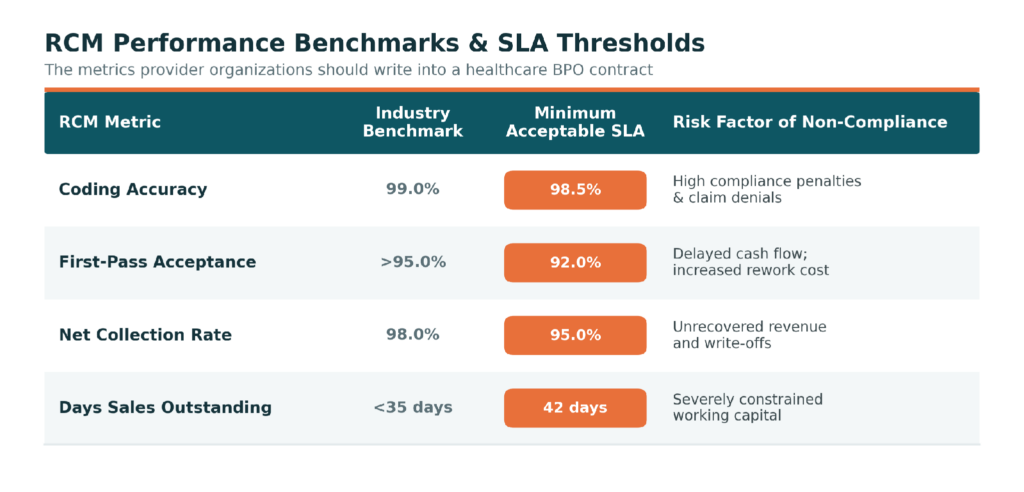
These metrics are interdependent. Coding accuracy is the upstream driver of nearly everything downstream — as accuracy climbs, denials fall almost in lockstep, which is exactly the relationship a monthly performance review should surface. Executives can pair this view with the financial KPIs hospital CEOs should watch after go-live.

How Do You Assess Patient Experience and Communication Quality in Clinical Support Roles?
Assess patient-facing roles on both linguistic proficiency and cultural alignment using a structured QA framework: empathy and sentiment scored via speech analytics, First-Contact Resolution for the large majority of inquiries, and a low escalation rate to onshore staff.
Measuring performance in patient-facing clinical support — intake, prior authorizations, and billing inquiries — requires more than accuracy checks. A robust Quality Assurance framework evaluates how the patient actually experienced the interaction. The same holds for front-office work, where offshore patient-access and scheduling teams are judged on how the call felt, not only on how many slots were filled.
- Empathy and patient sentiment: speech analytics score voice tone, active listening, and compassion.
- First-Contact Resolution (FCR): billing or scheduling inquiries resolved in a single interaction, targeting the large majority of contacts.
- Escalation rate: how often calls transfer to onshore clinical staff, kept to a small minority of calls.
In practice, those checkpoints run as tiers across a single call — verifying identity, scoring empathy, confirming documentation, and resolving or escalating — each producing an auditable score.

Healthcare outsourcing is not a transactional commodity; it is an extension of the patient care continuum. In the Philippines, the highest-performing vendors succeed because they don’t just measure how fast an agent hangs up the phone, but whether the patient felt heard, understood, and respected.
— John Maczynski, CEO of PITON-Global
What Data Security and Compliance Auditing Protocols Are Required?
Operational performance is irrelevant if a vendor cannot secure protected health information. Performance measurement must include scheduled and ad-hoc compliance audits of the offshore delivery site — continuous technical testing, full workforce compliance certification, and measured incident-response times.
Securing PHI is the precondition for every other metric. A measurement framework therefore treats compliance as an ongoing, audited discipline rather than a one-time certification.
- Continuous technical audits: regular penetration testing, vulnerability assessments, and strict clean-desk monitoring.
- Employee compliance training scores: the entire workforce holding active HIPAA and data-privacy certification.
- Incident response time: the exact minutes to detect, isolate, and mitigate a simulated or actual security anomaly.
How Did a Multi-Site Health System Cut Its Denial Rate by Two-Thirds?
Facing a double-digit denial rate and rising labor costs, a U.S. health system deployed a 45-person offshore RCM team focused on pre-authorization and complex coding. Within six months, denials fell sharply, DSO dropped 9 days, and administrative overhead fell substantially.
The Challenge
A U.S.-based health system saw claim denials spike into double digits as labor costs climbed, putting operating margins under pressure.
Selection and Solution
PITON-Global evaluated its vetted network of more than 100 Philippine providers, filtering for specialized healthcare vendors with certified medical coders and a documented HITRUST compliance history. The selected provider deployed a dedicated team of 45 RCM specialists focused on pre-authorization and complex coding.
The Outcomes
Within six months, the denial rate fell sharply, DSO dropped by 9 days, and administrative overhead declined substantially.

The turnaround depended on establishing clear, mutually agreed baseline metrics before any workflow moved offshore — so improvement could be measured against a known starting point. It mirrors the approach leading health systems take with offshore partners.
How Does PITON-Global Mitigate Risk in Healthcare Outsourcing Selection?
PITON-Global is a specialized BPO advisory and outsourcing consultancy that uses an advisory-led matching process across a vetted network of 100+ Philippine providers. It aligns provider organizations with partners that have the precise clinical expertise, technical infrastructure, and compliance posture healthcare demands.
PITON-Global helps healthcare organizations navigate the complex Philippine outsourcing landscape. Moving beyond the limits of transactional brokers, it applies an advisory-led matching process built around the realities of clinical work.
Leveraging a deeply vetted network of more than 100 capable Philippine call-center and back-office providers, PITON-Global aligns each organization with partners that have the clinical expertise, technical infrastructure, and compliance posture required for healthcare operations. That rigorous mitigation framework significantly reduces transition risk and accelerates time-to-value.
What Do Provider Organizations Most Often Ask About Vendor Scorecards?
Common questions cover cost savings, complex inpatient coding, required security certifications, time-zone coverage, and review cadence. Concise answers follow.
What is the average cost saving when outsourcing RCM to the Philippines?
Provider organizations typically realize a substantial reduction in labor and operational overhead versus comparable onshore administrative costs.
How do Philippine firms handle complex inpatient chart audits?
Top-tier vendors employ licensed nurses and AHIMA- or AAPC-certified coders who undergo continuous education on U.S. healthcare regulations.
What data-security certifications should a Philippine healthcare BPO hold?
At a minimum, HIPAA compliance plus SOC 2 Type II and ISO/IEC 27001. HITRUST certification is highly recommended for enterprise integrations.
How are time-zone differences managed for real-time patient support?
Providers run dedicated 24/7/365 shifts tailored to U.S. time zones (EST, CST, PST) to deliver seamless, real-time patient care.
How frequently should performance reviews be conducted?
Weekly operational touchpoints, paired with formal monthly SLA reviews and comprehensive quarterly business reviews (QBRs) to recalibrate strategic goals.