

On this page
- Key Takeaways
- How Do Primary Pricing Models Shift Risk Between Enterprise Buyers and BPO Vendors?
- How Should SLAs, Penalties, and Incentives Be Financed and Structured?
- How Do Volume Fluctuations and FX Rates Impact Contractual Risk?
- How Should Liability Caps, Termination, and Review Cadence Be Set?
- What Does Balanced Risk Allocation Look Like in Practice?
- What Role Does PITON-Global Play in Mitigating BPO Contractual Risk?
- Frequently Asked Questions
Outsourcing contracts allocate financial risk by balancing cost predictability against operational flexibility through structured pricing models, clear SLA penalty-incentive frameworks, and defined volume fluctuation bands. Risk is optimized when vendor compensation ties directly to measurable performance, with capped liabilities and financial incentives aligned to shared business outcomes. Allocation is one part of the wider governance that keeps offshore contracts on track.
Key Takeaways
- Model alignment decides who carries variance. Fixed-price structures shift operational variance to the vendor; time and materials exposes the buyer to vendor inefficiency.
- Volume buffer bands protect both sides. A defined fluctuation band shields the vendor from idle staffing cost and the buyer from sudden surge penalties.
- Balanced SLA governance beats penalties alone. Pair credits with an incentive pool so the vendor manages toward quality rather than toward minimum compliance.
- Currency and inflation need explicit hedging. Multi-year Philippine agreements require FX risk-sharing corridors and adjustments indexed to published benchmarks.
- Caps and exits belong in the same conversation. Liability ceilings, carve-outs, and termination triggers determine what the allocation is actually worth when something fails.
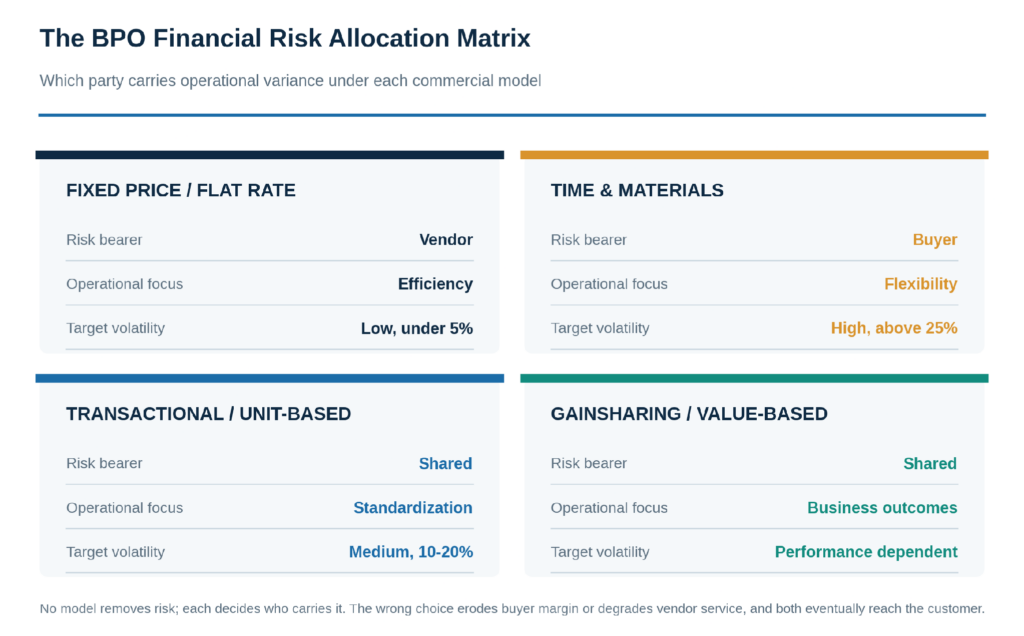
Figure 1. The BPO financial risk allocation matrix: risk bearer, operational focus, and target volatility under each commercial model.
How Do Primary Pricing Models Shift Risk Between Enterprise Buyers and BPO Vendors?
The pricing model determines which party absorbs operational inefficiency, labor cost increases, and volume volatility. Fixed price places variance on the vendor, time and materials places it on the buyer, and transactional and gainsharing models split it. Choosing the wrong framework produces either buyer margin erosion or vendor service degradation.
Across the typical range of fully loaded voice CX rates in the Philippines, the model chosen usually matters more to total cost than the rate negotiated within it. A well-structured transactional agreement at the top of that range will frequently outperform a poorly structured time-and-materials agreement at the bottom of it, because the structure decides what happens when volumes move, wages rise, or productivity disappoints — and one of those three always happens.
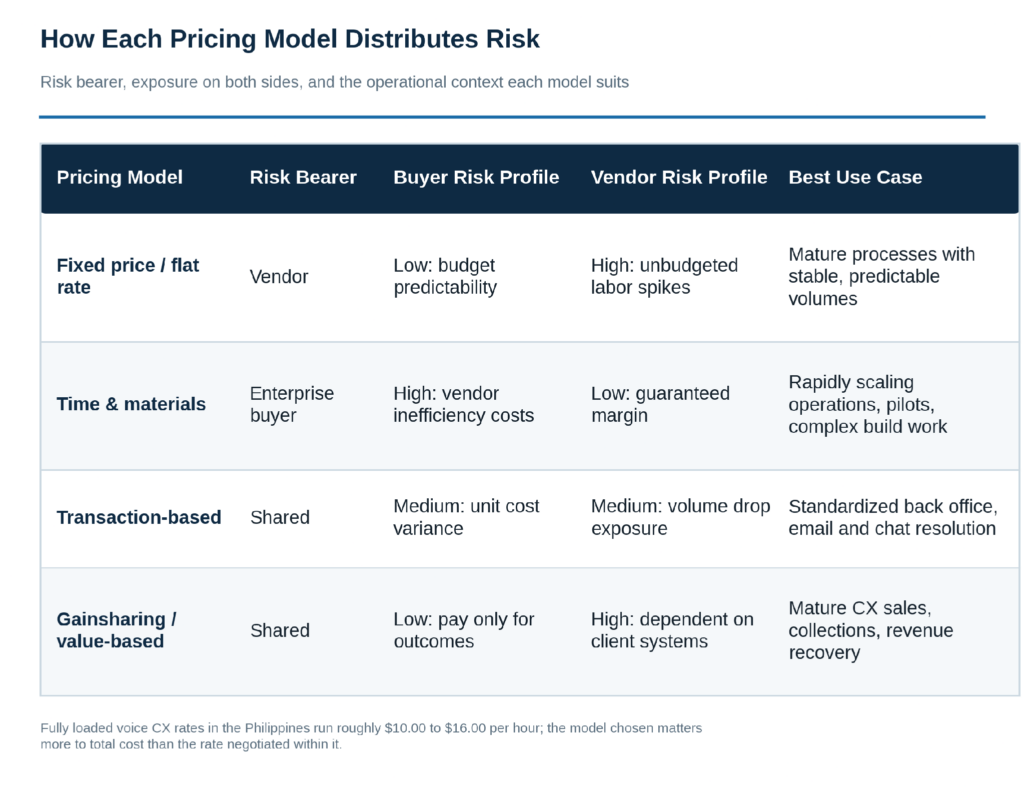
Figure 2. How each pricing model distributes risk, with the exposure on both sides and the operational context each suits.
Fixed Price Suits Predictability, Not Change
A flat rate gives the buyer budget certainty and hands the vendor every unit of operational variance. That is a fair trade when the process is mature and volumes are stable within a narrow range. It becomes expensive when the scope evolves, because every change request reopens the price, and the vendor prices each one knowing the buyer has already committed.
Time and Materials Suits Uncertainty, at a Cost
T&M is the right structure for pilots, rapid scaling, and complex build work where the specification is still moving. The exposure is that the buyer funds inefficiency: with margin guaranteed, the vendor has no financial reason to reduce hours. Use it deliberately and for a defined period rather than as a default, and pair it with a documented transition to a fixed or unit-based structure once the operation stabilizes.
Transactional and Gainsharing Models Split the Exposure
Unit-based pricing suits standardized back-office processing and email or chat resolution, where output is discrete and countable; the vendor carries volume-drop risk and the buyer carries unit cost variance. Gainsharing suits mature sales, collections, and revenue recovery programs, but it depends heavily on client systems and data quality — which is why attribution needs settling before the first payout period rather than during the first dispute.
How Should SLAs, Penalties, and Incentives Be Financed and Structured?
Withhold a set share of monthly billings for critical SLA misses, cap total penalties at a fixed share of invoice value, pair that with a matching bonus pool for top-tier CSAT or FCR, and allow earn-back of withheld fees for sustained over-performance. Exclude failures caused by client-side events.
Penalties alone reliably produce minimum compliance. A vendor managing to avoid credits optimizes for the threshold, not past it, and once a quarter’s credits are lost it has no financial reason to invest in recovery for the remainder of the period. Symmetry changes the calculation: with a bonus pool of comparable size, exceeding the SLA has commercial value, and with earn-back the incentive to fix a problem survives the miss that created it.
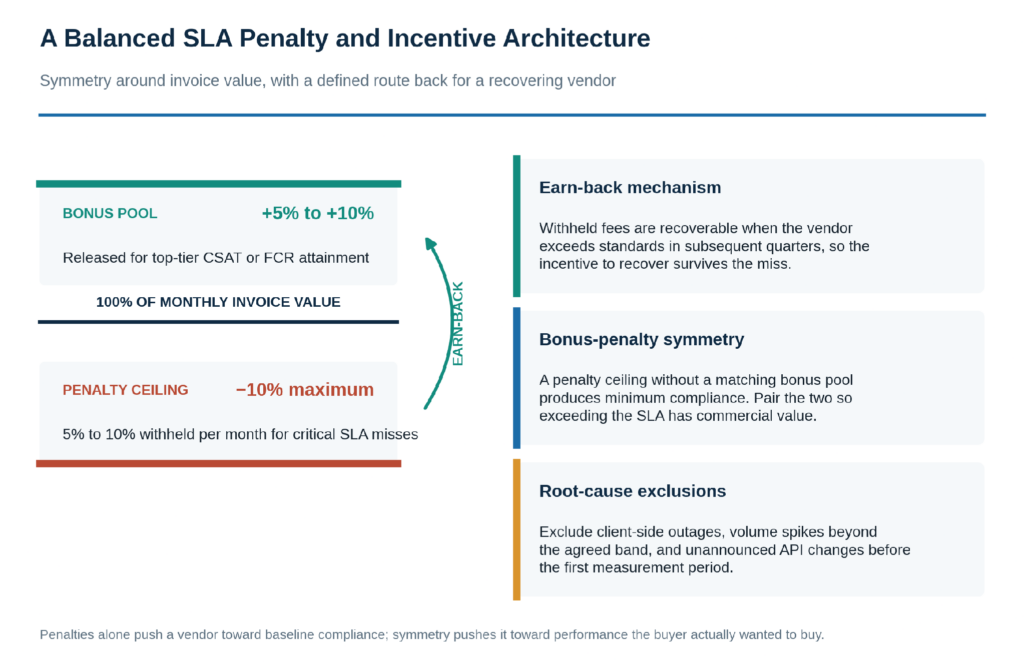
Figure 3. A balanced SLA penalty and incentive architecture, with the earn-back path and the exclusions that keep it fair.
Root-Cause Exclusions Protect the Framework’s Credibility
Penalties should not apply when performance drops for reasons the vendor does not control: client-side system outages, volume spikes beyond the agreed band, or unannounced API changes. Excluding these is not a concession — it is what keeps the remaining penalties enforceable. A framework that charges a vendor for the buyer’s own outage will be disputed every time it triggers, and a mechanism disputed at every trigger stops functioning as an incentive.
Define the Measurement Before the First Dispute
Name the system of record whose numbers are contractually authoritative, document the calculation for each metric, and agree the exclusion list before the first measurement period. Most SLA disputes are not disagreements about performance; they are disagreements about measurement, and they are cheap to prevent and expensive to resolve.
A contract built purely on punitive SLA credits creates an adversarial relationship that compromises service quality. Enterprise risk management requires aligning vendor margins with measurable client value, turning contractual compliance into a joint profit center.
— John Maczynski, CEO, PITON-Global
How Do Volume Fluctuations and FX Rates Impact Contractual Risk?
Both are absorbed by bands rather than renegotiation. A volume deadband around forecast holds the baseline rate steady, with a floor rate below and a surge premium above. A narrow currency corridor holds billing steady, sharing variance beyond it on a pre-agreed split.
Volume volatility and currency movement are the two exposures most likely to force a mid-term renegotiation, and both are cheaper to price in advance than to argue about later. The principle in each case is the same: define a range within which nothing changes, define what happens outside it, and remove the need for either party to raise the subject.
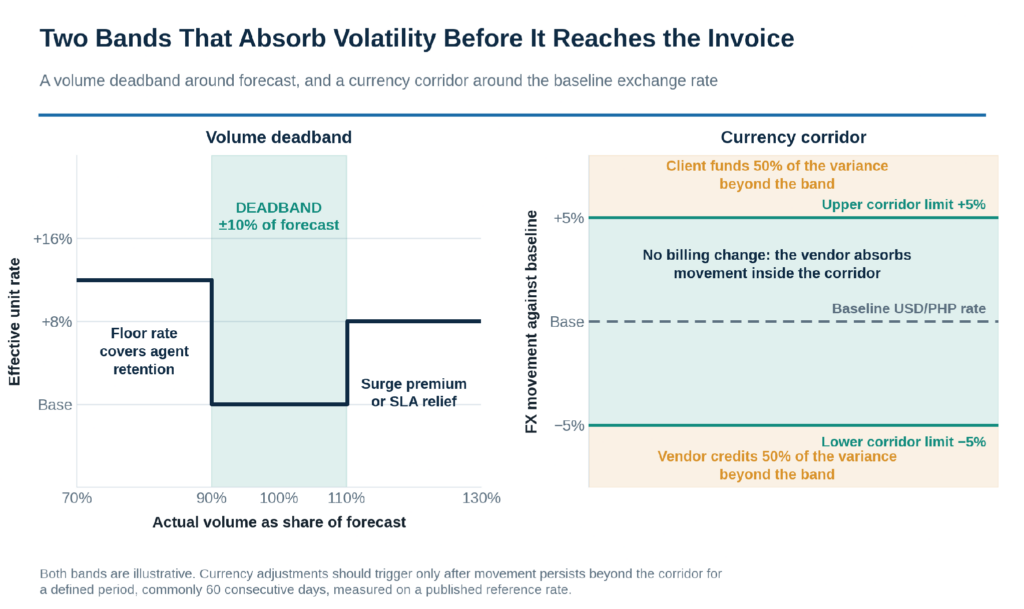
Figure 4. The volume deadband around forecast and the currency corridor around the baseline exchange rate.
The Volume Deadband
Inside the band, the baseline rate applies and the vendor manages normal variation. If volume falls below the lower threshold, the buyer pays a reduced floor rate covering fixed agent retention cost — which is what keeps the trained team on the account through a trough rather than redeployed to another client. If volume exceeds the upper threshold, the vendor receives a temporary surge premium or extended SLA relief windows, because a floor staffed for forecast cannot absorb an unplanned surge without one or the other.
The Currency Corridor
For agreements billing in US dollars, Australian dollars, or euros against the peso, hold the baseline rate while FX movement stays within the agreed corridor. If movement exceeds the band and persists — 60 consecutive days is a common test — billing adjusts using a pre-agreed split, commonly 50/50 of the variance beyond the corridor. The persistence requirement matters: without it, a single volatile fortnight triggers an adjustment that reverses the following month.
Make Both Bands Symmetrical
A deadband that charges a surge premium above the band but pays no floor rate below it, or a corridor that adjusts only when the vendor is squeezed, is a one-way option written at one party’s expense. Symmetry is what makes these mechanisms durable, and its absence tells a buyer a good deal about how the rest of the agreement has been drafted.
How Should Liability Caps, Termination, and Review Cadence Be Set?
Cap direct liability at three to twelve months of average billings, carve out data privacy and confidentiality breaches under separate sub-limits or insurance, include termination for cause with a 30-day cure period, and review the allocation annually or whenever volume shifts permanently and materially. Exit costs are also easier to predict when the handover method is agreed in advance; see our guide to transition methodologies.
Liability Caps and Carve-Outs
Standard commercial agreements cap overall direct liability at three to twelve months of average contract billings, scaled to program criticality. Data privacy breaches and confidentiality violations are normally carved out of that cap or managed under separate insurance sub-limits, because the potential exposure bears no relationship to the contract value. Confirm the provider carries cyber liability cover sized to the carve-out rather than to the cap.
Termination for Cause With a Cure Period
Where SLA failures persist — typically driven by attrition the vendor has not controlled — the buyer needs a defined exit. A termination for cause clause with a 30-day cure period, followed by the right to terminate without penalty and recover transition costs, is standard and rarely invoked. Its value is in the conversations it shapes: a remediation discussion held against a live cure clock proceeds differently from one held without.
Review the Allocation on a Schedule
Financial frameworks and pricing tiers should be reviewed annually, and immediately whenever program volume shifts permanently well beyond the original projection. A risk allocation designed for a 40-seat pilot is the wrong allocation for a 200-seat steady-state operation, and the drift between them is gradual enough that nobody notices until a renewal exposes it. Growth also changes how much of the program one vendor should hold, as our CFO guide to concentration risk explains.
What Does Balanced Risk Allocation Look Like in Practice?
A US HealthTech scale-up with sharp seasonal volume swings was overrunning budget under pure time and materials. A hybrid structure — a fixed base capacity fee covering most of core volume, a transactional unit rate for peaks, and a small bonus pool tied to FCR — cut handling costs substantially in six months while FCR rose markedly.
Client Challenge
A rapidly growing US HealthTech firm was running sharp seasonal volume fluctuation against a pure time-and-materials contract with an overseas call center. The structure guaranteed the vendor’s margin regardless of productivity and left the buyer funding every hour of the peak and every hour of the trough, which produced budget overruns that no amount of operational management could resolve. The problem was commercial, not operational.
Vendor Selection Process
PITON-Global evaluated candidate providers across its Philippine network, filtering for healthcare compliance capability, back-office depth, and — critically — willingness to work within a flexible commercial structure. Not every provider will accept a hybrid model, because it requires carrying real capacity risk on the fixed portion, and that willingness narrowed the field usefully.
Solution Implemented
The engagement moved to a hybrid: a fixed base capacity fee covering most of core volume, a transactional unit rate applied to peak volume above that baseline, and a performance bonus pool tied to first contact resolution targets. Each component addressed a different exposure — the fixed base gave the vendor a stable core to staff against, the transactional tier meant the buyer stopped paying peak capacity year-round, and the bonus pool kept quality from being the variable that flexed.
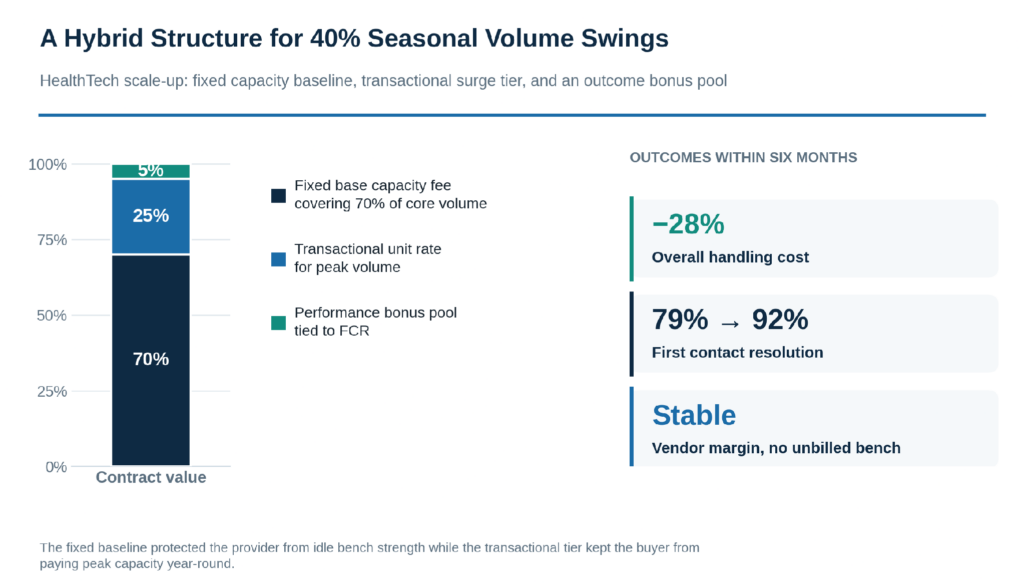
Figure 5. The hybrid contract structure and the outcomes it produced within six months.
Outcomes and Lessons
The client reduced overall handling costs substantially within six months while first contact resolution improved markedly, and the vendor maintained stable margins without carrying unbilled bench strength. The lesson is that a fixed capacity baseline and a transactional surge tier are complements rather than alternatives: together they protect the buyer’s budget and the provider’s margin at the same time, which is the definition of a well-allocated risk. The same evidence should drive the next renewal decision, as our framework for renewal and restructuring decisions explains.
What Role Does PITON-Global Play in Mitigating BPO Contractual Risk?
PITON-Global is an independent BPO sourcing advisory firm based in Manila. Rather than charging matchmaker fees or promoting preferred vendors, it evaluates providers on delivery record, financial stability, technology integration, and operational maturity, and helps buyers structure balanced financial risk allocation.
Who Is PITON-Global?
PITON-Global advises enterprise buyers on Philippine outsourcing across provider selection, commercial structuring, and the governance that follows signature. Its relevance to risk allocation is specific: knowing which providers can genuinely carry fixed capacity risk, which have the balance sheet to absorb a currency movement, and which will accept a capped margin requires reading operations and financials rather than proposals. In a market of more than 1,000 contact centers and back-office operations, none of that is visible from the outside.
How Does PITON-Global Differ from Traditional Outsourcing Brokers?
Traditional brokers charge matchmaker fees or steer buyers toward preferred vendors, and their involvement ends at the introduction — before the commercial structure is written. An advisory-led model is organized around the buyer’s outcome: objective evaluation, recommendations that may include providers with no commercial relationship to the advisor, and continued engagement through structuring, negotiation, and governance. On risk allocation the distinction is concrete, because an intermediary paid on placement has no reason to tell a buyer that the proposed model puts every exposure on their side of the table.
How Does PITON-Global’s Network of 100+ Vetted Philippine BPO Providers Benefit Organizations?
The network spans top-tier Philippine call centers and back-office providers, each evaluated on delivery track record, financial stability, technology integration, and operational maturity before entering it. Because that screening has already happened, buyers begin from a field where every candidate could realistically deliver the program and survive the commercial structure being proposed — which is what makes a balanced allocation negotiable rather than aspirational.
How Does PITON-Global’s Advisory-Led Vendor Matching Process Work?
The process runs from requirement definition to executed terms, returning six to ten matched partners within 48 to 72 hours and continuing through commercial structuring and governance design.
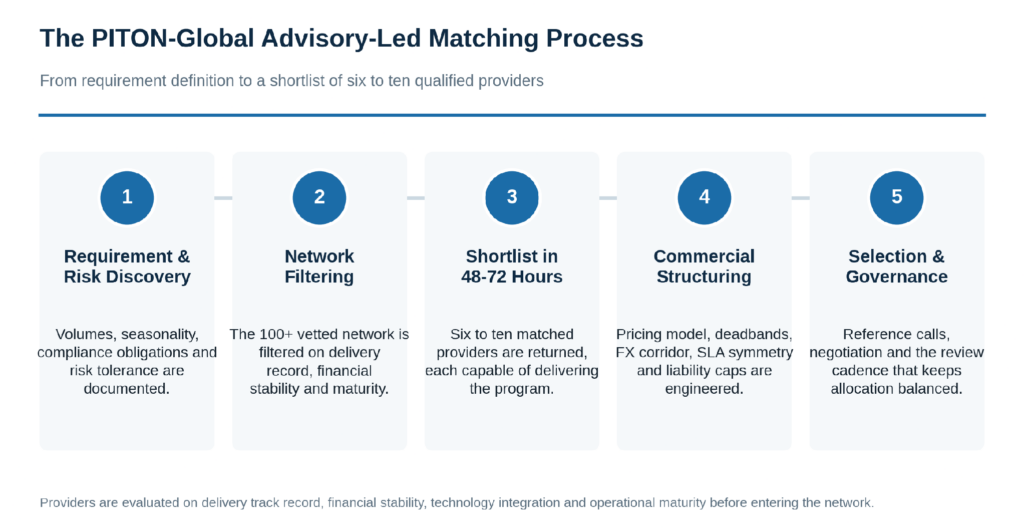
Figure 6. The PITON-Global advisory-led matching process, from requirement discovery to selection and governance.
Why Do Organizations Use PITON-Global?
- Reduced contractual risk. Independent diligence on delivery record, financial stability, and operational maturity surfaces exposure before it reaches the agreement.
- Balanced financial structures. Pricing model, deadbands, FX corridors, SLA symmetry, and liability caps are engineered rather than inherited from a vendor template.
- Improved provider fit. Matching on domain capability and commercial flexibility, so the provider can actually carry the risk the structure assigns it.
- Accelerated selection. A qualified shortlist within 48 to 72 hours compresses a discovery cycle that typically runs for months.
- Market-competitive pricing. Terms benchmarked against the wider market rather than against the other bids in the room.
Frequently Asked Questions
What is the most effective contract structure for new outsourcing programs?
A hybrid: time and materials for the first 90 to 180 days, transitioning to a fixed-unit or transactional rate. This lets the vendor stabilize operations before taking on performance risk, and it gives both parties measured data to set the eventual rate against rather than a negotiating position.
How are liability caps typically structured in Philippine BPO contracts?
Direct liability is generally capped at three to twelve months of average contract billings. Data privacy breaches and confidentiality violations are usually carved out of the cap or managed under separate insurance sub-limits, since the potential exposure is unrelated to contract value.
How often should financial risk allocation models be reviewed?
Annually as a minimum, and immediately whenever program volume shifts permanently well beyond initial projections. Structures designed for a pilot rarely remain appropriate at steady-state scale, and the mismatch usually goes unnoticed until a renewal.
What happens if a vendor consistently fails SLA targets due to high agent attrition?
The contract should include termination for cause with a 30-day cure period. If failures continue past the cure window, the buyer can terminate without penalty and recover transition costs. Pair this with an attrition threshold in the SLA so the underlying driver is measured, not just its symptoms.
Can inflation risk be tied to local Philippine economic indicators?
Yes. Multi-year agreements commonly include an annual price adjustment capped and indexed to the Philippine Consumer Price Index, or a modest pre-negotiated fixed escalator. Apply the adjustment to the labor component rather than the total invoice, since facilities and technology do not track local wage inflation.