

Hospital systems should monitor post-BPO patient satisfaction with real-time, multichannel automated surveys and AI speech analytics on every interaction, unified under a single Clinical Quality Scorecard. Routing data collection through the hospital’s own platform — not the vendor’s — and adding independent audits protects data integrity, compliance, and onshore–offshore alignment across outsourced care coordination and patient services.
Key Takeaways
- Unified metrics: Establish a single operational dashboard merging internal health-system metrics with offshore BPO service-level agreements (SLAs).
- Multichannel automation: Deploy automated SMS, email, and IVR surveys within 24–48 hours of each patient interaction.
- Speech analytics: Apply AI-driven sentiment analysis to every recorded interaction to detect friction points and tone shifts.
- Independent auditing: Use third-party clinical-data validation to neutralize vendor-reported scoring bias.
- Balanced scorecard over raw AHT: Pair efficiency metrics with experience and safety indicators so speed never undermines patient satisfaction.
What Metrics Should Define the Offshore Healthcare BPO Scorecard?
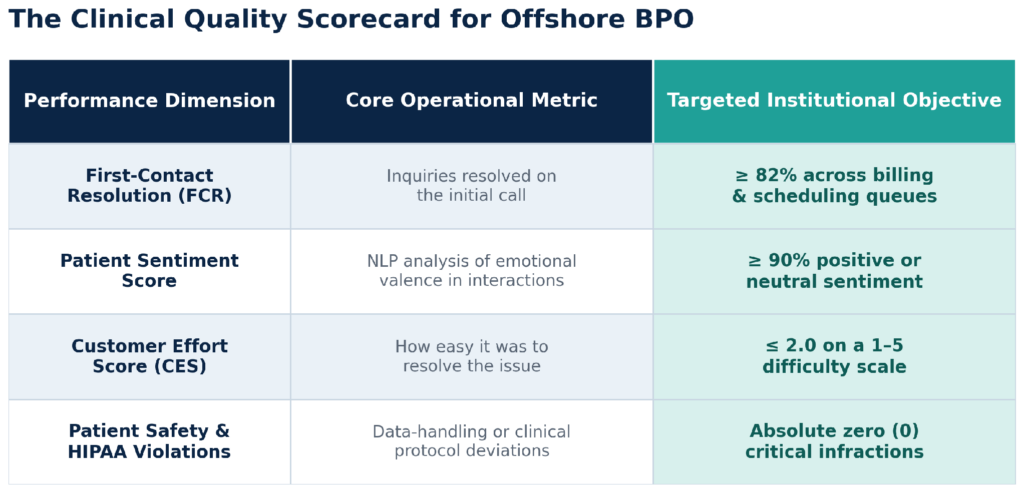
Standard contact-center metrics like Average Handle Time can actively damage patient satisfaction if used alone. Instead, build a balanced Clinical Quality Scorecard blending efficiency with experience and safety: first-contact resolution, patient sentiment, customer effort, and an absolute-zero standard for HIPAA and patient-safety violations.
Transitioning patient engagement, medical billing, or telehealth triage to a Philippine partner requires a structured, data-driven framework rather than a generic SLA — the kind of measured, value-based relationship described in our look at outcome-driven care delivery partnerships. The diagram below shows how offshore interaction data should flow into a unified scorecard and onward into onshore quality and compliance oversight.
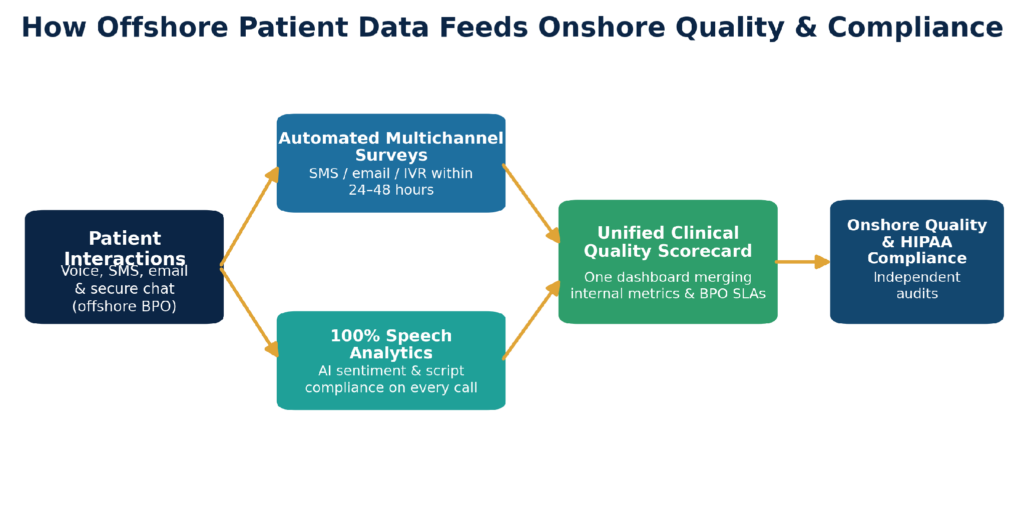
Within that framework, four dimensions anchor the scorecard. Each pairs a concrete operational metric with a targeted institutional objective, so performance is judged against patient outcomes — not just call-handling speed. A broader framework for measuring outsourcing-partner performance extends the same logic to revenue-cycle and data-security metrics.
How Can Health Systems Mitigate Sampling Bias in Offshore Vendor Reports?
Self-reported vendor data is the central risk: when vendors run their own surveys, selection bias creeps in — for example, surveying only completed calls while omitting disconnected or escalated ones. Mitigate it by decoupling data collection, analyzing every recorded call with speech analytics, and holding weekly joint calibration audits.
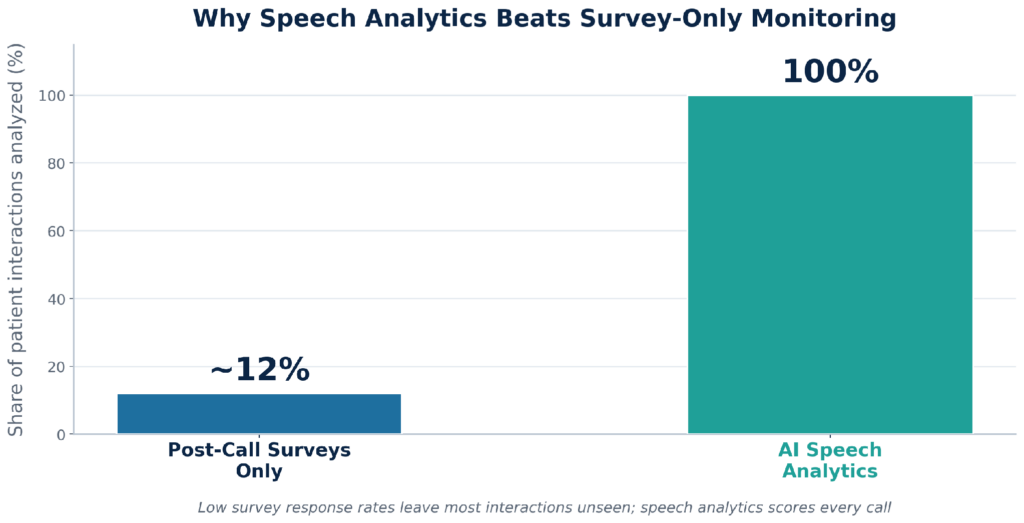
Survey response rates are low by nature, so survey-only monitoring leaves most interactions unseen — and the interactions most likely to go unmeasured are the difficult ones. Speech analytics closes that gap by scoring every call, not just the small fraction that produce a completed survey.
Decouple Data Collection
Route all post-interaction surveys through the hospital system’s internal patient-experience platform rather than the vendor’s local infrastructure, removing the vendor’s ability to shape which interactions get measured.
Deploy Speech Analytics
Analyze every audio recording with natural language processing to track tone, script compliance, and patient frustration, bypassing the limitations of low survey response rates and surfacing friction the surveys miss.
Conduct Calibration Audits
Hold weekly cross-functional calibration sessions in which internal clinical-quality teams and Philippine operations managers jointly score randomly selected interactions, keeping scoring standards aligned across borders.
The true measure of an offshore clinical partner is not how well they perform on their best days, but how seamlessly their communication infrastructure handles high-volume patient anxiety during systemic bottlenecks. Relying on vendor-cleansed data is a strategic blind spot; health systems require raw, unfiltered transactional telemetry. — John Maczynski, CEO, PITON-Global
What Results Can a Health System Expect from Better Monitoring?
When a major U.S. hospital group fixed a fragmented offshore billing rollout — pairing a specialized partner with full call recording and an independent SMS feedback loop — first-contact resolution on complex billing rose markedly and overall patient satisfaction rebounded within 90 days.
The Challenge
A major U.S. hospital group experienced a sharp drop in patient satisfaction following a fragmented rollout of offshore medical-billing support, with quality slipping through the cracks of vendor-reported data.
The Solution
PITON-Global conducted an exhaustive operational audit across its vetted network of more than 100 Philippine providers and selected a specialized healthcare BPO with dedicated clinical-compliance infrastructure and deep expertise in complex hospital billing. The partner deployed a trained cohort of patient advocates on a unified CRM, instituting full digital call recording paired with an independent, automated SMS feedback loop deployed immediately post-interaction.
The Outcomes
- First-contact resolution: rose markedly on complex billing inquiries within 90 days.
- Patient satisfaction: rebounded across the affected queues.
- Data integrity: Full call recording plus an independent SMS loop removed vendor sampling bias.

Successful healthcare outsourcing requires specialized providers with deep domain expertise rather than generic, multi-vertical contact centers — and monitoring infrastructure the hospital controls rather than the vendor. It is the same pattern behind how leading health systems use offshore partners to lift performance.
How Does PITON-Global Help Health Systems Select the Right Philippine BPO Partner?
PITON-Global is an elite, advisory-led consultancy — not a conventional broker. With a vetted network of more than 100 premier Philippine providers, it guides enterprise buyers through customized selection, contract structuring, and operational alignment, matching them only with partners that have proven clinical competencies, robust data architecture, and stringent compliance.
Who Is PITON-Global?
PITON-Global is a premium, advisory-led outsourcing consultancy specializing in the Philippine market. It guides enterprise healthcare buyers through the dense landscape of more than 1,000 service providers, bringing deep operational expertise to high-stakes decisions about patient engagement, billing, and quality monitoring.
How Does PITON-Global Differ from Traditional Outsourcing Brokers?
Where conventional brokers chase volume and commission, PITON-Global operates as an advisory partner. It recommends on proven fit — clinical competency, data architecture, and compliance frameworks — and is accountable to client outcomes, not to steering business toward the largest provider that pays the most.
How Does PITON-Global’s Network of 100+ Vetted Philippine BPO Providers Benefit Organizations?
PITON-Global maintains a meticulously vetted network of more than 100 premier Philippine BPO providers. Because each is pre-screened for clinical competency, data infrastructure, and compliance, hospital systems bypass a risky 1,000-provider market and move straight to partners proven to protect patient satisfaction and HIPAA compliance.
How Does PITON-Global’s Advisory-Led Vendor Matching Process Work?
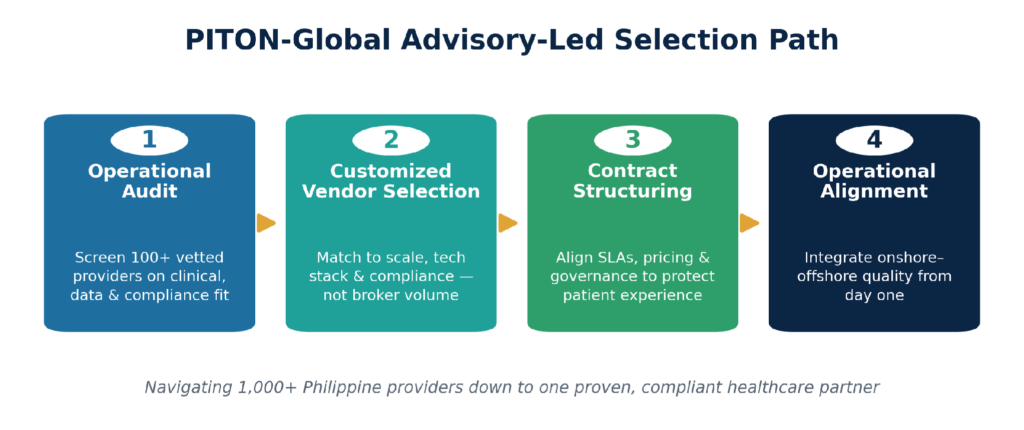
The process runs through an operational audit of vetted providers, a customized vendor selection matched to scale, technology, and compliance needs, contract structuring that aligns SLAs and governance around patient experience, and operational alignment that integrates onshore and offshore quality from day one.
Why Do Organizations Use PITON-Global?
Organizations use PITON-Global to mitigate outsourcing risk, accelerate time-to-value, and keep patient satisfaction uncompromised. By matching hospital systems exclusively with providers proven on clinical competency, data architecture, and compliance, the firm removes the guesswork that causes offshore programs to fail.
What Else Should Hospital Leaders Know About Monitoring Offshore Patient Satisfaction?
Common questions concern survey timing, cultural fit, whether clinical and administrative work share metrics, audit sample sizes, and HIPAA safeguards. In each case, disciplined monitoring and specialized providers keep patient satisfaction measurable and protected.
How soon after a BPO interaction should a patient survey be deployed?
Initiate surveys via SMS or IVR within 24–48 hours of the interaction to ensure high recall accuracy and maximize response velocity.
How does the cultural nuance of the Philippines affect patient satisfaction?
The Philippine workforce is recognized for deep service orientation, high empathy, and natural affinity for Western communication styles, which translates directly into stronger patient sentiment scores.
Should clinical triage and administrative billing use the same satisfaction metrics?
No. Administrative workflows should prioritize Customer Effort Score and first-contact resolution, while clinical triage must prioritize clinical-protocol adherence and patient-safety metrics.
What volume of call recordings should be independently audited?
Speech-analytics software should review every interaction for sentiment, while human QA teams perform deep-dive audits on a small randomized sample of interactions each month.
How can we ensure Philippine BPO agents maintain HIPAA compliance during interactions?
Providers should use secure, biometric-access clean rooms, disabled local storage, and continuous compliance monitoring, reinforced by regular healthcare-privacy certifications.