

Health systems should forecast long-term savings by calculating a fully-loaded cost differential built on a substantial baseline operational arbitrage. Accurate multi-year projections for patient support and medical billing delivered offshore must also capture secondary dividends: a structural reduction in claim denial rates and the elimination of domestic recruitment, training, and turnover costs.
Key Takeaways
- Baseline labor arbitrage: Expect a substantial direct hourly operating-cost reduction versus domestic US administrative and clinical-support staff.
- The revenue-cycle dividend: Model a measurable boost in revenue integrity from overnight claims processing and consistently high coding accuracy.
- Operational tailwinds: True forecasts capture the elimination of domestic recruitment, benefits, physical infrastructure, and attrition expense.
- Turnover mitigation: Offloading high-burnout administrative tasks to offshore teams stabilizes domestic clinical staff and protects the bottom line.
- Account for friction: Net savings emerge only after modeling implementation, compliance governance, and a modest oversight premium.
What Financial Baseline Should a Health System Use for a Philippine Cost Model?
Use fully-loaded cost, not base wage. A US coder or administrator carries an hourly loaded cost—insurance, payroll taxes, retirement, facility overhead, and software—well above their wage, whereas an enterprise-grade offshore BPO consolidates those variables into a single all-inclusive bill rate, producing a substantial differential.
When constructing a multi-year financial forecast, health systems cannot rely on simple hourly-wage comparisons. A precise long-term projection requires a fully-loaded comparison. In the United States, a healthcare administrative professional or medical coder carries an hourly loaded cost—health insurance, payroll taxes, retirement benefits, facility overhead, and management software—that far exceeds their base wage. Partnering with an enterprise-grade offshore BPO consolidates these variables into one all-inclusive hourly bill rate, as the comparison below shows.
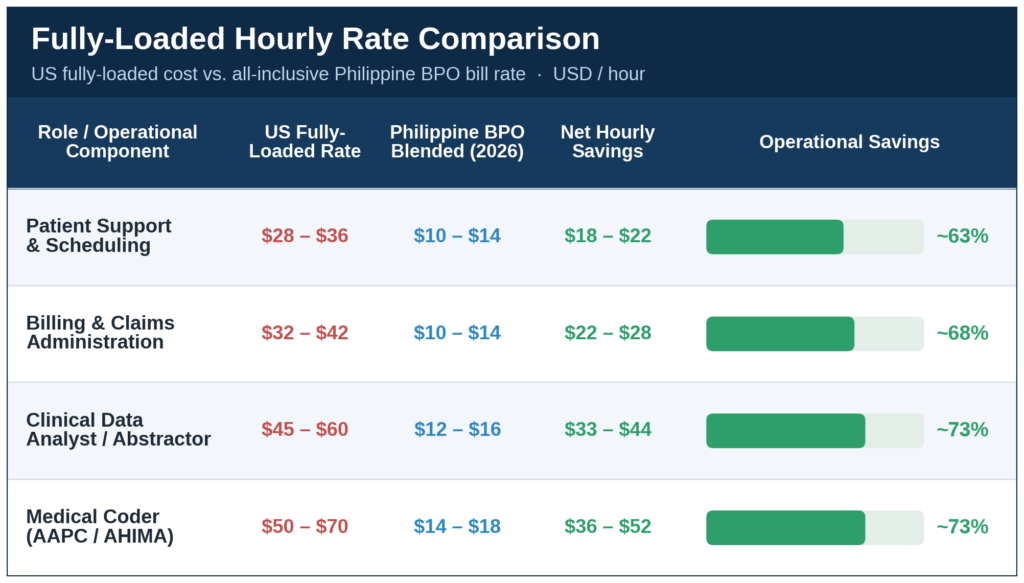
Figure 1 — Fully-loaded US hourly cost versus all-inclusive offshore bill rate across four core roles, with operational savings.
How Do Quality and Revenue-Cycle Metrics Impact Long-Term Projections?
Operational quality is a financial variable, not a footnote. Every denied claim consumes internal rework labor, so specialized offshore teams that sharply cut denial rates capture millions in leakage. A follow-the-sun model also compresses AR cycles and accelerates cash flow.
The primary pitfall in basic forecasting is ignoring the downstream financial impact of operational quality. In revenue cycle management (RCM), an unvetted or low-cost provider can quickly erase labor savings through administrative errors, backlogs, and elevated denial rates. Reworking every denied claim consumes internal administrative labor. Specialized offshore providers executing RCM and coding workflows—the administrative functions with the highest financial returns—leverage a unique regional asset: a vast, culturally aligned pool of college-educated professionals, including registered nurses and medical technicians.
The true value of Philippine healthcare outsourcing lies in its capacity for high-touch clinical support and strict process discipline, not just high-volume processing. When you inject licensed professionals who utilize advanced, human-in-the-loop technical workflows into your middle office, you aren’t just saving on labor. You are structurally reducing claim denial rates from double digits down to a fraction of that, capturing millions in leakage that legacy financial models completely overlook.
— John Maczynski, CEO, PITON-Global
Consequently, long-term forecasts should model an optimization of revenue integrity. By transitioning to a follow-the-sun operational model—where Filipino teams use the 12-hour time-zone difference to clear charts, verify insurance eligibility, and process claims overnight—health systems compress their accounts-receivable cycles and accelerate cash flow. The complete long-term picture combines three components:
Long-Term Impact = Direct Labor Arbitrage + Denial-Reduction Recovery − Governance & Implementation Costs
Visualized as a build-up, the arbitrage establishes the largest block of value, the revenue-integrity recovery adds a meaningful second layer, and disciplined governance costs trim the total to a durable net benefit.

Figure 2 — How long-term savings stack up relative to baseline administrative spend (illustrative).
What Are the Hidden Risks and Implementation Costs to Model?
An expert forecast accounts for three friction costs: a 60–90 day implementation and knowledge-transfer period with parallel-running costs; HIPAA/HITRUST compliance infrastructure (DLP, secure VDI, access governance) amortized over 36 months; and a governance premium for internal oversight, QA audits, and quarterly reviews.
An expert-level forecast must account for the friction and upfront costs of transitioning operations offshore. Failing to model these variables leads to inflated short-term expectations and budget variances.
1. Implementation and Knowledge Transfer
Health systems must budget for an initial 60–90 days of training, workflow documentation, and system integration. This period requires parallel-running costs before the offshore team reaches peak operational velocity.
2. Data Security and Compliance Governance
Mitigating risk under HIPAA and HITRUST requires strict data-loss-prevention (DLP) controls, secure virtual desktop infrastructure (VDI), and robust access governance. These security investments should be amortized across the first 36 months of the contract.
3. Management and Oversight Overhead
A successful engagement requires internal management bandwidth. Organizations should plan for a modest governance premium covering relationship management, continuous quality-assurance audits, and quarterly performance reviews.
What Does the Forecast Look Like in a Real Engagement?
A regional health system with a double-digit denial rate, a 60-day AR backlog, and burned-out billing staff deployed a 25-seat co-sourced Philippine team for eligibility, pre-authorizations, and chart abstraction. Within 180 days, denials fell sharply, turnaround dropped under 24 hours, and the system realized millions in annualized savings.
Client Challenge
A regional health system faced a persistent double-digit initial claim denial rate, a growing 60-day AR backlog, and severe burnout among its domestic billing staff.
Vendor Selection Process
Using a data-driven matching methodology, the health system bypassed legacy generalist BPOs to evaluate three specialized, healthcare-exclusive Philippine providers staffed entirely by certified coders.
Solution Implemented
The system deployed a co-sourced team of 25 dedicated Philippine operational specialists to handle eligibility verification, pre-authorizations, and complex chart abstractions overnight. The 180-day trajectory below shows denials falling as annualized savings accumulate.

Figure 3 — The 180-day transition: claim denial rate falling steadily as the annualized savings run-rate builds.
Success depends on choosing a partner whose operational scale matches the workflow complexity, rather than selecting a vendor solely on the lowest hourly rate.
Why Do Enterprise Healthcare Buyers Partner with PITON-Global?
Navigating the vast Philippine BPO ecosystem introduces procurement risk. PITON-Global is an independent, advisory-led consultancy that acts as an objective corporate advocate—not a commission-driven broker—matching health systems to the right provider from a curated network of 100+ vetted operators through a disciplined, multi-lens audit.
Unlike traditional commission-driven brokers whose recommendations may be influenced by referral incentives, PITON-Global operates as an objective corporate advocate. The firm uses a disciplined, multi-lens auditing process to evaluate and match health systems with the ideal provider from a curated network of more than 100 highly vetted Philippine BPO operators, screening each on the criteria below.

Figure 4 — PITON-Global’s multi-lens audit screens every provider before an objective, requirements-based match.
By evaluating candidates on precise criteria—domain specialization, clinical talent pipelines, HITRUST compliance readiness, and physical infrastructure redundancy—PITON-Global eliminates procurement blind spots. This advisory-led approach ensures a health system’s long-term operational framework aligns with its broader financial and strategic objectives from day one.
Frequently Asked Questions
What is the typical timeframe required to realize net positive savings?
Most health systems offset their initial transition, training, and integration costs within the first 90–120 days of live operations, achieving a net positive financial return by month five—the starting point for the longer-term ROI health systems can expect.
Do Philippine BPO providers comply with HIPAA and US data-privacy standards?
Yes. Premium, healthcare-vetted Philippine providers operate within secure, biometric-restricted facilities using advanced data-loss-prevention software, secure network routing, and regular SOC 2 Type II and HITRUST audits.
How does the 12-hour time difference affect clinical workflows?
The time difference serves as a strategic financial engine. Administrative tasks, medical coding, and chart documentation are completed overnight by the offshore team, so domestic providers begin each morning with pre-verified data and clean queues.
Can outsourcing assist with value-based care models?
Yes. Specialized teams manage proactive patient outreach, chronic-care-management tracking, and hierarchical condition category (HCC) coding validation, directly supporting quality-score optimization and reimbursement retention, as the HPO strategic blueprint describes.
What is the minimum scale required for a viable offshore engagement?
While mega-providers often mandate 50–100-seat minimums, mid-market and boutique operators within the specialized ecosystem can deploy customized, highly compliant programs starting at 10–15 dedicated seats.