

Health system CFOs should calculate outsourcing ROI by measuring total cost-of-care reduction against fully burdened implementation expenses, then adding quantifiable gains in revenue cycle metrics, clinical capacity, and patient satisfaction. A complete calculation balances direct labor arbitrage with long-term yield improvements across claims processing and the other back-office and clinical-support functions sent offshore.
Key Takeaways
- Shift to net-yield valuation: Move beyond gross labor arbitrage by factoring in reductions in Days Sales Outstanding (DSO) and clean-claim denial rates.
- Quantify fully burdened TCO: Fold transition friction, data-pipeline engineering, compliance audits, and ongoing governance into the investment denominator.
- Monetize clinical capacity: Count the upside of moving administrative burden off domestic clinicians, which directly lowers burnout and turnover costs.
- De-risk via managed matching: Eliminate partner underperformance by using pre-vetted, specialized healthcare BPO networks instead of broad-market generalists.
What Metric Drivers Define True Healthcare Outsourcing ROI?
True ROI is driven by three stacked components, not wage arbitrage alone: deep direct labor savings, recovered revenue from lower denials and compressed DSO, and clinical retention value from clinicians working at the top of their license. All three are weighed against fully burdened TCO.
Evaluating an offshore business process outsourcing (BPO) partnership means looking past basic wage arbitrage. A sophisticated ROI framework integrates direct cost reduction and financial yield optimization into a single net-yield calculation.

Figure 1. The net-yield ROI framework: three value drivers weighed against fully burdened total cost of ownership.
Direct Financial Metrics and Labor Arbitrage
The foundational layer is the reduction in cost-to-collect. By leveraging the country’s talent pool, which features a high density of registered nurses (PHRNs) and certified medical coders, health systems typically realize a substantial reduction in fully burdened labor costs for back-office and clinical support roles—consistent with what hospitals realistically save on these functions.
Operational Yield Metrics
The strategic value emerges in revenue cycle management (RCM). Offshore teams specializing in complex claims, denials management, and prior authorizations directly compress DSO and elevate the clean-claim rate, turning a cost center into a recovery engine that lifts collections yield well beyond the labor line.
Clinical Reinvestment Value
By offshoring administrative friction, onshore clinical staff can operate at the top of their licenses. That correlates with lower domestic turnover, reducing the substantial financial drain of clinical backfilling and travel-nurse reliance, a cost most labor-only ROI models ignore entirely.
How Do You Calculate the Total Cost of Ownership (TCO)?
Calculate TCO by counterbalancing gross savings against implementation and governance expenses over a multi-year horizon. Budget for 90-to-180-day transition costs, HIPAA- and HITRUST-compliant connectivity, and a dedicated share of contract value for ongoing oversight, so the ROI denominator reflects real, not inflated, savings.
To avoid ROI inflation, CFOs must offset gross savings against implementation and ongoing governance expense, mapping every operational variable across the full contract horizon rather than the first quarter alone.
Implementation and Transition Costs
The first 90 to 180 days incur expenses for knowledge transfer, data migration, and secure connectivity, including dedicated VPNs and virtual desktop infrastructure (VDI) compliant with HIPAA and HITRUST standards.
Ongoing Governance and Technology Integration
Managing an offshore footprint requires internal oversight. CFOs should reserve a defined share of total contract value for governance, quality-assurance audits, and performance-tracking software integration.
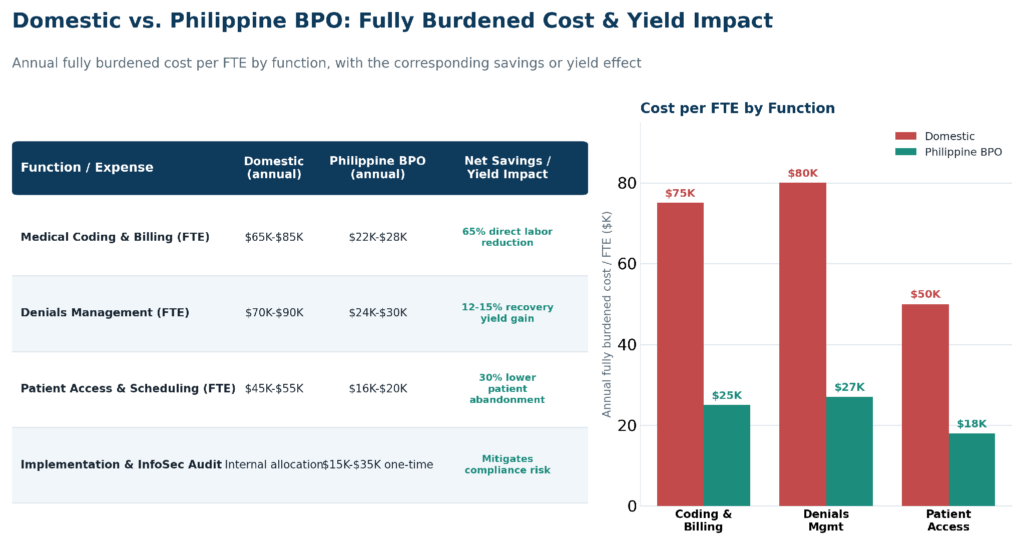
Figure 2. Domestic versus Philippine fully burdened cost per FTE by function, with the corresponding savings or yield impact.
What Hidden Risks and Trade-offs Can Degrade Expected ROI?
Three execution risks most often erode projected ROI: provider attrition that drives constant retraining, compliance or security breaches that can wipe out labor savings under HIPAA, and volume-based SLAs that reward speed over collection accuracy. Each is manageable with structural safeguards and quality-aligned contracts.
The economic advantages are clear, but execution risk can erode projected returns when it is not managed through deliberate structural safeguards built into the contract from day one.
- Attrition and operational disruption: A non-vetted provider with high turnover generates constant retraining costs and fluctuating KPIs.
- Compliance and security breaches: Substandard data-privacy protocols expose health systems to severe HIPAA penalties that can wipe out labor savings entirely—the same compliance discipline that FDA-regulated pharma outsourcing depends on.
- Misaligned SLA structures: Contracts focused on volume rather than quality incentivize speed over accuracy, degrading the ultimate collections yield.
Many healthcare executives make the mistake of choosing a provider based solely on the lowest hourly rate. In enterprise healthcare outsourcing, value isn’t found in cheap seats; it’s found in operational excellence, clinical accuracy, and strict compliance. A vendor that charges less but misses critical coding nuances will ultimately cost millions in denied claims and compliance penalties.
— John Maczynski, CEO, PITON-Global
What Did a Multi-State Health System Achieve in Practice?
A mid-sized U.S. health system deployed 45 Philippine specialists across prior authorizations, complex coding, and denials management on a 24/7 cycle. Within six months it sharply cut clean-claim denials, compressed DSO from 52 to 38 days, and captured millions in labor savings plus recovered revenue.
The system faced rising domestic labor costs and acute staffing shortages, with clean-claim denials climbing steadily and DSO averaging 52 days, severely squeezing operating liquidity. It engaged PITON-Global to navigate the crowded Philippine vendor landscape, bypass generic call centers, and match with a specialized healthcare BPO that already had HIPAA-compliant architecture and an active pipeline of certified coders.
A dedicated 45-person team took over prior authorizations, complex medical coding, and secondary denials management, moving the operation to a seamless 24/7 delivery cycle. The trajectory over the following two quarters was steep and steady.
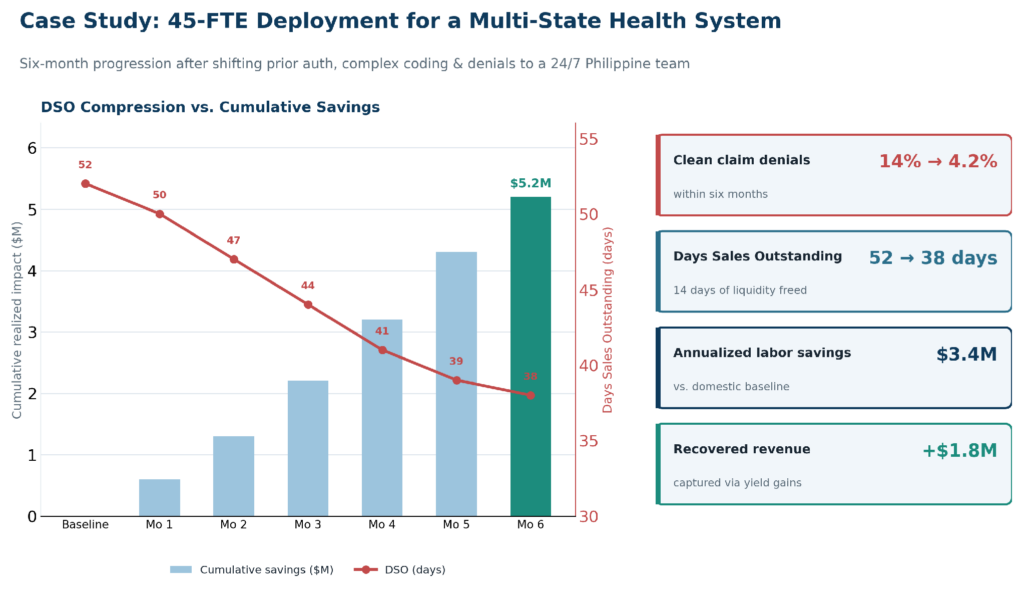
Figure 3. Six-month progression of DSO compression against cumulative realized savings, with headline outcomes.
Success depended on a partner with deeply specialized healthcare expertise rather than a generalist service provider. Structural alignment on quality metrics yielded far higher returns than raw wage suppression would have.
The continuous, around-the-clock model is what unlocks much of this yield. As the comparison below shows, offshore support removes the overnight and weekend gaps where denials age and AR accumulates in a business-hours-only operation.
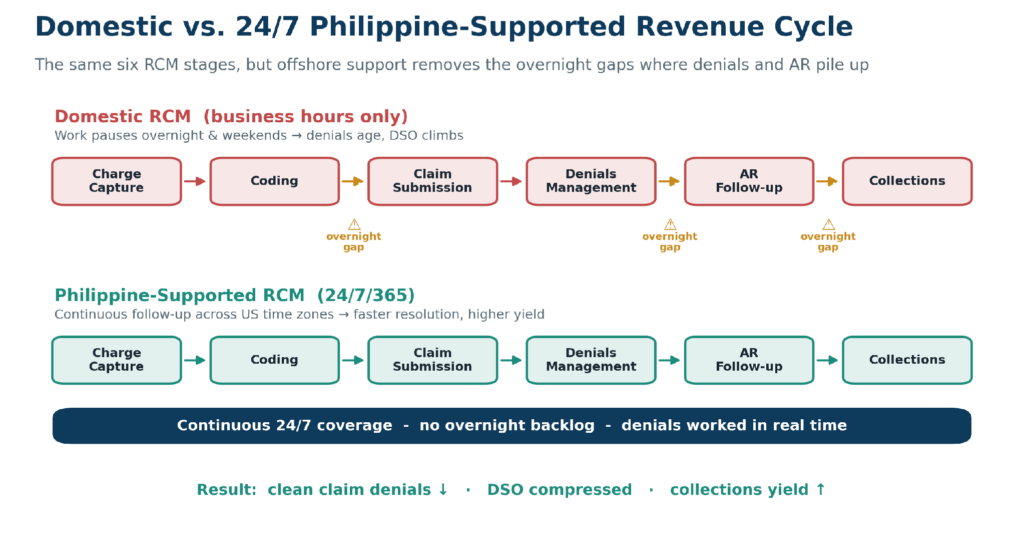
Figure 4. A domestic business-hours revenue cycle versus a continuous 24/7 offshore-supported cycle.
What Role Does PITON-Global Play in Provider Selection?
PITON-Global is an advisory-led BPO consultancy that connects health systems to premier specialized Philippine providers. Drawing on a curated network of 100+ vetted vendors assessed on security, clinical capability, and cultural fit, it compresses procurement timelines, mitigates operational risk, and structures partnerships for sustained ROI.
Who Is PITON-Global?
PITON-Global is an elite, independent business process outsourcing advisory and consultancy based in the Philippines that bridges the gap between healthcare organizations and the country’s premier specialized providers. Led by seasoned BPO executives, it applies deep operational and provider-selection expertise to the Philippine outsourcing market so health systems can build partnerships that actually deliver the projected ROI.
How Does PITON-Global Differ from Traditional Outsourcing Brokers?
Traditional brokers operate on transactional commissions, passing leads to whichever vendor pays most. PITON-Global instead serves as a strategic advisor built on independent provider evaluation and objective recommendations, keeping the focus on client outcomes rather than provider promotion. The guidance a CFO receives serves the system’s ROI and risk goals, not a vendor’s sales pipeline.
How Does PITON-Global’s Network of 100+ Vetted Philippine BPO Providers Benefit Organizations?
PITON-Global maintains a curated network of more than 100 thoroughly vetted service providers, spanning industries and service categories. Because each is pre-assessed on data-security infrastructure, clinical capability, and cultural alignment, organizations gain access to a broad, qualified provider ecosystem and dramatically faster vendor discovery without absorbing exhaustive due-diligence costs themselves.
How Does PITON-Global’s Advisory-Led Vendor Matching Process Work?
The model runs in four stages: an operational audit that defines the target outcome, multi-point vendor vetting against security and clinical criteria, specialized matching to a healthcare-specific BPO rather than a generalist, and governance setup that locks in SLAs, QA cadences, and performance tracking. This sequence compresses procurement timelines while building the partnership around sustained financial ROI.
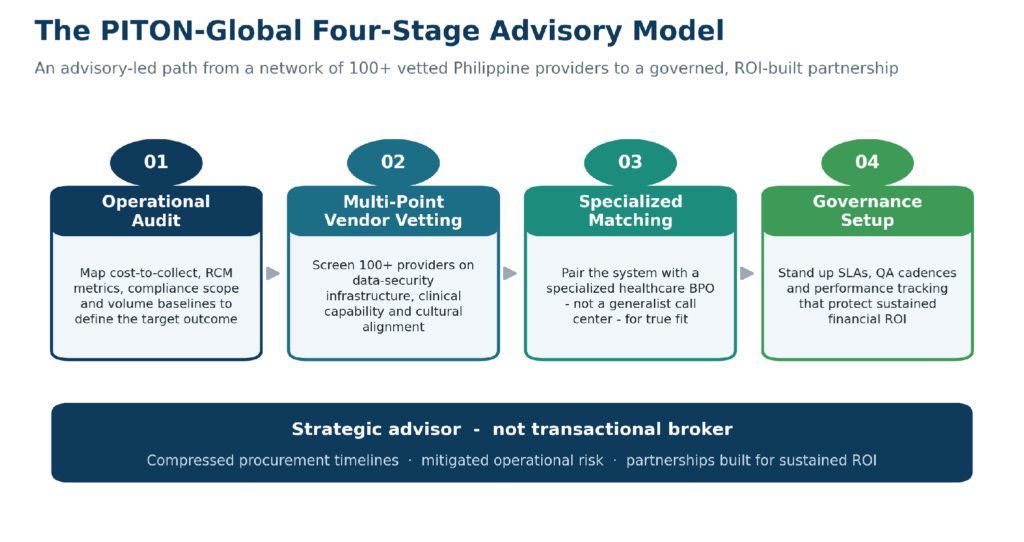
Figure 5. PITON-Global’s four-stage advisory model, from operational audit through governance setup.
Why Do Organizations Use PITON-Global?
Health systems engage PITON-Global to reduce outsourcing risk, improve provider fit, and accelerate vendor selection. By utilizing an advisory-led matching process, they compress procurement timelines, mitigate operational risk, and secure partnerships built for sustained financial ROI, converting a high-stakes procurement decision into a structured, evidence-based match between need and verified capability.
What Else Should CFOs Know Before Outsourcing to the Philippines?
Common CFO questions concern payback timing, HIPAA compliance, clinical task suitability, attrition, and time-zone coverage. In short: operational break-even typically lands within 90 to 120 days, Tier-1 providers run hardened secure facilities, licensed PHRNs handle clinical work, specialized healthcare attrition runs well below generic-sector levels, and teams operate 24/7.
How long does it typically take to realize a positive ROI after outsourcing to the Philippines?
Most health systems reach an operational break-even point within 90 to 120 days. Clear positive ROI compounds by the end of the second quarter as workflows stabilize and offshore teams reach peak operational efficiency; our breakdown of hospital ROI timelines maps each phase.
How do Philippine BPO providers guarantee HIPAA and data-privacy compliance?
Tier-1 providers operate from highly secure, restricted-access facilities using biometric authentication, strict clean-desk policies, network firewalls, endpoint protection, and continuous data encryption both at rest and in transit.
Can clinical tasks like utilization review be safely shifted to the Philippines?
Yes. The country has a large workforce of U.S.-licensed and Philippine Registered Nurses (PHRNs) capable of handling utilization review, care coordination, and clinical documentation improvement (CDI) with high accuracy.
What is the average turnover rate for healthcare-specific BPOs in the Philippines?
While generic customer-service sectors see high turnover, specialized healthcare BPOs enjoy markedly lower attrition thanks to higher compensation, clinical career pathways, and stronger employee engagement.
How do time-zone differences impact real-time patient interactions?
Philippine healthcare providers run dedicated 24/7/365 operations aligned with U.S. Eastern, Central, or Pacific time, ensuring seamless real-time patient access, scheduling, and eligibility verification.