

On this page
- Key Takeaways
- What Are the Core Financial Metrics Beyond Hourly Seat Rates?
- How Does Operational Quality Directly Affect Bottom-Line ROI?
- How Should Organizations Account for Technology and AI Integration Costs?
- What Does Optimized Financial Performance Look Like in Practice?
- Why Do Enterprises Partner with PITON-Global for Strategic BPO Sourcing?
- Frequently Asked Questions
Enterprises measuring the financial performance of Philippine outsourced operations must look beyond hourly labor rates to Total Cost of Engagement (TCE), Cost per Resolved Interaction (CPRI), and risk-adjusted return models. Evaluating operational performance requires combining labor savings, error-reduction yields, and AI-driven efficiency across both voice and back-office functions, with FX corridors and governance overhead built into the model. It also means reading those numbers against where cost KPIs fit in the wider scorecard of service and quality measures.
Key Takeaways
- Total Cost of Engagement vs. unit seat rates: Direct fully loaded labor is only part of true operating expense; governance, integration, and attrition overhead define TCE.
- Economic value of First-Contact Resolution: Higher FCR reduces repeat contact volume, lowering overall operating expenditure far more effectively than low unit costs.
- Agentic AI efficiency yields: Hybrid “Pilot and Wingman” AI-human workflows achieve materially higher transactional throughput without scaling headcount proportionally.
- Risk safeguards and advisory-led selection: Transparent FX corridors and PEZA tax allowances protect long-term margins, while vetted partner networks eliminate trial-and-error costs and shorten time-to-value considerably.
What Are the Core Financial Metrics Beyond Hourly Seat Rates?
Beyond the fully loaded seat rate, four metrics define financial performance: Total Cost of Engagement—direct vendor fees plus in-house governance, technology integration, and a quality risk buffer; Cost per Resolved Interaction rather than Average Handle Time; Error-Free Transaction Rate rather than QA score; and Shrinkage-Adjusted Yield per FTE rather than billable headcount.
Evaluating offshore operations strictly on fully loaded hourly seat rates overlooks critical cost drivers that directly affect bottom-line profitability. Enterprise procurement teams must evaluate financial performance using a holistic unit-economics framework in which Total Cost of Engagement equals direct vendor fees plus in-house governance, technology integration, and a quality risk buffer. The diagram below shows the overhead layers the hourly rate hides.

Figure 1. Traditional hourly-rate modeling versus the Total Cost of Engagement breakdown, showing the governance, integration, and quality-risk layers a seat rate omits (illustrative).
The table below maps each traditional metric to its advanced counterpart and the enterprise impact of making the switch.

Figure 2. Traditional focus versus advanced financial measurement for labor cost, volume efficiency, quality yield, and capacity utilization.
Focusing on Cost per Resolved Interaction instead of Average Handle Time ensures offshore teams are incentivized to resolve inquiries completely on first contact rather than rushing through interactions to meet volume targets.
How Does Operational Quality Directly Affect Bottom-Line ROI?
Operational quality is a direct financial lever: Net Financial Value equals direct labor savings plus revenue retention gains minus escalation overhead. When specialists apply cultural empathy—Malasakit—and deep domain expertise, repeat contacts fall measurably, high-value accounts are de-escalated and their lifetime value preserved, and back-office precision eliminates the rework and compliance penalties that processing errors create.
Operational quality in Philippine customer experience and back-office delivery acts as a direct financial lever. When front-line specialists apply cultural empathy—Malasakit—and deep domain expertise, downstream operational waste decreases significantly, and the effect shows up in three places.
Reduced Repeat Contact Volume
Even a modest decrease in repeat contacts drives substantial reductions in total required operating volume. Every contact that is resolved the first time is a second contact that never has to be staffed, which is why first-call resolution moves cost per case more than the seat rate does, as the chart below shows.
Customer Churn Mitigation
Empathy-driven customer support de-escalates high-value account issues, preserving customer lifetime value. The revenue retained rarely appears in a procurement model, but it belongs in the Net Financial Value calculation.
Back-Office Precision
Eliminating processing errors in claims or financial data entry mitigates regulatory compliance penalties and rework costs. In regulated workflows, an Error-Free Transaction Rate is a financial metric, not just a quality one, and AI-driven monitoring of every interaction is what makes it measurable at scale.
The 2026 paradigm shift is simple: Nearshore is where you go to build with your team in real-time, but the Philippines is where you go to scale a world-class operational engine. While AI handles the speed, the emotional resonance of the Filipino workforce handles the customer. At a $14/hour baseline, call centers in the Philippines aren’t just a cost-save—they’re an innovation accelerator.
— John Maczynski, CEO, PITON-Global
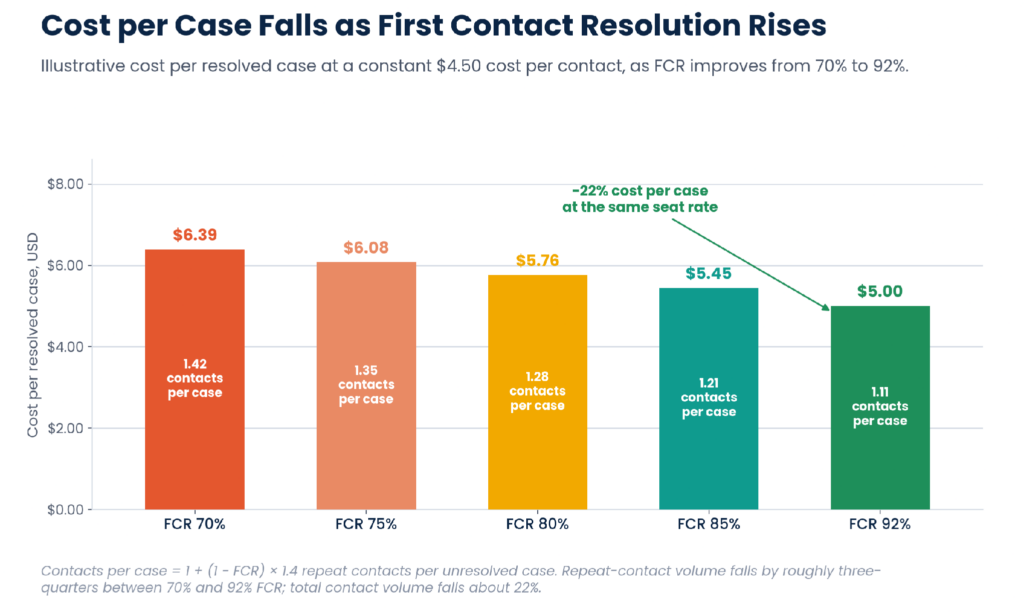
Figure 3. Reduction in cost per case as First Contact Resolution rises (illustrative, repeat contacts modeled per unresolved case).
How Should Organizations Account for Technology and AI Integration Costs?
Modern Philippine providers deploy agentic AI—autonomous agents supporting specialists in real time—so financial models must track how the technology boosts labor output. The AI ROI ratio divides transactions processed multiplied by their human-equivalent cost by platform subscription fees plus human supervision overhead; in a Pilot and Wingman setup, the gains belong in unit cost calculations, not in unrecoverable overhead.
In a hybrid Pilot and Wingman setup, AI handles routine administrative tasks such as account verification and case summaries, allowing human specialists to focus on complex problem resolution. Financial models should account for these efficiency gains directly in unit cost calculations rather than categorizing software fees as unrecoverable overhead. The framework below shows the ratio and a worked example.
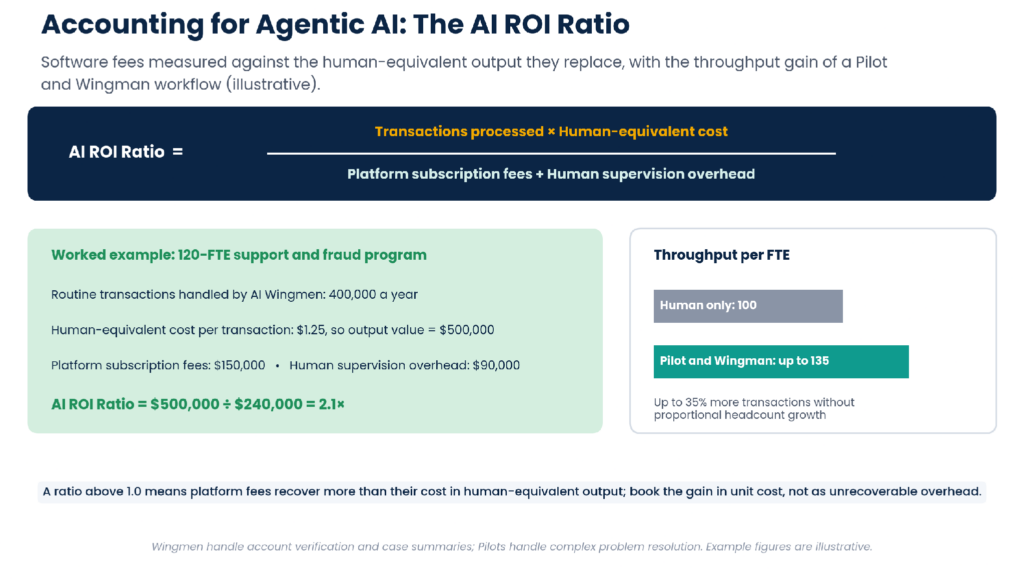
Figure 4. The AI ROI ratio with a worked example, and the per-FTE throughput gain of a Pilot and Wingman workflow (illustrative).
The practical test is simple: if the AI ROI ratio exceeds 1.0, the platform fees are recovering more than their cost in human-equivalent output, and the throughput gain, achieved without proportional headcount growth, flows straight into Cost per Resolved Interaction. That is one of the productivity gains buyers should expect from offshore delivery.
What Does Optimized Financial Performance Look Like in Practice?
Optimized financial performance follows from outcome-linked contracts. A North American fintech facing steeply rising annual costs and declining NPS transitioned 120 FTE roles to a Manila BPO with agent-assist tools, under performance tiers tied to First-Contact Resolution and fraud accuracy, cutting operating spend sharply within 12 months, lifting NPS 22 points, and adding capacity without new headcount.
Client Challenge
A North American fintech firm experienced a steep annual cost increase across its internal customer support and fraud prevention units, along with declining Net Promoter Scores.
Vendor Selection
The organization engaged PITON-Global to review its delivery model. PITON-Global evaluated operational requirements against its network of more than 100 vetted Philippine BPO providers, shortlisting three specialized mid-market partners with verified financial services compliance credentials.
Solution Implemented
The company transitioned 120 FTE roles to a specialized Manila-based BPO equipped with automated agent-assist tools. The contract was structured around performance tiers linked directly to First-Contact Resolution and fraud evaluation accuracy, and the program moved from evaluation to ROI realization on the 90-day timeline below.
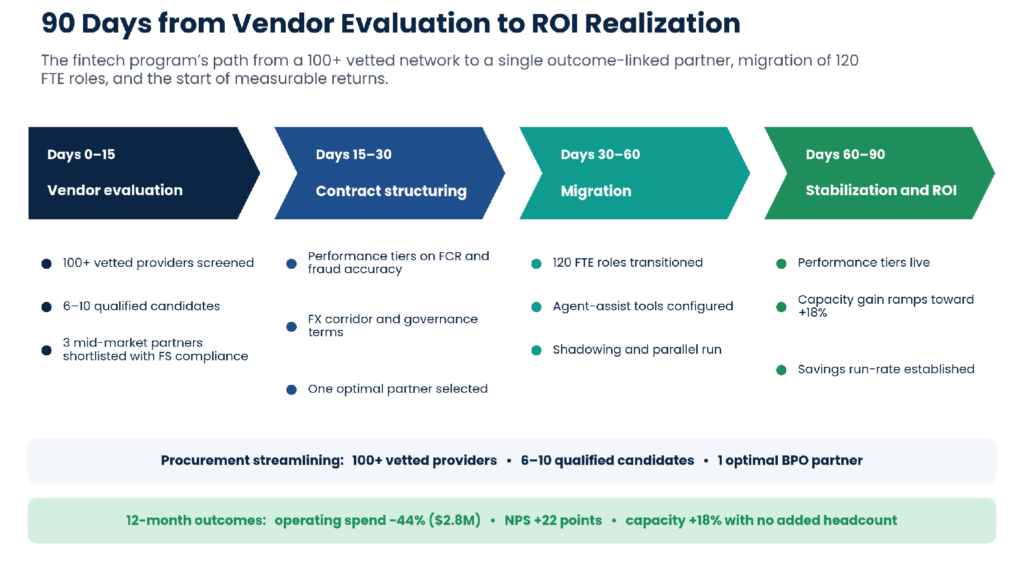
Figure 5. The 90-day vendor evaluation, migration, and ROI realization timeline, from the 100+ vetted network to a single partner and outcome-linked performance tiers.
Outcomes and Lessons
Annual operating spend fell sharply within the first 12 months. Net Promoter Score rose 22 points following faster resolution and empathetic service, and transaction capacity increased markedly through integrated AI-human workflows without expanding team size. The key lesson: aligning vendor contract terms with business outcomes rather than seat headcount transforms outsourced BPO operations from cost centers into high-value operational extensions.

Figure 6. Quantifiable outcomes of the fintech firm’s outcome-linked BPO transition.
Why Do Enterprises Partner with PITON-Global for Strategic BPO Sourcing?
PITON-Global is an independent, founder-led BPO sourcing advisory based in Manila. Led by CEO John Maczynski and CSO Ralf Ellspermann, who bring more than 65 combined years of BPO executive experience, it provides buyer-side advisory backed by hands-on operational governance, benchmarking candidates against real performance data from more than 100 vetted providers to narrow the field to a single partner.
Who Is PITON-Global?
PITON-Global is an independent, founder-led BPO sourcing advisory firm based in Manila. Led by CEO John Maczynski and CSO Ralf Ellspermann, who bring a combined 65-plus years of global BPO executive experience, the firm provides buyer-side advisory backed by hands-on operational governance in a market of more than 1,000 Philippine operators.
How Does PITON-Global Differ from Traditional Outsourcing Brokers?
Traditional brokers rely on commission-based models that favor high-volume, generic providers. PITON-Global benchmarks candidate providers against real performance data—FCR, error-free transaction rates, shrinkage-adjusted yield, attrition—recommends on the buyer’s Total Cost of Engagement rather than provider promotion, and stays engaged through outcome-linked contract structuring.
How Does PITON-Global’s Network of 100+ Vetted Philippine BPO Providers Benefit Organizations?
A network of more than 100 vetted Philippine BPO providers, each benchmarked on verified performance data, lets buyers skip trial-and-error selection: procurement narrows from 100-plus vetted providers to six to ten qualified candidates to one optimal partner. That compression is what shortens time-to-value.
How Does PITON-Global’s Advisory-Led Vendor Matching Process Work?
The process runs from delivery-model review to contract structuring: establishing the buyer’s Total Cost of Engagement baseline and outcome priorities; matching requirements against the vetted network on compliance credentials, performance data, and capacity; delivering six to ten qualified candidates and a shortlist within 48–72 hours; verifying compliance, PEZA status, and attrition; then structuring performance tiers, FX corridors, and governance terms.
Why Do Organizations Use PITON-Global?
Enterprises partner with PITON-Global to reduce vendor discovery time, minimize contract risk, and secure enterprise-grade pricing structures. Because the advisory carries no cost to the buyer, it adds an operator’s view of unit economics at the point where a seat-rate comparison is most tempting.
Frequently Asked Questions
What is the average fully loaded hourly rate for enterprise BPO services in the Philippines?
Standard voice customer experience rates in the Philippines sit at a fraction of comparable onshore rates on a fully loaded hourly basis, varying with specialized skill requirements, regulatory standards, and shift schedules. Complex back-office, IT, and financial roles command higher rates.
How does attrition affect the overall financial performance of an outsourced team?
Agent turnover increases recruitment, onboarding, and training costs while affecting resolution quality. Choosing providers with low attrition rates preserves domain knowledge and keeps operational spend stable.
How do currency fluctuations impact long-term BPO contract pricing?
Most enterprise BPO contracts in the Philippines are priced in USD or AUD. Setting up contracts with defined currency exchange corridors protects both the enterprise buyer and the service provider from sudden FX volatility.
What governance overhead should enterprise buyers budget for?
Enterprise organizations should set aside a defined share of total contract value for internal vendor management, quality audits, and compliance tracking to ensure long-term performance stability.
How do PEZA tax incentives benefit international enterprise buyers?
BPO providers located within Philippine Economic Zone Authority (PEZA) zones receive corporate tax incentives and duty-free equipment imports. These operational savings help providers maintain competitive, stable pricing for international clients.