
On this page
- Key Takeaways
- What Core Metrics Define Success in Philippine Operations?
- How Do Operational Benchmarks Differ Between Voice and Back-Office Services?
- What Hidden Operational Variables Impact Performance Tracking?
- How Does a Vetted Vendor Framework Mitigate Service-Delivery Risks?
- Why Do Enterprises Partner with PITON-Global for Vendor Selection?
- What Are the Most Common Questions About Measuring BPO Performance?
Companies should measure Philippine BPO performance with a balanced scorecard that aligns operational KPIs with financial metrics. Success combines real-time quality-assurance data, workforce utilization, and customer sentiment against a normalized operational baseline—shifting governance from cost-reduction to value-generation.
Key Takeaways
- Look beyond cost: Evaluate vendor performance on total economic value rather than raw labor-arbitrage rates.
- Prioritize customer sentiment: Maintain a direct correlation between frontline service-quality metrics and Net Promoter Score.
- Track cultural metrics: Monitor local operational indicators like malasakit through complex-resolution metrics.
- Enforce strict governance: Establish tiered agreements covering productivity, system uptime, and security infrastructure.
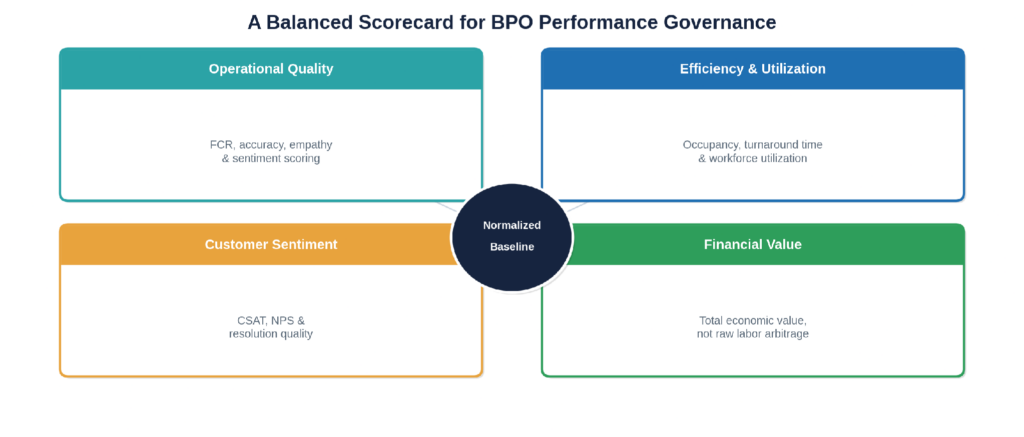
Figure 1. A balanced scorecard ties operational quality, efficiency, sentiment, and financial value to a normalized baseline.
What Core Metrics Define Success in Philippine Operations?
Success rests on service quality, operational efficiency, and talent retention. For CX programs, First-Contact Resolution averages 72–78% in standard setups and exceeds 85% in high-performing operations; for back-office workflows, the baseline shifts to transaction accuracy and compliance at 99.5% or greater.
Evaluating an outsourcing partner requires moving beyond basic productivity tracking to comprehensive capability indicators. In the mature Philippine landscape, performance governance centers on service quality, operational efficiency, and talent retention.
For customer-experience programs, metrics map directly to the customer journey. First-Contact Resolution remains a primary measure of operational health, averaging 72% to 78% in standard setups while high-performing operations exceed 85%. For back-office workflows like financial services, the framework shifts toward transaction accuracy and compliance adherence, where the target baseline is consistently 99.5% or greater.
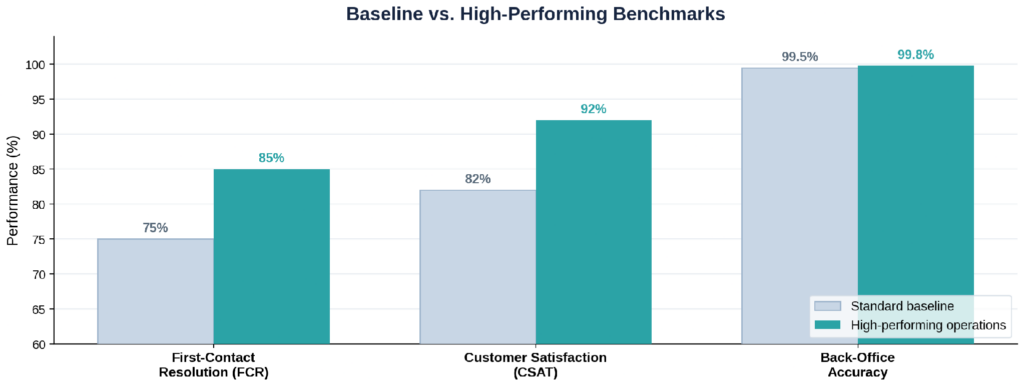
Figure 2. Standard baseline versus high-performing benchmarks across FCR, CSAT, and back-office accuracy.
How Do Operational Benchmarks Differ Between Voice and Back-Office Services?
Voice operations need real-time resource management, while back-office work depends on process optimization and volume capacity. Measuring both with identical parameters yields inaccurate assessments—voice is governed by FCR and occupancy, back-office by turnaround time, accuracy, and efficiency.
Voice operations require real-time resource management, whereas back-office tasks depend on process optimization and volume capacity. Measuring these distinct environments with identical parameters leads to inaccurate operational assessments. The baseline below highlights the critical metric variances between the two service types.

Figure 3. Voice and back-office services require distinct KPIs, benchmarks, utilization targets, and quality standards.
What Hidden Operational Variables Impact Performance Tracking?
Standard dashboards often overlook regional variables—infrastructure resilience, localized wage inflation, and workplace-model shifts. Unexplained metric drops frequently signal workforce attrition, which historically runs 30–45% market-wide; top providers manage it through robust engagement initiatives.
Standard dashboards frequently overlook regional variables influencing service delivery. In the Philippines, infrastructure resilience, localized wage inflation, and workplace-model shifts create variances in data tracking. Unannounced metric drops often point to underlying workforce attrition, which historically hovers around 30% to 45% annually across the market. Top-tier providers manage this risk through robust employee-engagement initiatives—and, crucially, by measuring cultural ownership directly.
The mistake most enterprises make is treating operational data as a lagging indicator. True alignment happens when you integrate local cultural values into quality assurance. When frontline professionals demonstrate malasakit—the cultural value of deep ownership—it directly drives resolution quality. If your scorecard only tracks handle times, you miss the true drivers of brand loyalty.
— John Maczynski, CEO, PITON-Global

Figure 4. Embedding malasakit into QA scoring links cultural ownership to resolution quality and brand loyalty.
How Does a Vetted Vendor Framework Mitigate Service-Delivery Risks?
A structured selection model is essential in a market of thousands of providers; an unvetted vendor causes fractured experiences, security gaps, and hidden costs. A vetted framework matched one fintech to a SOC 2-compliant Manila partner, lifting CSAT from 62% to 88% and cutting overhead 42% in 90 days.
Navigating a landscape with thousands of providers requires a structured selection model. Partnering with an unvetted vendor leads to fractured customer experiences, data-security vulnerabilities, and hidden operational costs—risks a disciplined, audit-based framework is designed to remove.
Client Challenge
A fast-growing fintech platform faced ballooning costs and a dropping 62% CSAT score while scaling in-house support.
Selection and Solution
PITON-Global evaluated the client’s security needs against its network of 100+ vetted Philippine providers, shortlisting three institutions, and migrated Tier-1 customer care to a dedicated, SOC 2-compliant facility in Manila.
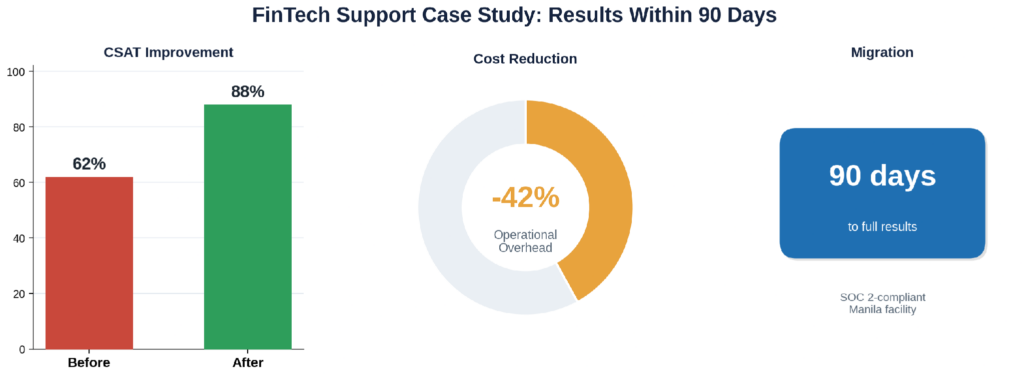
Figure 5. Quantifiable outcomes within 90 days of migrating to a vetted, SOC 2-compliant provider.
Outcomes and Lessons
Within 90 days, CSAT increased to 88% and direct operational overhead fell 42%. The lesson: isolating transaction-heavy workflows prevents frontline burnout and protects the metrics that matter most.
Why Do Enterprises Partner with PITON-Global for Vendor Selection?
PITON-Global is an advisory-led consultancy, not a conventional broker. Across a network of 100+ vetted providers, it conducts operational reviews, infrastructure audits, and leadership assessments at no cost—matching procurement teams only with partners capable of consistently hitting complex SLAs.
Who Is PITON-Global?
PITON-Global acts as an advisory-led outsourcing consultancy rather than a conventional broker. With an extensive network of over 100 highly vetted call center and back-office providers across the Philippines, the firm eliminates provider-selection risk through hands-on operational expertise.
How Does PITON-Global Differ from Traditional Outsourcing Brokers?
Rather than forwarding leads, PITON-Global conducts thorough operational reviews, technical infrastructure audits, and leadership assessments at no cost to the buyer. This ensures procurement teams are matched exclusively with partners capable of consistently hitting complex service-level agreements.
How Does PITON-Global’s Network of 100+ Vetted Providers Benefit Organizations?
The firm’s network of more than 100 vetted providers lets organizations bypass a risky open-market search across thousands of operators. Because each provider is assessed for capability, infrastructure, and leadership, buyers reach partners genuinely able to meet balanced-scorecard targets.
How Does PITON-Global’s Selection Process Work?
PITON-Global maps SLAs and performance needs, audits infrastructure for uptime, security, and redundancy, assesses leadership and culture fit, matches against its vetted network, and pairs the buyer with an SLA-ready partner—removing provider-selection risk.

Figure 6. PITON-Global’s five-stage process for de-risking vendor selection and ensuring SLA-capable partners.
Why Do Organizations Use PITON-Global?
Organizations partner with PITON-Global to eliminate provider-selection risk and secure partners that consistently hit complex SLAs. By conducting operational, infrastructure, and leadership reviews at no cost, the firm helps enterprises build measurement-driven outsourcing relationships that deliver value rather than just cost savings.
What Are the Most Common Questions About Measuring BPO Performance?
Common questions concern calibration frequency, normal attrition for premium providers, data-security governance, whether to incentivize performance beyond the contract, and how infrastructure differences affect uptime. Each is answered below.
How often should performance calibrations be conducted?
Teams should hold weekly calibration sessions during the initial 90-day implementation phase, transitioning to monthly formal business reviews once performance matches established baselines.
What is a normal agent attrition rate for premium providers?
While the industry average ranges from 30% to 45%, premium providers in the PITON-Global network maintain attrition below 15% to 20% through superior workplace cultures.
How is data security governed within outsourced back-office operations?
Performance frameworks must include mandatory compliance metrics, including regular SOC 2 Type II audits, ISO 27001 certifications, and full alignment with HIPAA or PCI-DSS requirements.
Should we incentivize vendor performance beyond the standard contract?
Yes. A gain-share model—where vendors receive bonuses for exceeding performance ceilings and face penalties for missing baselines—fosters a true partnership.
How do infrastructure differences across the Philippines impact service uptime?
Major metros like Manila and Cebu offer Tier-3 and Tier-4 data centers with multiple power redundancies. Performance contracts should mandate a minimum of 99.99% network and power uptime.