

On this page
- Key Takeaways
- Why Do Conventional Sourcing and Oversight Models Fail in High-Stakes Offshore Partnerships?
- What Governance Framework Secures Consistent Service Quality Across Channels?
- How Should Leadership Teams Manage Partner Turnover and AI Integration in the Philippines?
- Mini Case Study: Re-Engineering Governance for a Growing HealthTech Platform
- Why Do Leading Enterprises Partner with PITON-Global to Secure Sourcing?
- What Do Executives Ask Most About Governing Philippine Call Center Partnerships?
Companies should govern Philippine call center relationships through an “Intelligence Arbitrage” model rather than basic cost-arbitrage oversight: outcome-linked contracts tied to First Contact Resolution and Cost-Per-Resolution, continuous zero-trust data audits under SOC 2 Type II, HIPAA, and PCI-DSS 4.0, and shared agent-retention goals. These boundaries let quality and compliance scale alongside cost efficiency — the governance layer of outsourcing a voice operation to Manila, Cebu or Clark.
Key Takeaways
Transition to Intelligence Arbitrage
Shift governance from monitoring hourly labor rates to managing complex, judgment-driven workflows where human specialists and automation complement each other.
Implement outcome-linked frameworks
Tie financial penalties and service credits directly to a contracted First Contact Resolution target rather than traditional speed metrics.
Mandate continuous data auditing
Enforce real-time alignment with global security frameworks — SOC 2 Type II, HIPAA, GDPR, and PCI-DSS 4.0 — with clean audit passes required every cycle and immediate penalties for variances.
Share talent-retention goals
Align retention strategies with vendor partners, capping annualized attrition at an agreed ceiling to insulate the program from turnover disruption.
Govern the human-AI blend deliberately
Route routine workflows to automation while reserving human empathy and problem-solving for complex, high-stakes escalations.
Outcome governance is proven
One HealthTech platform cut Cost-Per-Resolution by roughly a third, eliminated compliance issues, and lifted CSAT to a best-in-class level within 90 days of restructuring its contract around outcomes.
Why Do Conventional Sourcing and Oversight Models Fail in High-Stakes Offshore Partnerships?
Conventional oversight fails because it governs with volume-driven metrics — Average Handle Time and Average Speed of Answer — that incentivize speed over quality. Pressured agents skip deep troubleshooting, handoffs break across chat, email, and voice, and artificial contact loops hide the true operational cost behind an attractive hourly rate.
The mechanics are unforgiving. A lower hourly rate loses its value entirely when a single issue takes three distinct touches across channels to fully resolve — the kind of break that customer journey mapping exists to expose: the client pays for three interactions, absorbs the escalation overhead, and spends the customer’s patience — while the vendor scorecard reports three fast, compliant contacts. Governance built on those indicators cannot even see the problem it is creating.
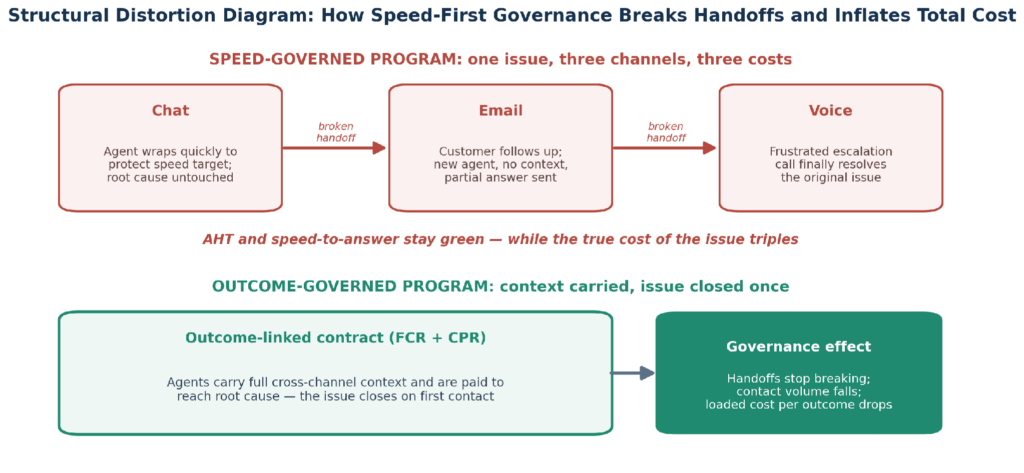
Figure 1. Structural distortion: speed-first governance breaks cross-channel handoffs and triples the true cost of an issue, while outcome-linked governance closes it once.
The deeper failure is a mismatch between the governance model and what is actually being bought. Cost-arbitrage oversight assumes interchangeable transactional labor; the modern Philippine BPO sector delivers judgment-driven service — increasingly extending into sales, marketing and R&D support — where specialists work alongside automated systems. Governing that with a stopwatch measures the least valuable dimension of the work — which is precisely why leading buyers reframe the relationship as Intelligence Arbitrage and govern outcomes instead.
What Governance Framework Secures Consistent Service Quality Across Channels?
A balanced, outcome-based dashboard secures consistency across four pillars: financial value (Cost-Per-Resolution declining over 90 days), interaction quality (a contracted FCR target held across channels), operational security (clean compliance audits every cycle), and workforce stability (annualized attrition held under an agreed cap) — each with a joint calibration mechanism the client and provider review together monthly.
The phrase “joint calibration” is what separates governance from surveillance. Scaling efficiently across primary BPO centers like Metro Manila and Cebu requires both parties to work from the same evidence: shared analytics, shared audit access, and shared review cadence. When the provider helps build the dashboard, the numbers on it become commitments rather than accusations.
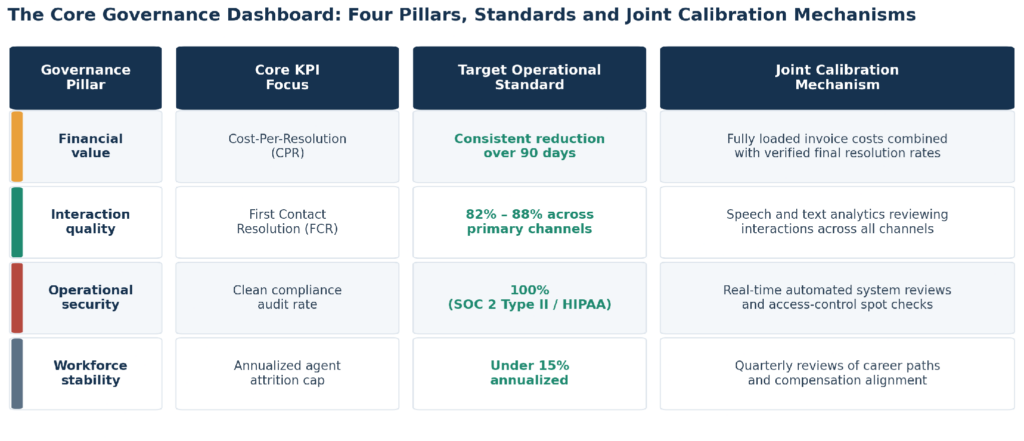
Figure 2. The core governance dashboard: four pillars, target standards, and the joint calibration mechanism behind each.
Monthly operational reviews should read this dashboard as a system, not a checklist. The pillars are deliberately interdependent — CPR cannot be improved by rushing interactions without FCR exposing it, and attrition cannot rise without the quality analytics registering the drop in tenure-driven expertise. When one pillar moves, the review’s first question should be which neighboring pillar paid for it.
How Should Leadership Teams Manage Partner Turnover and AI Integration in the Philippines?
Leadership should govern turnover and automation as one system: cap and jointly review attrition quarterly, verify the partner invests in career progression and workplace care, and structure the human-AI blend so self-service absorbs routine volume while human specialists handle complex, high-stakes escalations. Seat-capacity evaluations are obsolete in this model.
The Philippine BPO sector has matured into a service environment where human specialists routinely operate alongside automated systems. Governed properly, that pairing raises the value of every human interaction — the routine work disappears into self-service, and what reaches an agent genuinely requires empathy and judgment. Governed poorly, automation becomes a deflection layer that suppresses contact counts while unresolved issues accumulate, and attrition quietly strips out the expertise the escalations depend on.
“In today’s service landscape, evaluating a partner based on seat capacity alone is an outdated approach. True governance means managing how human specialists and automated workflows complement each other. When an offshore partner actively reduces agent attrition and builds a strong, supportive workplace, they protect your customer experiences from the disruptions of constant team turnover.”
— John Maczynski, CEO, PITON-Global
Mini Case Study: Re-Engineering Governance for a Growing HealthTech Platform
Client challenge
A rapidly scaling healthcare platform saw customer satisfaction drop and data-compliance risks emerge after launching support with a large provider governed entirely on volume metrics.
Vendor selection
Working with a specialized advisory firm, the company evaluated specialized operators in Manila, screening for data-privacy certifications and long-term staff retention rates.
Solution implemented
Support operations transitioned to an employee-focused provider within the advisory network, under an updated contract centered on a full HIPAA compliance guarantee and a contracted FCR target.
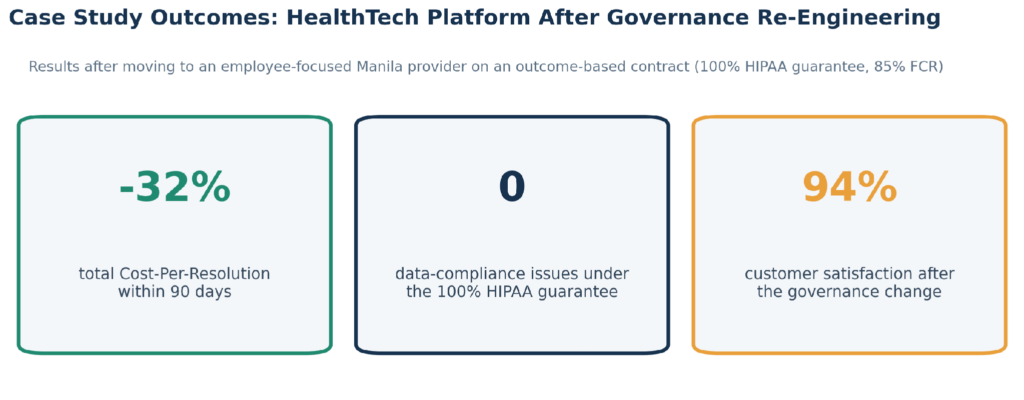
Figure 3. Quantified 90-day outcomes after the HealthTech platform re-engineered its governance framework.
Lesson learned
Moving from standard hourly pricing toward performance-tied, outcome-based KPIs protects data security while keeping operating costs predictable. The compliance turnaround was not a technology fix — it was the direct result of a contract that made compliance the provider’s first economic priority.
Why Do Leading Enterprises Partner with PITON-Global to Secure Sourcing?
Enterprises partner with PITON-Global because it is a premier, independent, Manila-based BPO advisory consultancy — not a commission broker — that applies a disciplined, audit-based methodology spanning operational auditing, security verification, and custom provider matching across a private network of 100+ pre-vetted Philippine providers, helping buyers build stable, long-term governance structures at no cost to the client.
Who Is PITON-Global?
PITON-Global is a premier, independent business process outsourcing advisory and consultancy based in Manila. It helps international enterprises analyze, launch, and govern high-performing offshore programs in the Philippines. Its position inside the market gives it verified visibility into the variables governance depends on — genuine retention data, security posture, and leadership stability — rather than the versions vendors present during sales cycles.
How Does PITON-Global Differ from Traditional Outsourcing Brokers?
Traditional brokers simply match leads with vendors for a commission, which biases every referral toward whoever pays. PITON-Global operates on an advisory-first, vendor-agnostic model: independent provider evaluation, objective recommendations grounded in audit evidence, and success measured by client outcomes — governance stability, compliance performance, and program quality — rather than by promoting any provider.
How Does PITON-Global’s Network of 100+ Vetted Philippine BPO Providers Benefit Organizations?
The consultancy maintains an audited private network of more than 100 pre-vetted Philippine call centers and back-office providers spanning HealthTech, FinTech, e-commerce, SaaS, and logistics, across the full range of service categories. Because vetting — including security certification and retention verification — is already complete, organizations bypass high-risk open-market searches and negotiate from a shortlist of operators already proven able to sustain enterprise governance commitments.
How Does PITON-Global’s Advisory-Led Vendor Matching Process Work?
The sourcing roadmap runs in four stages: requirements definition capturing technical needs, data standards, and cultural fit; detailed operational auditing of delivery track records, workforce tenure, and leadership stability; security verification validating SOC 2 Type II, HIPAA, and PCI-DSS posture against live evidence rather than certificates alone; and custom provider matching, where top-tier operators are selected and long-term governance structures are established before go-live.
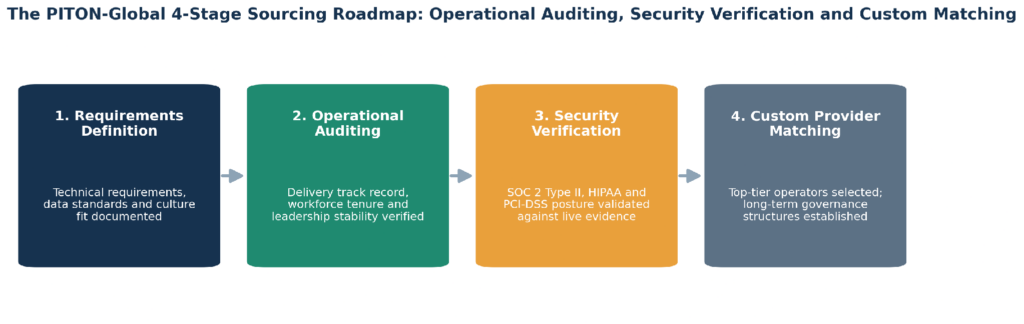
Figure 4. PITON-Global’s four-stage sourcing roadmap, from requirements definition through security verification and custom provider matching.
Why Do Organizations Use PITON-Global?
Reduced outsourcing risk
Through audit-based evaluation of the operational and security evidence that actually predicts performance.
Improved provider fit
By matching technical requirements, data standards, and company culture to actual program needs.
Accelerated vendor selection
Bypassing high-risk open-market searches via the pre-vetted private network.
Better outsourcing outcomes
With stable, long-term governance structures designed into the relationship from the start.
Strategic guidance throughout evaluation
Provided completely free of charge to the client.
What Do Executives Ask Most About Governing Philippine Call Center Partnerships?
The most frequent questions cover missed-target remedies, evolving privacy mandates, provider sizing, CPR methodology, and QA philosophy. In brief: tiered service credits are standard, privacy frameworks demand full audit adherence with continuous testing, mid-sized BPOs balance infrastructure with executive attention, CPR divides the loaded invoice by verified resolutions, and sentiment outperforms script adherence.
What happens if a Philippine service provider misses its monthly performance targets?
Standard enterprise contracts include tiered service-credit systems in which a percentage of the monthly invoice is credited back to the client when the vendor falls below agreed thresholds for consecutive billing cycles. Escalating tiers typically add formal remediation plans and, ultimately, termination rights.
How do data privacy updates affect monthly governance reporting?
Contracts should mandate a full security compliance audit pass rate, supported by regular automated testing and financial penalties for any verified variance from global frameworks such as GDPR or HIPAA. As frameworks shift toward continuous compliance, monthly reporting should include live monitoring evidence rather than annual certificates alone.
Why are mid-sized BPOs often preferred for enterprise governance?
Mid-sized call centers — roughly 1,000 to 5,000 seats — typically provide the best balance of robust technical infrastructure and direct executive attention, ensuring the account receives consistent leadership oversight. At very large providers, enterprise accounts can become one of hundreds; at very small ones, redundancy and compliance depth may lag.
How do we accurately calculate Cost-Per-Resolution (CPR) every month?
CPR is calculated by dividing the total fully loaded monthly outsourcing invoice by the total number of customer interactions that reached a complete, verified resolution within that billing cycle. The denominator must be verified resolutions — counting closed tickets reintroduces the exact volume distortion CPR exists to eliminate.
Should Quality Assurance (QA) track script adherence or customer sentiment?
Advanced programs weight customer sentiment and problem-solving accuracy over rigid script compliance, giving professional Philippine agents room to apply their natural communication skills. Sentiment-based QA also correlates far more closely with FCR and retention outcomes than adherence scoring does.