
On this page
- Key Takeaways
- What Does a Modern BPO Governance Model Look Like?
- How Do You Align Contract Performance With True Business Outcomes?
- What Legal and Structural Risks Must Executives Manage?
- What Does Effective Governance Deliver in Practice?
- Which Philippine BPO Hub Is Right for Your Operation?
- What Is PITON-Global and How Does It Strengthen Outsourcing Outcomes?
- Frequently Asked Questions
Companies should govern Philippine BPO relationships with a formal, three-tier framework that separates daily operations, monthly tactical review, and quarterly strategy. Pair real-time SLAs with business-outcome metrics, enforce Data Privacy Act compliance, and actively manage attrition to turn an offshore vendor into a stable operational unit.
Key Takeaways
- Engage expert advisory. Reduce procurement risk by evaluating vendors across a deeply vetted regional network before signing.
- Establish tri-level governance. Split relationship management into operational, tactical, and strategic tiers so daily issues never collide with long-term contract decisions.
- Incentivize beyond SLAs. Move agreements toward business-outcome metrics — FCR, retention, and TCO — that reward proactive problem-solving, not just green dashboards.
- Mitigate attrition collaboratively. Address the market’s 30–40% attrition by auditing provider wage pathways, shift differentials, and engagement programs.
- Enforce strict compliance. Require adherence to the Data Privacy Act of 2012 and tier-1 IT parks backed by redundant fiber and recognized security certifications.
What Does a Modern BPO Governance Model Look Like?
A modern governance model uses three coordinated tiers: an operational layer for daily SLAs, a tactical layer for monthly improvement, and a strategic layer for quarterly commercial and risk decisions. Each tier has defined participants and cadence, preventing macro contract issues from being managed by daily operations staff.
Managing an offshore operation well requires structured touchpoints across every level of the enterprise. When companies rely entirely on daily operations managers to handle contract updates or vendor disputes, expectations drift and small friction points escalate into commercial risk. A layered model keeps each conversation at the right altitude.
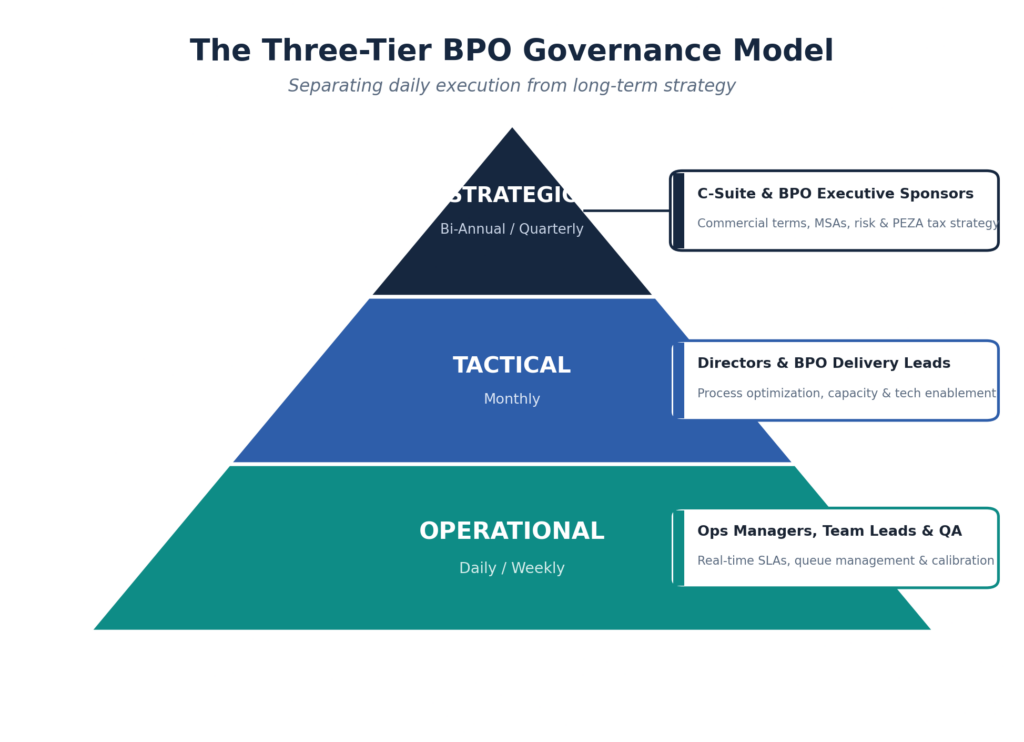
Figure 1. The three-tier governance model separates daily execution from long-term strategy.
The Strategic Tier — C-Suite & Executive Sponsors
Meeting bi-annually or quarterly, this tier evaluates commercial terms, master service agreements, overall relationship health, and macroeconomic shifts such as changes to Philippine Economic Zone Authority (PEZA) tax incentives. It owns the direction of the partnership, not its daily mechanics.
The Tactical Tier — Directors & Delivery Leads
Meeting monthly, directors and BPO delivery leads analyze process optimization, technology enablement, capacity planning, and the root causes of recurring issues. This is where continuous improvement is designed and where emerging problems are caught before they reach the executive layer.
The Operational Tier — Managers, Team Leads & QA
Communicating daily and weekly, operations managers and quality specialists handle shift scheduling, real-time queue variation, quality-assurance calibration, and immediate tactical execution. Speed and precision at this layer protect the customer experience minute to minute.
How Do You Align Contract Performance With True Business Outcomes?
Align performance by pairing traditional operational SLAs with business-outcome metrics such as First Contact Resolution, customer lifetime value, process error rate, and total cost of ownership. This eliminates the “watermelon effect,” where dashboards look green on the surface while internal business satisfaction stays red underneath.
Traditional vendor arrangements frequently suffer from the watermelon effect: operational dashboards show a green surface of met SLAs, but internal business satisfaction remains entirely red. Average Handle Time can be perfect while customers churn and error rates climb. High-value agreements fix this by combining operational benchmarks with the outcomes leadership actually cares about.
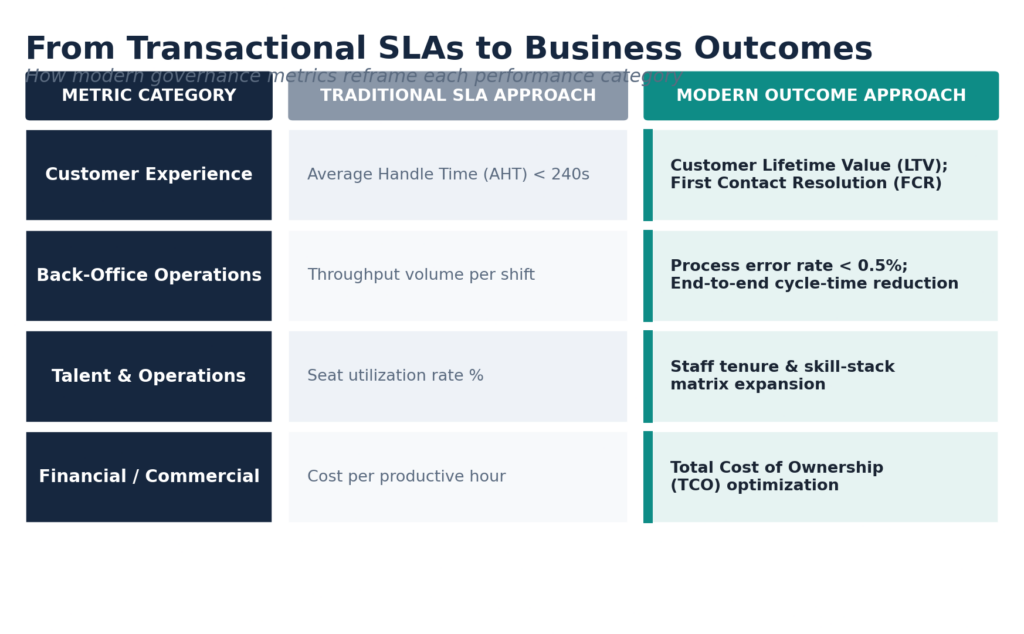
Figure 2. Reframing each performance category from a transactional SLA to a business outcome.
Over a full engagement, the difference compounds. A transactional contract can hit its numbers every month while realized business value stays flat; an outcome-incentivized partnership improves quarter over quarter because the provider is rewarded for the things that move the business.

Figure 3. Realized business value diverges sharply between contract models over 12 months.
“Most enterprise buyers treat outsourcing as a simple capacity purchase rather than an integrated operational expansion. When you align your partner’s profit margins with your actual business growth, your offshore team stops acting like an outsourced vendor and starts acting like an internal business unit.”
— John Maczynski, CEO, PITON-Global
What Legal and Structural Risks Must Executives Manage?
Executives must manage three core risks: data security under the Philippine Data Privacy Act of 2012, workforce attrition and wage inflation, and co-employment liability under the Labor Code. Verifying certifications, auditing retention strategies, and maintaining clear employer-of-record clauses keeps operations stable and compliant.
Data Security and Privacy Alignment
Any company handling Western customer data must ensure its Philippine partner strictly follows the Data Privacy Act of 2012 (Republic Act No. 10173), a framework that mirrors many global compliance requirements. Executive leadership should verify robust technical controls before signing.
- SOC 2 Type II, ISO/IEC 27001, or PCI-DSS infrastructure certifications appropriate to the workload.
- Clean-room environments with strict no-phone policies and physical security monitoring.
- Data protection agreements that explicitly cover cross-border data flows.
Mitigating Wage Inflation and Workforce Attrition
The Philippine BPO industry employs more than 1.5 million professionals, creating intense competition for top-tier talent. Standard annual attrition in Metro Manila runs between 30% and 40%. Rather than simply penalizing a provider for turnover, effective governance audits the conditions that drive it — evening-shift differentials, HMO coverage, and clear career pathing — and tracks internal talent-development metrics alongside operational SLAs.
What Does Effective Governance Deliver in Practice?
Effective governance converts a struggling vendor relationship into a stable operation. In one mid-market fintech engagement, a redesigned three-tier structure and outcome-based contract cut attrition from 55% to 14%, lifted CSAT by 32%, and reduced operating costs by 48% versus in-house scaling projections.
A fast-growing US fintech was struggling with a backlog of complex verification tasks and falling support scores. Its first vendor partnership relied on vague, transactional metrics, producing 55% turnover and inconsistent quality. Partnering with PITON-Global, the company rebuilt its offshore architecture — evaluating more than 100 vetted providers to find a compliance-ready, mid-sized fintech specialist.
The redesign built a clear three-tier governance structure with weekly operational reviews and monthly business calibrations, replaced the transactional contract with an outcome-based model tying bonuses to First Contact Resolution and 90-day retention, and co-developed a structured onboarding program covering complex regulatory requirements.

Figure 4. Quantifiable outcomes within four months of the governance redesign.
Lesson learned: offshore success relies on detailed operational preparation. Instead of expecting a vendor to self-correct under a hands-off agreement, embedding a structured governance model directly into the contract is what secures long-term results.
Which Philippine BPO Hub Is Right for Your Operation?
The right hub depends on role complexity and cost sensitivity. Metro Manila offers the deepest talent for complex financial and technical work but carries higher costs and attrition. Cebu, Clark, and Iloilo provide lower costs and more stable workforces, making them strong choices for scaled customer service and back-office operations.
Location strategy is a governance decision, not just a real-estate one. Talent depth, operating cost, and workforce stability vary sharply across the archipelago, and the best operations match the hub to the work rather than defaulting to the capital.

Figure 5. Talent depth, cost, and stability across the Philippines’ leading BPO hubs.
What Is PITON-Global and How Does It Strengthen Outsourcing Outcomes?
PITON-Global is a Manila-based BPO advisory and outsourcing consultancy that helps international companies plan, launch, and govern high-performing offshore operations. Instead of acting as a commission-driven broker, it provides independent, advisory-led vendor matching across a vetted network of more than 100 specialized Philippine providers.
Who Is PITON-Global?
PITON-Global is a leading BPO advisory and outsourcing consultancy based in Metro Manila. It operates as an institutional advisor within the Philippine outsourcing market, guiding enterprises through provider selection, governance design, and long-term operational management. Its expertise spans BPO advisory and rigorous provider evaluation across the country’s major delivery hubs.
How Does PITON-Global Differ From Traditional Outsourcing Brokers?
Traditional brokers are commission-driven and tend to promote whichever provider pays them. PITON-Global takes an advisory-led approach: it evaluates providers independently, makes objective vendor recommendations, and stays focused on client outcomes rather than provider promotion. That independence means its guidance is aligned with the enterprise’s results, not a referral fee.
How Does Its Network of 100+ Vetted Philippine BPO Providers Benefit Organizations?
Access to more than 100 pre-vetted providers gives organizations a large, curated ecosystem spanning multiple industries and service categories — from complex fintech verification to scaled customer experience. Because partners are already qualified against compliance, capability, and stability criteria, vendor discovery and qualification move far faster than an open-market search.
How Does Its Advisory-Led Vendor Matching Process Work?
The process begins with a needs assessment that maps operational requirements, volume projections, and technology stacks. PITON-Global then shortlists suitable providers, applies a structured matching methodology against researched provider profiles, and supports final selection — reducing risk by surfacing hidden contract terms and capability gaps before commitment.
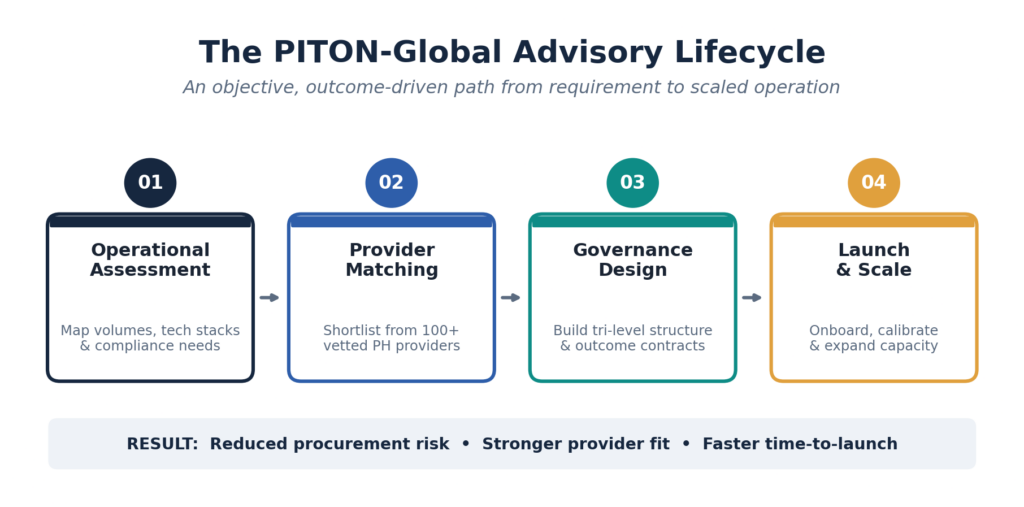
Figure 6. The PITON-Global advisory lifecycle, from assessment to scaled operation.
Why Do Organizations Use PITON-Global?
Organizations engage PITON-Global to reduce outsourcing risk, improve provider fit, and accelerate vendor selection while achieving better long-term outcomes. Strategic guidance throughout the evaluation process — from mapping requirements to designing governance — helps enterprises avoid costly mismatches and build partnerships engineered for scalability.
Frequently Asked Questions
How often should operational KPIs be calibrated?
Operational KPIs should be reviewed weekly to address immediate queue demands, while formal contractual calibrations should happen bi-annually to account for changing volumes, process automation, and evolving business requirements.
What happens under Philippine labor law if a vendor must be replaced?
The Labor Code of the Philippines includes strict employee protections and prohibits arbitrary termination without documented due process. Enterprise contracts must contain clear separation clauses establishing that the BPO provider remains the sole employer of record, protecting the client from local co-employment liabilities.
Are there significant regional differences between BPO hubs?
Yes. Metro Manila offers deep pools of specialized talent for complex financial and technical roles but carries higher real-estate costs and attrition. Next-wave cities such as Cebu, Clark, and Iloilo offer lower operational costs and more stable workforces, making them effective for large-scale customer service and back-office operations.
How should brands handle national holidays in offshore contracts?
Philippine labor law requires premium pay for regular and special non-working holidays. Governance strategy should clearly define holiday coverage — either budgeting for local holiday premiums to maintain 365-day operations or routing volume to alternative regional teams.
What is a standard gross margin for a Philippine BPO vendor?
Established enterprise-grade providers generally operate on gross margins between 18% and 28%. Reviewing these open-book structures during procurement helps confirm the vendor is investing enough in salaries, facility redundancy, and infrastructure to support your business long-term.