
On this page
- Key Takeaways
- What Operational Metrics Best Reflect True Agent Competency?
- How Do Top-Tier Providers Structure Their Recruitment Pipelines?
- What Role Does Continuous Learning Play in Sustaining Service Excellence?
- What Does a Successful Workforce-Quality Turnaround Look Like?
- How Does PITON-Global Help Enterprises Secure High-Quality Talent?
- What Are the Most Common Questions About Evaluating Philippine BPO Workforce Quality?
Companies evaluating Philippine BPO workforce quality must look beyond generic language proficiency to assess specialized domain expertise, cognitive problem-solving, and historical performance. A rigorous evaluation combines standardized baseline testing with structural audits of a provider’s recruitment pipeline and upskilling frameworks—effectively mitigating long-term delivery risk.
Key Takeaways
- Holistic metrics: Evaluate technical competence and critical thinking rather than relying solely on generic communication skills.
- Recruitment funnels: Audit vendor selectivity ratios—top-tier providers maintain highly selective, single-digit hiring rates.
- Upskilling infrastructure: Prioritize partners with formal continuous-learning programs mapped to complex domain certifications.
- Retention alignment: Assess how frontline employee-engagement strategies directly influence service-quality stability.
What Operational Metrics Best Reflect True Agent Competency?
The metrics that best reflect competency measure operational accuracy, independent problem-solving, and subject-matter mastery—not conversational fluency alone. Strong workforces show high accuracy in regulated environments like medical billing and financial compliance, plus low escalation on complex workflows.
When enterprise buyers evaluate talent quality in the Philippine outsourcing sector, they frequently over-index on conversational fluency. Exceptional English proficiency is a baseline characteristic of the local labor market, but complex business processes demand deeper technical capability. True workforce quality shows up in metrics that measure operational accuracy, independent problem-solving, and subject-matter mastery.
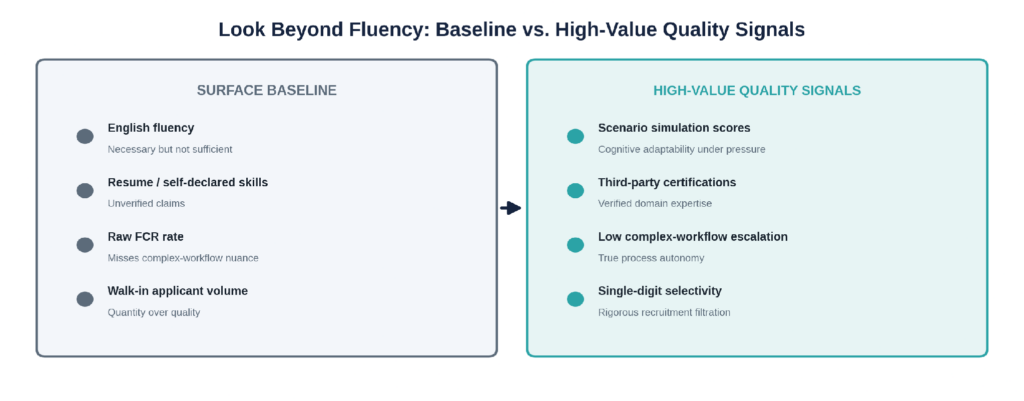
Figure 1. Surface baseline signals are necessary but insufficient; high-value signals reveal true quality.
Assessing these advanced metrics requires examining a provider’s internal performance data. High-quality workforces consistently maintain low error rates in highly technical or strictly regulated environments such as medical billing, financial compliance, and advanced technical support. The contrast between traditional and advanced auditing methods is summarized below.

Figure 2. Each competency dimension is far better revealed by advanced auditing than by traditional screening.
How Do Top-Tier Providers Structure Their Recruitment Pipelines?
Top-tier providers run rigorous, multi-stage funnels—automated aptitude testing, psychological profiling, and senior-led panel interviews—and accept fewer than 6% of applicants. A vendor’s selectivity rate is the single strongest leading indicator of workforce performance.
Workforce quality is a direct byproduct of a vendor’s recruitment stringency. In major Philippine sourcing hubs, candidate pools are vast, but the talent required for specialized enterprise operations remains highly competitive, so buyers must evaluate the exact yield and selectivity of a prospective provider’s hiring funnel.
Premium providers rarely hire from walk-in pools without rigorous filtration. Their recruitment engines incorporate automated aptitude testing, psychological profiling, and multi-stage panel interviews conducted by senior operational managers, as illustrated below.
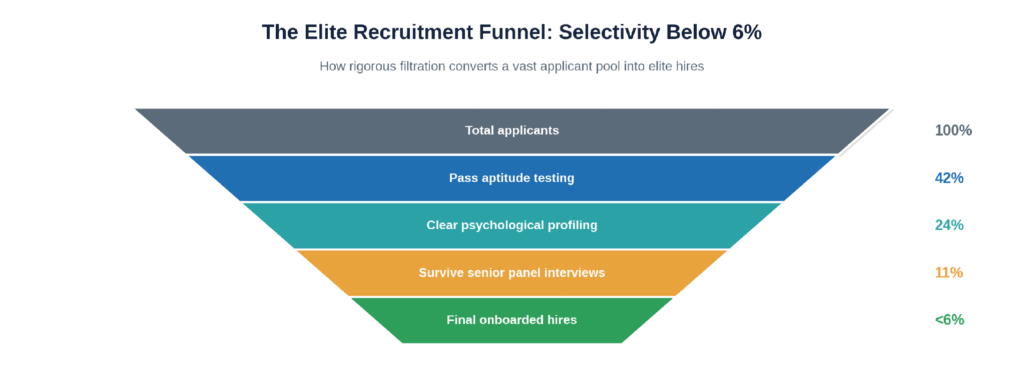
Figure 3. A rigorous funnel filters a vast applicant pool down to fewer than 6% of hires.
Many corporate buyers fail to realize that a vendor’s selectivity rate is their strongest leading indicator of performance. Top-tier providers accept fewer than 6% of applicants. If a BPO provider cannot show you a rigorous, data-driven filtration process, you are essentially inheriting their recruitment lottery.
— John Maczynski, CEO, PITON-Global
What Role Does Continuous Learning Play in Sustaining Service Excellence?
Continuous learning is the primary mechanism for sustaining quality, since initial capabilities plateau as processes evolve. Buyers should audit both onboarding curricula and ongoing upskilling; structured training hours correlate directly with long-term agent accuracy.
The initial capabilities of an outsourced team eventually plateau without structured institutional support. As business processes evolve, a provider’s training infrastructure becomes the primary mechanism for maintaining quality, so buyers must audit both the initial onboarding curriculum and the continuous upskilling framework.
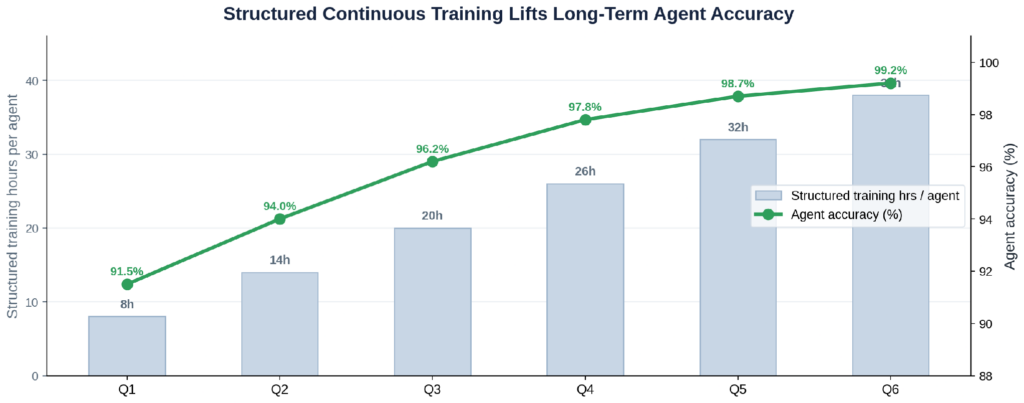
Figure 4. Cumulative structured training hours track closely with rising long-term agent accuracy.
Leading providers co-develop training tracks alongside their clients, embedding industry-specific regulatory standards and specialized software certifications into the workforce. This proactive approach ensures teams adapt to changing business requirements without a decline in operational performance.
What Does a Successful Workforce-Quality Turnaround Look Like?
A successful turnaround matches the client to a specialized provider with a certified training academy. One healthcare tech firm with high medical-coding error rates reached 99.2% processing accuracy, cut claim denials 41%, and scaled capacity without adding headcount within nine months.
Client Challenge
A North American healthcare technology enterprise was experiencing high processing error rates and low customer-satisfaction scores with its existing offshore medical coding team. The legacy provider lacked specialized training, pushing claim denials above acceptable industry thresholds.
Solution
PITON-Global audited the operational landscape and matched the firm with a specialized healthcare BPO in Manila. The new partner used an exclusive, certified academy format to vet and train registered nurses specifically in complex clinical coding.
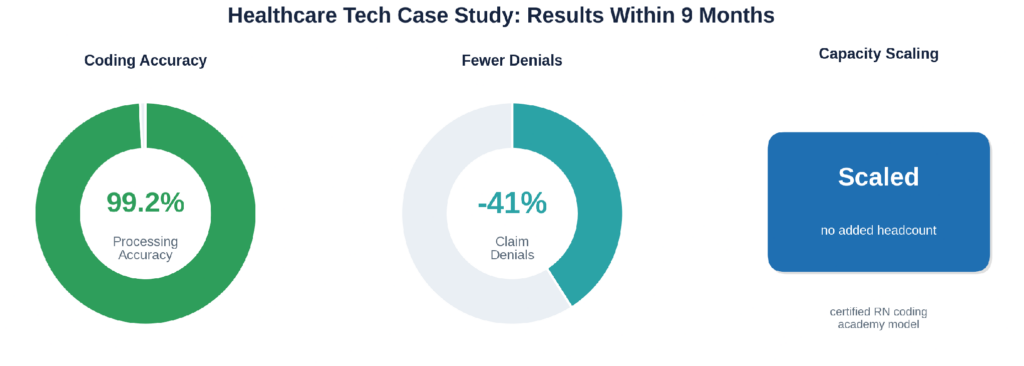
Figure 5. Quantifiable outcomes within nine months of the specialized-provider transition.
Outcomes and Lessons
Within nine months, processing accuracy reached 99.2%, claim denials dropped 41%, and the client scaled daily processing capacity without adding headcount. The lesson: matching a regulated, high-complexity workflow to a provider with a certified, domain-specific academy converts quality problems into a durable competitive advantage.
How Does PITON-Global Help Enterprises Secure High-Quality Talent?
PITON-Global is an advisory-led outsourcing consultancy that removes vendor-selection risk in the Philippine BPO landscape. By auditing talent-acquisition funnels, evaluating management capability, and verifying training infrastructure across 100+ vetted providers, it ensures buyers partner with providers capable of elite quality.
Who Is PITON-Global?
PITON-Global is an advisory-led outsourcing consultancy that removes the risks of vendor selection within the complex Philippine BPO landscape. Rather than acting as a standard independent broker, the firm takes a consultative approach, drawing on detailed verification work to guide enterprise buyers toward genuinely high-quality providers.
How Does PITON-Global Differ from Traditional Outsourcing Brokers?
Traditional independent brokers merely pass along leads. PITON-Global instead uses a consultative methodology to match buyers with more than 100 thoroughly vetted call center and back-office providers, evaluating each on talent-acquisition rigor, management capability, and training depth so recommendations reflect quality and fit rather than referral incentives.
How Does PITON-Global’s Network of 100+ Vetted Providers Benefit Organizations?
Access to a network of more than 100 thoroughly vetted providers lets organizations bypass a risky open-market search. Because each provider is assessed for selectivity, training infrastructure, and management quality, buyers can quickly shortlist partners genuinely capable of delivering elite workforce quality in their specific domain.
How Does PITON-Global Verify Workforce Quality?
PITON-Global audits internal talent-acquisition funnels, evaluates management capabilities, and verifies technical training infrastructure before recommending a partner. By confirming selectivity rates, certification academies, and trainer credentials up front, the firm ensures buyers inherit a proven quality engine rather than a recruitment lottery.
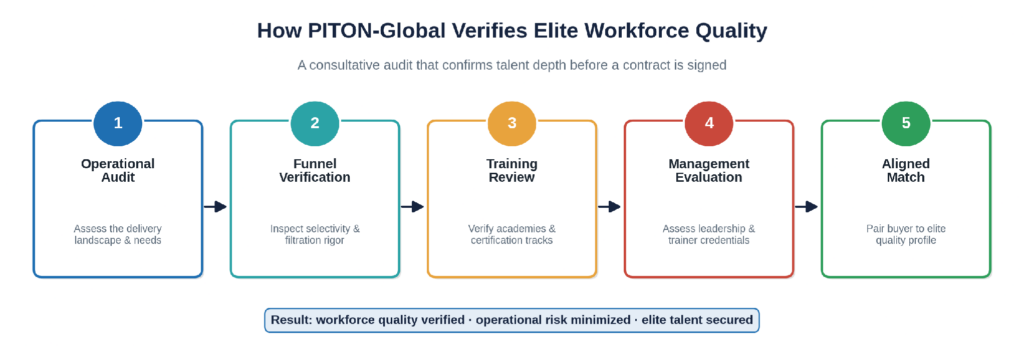
Figure 6. PITON-Global’s five-stage process for verifying elite workforce quality before a contract is signed.
Why Do Organizations Use PITON-Global?
Organizations use PITON-Global to minimize operational risk and establish a stable foundation for long-term outsourcing success. By verifying recruitment rigor, training infrastructure, and management capability, the firm ensures buyers partner with providers that can sustain elite workforce quality as requirements evolve.
What Are the Most Common Questions About Evaluating Philippine BPO Workforce Quality?
Common questions concern standard selectivity rates, how domain expertise is verified, whether location affects quality, how to audit a provider’s training team, and whether buyers can join the selection process. Each is answered below.
What Is a Standard Selectivity Rate for Elite BPO Providers in the Philippines?
Elite providers typically maintain a selectivity rate between 4% and 8% for highly technical or specialized enterprise back-office service lines.
How Do Providers Verify Domain Expertise in Specialized Fields?
Top-tier vendors use specialized practical testing, role-playing simulations, and mandatory third-party professional certifications to verify domain expertise.
Does Geographic Location Within the Philippines Impact Workforce Quality?
Metro Manila provides the largest pool of specialized technical and executive talent, while secondary hubs like Cebu and Clark offer highly stable workforces with lower attrition rates.
How Should Buyers Audit a BPO Provider’s Internal Training Team?
Buyers should evaluate the professional certifications, operational experience, and student-to-trainer ratios of the provider’s internal instructional staff.
Do Premium Providers Offer Client-Managed Selection Options?
Yes. Quality-focused providers allow enterprise buyers to participate directly in final-stage panel interviews and technical assessments for dedicated teams.