

CFOs should evaluate Philippine healthcare outsourcing on total cost of ownership and net revenue yield, not nominal wage savings alone. Migrating clinical documentation, revenue cycle management, and patient coordination to specialized providers — the core of US hospital operations supported from the Philippines — typically cuts operating costs substantially while lifting first-pass claim acceptance and embedding continuous compliance protection.
Key Takeaways
- Substantial cost reduction: Shifting administrative and clinical support workflows offshore delivers deep operating-expense savings versus understaffed onshore teams.
- Clinical talent depth: A tertiary-educated, clinically literate workforce—including thousands of registered nurses—handles complex coding, utilization review, and patient coordination.
- Revenue-cycle upside: Advanced providers cut institutional claims-error rates materially and push clean-claim rates higher.
- Embedded compliance: Tier-1 firms operate hardened physical and digital environments with role-based access, segmentation, and audit logging.
- Geographic balance matters: Pairing Metro Manila leadership with provincial delivery hubs adds further savings and improves retention.
- Advisory de-risks sourcing: An independent advisor like PITON-Global matches buyers to vetted, fit-for-purpose providers and compresses selection timelines.
What Are the Real Cost Structures and Arbitrage Benchmarks?
The true benchmark is fully-loaded cost per seat, not base wage. Onshore seats carry payroll taxes, benefits, facility overhead, and HR management; Philippine all-in hourly rates, set at a fraction of onshore wage levels, bundle supervision, training, technology, and redundancy—producing major operational savings across core workflows.
Evaluating an international delivery model requires a granular look at fully-loaded operational cost structures rather than simple base-wage comparisons. In the onshore environment, a dedicated revenue cycle management or clinical administrative seat carries a substantial financial burden. Beyond the base salary, fully-loaded costs include payroll taxes, comprehensive health benefits, workers’ compensation, facility overhead, and ongoing internal human-resources management.
Specialized providers in primary corporate hubs like Metro Manila and expanding provincial zones reset this equation. Published all-in hourly rates reflect a turnkey service environment that already encompasses specialized supervision, continuous corporate training, technology infrastructure, and robust operational redundancy. The matrix below maps current rate bands against onshore benchmarks and the resulting savings.

Figure 1 — All-in 2026 hourly rate bands by workflow and delivery location, with average operational savings versus onshore.
Optimizing for the lowest absolute rate frequently introduces hidden operational friction: unbacked claims, missed filing deadlines, and processing bottlenecks. A structured financial appraisal shows that deploying specialized, mid-career professionals delivers a materially higher return on investment than budget providers that cut corners on security and management oversight. The grouped comparison below isolates the fully-loaded gap by workflow; how that gap flows through to margin is covered in our analysis of EBITDA improvement for health systems.
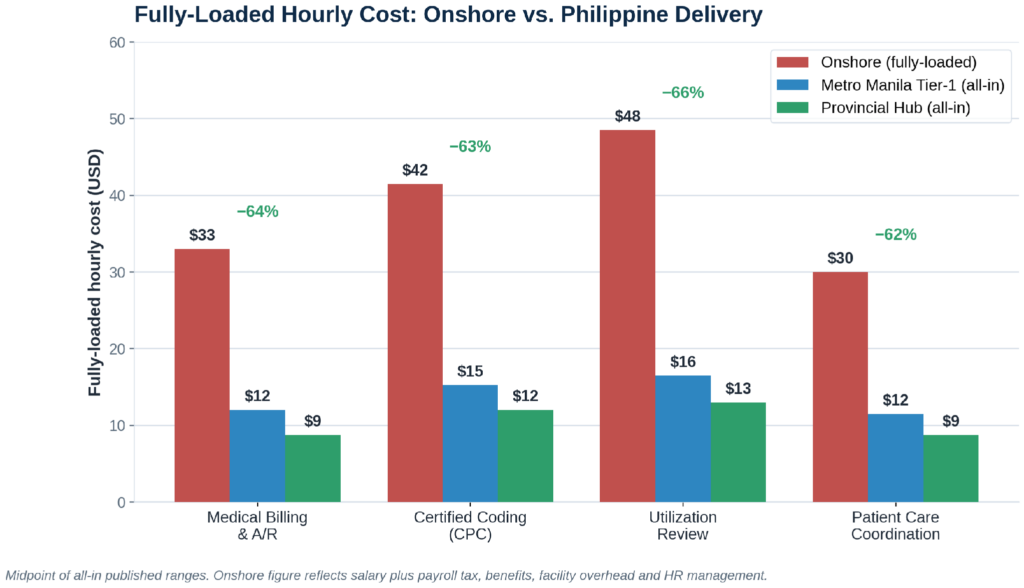
Figure 2 — Fully-loaded hourly cost by delivery model. Savings against onshore hold consistently across workflows at the midpoint of published bands.
How Does Clinical Literacy Impact Revenue Cycle Yields?
Clinical literacy protects top-line revenue. Because Philippine providers staff licensed nurses and allied-health graduates who understand medical terminology, payer rules, and diagnostic coding, accurate documentation reduces denial write-offs sharply and sustains high clean-claim rates—converting administrative quality directly into cash flow.
In high-ticket healthcare administration, operational errors directly disrupt corporate cash flow. While standard consumer customer-service centers prioritize handling volume, healthcare administrative processes demand precise specialized knowledge. The primary advantage of the Philippine talent pool is its deep bench of clinically trained professionals—licensed nurses and allied-health graduates who have chosen to build careers within the healthcare information-management services sector.
Many corporate buyers misclassify healthcare outsourcing as a generic data-entry exercise. In reality, a specialist managing your revenue cycle must understand complex medical terminology, payer-specific authorization rules, and evolving diagnostic coding systems. When you partner with a dedicated provider that employs clinically literate professionals, you are protecting your top-line revenue, not just lowering your bottom-line costs. — John Maczynski, CEO, PITON-Global
This specialized clinical background translates into quantifiable operational improvements across the revenue cycle, summarized below.
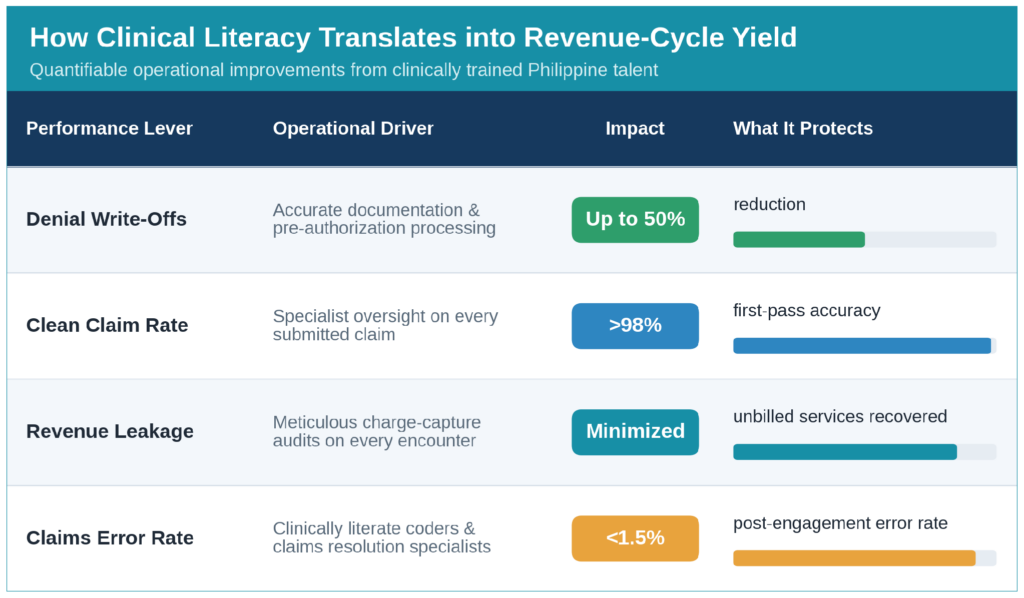
Figure 3 — How clinically literate talent converts into measurable revenue-cycle performance.
From Documentation Accuracy to Cash Flow
- Reduction in denials: Accurate documentation and precise pre-authorization processing reduce institutional denial write-offs significantly.
- Improved claims accuracy: Specialized oversight sustains consistently high clean-claim rates, accelerating cash optimization.
- Minimized revenue leakage: Meticulous charge-capture audits prevent unbilled services from slipping through complex institutional systems.
What Financial and Operational Risks Require Mitigation?
Three risks demand systematic management: data security, operational continuity, and talent attrition. Tier-1 Philippine environments enforce role-based access, network segmentation, and activity logging, while a balanced metro-plus-provincial footprint protects continuity—anchoring governance in Manila and scaling stable, high-retention processing in the provinces.
Any change in delivery model introduces structural risks that financial leaders must address head-on. In healthcare, data security, operational continuity, and talent attrition are the critical variables that can erode the benefits of labor arbitrage if left unmanaged.
Data privacy requires a non-negotiable approach. Tier-1 operational environments in the Philippines enforce strict data-security frameworks built on role-based access controls, complete network segmentation, and advanced activity logging. These controls are designed to align fully with institutional security requirements rather than retrofitted after the fact, and they belong alongside the patient-experience safeguards hospitals should write into contracts.
Geographic diversification is equally central to continuity. While primary corporate centers in Metro Manila offer deep pools of specialized leadership talent, provincial technology hubs provide lower talent competition and exceptionally high retention. High-performing programs often use a balanced model—anchoring strategic governance and advanced workflows in major metro centers while scaling high-volume processing in stable provincial facilities. Crucially, the protective effect of vendor training compounds over time, as the trajectory below illustrates.
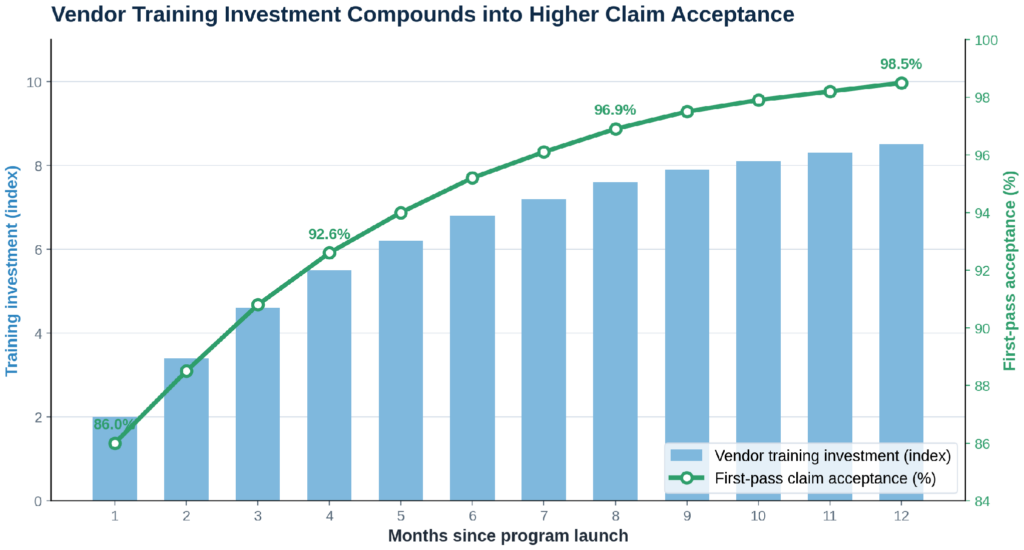
Figure 4 — Sustained vendor training investment correlates with rising first-pass claim acceptance across the first 12 months.
What Does a Real Revenue-Cycle Turnaround Look Like?
A multi-state provider replaced understaffed onshore billing with a specialized 45-seat Metro Manila team. Within six months, direct labor costs fell sharply, first-pass acceptance climbed to near-perfect levels, Days Sales Outstanding dropped 19 days, and error rates fell to a minimum.
Client Challenge
A prominent multi-state healthcare provider faced severe margin compression driven by an acute shortage of local medical-billing professionals. The talent deficit produced an elevated first-pass denial rate, a backlog in account-retrieval timelines, and millions of dollars in outstanding receivables.
Vendor Selection Process
The organization engaged PITON-Global to move away from generic, high-volume call centers toward a highly specialized partner. PITON-Global evaluated its network of more than 100 vetted providers to select an agile firm with dedicated experience in complex revenue cycle management and an established team of certified medical coders.
Solution Implemented
The chosen provider built a dedicated 45-seat offshore team in Metro Manila of certified coders and experienced claims-resolution specialists. The team implemented an AI-assisted workflow for claim tracking, initiated continuous account follow-ups, and established daily feedback loops with the client’s onshore clinical teams.

Figure 5 — Quantifiable business outcomes within the first six months of the engagement.
Success in healthcare outsourcing depends on selecting providers with deep domain specialization rather than large-scale, general-purpose operations. Integrating advanced workflows with specialized clinical teams delivers consistent quality and scalable performance—and the right advisory partner is what makes that match reliable rather than accidental.
What Role Does PITON-Global Play in the Philippine Outsourcing Ecosystem?
PITON-Global is an independent, advisory-led sourcing firm that connects enterprise buyers to elite, vetted Philippine BPO providers. Rather than brokering on commission, it runs an objective evaluation of each provider’s capabilities, compliance maturity, and cultural fit to match organizations with partners that deliver measurable outcomes.
Who Is PITON-Global?
PITON-Global is a specialized outsourcing advisory firm focused exclusively on the Philippine market. It sits between enterprise buyers and the country’s large, fragmented provider landscape, bringing deep local market intelligence and BPO advisory expertise to provider selection. Its core competency is helping organizations identify, qualify, and engage the right offshore partner for clinical and administrative workflows—particularly in healthcare, where domain specialization is decisive, and in adjacent life-sciences work such as digital-first pharma operations.
How Does PITON-Global Differ from Traditional Outsourcing Brokers?
Traditional brokers are typically commission-driven: they steer buyers toward whichever provider pays the referral, which can compromise objectivity. PITON-Global takes an advisory-led approach instead. It evaluates providers independently, makes objective vendor recommendations, and orients every engagement around client outcomes rather than provider promotion. The result is guidance aligned with the buyer’s operational and financial goals, not a vendor’s sales pipeline.
How Does the Network of 100+ Vetted Philippine BPO Providers Benefit Organizations?
Access to an exclusive network of more than 100 pre-vetted providers gives organizations immediate reach across industries and service categories—from medical billing and certified coding to utilization review and patient coordination. Because each partner is screened in advance for capability, compliance, and stability, buyers skip months of cold discovery and qualification and move directly to evaluating partners that already meet a high baseline.
How Does the Advisory-Led Vendor Matching Process Work?
The process is structured to reduce risk at every stage: a needs assessment captures cost, compliance, and growth objectives; provider shortlisting narrows the network to fit; a matching methodology weighs technical capability, compliance maturity, management depth, and cultural alignment; risk-reduction strategies vet security, continuity, and attrition safeguards; and selection support guides the buyer through to a value-driven contract.

Figure 6 — PITON-Global’s advisory-led matching process, from operational audit to optimized provider selection.
Why Do Organizations Use PITON-Global?
Organizations turn to PITON-Global to reduce outsourcing risk, improve provider fit, and accelerate vendor selection. By replacing guesswork with an objective, evidence-based evaluation framework, the firm helps enterprise buyers avoid common operational pitfalls, compress sourcing timelines, and establish stable, value-driven offshore operations—supported by strategic guidance throughout the evaluation process.
Frequently Asked Questions
What are the average hourly savings when moving healthcare workflows to the Philippines?
All-in hourly rates for specialized healthcare administrative roles vary by specialization and location and sit at a fraction of onshore wage levels. That translates into a substantial operating-expense reduction versus standard onshore staffing configurations.
How do Philippine providers ensure compliance with healthcare data regulations?
Premium providers maintain specialized delivery environments featuring advanced data encryption, strict endpoint security, role-based access management, and regular security audits to align fully with institutional standards.
Does the Philippines have sufficient talent for advanced clinical workflows?
Yes. The country has a robust healthcare information-management sector staffed by university-educated professionals, including registered nurses who manage utilization reviews, clinical documentation, and complex coding.
How do provincial delivery centers compare to Metro Manila operations?
Provincial centers offer additional savings and lower talent competition, supporting strong team stability. Metro Manila remains ideal for highly complex, leadership-heavy operations requiring deep technical specialization.
What pricing models are standard in healthcare BPO?
Fixed hourly or full-time-equivalent structures are the most reliable, aligning incentives around quality and throughput. Volume-based or percentage-of-collection models are available but require structured management at scale.
How long does it take to transition a workflow?
A disciplined transition typically takes 30–60 days, covering secure network integration, detailed process mapping, role-specific training, and a phased pilot to ensure stability before full deployment.