

On this page
- Key Takeaways
- What Key Components Determine Total Cost of Ownership in BPO Agreements?
- How Does Workforce Stability Drive Long-Term Operational Performance?
- What Compliance and Infrastructure Assurances Should Buyers Require?
- How Should Buyers Measure Strategic Value and Business Impact?
- What Does Value-Based Vendor Selection Deliver in Practice?
- How Does PITON-Global Mitigate Risk and Accelerate BPO Provider Selection?
- Frequently Asked Questions
Evaluating total vendor value requires assessing complete total cost of ownership, workforce retention stability, operational compliance, technology capability, and measurable business impact rather than hourly bill rates alone. Focusing exclusively on price ignores downstream expense created by agent attrition, retraining, quality friction, and lost customer retention. The quoted rate is where the assessment starts, and an itemized view of outsourcing spend shows how much of the fully loaded figure sits outside it.
Key Takeaways
- Total cost of ownership, not hourly rate. Low FTE rates conceal quality friction, supervisor overhead, rework, and the cost of continuous replacement hiring.
- Workforce retention drives performance. Providers paying competitive wages in tier-1 and tier-2 Philippine hubs sustain lower turnover, which raises first contact resolution directly.
- Compliance and infrastructure assurance. ISO 27001, SOC 2 Type II, and tested platform redundancy protect the buyer from breach exposure and operational downtime.
- Strategic value realization. Assessing partners on customer lifetime value impact turns outsourcing from a commoditized expense into a measurable growth contributor.
- Governance keeps value visible. Joint scorecards and executive steering reviews convert a one-time evaluation into sustained accountability.
What Key Components Determine Total Cost of Ownership in BPO Agreements?
Total cost of ownership adds the friction the buyer absorbs to the rate the vendor bills: retraining driven by attrition, additional supervision, rework and repeat contacts, and client-side management time. A low quoted rate frequently runs materially higher once those are counted.
Procurement teams routinely select on baseline hourly FTE quotes, which is the one number in a proposal guaranteed to be comparable and the one least predictive of outcome — the reason benchmarking proposals on one normalized, fully loaded basis matters so much. An executive-level evaluation has to price the full operating ecosystem. In Metro Manila, Clark, or Cebu, the lowest-quoting provider often runs very high annual attrition, producing continuous retraining, weaker first contact resolution, and degraded satisfaction scores. A value-focused partner quoting a modestly higher rate that reinvests in compensation and development typically delivers better handle times, lower error rates, and materially less brand exposure.
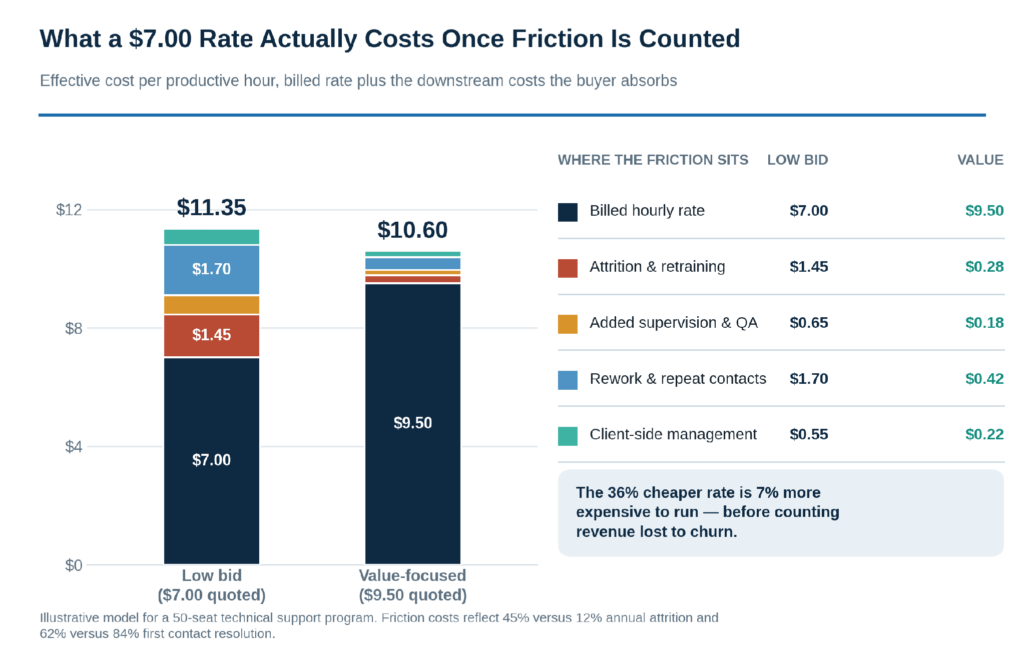
Figure 1. Effective cost per productive hour: the quoted rate plus the downstream friction the buyer absorbs.
How to Price the Friction
Each friction component is estimable from data the provider already holds. Retraining cost is the replacement rate multiplied by recruitment, classroom, and nesting cost per agent, spread across billed hours. Rework is the inverse of first contact resolution applied to contact volume at the same unit cost. Supervision overhead shows up as the delta between the quoted span of control and the ratio the account actually needs at that attrition level. Client-side management is the least visible and often the largest: escalation handling, additional governance meetings, and internal QA that exists only because the provider’s own quality function is thin.
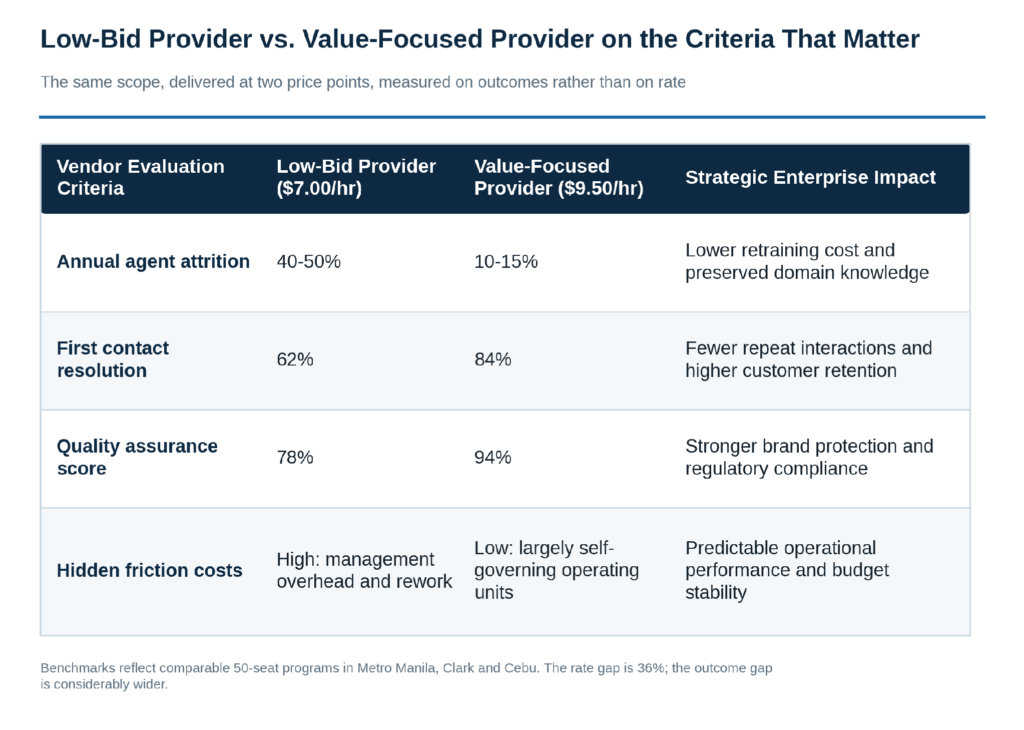
Figure 2. Low-bid provider versus value-focused provider across the criteria that determine enterprise impact.
The Delivery Cost Gap Is Not the Main Event
Worth being precise here, because overstating the case invites dismissal. On delivery cost alone the difference between these two providers is real but modest — a small fraction of the cost of a productive hour. What makes the low bid genuinely expensive is what happens outside the invoice — repeat contacts consuming customer patience, escalations reaching account managers, and churn among customers whose problems took three attempts to resolve. That is where the order-of-magnitude difference sits, and it never appears in a rate card comparison.
How Does Workforce Stability Drive Long-Term Operational Performance?
Agent retention dictates efficiency, customer effort, and program productivity. Tenured agents resolve complex transactions faster, escalate less, and hold higher CSAT. Providers offering competitive wages, HMO coverage, night differential, and defined career pathing sustain attrition at a fraction of the industry norm.
Turnover destroys institutional knowledge, inflates managerial overhead, and resets the productivity ramp continuously. The mechanism is straightforward: an agent reaches full productivity somewhere between month three and month six, so a floor running at high attrition never holds a majority of fully productive agents. The buyer pays the same rate for a permanently junior team.
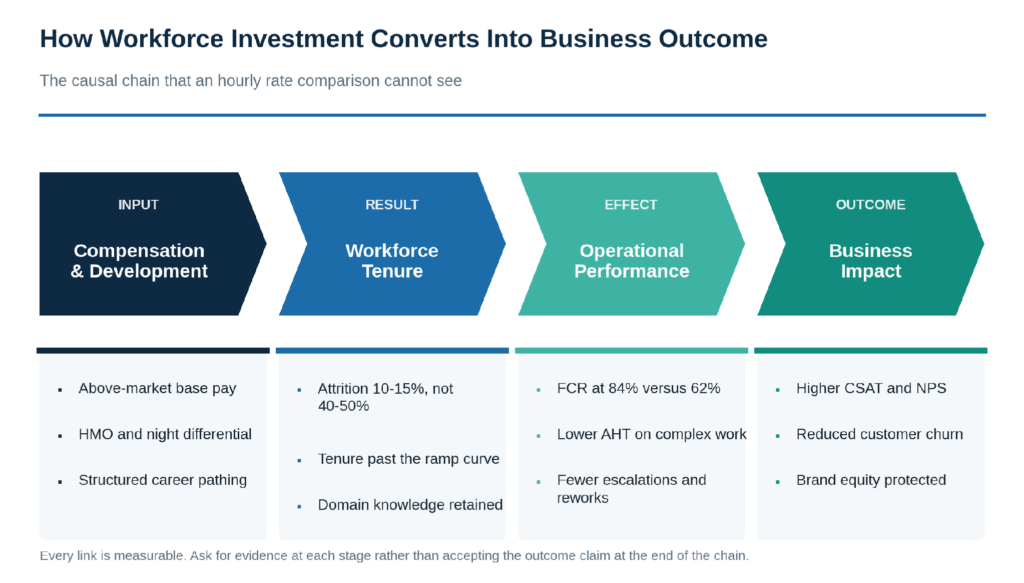
Figure 3. The causal chain from workforce investment through tenure and operational performance to business outcome.
Verify the Chain Link by Link
Each stage of that chain produces evidence a buyer can request during evaluation. Compensation is verifiable against local market benchmarks for the skill tier. Tenure is verifiable from account-level attrition data at 90 days and 12 months. Operational performance is verifiable from FCR, AHT, and escalation data with written definitions attached. Business impact is verifiable from CSAT and retention on comparable accounts. A provider that can only evidence the final claim has not demonstrated the chain — it has asserted the conclusion.
Competing on price alone in outsourcing is a race to the bottom that ultimately damages the client’s brand. The real competitive advantage lies in partnering with BPO providers that reinvest in top-tier talent, technology infrastructure, and operational rigor to deliver sustainable long-term value.
— John Maczynski, CEO, PITON-Global
What Compliance and Infrastructure Assurances Should Buyers Require?
Require ISO 27001 with the scope covering your site and service, a SOC 2 Type II report read for exceptions rather than cover page, PCI-DSS where card data is handled, Data Privacy Act alignment with GDPR and HIPAA obligations as applicable, and evidence of tested multi-site failover.
Compliance failures are low-probability and high-severity, which is exactly the risk profile procurement scoring tends to handle badly. The practical discipline is to treat certifications as claims requiring verification rather than as binary attributes. A certificate number establishes that something was certified; the scope establishes whether it was the operation that will run your program.
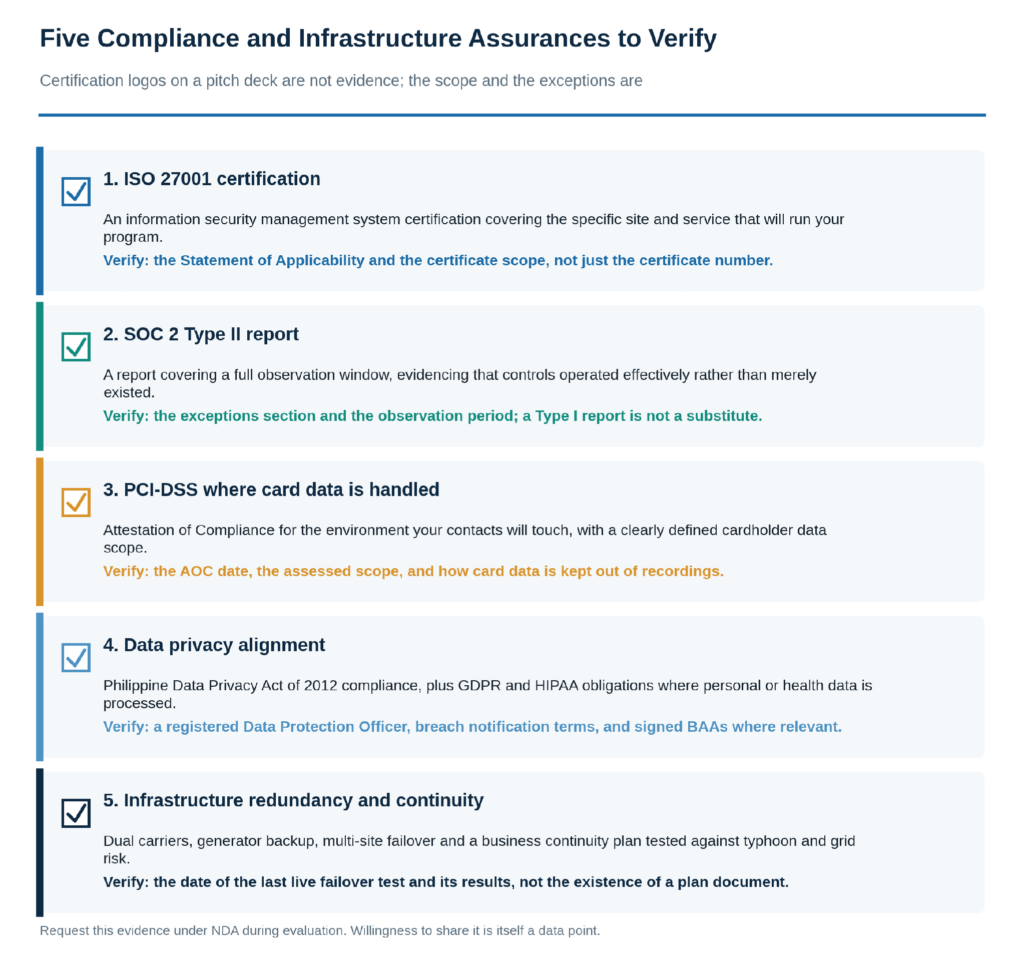
Figure 4. Five compliance and infrastructure assurances, with what to verify in each case.
Infrastructure Redundancy Deserves Equal Weight
The Philippines sits in a typhoon belt and grid reliability varies by region, so business continuity is an operational question rather than a paperwork exercise. Ask for dual carrier arrangements, generator capacity and fuel contracts, multi-site failover capability, and — the question that separates real capability from documentation — the date and result of the last live failover test. A plan that has never been exercised is a hypothesis.
How Should Buyers Measure Strategic Value and Business Impact?
Score vendors across four weighted dimensions rather than on rate alone: commercial terms, operational capability, compliance and continuity, and strategic impact measured through customer lifetime value, churn, and revenue protection. Agree the weights before proposals are opened.
The shift from cost center to growth contributor happens in the measurement. A support program that raises first contact resolution reduces contact volume, and a program that resolves problems well protects renewal rates in subscription businesses where a single poor support experience is a leading churn indicator. Those effects are quantifiable if the buyer instruments them: contact-to-churn correlation, resolution time against renewal probability, customer effort score against expansion revenue. The functions where that return runs highest are set out in our comparison of shared-services outsourcing ROI by function.
Build the Scorecard Before the Bids Arrive
A defensible weighting for an enterprise CX program gives commercial terms and operational capability the two largest and roughly equal shares, with compliance and continuity and strategic impact carrying the balance — adjusted for context, but agreed and documented before proposals are opened. Weights set afterwards are weights fitted to a preferred answer, and every procurement team knows it. Publishing the criteria with the RFP also improves the bids themselves, because providers respond to what is actually being scored.
Governance Turns Evaluation Into Value
Selection is a point-in-time judgment; governance is what keeps it true. Monthly executive steering, a joint operational scorecard owned by both parties, and continuous improvement audits maintain alignment as business goals shift and give provider-led innovation and continuous improvement a formal place on the agenda. The scorecard should carry the same four dimensions used at selection, so the criteria that won the contract remain the criteria the relationship is managed against.
What Does Value-Based Vendor Selection Deliver in Practice?
A North American software company losing more than a third of its customers annually to poor technical support replaced a low-cost vendor with a specialized Philippine partner. First contact resolution rose sharply within 90 days, customer churn fell by roughly a quarter over twelve months, and agent turnover dropped to single digits.
Client Challenge
A North American enterprise software company was carrying an annual customer churn rate above a third, traced directly to technical support performance. The incumbent was a low-cost offshore vendor with agent turnover so high that the team supporting a technically complex product was perpetually in its first six months of tenure. The rate was the lowest the company had ever paid for support and the support was the most expensive it had ever been.
Vendor Selection Process
PITON-Global ran an operational assessment of the existing program and matched the company with a vetted mid-market Philippine provider with genuine SaaS domain experience and documented employee retention programs. Retention capability was treated as a primary selection criterion rather than a secondary consideration, on the reasoning that tenure is what resolves tier-2 technical contacts.
Solution Implemented
A dedicated 50-FTE technical support unit was deployed in Manila with custom tier-2 escalation pathways, performance-linked compensation bonuses for agents, and continuous workflow automation to remove repetitive handling from the queue.
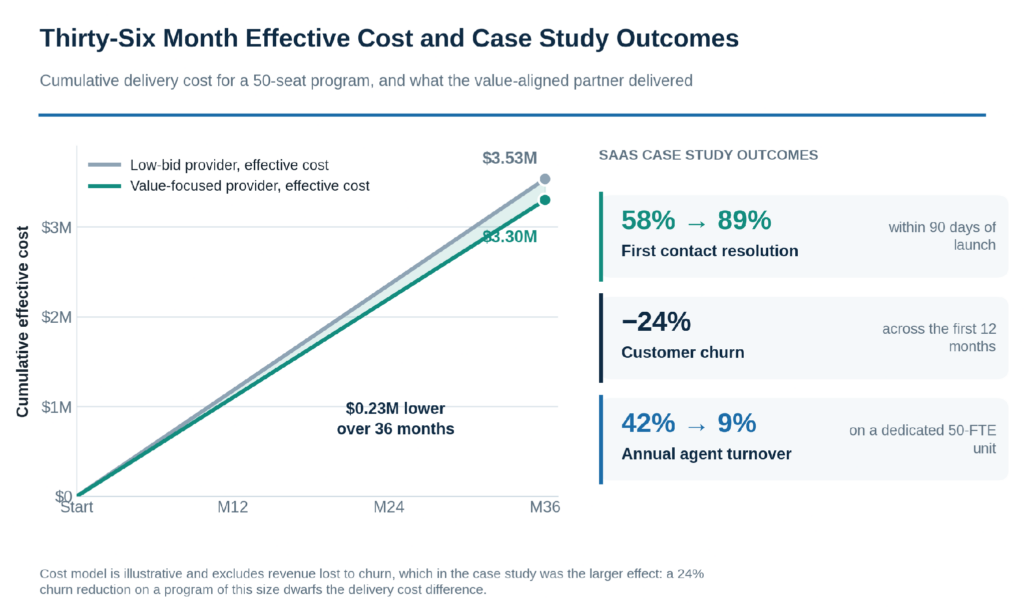
Figure 5. Thirty-six month effective delivery cost for a 50-seat program, alongside the outcomes the value-aligned partner delivered.
Outcomes and Lessons
First contact resolution rose sharply within 90 days, churn fell by roughly a quarter across twelve months, and annual agent turnover dropped to single digits. The delivery cost comparison tells only part of the story: over 36 months the effective cost difference is measured in hundreds of thousands, while a churn reduction of that size on an enterprise software base is worth considerably more. Aligning with a provider focused on talent development, quality systems, and operational maturity produces a materially higher return than selecting the lowest hourly bill rate — and the return arrives mostly on the revenue side of the ledger.
How Does PITON-Global Mitigate Risk and Accelerate BPO Provider Selection?
PITON-Global is a BPO advisory and outsourcing consultancy specializing in enterprise vendor matching across the Philippines. Rather than operating as a passive vendor directory, it acts as an independent strategic advisor to executive decision-makers through evaluation, diligence, and commercial structuring.
Who Is PITON-Global?
PITON-Global advises enterprise buyers on Philippine outsourcing across provider selection, operational diligence, and commercial structuring. Its relevance to a total-value evaluation is specific: pricing friction correctly requires knowing what attrition actually runs on comparable accounts, what local market compensation supports retention in a given hub, and which providers have the quality architecture to sustain an FCR figure rather than report one. In a market of more than 1,000 contact centers and back-office operations, none of that is visible from a rate card.
How Does PITON-Global Differ from Traditional Outsourcing Brokers?
A directory or a commission-driven broker earns when a placement happens, which narrows the recommendation set to whichever providers pay best and ends the relationship at introduction. An advisory-led model is organized around the buyer’s outcome: independent evaluation, objective recommendations that may include providers with no commercial relationship to the advisor, and continued engagement through diligence, negotiation, and governance design. On total-value work the distinction matters, because an intermediary paid on placement has no reason to report that the cheapest shortlisted provider will cost the most to run.
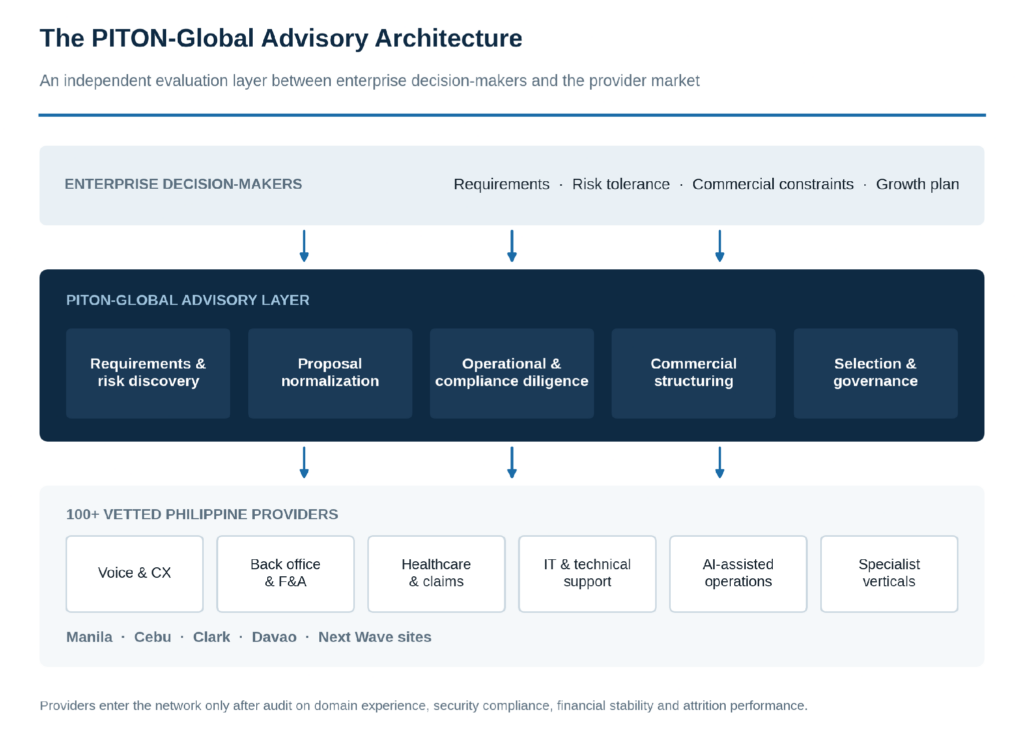
Figure 6. The PITON-Global advisory architecture connecting enterprise decision-makers to vetted Philippine providers across service domains.
How Does PITON-Global’s Network of 100+ Vetted Philippine BPO Providers Benefit Organizations?
The network spans audited providers across voice and CX, back office and finance, healthcare and claims, IT and technical support, AI-assisted operations, and specialist verticals in Manila, Cebu, Clark, and Davao. Because candidates are pre-assessed on domain experience, security compliance, financial stability, and attrition performance, buyers start from a shortlist that could realistically deliver the program. Qualification compresses from months to weeks, and the comparison begins from a field where the outcome differences are meaningful rather than a field where several bidders would fail diligence.
How Does PITON-Global’s Advisory-Led Vendor Matching Process Work?
Matching runs from requirement definition to selection support. Technical requirements, security compliance standards, regional talent availability, and cultural fit are documented; the vetted network is filtered against them; competing proposals are restated onto one fully loaded basis so friction costs can be modeled rather than assumed; shortlisted providers are validated on attrition history, quality architecture, continuity planning, and reference performance; and the buyer is supported through negotiation, commercial structuring, and the governance cadence that follows signature.
Why Do Organizations Use PITON-Global?
- Reduced outsourcing risk. Independent diligence on delivery capability, compliance posture, and attrition history surfaces problems while there is still leverage to act.
- Accelerated selection timelines. A streamlined procurement framework shortens provider selection cycles without shortening the diligence itself.
- Improved provider fit. Objective matching on technical requirement, security standard, talent availability, and corporate culture rather than on rate.
- Commercial protection. Support in structuring terms that hold the provider to the outcomes the evaluation was based on.
- Better long-term outcomes. Engagement continues through transition and governance, where selection decisions are actually tested.
Frequently Asked Questions
Why is hourly rate a misleading metric when selecting a BPO partner?
Hourly rate excludes the costs the buyer absorbs: repeat contacts, retraining driven by attrition, additional management oversight, and revenue lost to churn caused by poor service delivery. A rate far below market can still run more expensive on delivery cost alone, before any revenue effect is counted.
How do Philippine BPO providers maintain higher workforce stability?
Through above-market salary packages, HMO coverage, night differential paid correctly, modern facility amenities, structured career progression, and workplace culture. The measurable proxy is tenure mix: ask what proportion of the agents on comparable accounts have passed twelve months.
What security certifications should enterprise buyers require from an outsourcing vendor?
ISO 27001 and SOC 2 Type II as a baseline, PCI-DSS where card data is handled, and demonstrated adherence to applicable privacy regimes including the Philippine Data Privacy Act, GDPR, and HIPAA. Verify the scope of each certification covers the specific site and service, and read the SOC 2 exceptions.
How does vendor location within the Philippines affect total value?
Tier-1 hubs such as Metro Manila offer the deepest specialized talent pools for complex technical and regulated work. Tier-2 hubs like Cebu and Clark provide cost efficiency and lower competition for talent, which often translates into better retention on programs that do not require a narrow skill profile.
What role does governance play in maximizing total vendor value?
Structured governance — monthly executive steering, a joint operational scorecard, and continuous improvement audits — maintains strategic alignment, accountability, and innovation over the life of the agreement. Without it, the criteria that won the contract quietly stop being the criteria the relationship is managed against.