

Leading Philippine BPOs are reskilling front-line agents into specialized “AI Pilots” built on three traits — Adaptability Quotient, Prompt Literacy, and premium Emotional Intelligence. This systemic upskilling compresses legacy multi-tier support into hybrid, human-in-the-loop workflows — the model behind AI tooling inside a managed offshore program — letting enterprises deploy agentic AI safely while mitigating hallucination risk: the shift from labor arbitrage to intelligence arbitrage.
For three decades, the Philippine outsourcing pitch was simple arithmetic: rent skilled labor at a fraction of Western cost. In 2026 that math no longer impresses enterprise buyers. As agentic AI autonomously absorbs up to 80% of routine data entry and Tier-1 tickets, the script-following agent is effectively obsolete. The providers that win are retraining their people to supervise machines rather than compete with them — selling intelligence, not headcount.
What Are the Core Pillars of the 2026 BPO Talent Profile?
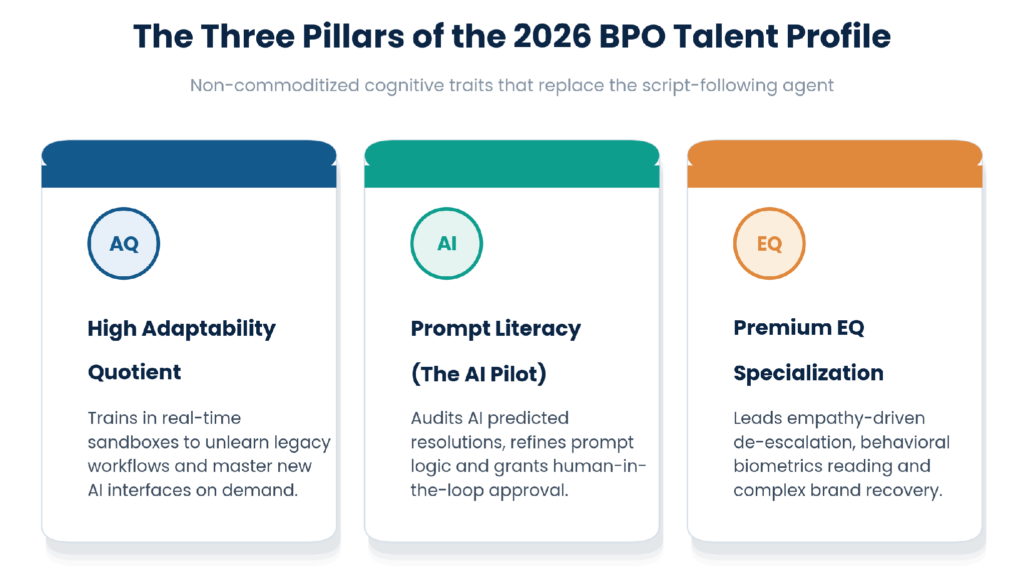
Three non-commoditized cognitive traits: a high Adaptability Quotient (AQ) to master fast-changing AI tools, Prompt Literacy to audit and refine AI “predicted resolutions,” and premium Emotional Intelligence (EQ) for the intense, high-stakes conversations that escalate past automation. Together they define the “AI Pilot” that replaces the legacy script-follower.
PITON-Global’s 2026 AI Talent Readiness Index (ATRI) finds progressive providers building hiring and training around three traits machines cannot commoditize. A high Adaptability Quotient matters because enterprise LLMs and their software layers update dynamically, so agents train in real-time simulation sandboxes to unlearn legacy workflows and master new interfaces on demand. Prompt Literacy turns front-line talent into supervisors who receive AI-predicted resolutions, audit them for hallucinations, refine the prompt logic, and grant human-in-the-loop approval. And because automated guardrails strip out the easy inquiries, the conversations that remain are roughly 2.5 times more intense — making premium EQ, empathy-led de-escalation, and complex brand recovery core curriculum rather than optional polish. The net effect is a role that looks less like a call-center seat and more like a junior systems operator — part editor, part quality auditor, part empath — a shift traced in our look at where AI is taking call centers.
How Has the Tiered Customer Support Matrix Evolved?
The legacy L1/L2/L3 architecture has collapsed. Automated systems now absorb the structural volume, pushing human talent upward into supervisory, analytical, and system-optimization roles — AI Quality Auditors, AI Pilots, and Technical Architects. The shift is also geographic, with Metro Manila concentrating on Tier-3 architecture and Next-Wave Cities scaling Tier-2 hybrid work.
Automated systems ingest the structural volume, forcing human talent to move vertically rather than horizontally. Tier-1 hubs such as Metro Manila and Bonifacio Global City concentrate on advanced Tier-3 technical architecture, while Next-Wave Cities — Cebu, Clark, Iloilo, and Davao — rapidly scale Tier-2 hybrid environments, fueled by an influx of tech-literate university graduates.

How human roles, performance impact, and geographic focus realign across the new support tiers.
The performance gains are not incremental. Automation sharply cuts the cost of simple transactional tickets, hybrid AI Pilots markedly accelerate Mean Time to Resolution, and expert architects resolve complex Tier-3 business issues at a high success rate. At every level, the human role climbs the customer experience value chain rather than competing with the machine for volume. For buyers, the practical signal is that a provider’s raw headcount reveals little; what matters is how its people are distributed across this vertical stack.

In 2026, if you are still purchasing headcount, you are acquiring a structural liability. Forward-looking brands are sourcing Intelligence Arbitrage. A single, highly trained AI Pilot in Manila, backed by advanced agentic workflows and certified in SOC 2 Type II compliance environments, yields the operational output of five legacy agents from 2022 — while driving down data-processing costs.”
— John Maczynski, CEO of PITON-Global
How Did a Fintech Firm Scale Tier-2 Operations Through Upskilled Talent?
When a North American fintech hit a bottleneck in complex loan disputes, PITON-Global matched it to a specialized, IBPAP-certified Manila provider and embedded ten AI Pilots over three phases. Within 90 days, operational overhead fell substantially, reconciliation time dropped from 48 hours to 4.5 minutes, and turnover hit zero across two quarters.
Rather than throwing bodies at the problem, PITON-Global mapped the client to a specialized boutique provider from its network of more than 100 premium Philippine centers — one that had already integrated an AI Pilot upskilling curriculum certified by the IT and Business Process Association of the Philippines (IBPAP). The rollout unfolded in three deliberate phases.

Custom Action-Adapters were installed on the firm’s legacy green-screen systems to translate unstructured data into clean LLM inputs; ten specialized Philippine AI Pilots were embedded to manage, audit, and optimize automated outputs; and strict human-in-the-loop guardrails capped autonomous restitution at a small fixed dollar threshold, pausing any larger valuation for manual logic review by a Manila-based supervisor.
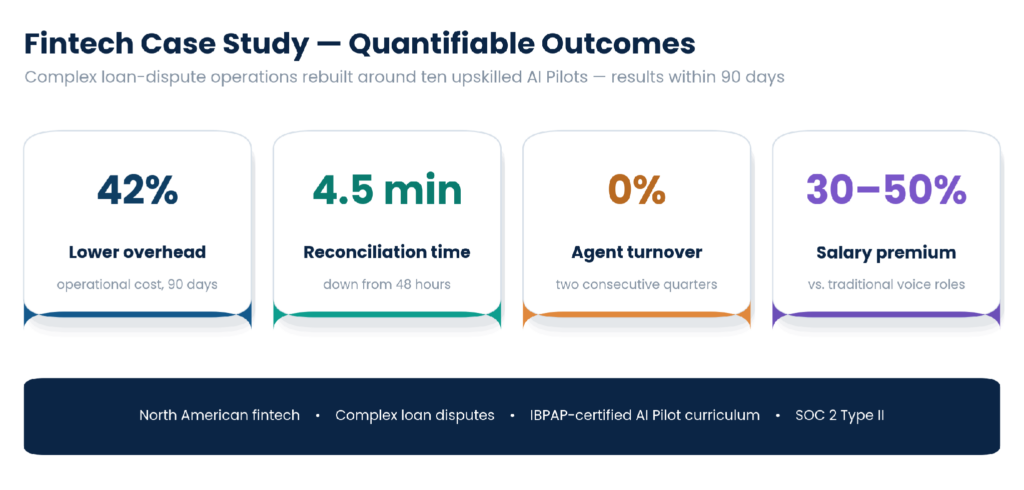
The outcomes compounded quickly. Beyond the cost and speed gains, the program recorded zero turnover across two consecutive quarters — a direct consequence of AI-certified roles now commanding a clear salary premium over traditional voice jobs, which fuels exceptional career velocity and operational continuity. Stability, in other words, is not a soft metric — it compounds directly into data consistency, faster resolution, and lower total cost.
What Should Enterprise Buyers Take Away?
Stop buying seats and start buying capability. Audit a provider’s training curriculum, certifications, and the guardrails governing autonomous action rather than its hourly rate. In a market where one upskilled AI Pilot can do the work of five legacy agents, intelligence arbitrage is becoming the only arbitrage that matters.
The unit of value has changed. Counting seats now measures the wrong thing; the better question is how much intelligence — human and machine combined — a partner can bring to bear on a problem. Providers that have rebuilt their talent around adaptability, prompt literacy, and premium emotional intelligence are not simply cheaper; they are the ones pulling ahead as agent-assist and automation reset offshore service metrics. They are structurally faster, more compliant, and more resilient — and that, not the hourly rate, is what now separates a 2026 partner from a legacy vendor.