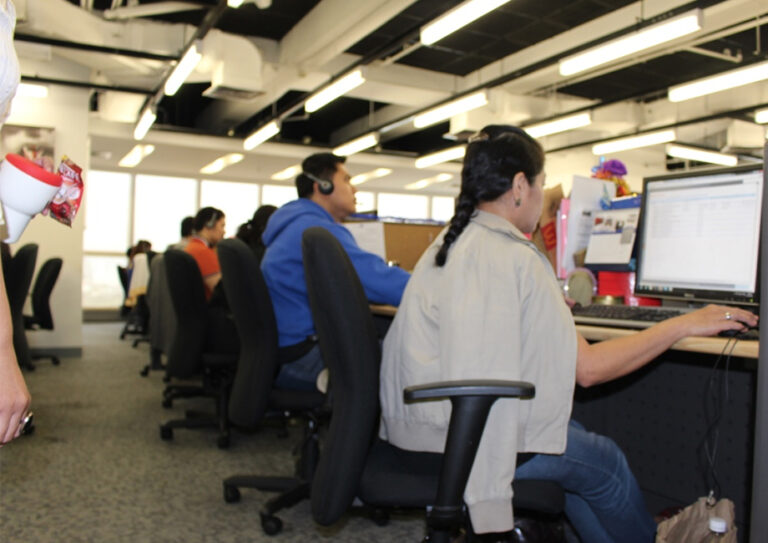

As of June 2026, Philippine call centers charge roughly $8–$18 per hour fully loaded for English-language voice agents, versus $25–$45 in the US—a 60–70% saving. Rare-language support (e.g., Japanese) can reach ~$32. Dedicated agents run about $1,200–$2,500 per month, and hourly billing is increasingly giving way to outcome-based, per-resolution pricing. To see the fully loaded number for your own function, headcount and coverage, run the live pricing calculator yourself.
Key takeaways
- The headline number: $8–$18/hr fully loaded for English voice agents in 2026 (about $1,200–$2,500/month per dedicated FTE)—roughly 60–70% below US rates of $25–$45/hr. Rare-language and specialized roles run higher.
- Price is driven by service type and location: Routine front-office voice sits at the low end; specialized back-office work (finance, IT, healthcare) runs higher; and provincial sites cost materially less than Metro Manila.
- “Fully loaded” is the only number that matters: A headline rate is only about half salary; the rest is statutory benefits, facilities, technology, and management. Always compare all-in, not base.
- Hourly pricing is being replaced: As agentic AI lifts agent productivity 2–4x, the market is shifting from per-hour and per-FTE to outcome-based, per-resolution pricing.
How Much Do Philippine Call Centers Charge In 2026?
For English-language voice customer service, expect the mid-2026 headline range above—fully loaded, whether billed per hour or per dedicated agent per month—which sits well below onshore US rates. The exact figure turns on five levers: the pricing model, the service type, the location, the vendor’s specialization, and the contract volume.
The Philippine IT-BPM sector is on track for roughly 1.97 million workers and about $42 billion in revenue in 2026, and it remains the default home for English-language voice work. Rates have crept up with wage inflation but still deliver 60–75% savings versus onshore. Average annual attrition of 30–40% is the main quality variable to manage. Before comparing quotes, understand the five pricing models you will encounter:
| Pricing model | How it works | Typical 2026 PH rate | Best for |
| Per hour (FTE time) | You pay for agent time, used or idle | $8–$18/hr fully loaded (voice) | Ramping or variable volumes |
| Per dedicated FTE (monthly) | Flat monthly fee per agent | $1,200–$2,500/month | Steady, predictable workloads |
| Per minute | You pay for talk/handle time | ~$0.02–$0.10/min (+ telco) | Spiky inbound volumes |
| Per transaction / ticket | You pay per unit of work resolved | ~$2–$6 per call; $5–$15 per IT ticket | Measurable, repeatable tasks |
| Outcome / per resolution | You pay per resolved interaction | ~$1–$2 (AI-assisted) | High-volume tier-1 with AI |
Per-FTE, per-minute, and per-ticket ranges reflect 2026 BPO pricing analyses; outcome-based pricing is covered in detail below.
One lever buyers often miss is the vendor itself. For a comparable seat, a domain-specialized BPO typically bills a modest hourly premium over a generalist vendor—but that premium usually buys lower attrition, higher first-contact resolution, and faster ramp, so the specialist often costs less per resolved interaction despite the higher rate—and its knowledge management discipline is usually what keeps resolution high as agents rotate.
What’s Actually Inside The Rate? (The Fully-Loaded Cost Build-Up)
A typical fully-loaded voice seat is roughly half direct salary; the rest is statutory benefits, facilities and technology, and management and provider margin. When a vendor quotes a low “base” rate, the other half reappears later—so always insist on the fully-loaded number.

The statutory layer alone is significant: in 2026, employers contribute roughly 8.5% (SSS), 4.5% (PhilHealth), and 2% (Pag-IBIG), plus a prorated 13th-month pay (about 8.3%)—and Philippine law mandates a night-shift differential of at least 10% (top BPOs pay 15–20%) for US-time-zone work. Facilities and technology cover secure office space, virtual desktops, fiber redundancy, and 24/7 power backup; management covers HR, QA, training, compliance, and the provider’s margin. This is why a $7 “base” quote and a $14 “all-in” quote can describe the same seat: only the all-in number is comparable.
How does price vary by service type — front office, back office, or specialized?
Routine English front-office voice is cheapest; senior English voice sits toward the top of the headline range; rare-language support (e.g., Japanese) can command a steep premium well above it; non-voice and routine back-office (chat, email, data entry) prices at or just below entry-level voice; and specialized knowledge work (finance and accounting, IT helpdesk, healthcare, BFSI) runs materially higher because the skills are scarcer.
The Philippines is no longer just a voice destination: non-voice work now accounts for roughly half of the market, spanning chat and email, data entry, content moderation, finance and accounting, IT, healthcare, and digital marketing. Pricing tracks complexity and the scarcity of the skill—a content-moderation seat is not priced like a licensed-accountant or registered-nurse-adjacent role. Language is its own premium: bilingual agents typically cost substantially more than English-only peers, and scarce languages such as Japanese push fully-loaded rates to the top of the market. Use this as a planning guide:
| Service type | Examples | Typical 2026 PH rate (fully loaded) |
| Front office – English voice (entry) | Inbound customer service, order status, basic support | $8–$12/hr |
| Front office – English voice (senior) | Complex support, retention, sales, team leads | $13–$18/hr |
| Multilingual / rare-language voice | Japanese, Korean, Mandarin, German, French support | $18–$32/hr |
| Non-voice / back office (routine) | Chat & email, data entry, content moderation | $8–$10/hr |
| Specialized / KPO | Finance & accounting, IT helpdesk, healthcare, BFSI | $14–$25+/hr |
How Does Location Affect Price — Metro Manila Vs The Provinces?
Metro Manila is the most expensive hub (deepest talent, highest attrition). For comparable work, provincial sites cost materially less—with often better retention and disaster resilience. For a 50-agent voice program, that differential compounds into six-figure annual savings simply by basing outside Metro Manila.
Location is one of the biggest single levers on price. Metro Manila—Makati, BGC, Ortigas, Quezon City—offers the deepest talent pool and the most mature infrastructure, and is best for complex or executive work, but carries the highest rates and the most job-hopping. Secondary cities trade a little talent depth for lower cost and better retention.
| Location | Island group | Cost vs. Metro Manila | Notes |
| Metro Manila (Makati, BGC, QC) | Luzon | Baseline (highest) | Deepest talent; complex work; highest attrition |
| Clark (Pampanga) | Luzon | ~10–15% lower | Scalable, disaster-resilient, near Manila |
| Cebu | Visayas | ~10–15% lower | IT & multilingual; strong pipeline |
| Davao | Mindanao | ~10–15% lower | Voice; lower attrition; resilient |
| Iloilo / Bacolod | Visayas | ~10–15% lower | Next-wave; voice & back-office |
Incentives sharpen the picture further: under the CREATE MORE Act (RA 12066), registered enterprises benefit from a reduced corporate income tax rate and may run a substantial share of seats work-from-home without losing incentives—useful for distributing teams across lower-cost provinces.
What hidden fees should I watch for?
Beyond the hourly rate, scrutinize setup/onboarding fees, contract minimums and early-termination penalties, idle-time billing, recruitment and ramp-up charges, technology/tools fees, attrition-replacement costs, and how 13th-month pay, night differential, and currency are handled. A transparent provider folds these into one fully-loaded rate.
- Setup & onboarding: Some vendors charge a one-time fee; it is often waived on negotiation.
- Minimums & termination: 90–120-day minimum terms are common, with early-exit penalties tied to remaining contract value.
- Idle-time billing: Per-hour and per-FTE models bill for staffed time regardless of volume.
- Statutory “extras”: 13th-month pay and Service Incentive Leave should be in the all-in rate — not billed as a December surprise.
- Night differential: The statutory night premium for US-hours coverage should be priced in, not added later.
- Attrition & FX: Confirm who absorbs replacement/retraining cost; most 2026 contracts are USD-pegged to protect the client.
Why Is Hourly Pricing Being Replaced By Outcome-Based Pricing?
Because agentic AI breaks the logic of the billable hour. When AI lifts agent productivity 2–4x, paying by the hour means the faster your partner resolves issues, the less they earn—a tax on the very efficiency you want. The market is shifting to per-resolution and per-outcome pricing, where you pay for results, not seat-time.
This is the most important pricing story of 2026. Under hourly billing, every efficiency a BPO gains from AI investment cuts its own revenue—what industry leaders call the “efficiency paradox.” Leading agentic platforms have launched per-conversation pricing of roughly $0.99–$2.00 per fully resolved interaction, explicitly pitched against the $30-plus cost of a human-handled contact in Western markets. PITON-Global’s leadership has been among the most vocal voices arguing that “butts-in-seats” pricing is ending and that buyers should move deliberately to outcome-based contracts.
The per-resolution math
At standard Philippine hourly rates and a typical handle time, a human-handled contact costs a few dollars per resolved interaction. The same interaction handled by an AI agent supervised by a Filipino “AI Pilot” can cost a fraction of that—the “intelligence arbitrage” model profiled in our 2026 strategic intelligence index. In one reported deployment, tier-1 resolution rose sharply and cost per resolved interaction fell by roughly three-quarters within 180 days.
The practical implication for buyers: if a prospective partner only quotes per-hour or per-FTE for high-volume, repeatable tier-1 work, that can signal underinvestment in AI—and you pay for it every month in inflated per-resolution cost. For complex, judgment-heavy, or low-volume work, hourly and FTE models still make sense; the smart 2026 contract is often a hybrid: outcome-based for routine volume, FTE for complex work.
How Do I Make Sure I’m Comparing Prices Fairly?
Normalize every quote to a fully-loaded number, then match the pricing model to the work, the service type to the skill, and the location to your cost and resilience goals. Ask what’s included, what triggers extra fees, and—for high-volume tier-1—whether outcome-based pricing is on the table. And budget for the transition itself: change management during a BPO transition is a real cost line that no rate card shows.
- All-in, not base: Confirm the rate includes statutory benefits, 13th-month, night differential, facilities, and tech.
- Model fit: FTE/hourly for complex or variable work; per-ticket or per-resolution for measurable, high-volume tasks.
- Service type & language: Price entry voice, senior English voice, rare-language/multilingual, routine back-office, and specialized KPO separately — they’re not the same rate.
- Generalist vs. specialist: Expect a domain-specialized BPO to bill a modest hourly premium over a generalist — weigh that against its lower attrition and higher resolution before judging it “expensive.”
- Location: Weigh Metro Manila’s depth against the material savings, better retention, and resilience of provincial hubs.
- Hidden fees & FX: Get setup, minimums, idle-time, replacement, and currency terms in writing.
- AI readiness: For routine volume, ask whether the partner offers outcome-based pricing — a proxy for real AI investment.
The Bottom Line
Philippine call-center pricing varies substantially—across the headline range for English voice, and well beyond it for rare languages or specialized work—because so many variables move it: the pricing model, service type, language, location, vendor specialization, and volume. But one rule holds in the large majority of cases: the rate difference is also an indication of the quality a vendor provides. A higher hourly rate usually reflects more experienced, career-oriented agents, lower attrition, better infrastructure, and stronger governance—so the cheapest quote is rarely the cheapest outcome. Judge a price against the quality it reflects and the cost per resolved interaction, not the headline rate alone.
Frequently Asked Questions
How much does a Philippine call center agent cost per hour in 2026?
As the June 2026 headline above states, roughly $8–$18 per hour fully loaded for English voice work, versus $25–$45 in the US. Entry-level voice sits near the bottom and senior near the top; rare-language support such as Japanese commands a premium, up to ~$32/hour, and a domain-specialized vendor typically adds a modest hourly premium over a generalist.
What is the monthly cost of a dedicated agent?
About $1,200–$2,500 per month for a dedicated full-time agent under an FTE model, all-in, per the June 2026 headline above. Multiply by headcount for a team budget, or use the live model on our pricing page for your exact configuration.
Is back-office or front-office cheaper?
Routine back-office (data entry, content moderation, chat/email) prices at or just below entry-level voice. Specialized back-office — finance and accounting, IT, healthcare — costs materially more, because the skills are scarcer.
How much can I save by going outside Metro Manila?
Provincial hubs run materially cheaper than Metro Manila for comparable work, usually with better retention and disaster resilience. For a 50-agent program, the differential is worth six figures a year.
Should I still pay by the hour in 2026?
For complex or low-volume work, yes. For high-volume, repeatable tier-1 work, increasingly no — outcome-based or per-resolution pricing lets you capture the efficiency of agentic AI instead of paying for seat-time.