
On this page
- Key Takeaways
- What Are the ROI Timelines by Operational Function?
- What Does the Financial Trajectory Look Like from Day 1 to Month 12?
- How Can Enterprises Accelerate Time-to-Value?
- What Does a Successful Philippine BPO Transition Look Like?
- How Does PITON-Global De-Risk Scaling and Protect Target ROI?
- Frequently Asked Questions
Positive ROI from business process outsourcing to the Philippines typically takes 3 to 6 months for transactional customer support and back-office functions. Complex, highly specialized, or enterprise-grade shared services generally reach complete capital payback and net financial surplus within 6 to 12 months, with initial setup costs amortized during the first 90 to 180 days of production.
Key Takeaways
- Break-even horizon: Initial capital outlay—vendor selection, technical integration, compliance auditing, and onboarding—is fully amortized within the first 90 to 180 days of production.
- Cost vs. productivity curves: Gross labor cost savings of 60%–70% occur on Day 1, but true operational parity and peak agent efficiency arrive around Month 4 as teams complete their learning curves.
- Primary delay factors: Misaligned operational scope, unstandardized SOPs, and weak performance governance account for 80% of ROI delays, pushing break-even timelines past 12 months.
- The advisory acceleration: Engaging a specialized BPO advisory firm bypasses prolonged procurement friction, eliminates mispricing, and shortens the path to positive ROI by 30%–50%.
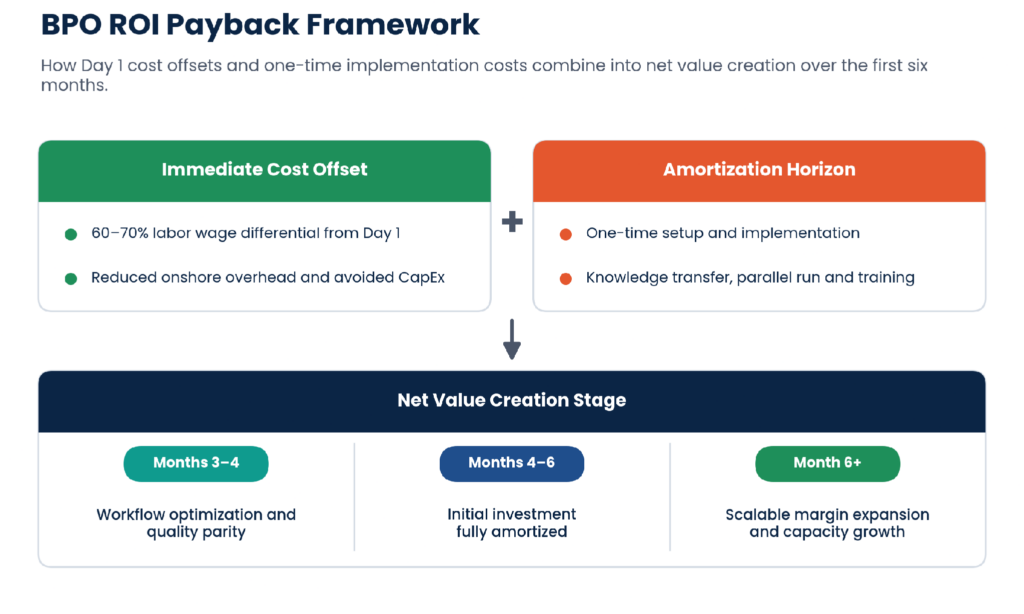
Figure 1. The BPO ROI payback framework: immediate cost offsets and the amortization horizon combine into net value creation from Month 3 onward.
What Are the ROI Timelines by Operational Function?
Tier 1 customer care and chat reach positive ROI in 3 to 4 months, back-office and accounting in 4 to 6 months, Technical Support (L2/L3) in 6 to 9 months, and enterprise shared services in 9 to 12 months. The spread is governed by three vectors: program complexity, scale, and implementation rigor.
The timeline required to achieve net-positive financial return from Philippine outsourcing depends on how much of the work is transactional, how large the program is, and how disciplined the implementation is. Transactional functions monetize the 60%–70% labor differential almost immediately because agents reach proficiency within weeks; specialized and enterprise functions carry longer training curves and heavier integration, so their payback horizon stretches even though their per-FTE savings are often larger.
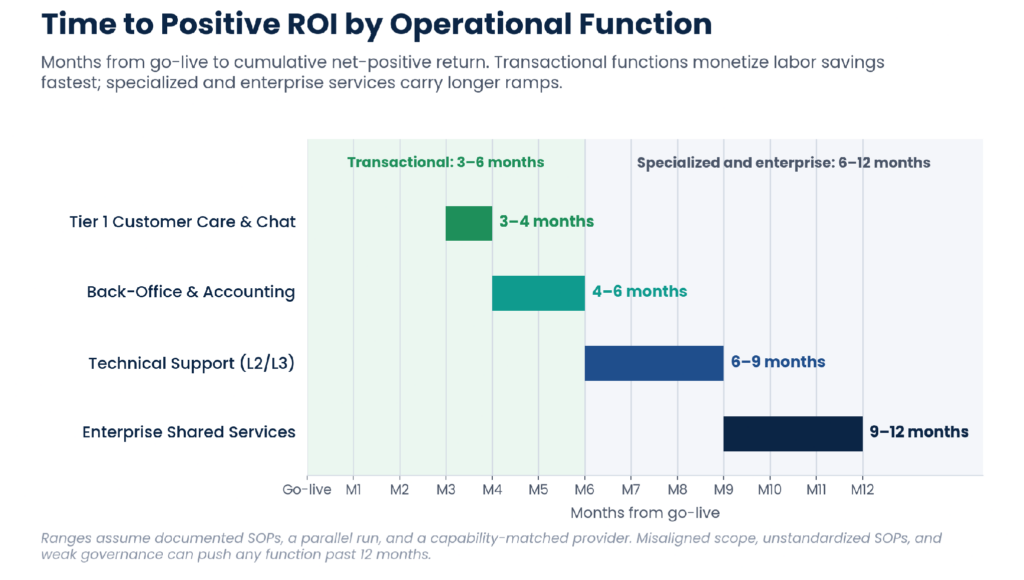
Figure 2. Time to positive ROI by operational function, in months from go-live.
Each function also has a characteristic value driver, delay risk, and efficiency metric, summarized below. Tracking the right metric from Day 1 matters because it is the earliest signal of whether the payback schedule is holding.

Figure 3. ROI timelines by operational function, with the primary value driver, delay risk, and key efficiency metric for each.
Scale compresses these timelines at the margin: a 50-seat program amortizes fixed setup costs across far more monthly savings than a 10-seat pilot. Implementation rigor—documented SOPs, a parallel run, and a governance cadence—determines whether a function lands at the front or the back of its range.
What Does the Financial Trajectory Look Like from Day 1 to Month 12?
The cash-flow curve of a Philippine BPO migration runs through four phases: net-negative onboarding and implementation in Months 1–2, operational break-even at go-live in Month 3 as the team reaches 70%–80% productivity, cumulative net-positive ROI and full capital payback in Months 4–6 at operational parity, and scalable margin expansion from Month 7 onward.
Understanding the shape of the curve lets financial and operations leaders plan capital allocation accurately: the initial outlay for setup, SOPs, technology, and the parallel run sits below the line, break-even arrives around Month 3.5 for a well-run transactional program, and the surplus compounds from there.

Figure 4. Cumulative financial net value from Day 1 to Month 12 across the four phases of a Philippine BPO migration (illustrative).
Phase 1: Onboarding and Implementation (Months 1–2)
Cash flow is net negative. Capital allocations cover vendor selection, advisory and legal work, HIPAA or other compliance audits, system integration, dual-monitored infrastructure setups, and initial agent training.
Phase 2: Go-Live and Operational Stabilization (Month 3)
Cash flow crosses the operational break-even threshold. The offshore team reaches 70%–80% of baseline productivity, and monthly labor cost savings begin offsetting initial transition expenses directly.
Phase 3: Operational Parity and Capital Payback (Months 4–6)
Cumulative net-positive ROI is achieved. Agents reach 100% operational efficiency, error rates and customer satisfaction scores equal or surpass onshore benchmarks, and all initial setup expenditure is fully amortized.
Phase 4: Scalable Value Creation and Optimization (Months 7–12+)
Cash flow reaches maximum ongoing yield and margin expansion. Operational maturity, human-in-the-loop AI pairing, and refined process workflows drive long-term profit expansion without adding fixed overhead.
How Can Enterprises Accelerate Time-to-Value?
Enterprises compress time-to-value with four levers: front-loaded knowledge capture that documents SOPs before contracting, a strict two-to-four-week hybrid parallel run that cross-validates output quality, outcome-based SLAs tied to throughput and resolution rather than billable seats, and agentic AI paired with skilled agents to raise output per FTE from Day 1. The right vendor match underpins all four.
Misaligned operational scope, unstandardized SOPs, and weak performance governance account for roughly 80% of ROI delays, and each is addressable before go-live. To minimize transition drag and reach positive yield faster, enterprise leaders should execute four operational levers.
Front-Loaded Knowledge Capture
Standardize and document Standard Operating Procedures into modular, searchable training modules before vendor contracting rather than during live transition. Programs that arrive at the provider with documented processes cut the learning curve by weeks and remove the single most common cause of a slipped payback date.
Hybrid Parallel Execution
Run a strict two-to-four-week parallel operation in which domestic and offshore teams process identical live streams, so output quality is cross-validated before full handover. The parallel run costs a few weeks of double payroll; skipping it costs quality incidents that push break-even out by months.
Outcome-Based SLAs
Structure commercial contracts around unit-level throughput and resolution metrics rather than purely billable seats or hours. When the provider is paid for resolved contacts, processed transactions, or accuracy, its incentives align with the buyer’s payback schedule from the first invoice.
Agentic AI and Human Pairing
Equip offshore teams with generative workflow tools to handle repetitive query drafting, summarization, and routing, raising baseline output per FTE from Day 1. Integrating agentic AI alongside skilled agents typically accelerates payback timelines by 20%–30%.
The biggest mistake enterprise buyers make isn’t miscalculating labor rates; it’s underestimating the operational drag of misaligned vendor selection. When you pair an enterprise account with a vendor whose operational model isn’t built for that specific complexity, your ramp-up time doubles. Getting the provider match right on day one is what compresses a twelve-month payback schedule down to ninety days.
— John Maczynski, CEO, PITON-Global
What Does a Successful Philippine BPO Transition Look Like?
A successful transition front-loads compliance and pairs the buyer with a capability-matched provider. A North American healthcare administration platform reduced cost per transaction from $18.50 to $5.80 (68.6%), lifted claims accuracy from 91% to 98.4%, compressed procurement from 180 days to 14, and reached net-positive ROI in 3.5 months against a 12-month internal estimate.
Client Challenge
A North American healthcare administration platform was hindered by escalating onshore scheduling and claims-processing expenses, with transaction costs averaging $18.50 per unit. High domestic turnover created processing backlogs, strained operating margins, and put compliance timelines at risk.
Vendor Selection
Rather than initiate a traditional six-month RFP, the organization engaged PITON-Global to streamline vendor selection. Leveraging an audited network of more than 100 Philippine BPO delivery centers, PITON-Global evaluated the operational parameters and isolated three specialized, HIPAA-compliant providers within 72 hours.
Solution Implemented
The selected provider deployed a dedicated, specialized team structure for scheduling and claims processing, with security checks and HIPAA compliance validation front-loaded before contracting rather than run alongside go-live. The benchmark summary below sets the onshore baseline against the offshore results.

Figure 5. Case study performance benchmark summary: onshore baseline versus offshore results.
Outcomes and Lessons
The program achieved complete net-investment break-even in 3.5 months. Cost per transaction dropped from $18.50 to $5.80, a permanent 68.6% operational saving; claims-processing accuracy rose from 91% to 98.4% within 120 days thanks to dedicated, specialized team structures; and front-loading security checks eliminated 45 days of compliance delays, enabling immediate operational scaling. The lesson: the 12-month payback the client had estimated assumed a conventional RFP and a generic provider, while a capability-matched provider and front-loaded compliance delivered the same savings in roughly a quarter of the time.
How Does PITON-Global De-Risk Scaling and Protect Target ROI?
PITON-Global is a specialized BPO advisory and executive sourcing firm led by global industry veterans. It delivers vendor-neutral, data-backed guidance across a pre-screened network of more than 100 Philippine delivery centers, qualifying providers on production performance, retention metrics, security compliance, and domain expertise rather than sales pitches—compressing procurement and protecting target ROI at no cost to the buyer.
Who Is PITON-Global?
PITON-Global is a specialized BPO advisory and executive sourcing firm headquartered in Manila and led by global BPO industry veterans with more than 65 combined years of outsourcing leadership. With more than 1,000 operational providers in the Philippines, vendor selection carries substantial operational risk; PITON-Global exists to remove it, delivering vendor-neutral, data-backed guidance that aligns each enterprise program with a provider built for its specific complexity.
How Does PITON-Global Differ from Traditional Outsourcing Brokers?
Generic brokers often match buyers with sales teams rather than capability-matched operations, which leads to hidden costs, poor service quality, and delayed financial returns. PITON-Global qualifies providers using production performance, historical agent retention metrics, security compliance, and domain expertise—not sales pitches—and recommends on the basis of the buyer’s outcomes rather than provider promotion, staying engaged through contracting and transition.
How Does PITON-Global’s Network of 100+ Vetted Philippine BPO Providers Benefit Organizations?
Access to pre-screened mid-market and enterprise delivery centers across Manila, Cebu, and emerging secondary hubs lets organizations skip the traditional six-month RFP. Each provider in the network has already been audited for infrastructure, security posture, retention performance, and domain specialization, so buyers can move from requirements to a qualified shortlist in days rather than months.
How Does PITON-Global’s Advisory-Led Vendor Matching Process Work?
The process runs from requirements assessment to selection support: mapping operational scope, complexity, compliance parameters, and target payback; filtering the audited network for capability match, hub, and right-sized capacity; delivering a shortlist of two to three specialized providers within 48–72 hours; verifying retention history, security certifications, and SLA track records; then supporting negotiation, outcome-based SLA design, and transition oversight.
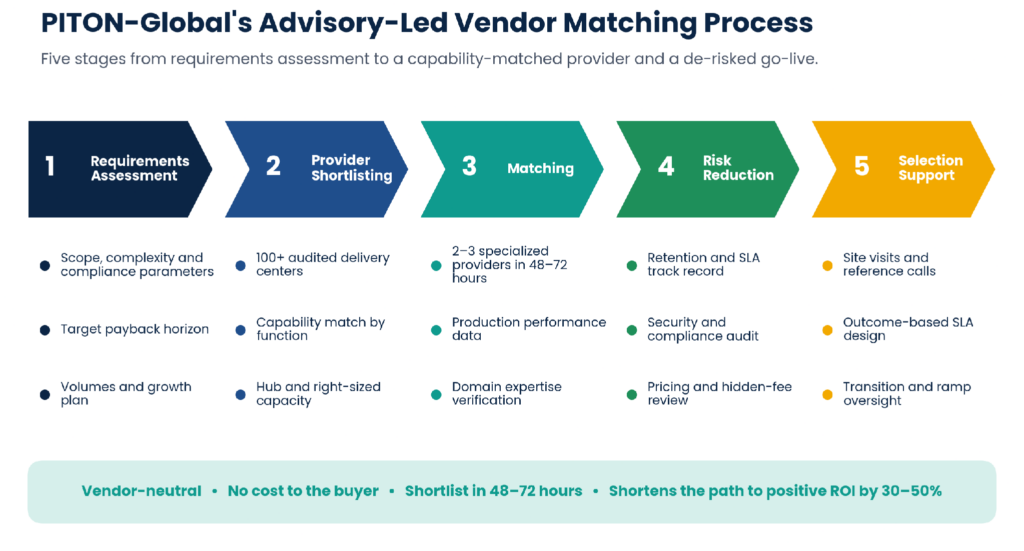
Figure 6. PITON-Global’s five-stage advisory-led matching process, from requirements to a de-risked go-live.
Why Do Organizations Use PITON-Global?
Organizations use PITON-Global to compress procurement timelines, eliminate hidden fees and mispricing, and protect target ROI by matching technical needs with proven delivery partners. Because advisory engagement typically shortens the path to positive ROI by 30%–50% and carries no cost to the buyer, it is the highest-leverage decision in the entire program.
Frequently Asked Questions
What setup costs impact the initial BPO payback timeline?
Initial expenses include advisory fees, legal and compliance audits, custom software licensing, dedicated telecom integrations, trainer onboarding, and parallel-running labor costs during transition. Together they form the capital outlay that is amortized during the first 90 to 180 days of production.
How do Philippine BPO hourly rates compare to onshore costs?
Fully loaded voice and back-office support rates in the Philippines range from $8 to $18 per hour depending on specialized skill requirements, compared with $30 to $55+ per hour for equivalent onshore positions in North America or Western Europe.
How does agent turnover affect operational ROI?
High agent turnover delays positive ROI by causing continuous retraining costs and temporary drops in throughput. Partnering with BPOs that maintain strong retention practices preserves the payback schedule.
How do AI workflows and automation impact the ROI timeline?
Integrating agentic AI tools alongside skilled offshore teams increases transaction speed and resolution accuracy, accelerating payback timelines by 20% to 30%.
What contract structure best protects project ROI?
Use clear Service Level Agreements with performance metrics, phased scaling targets, and incentives tied directly to output quality and transaction throughput rather than to billable seats alone.