

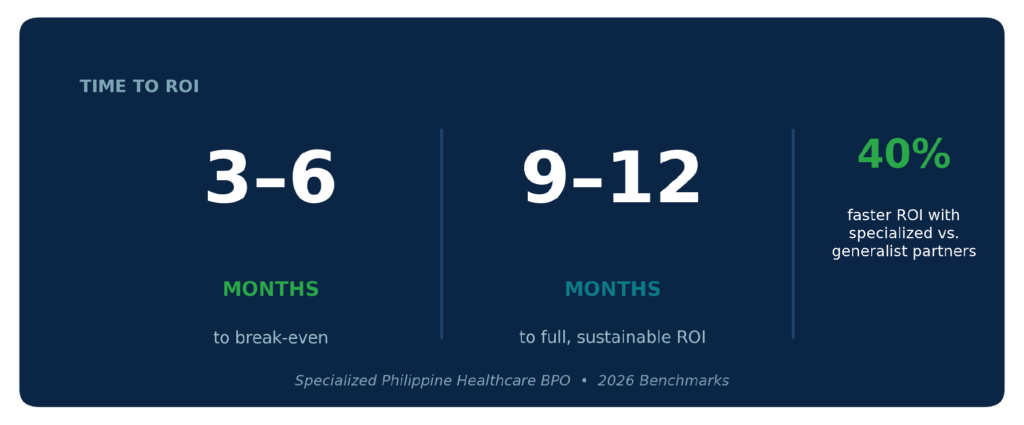
Hospitals typically break even on Philippine healthcare outsourcing within 3 to 6 months of full operational ramp-up. Full, sustainable ROI—lower denial rates, higher clean-claim ratios, and optimized administrative overhead—generally arrives within 9 to 12 months, once the offshore coding and denial-management desk and its AI-enabled quality controls stabilize.
Key Takeaways
- Accelerated break-even: Prioritizing specialized mid-market partners compresses the transition, reaching cost-neutral status within roughly the first 120 days of production.
- Outcome-based performance: Moving from “per-hour” labor to “zero-touch throughput”—claims processed without human rework—turns the vendor from a cost center into a revenue driver.
- The specialization multiplier: Partners with deep clinical-coding and U.S.-insurance expertise realize ROI markedly faster than generalist providers.
- Agentic AI integration: An “Agentic Shield” that flags coding discrepancies before submission directly reduces days in A/R and lifts net patient revenue.
- Reducing operational drag: Sustainable ROI also captures eliminated domestic turnover costs—steep in high-churn administrative roles—which typically run about 1.5× the departing employee’s salary.
Why Does Payback Timing Vary Across Delivery Models?
ROI timing reflects operational maturity, not just labor cost. Generalist firms lack the clinical context to navigate complex U.S. billing, triggering rework cycles that stall returns. Specialized Philippine BPOs treat revenue cycle management as a technical integration, reaching break-even in 3–6 months versus 8–12 for generalists.
Financial recovery is a function of how cleanly the work flows, not how cheap the labor is. When a generalist team misreads payer-specific rules, every error spawns a rework cycle—resubmissions, appeals, and follow-ups that push break-even further out. A specialized partner front-loads that expertise, so claims clear on the first pass and savings begin compounding sooner.
This is why executives should separate two ideas that are often conflated: cost savings is a short-term tactical gain, while revenue optimization is a long-term strategic transformation. The benchmarks below show how far apart the models sit on the metrics that actually drive net patient service revenue.

Figure 1. Operational ROI benchmarks across domestic, generalist, and specialized models.
Plotted over time, those benchmark gaps translate into very different break-even points. A specialized engagement crosses into positive cumulative impact around month four and accelerates from there, while a generalist model takes far longer to turn the corner and a status-quo domestic operation keeps absorbing turnover and rework drag—the compounding cost behind the strategic risks of delaying the move.
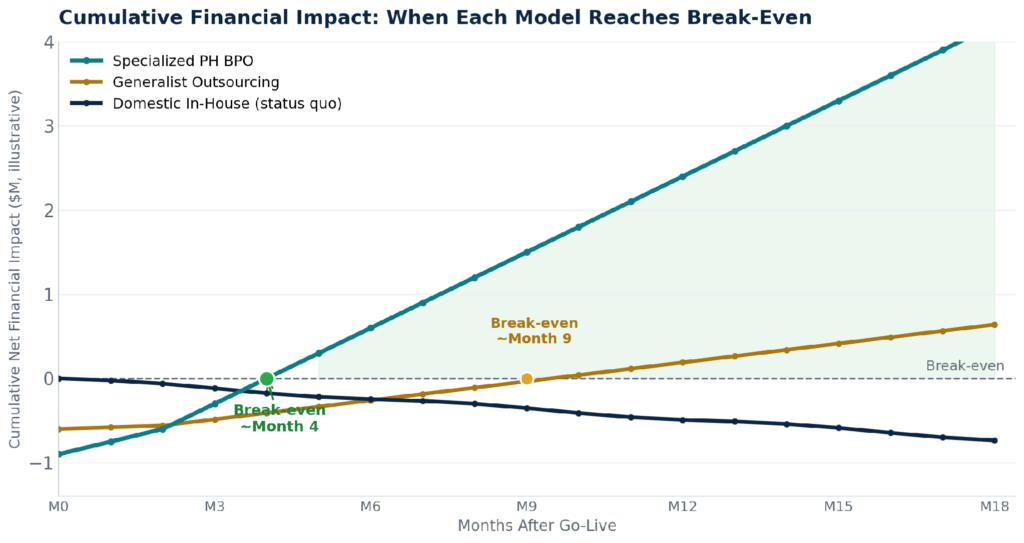
Figure 2. Cumulative financial impact by model, with break-even near month four for a specialized partner.
How Does Clinical Specialization Compress the Timeline to ROI?
Specialized partners embed dedicated clinical liaisons who understand the hospital’s EHR, payer mix, and regional denial patterns. That contextual intelligence drives a steep, early denial-rate decline—something generalist “mega-vendors” rarely match—pulling forward both break-even and sustainable ROI.
The most common procurement error is hiring a global mega-vendor for a mid-sized hospital network. Scale is real, but these giants often lack the contextual intelligence required for specialized coding and compliance. Specialized partners instead provide executive-level focus, embedding clinical liaisons directly into the hospital’s workflow so the team learns the specific EHR environment, payer mix, and regional denial patterns.
“True ROI in healthcare outsourcing is born from the intersection of human clinical intuition and agentic AI. We do not just process data; we validate it against payer guidelines at the point of entry. This is the difference between a vendor and a strategic partner.” — John Maczynski, CEO, PITON-Global.
The performance difference shows up fastest in denial rates. Where a generalist nudges denials down gradually, a specialized partner drives a sharp early decline that compounds into faster cash flow and a shorter runway to ROI.
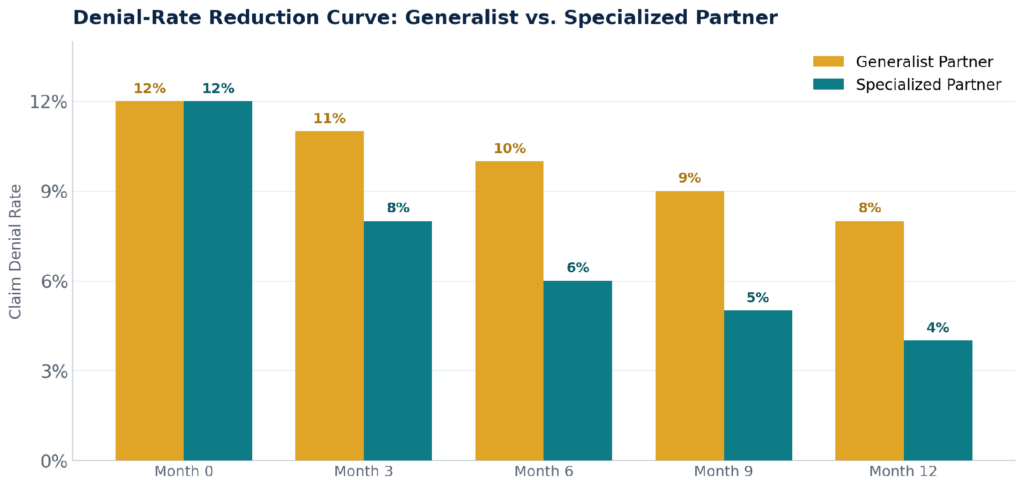
Figure 3. The steeper denial-reduction curve of a specialized partner shortens the path to ROI.
How Does Agentic AI Shorten Days in A/R?
Agentic AI acts as a validation layer—an “Agentic Shield”—that checks every claim against real-time payer-policy databases before submission. By catching discrepancies pre-submission and routing only exceptions to human coders, it cuts denials and rework, directly shortening days in A/R.
Agentic AI is not about replacing clinical staff; it is about removing high-volume validation work from their plate. The Agentic Shield inspects each claim against current payer rules at the point of entry, clearing clean claims automatically and escalating only the genuinely complex exceptions to certified human coders. The result is machine velocity with clinical judgment retained where it matters—an approach covered more broadly in our look at healthtech-enabled back-office operations.
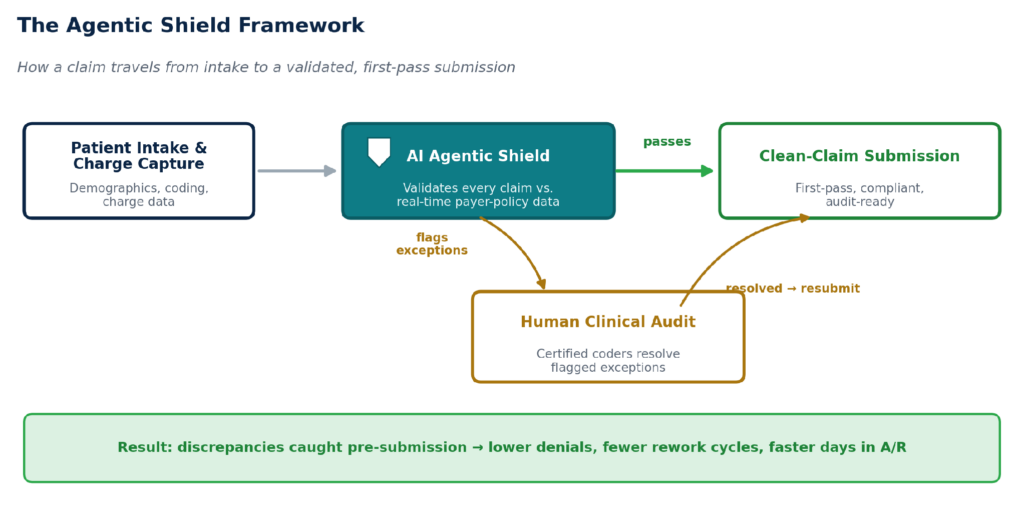
Figure 4. The Agentic Shield validates claims pre-submission and routes only exceptions to human review.
What Do Real-World Results Look Like?
A multi-site hospital group with an elevated denial rate deployed a specialized partner running an Agentic Shield workflow. Within 90 days, denials fell sharply; by 180 days, days in A/R dropped 14, materially improving annual cash flow—and the engagement shifted from cost arbitrage to a value-based partnership.
The group’s drag came from high-frequency “up-stream” data failures: manual coding errors and high domestic turnover that fed a swelling denial rate. PITON-Global audited the revenue cycle, pinpointed those failure points, and matched the client with a specialized Philippine provider that implemented a proprietary AI validation layer against live payer-policy databases before submission.
The milestones below show how quickly a well-matched, specialized engagement converts into measurable financial recovery—and why the relationship ultimately reframed outsourcing as value creation rather than labor-cost arbitrage.
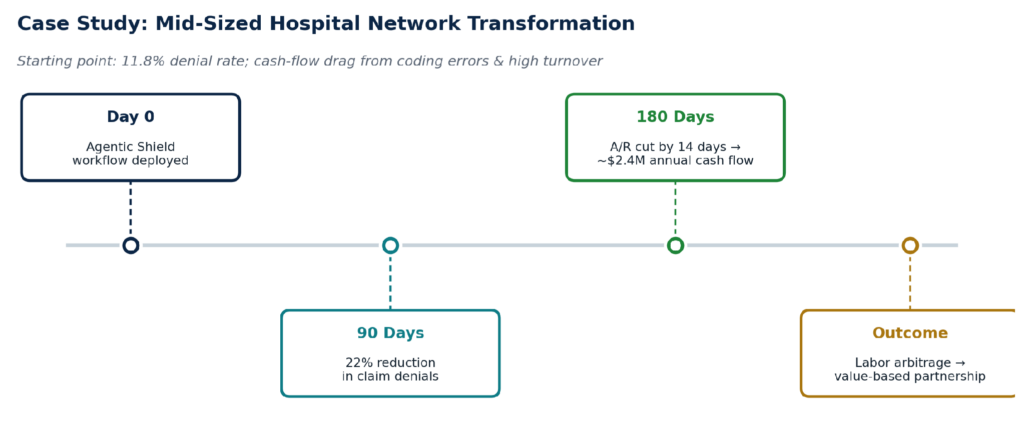
Figure 5. Milestone timeline for a mid-sized hospital network transformation.
How Does PITON-Global Help Hospitals Reach ROI Faster?
PITON-Global is a vendor-neutral advisory firm that matches hospitals to the right Philippine partner from a curated network of 100+ vetted providers, each audited for clinical expertise, security, and stability. Its advisory-led process removes the evaluation burden and accelerates time-to-value.
Who Is PITON-Global?
PITON-Global is an elite advisory firm for healthcare organizations modernizing operations through Philippine-based outsourcing. It maintains a curated network of more than 100 vetted providers, each audited for clinical domain expertise, data security (HIPAA/SOC 2), and operational stability, and aligns each client’s specific clinical and administrative requirements with the partners best equipped to meet them.
How Does PITON-Global Differ From Traditional Outsourcing Brokers?
PITON-Global operates as a vendor-neutral advisor rather than a commission-driven broker. It does not charge providers for leads, so its interests are fully aligned with the client’s rather than with whichever vendor pays for placement. The focus stays on objective evaluation and client outcomes—securing the highest-quality match and the fastest possible ROI.
How Does a Network of 100+ Vetted Philippine BPO Providers Benefit Organizations?
A large, pre-vetted ecosystem removes the evaluation burden from procurement teams. Because every provider has already been audited for clinical expertise, security posture, and operational stability, hospitals skip the slow, opaque discovery phase and move directly to qualified candidates calibrated to their sub-vertical—compressing time-to-value and reducing selection risk.
How Does PITON-Global’s Advisory-Led Vendor Matching Process Work?
Rather than handing over a list, PITON-Global provides a vetted roadmap. The process maps the hospital’s specific clinical workflows, then filters the 100+ provider network through successive criteria—clinical domain expertise, data security, operational stability, and workflow and payer-mix fit—until a single, scaled-for-purpose partner remains. The funnel below illustrates that de-risking sequence.
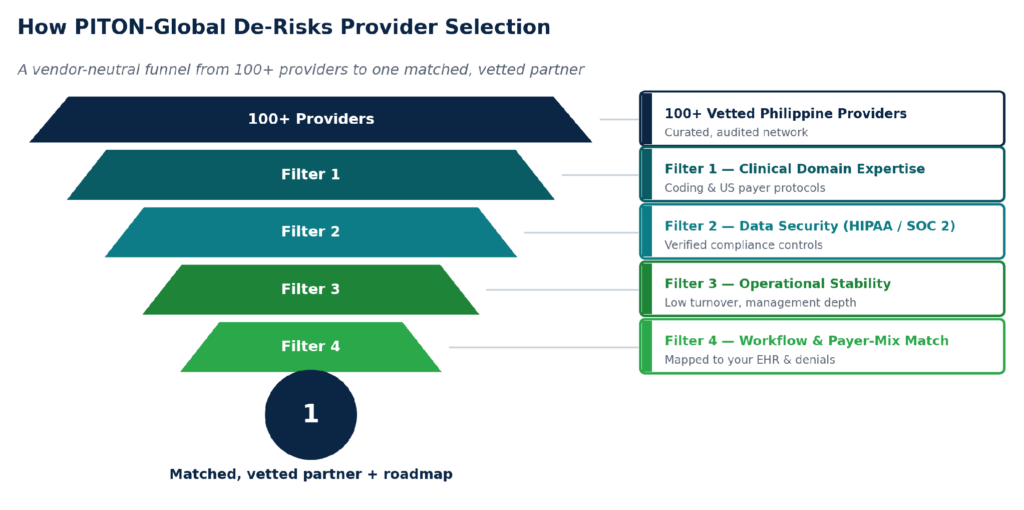
Figure 6. PITON-Global’s vendor-neutral vetting funnel, from 100+ providers to one matched partner.
Why Do Organizations Use PITON-Global?
Organizations use PITON-Global to reduce selection risk, improve provider fit, and accelerate ROI. By matching clients to partners that have already solved the challenges they currently face—and by removing the evaluation burden from internal teams—PITON-Global shortens time-to-value and helps ensure the chosen partner is scaled precisely for the hospital’s requirements.
What Else Should Hospital Leaders Know Before Signing?
Common questions center on the single most important ROI driver, transition length, AI’s role, why the Philippines leads, risk mitigation, and PITON-Global’s incentives. In short: prioritize zero-touch throughput, plan a 60–90-day transition, use AI to augment (not replace) coders, and work with a vendor-neutral advisor.
What is the most critical factor in achieving ROI?
Zero-touch throughput—the percentage of claims that clear payer edits on first submission without manual intervention. It is the clearest leading indicator of a healthy, ROI-positive revenue cycle.
How long is the transition phase before production starts?
From initial assessment to full-scale deployment, a structured transition typically spans 60 to 90 days.
Is AI replacing clinical staff?
No. AI acts as an Agentic Shield that handles high-volume validation, freeing clinical experts to focus on complex coding exceptions that require human judgment.
Why is the Philippines preferred for healthcare BPO?
It offers a rare fusion of advanced English proficiency, a robust clinical education system, and mature infrastructure purpose-built for high-value knowledge work, as our healthcare process outsourcing blueprint details.
How do we mitigate risk during the transition?
Use a phased launch—starting with a non-critical service line before scaling to complex inpatient billing—so issues surface early and safely.
Does PITON-Global charge vendors for leads?
No. PITON-Global is a vendor-neutral consultancy; its interests are fully aligned with the client’s to ensure the highest-quality match and the fastest possible ROI.