
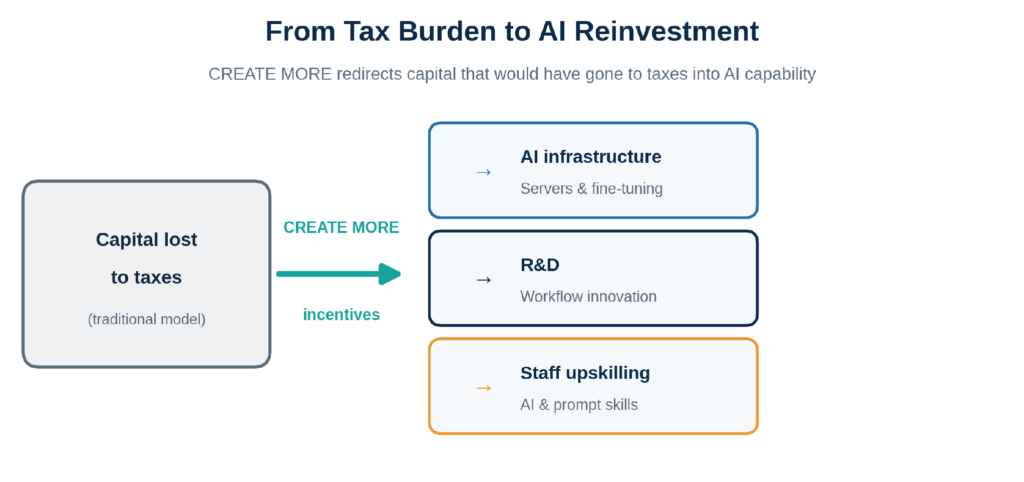
The CREATE MORE Act (RA 12066) offsets the heavy cost of deploying agentic AI by offering 4–7 years of income tax holidays, a preferential special corporate income tax, duty-free importation of AI hardware, and enhanced deductions on R&D and staff training. Capital that would have gone to taxes flows instead into AI infrastructure and upskilling, which is what makes AI-led delivery by offshore teams affordable at scale.
For years, the barrier to AI in Philippine outsourcing was cost — specialized infrastructure and large-scale upskilling are expensive. RA 12066 changes the math by turning tax savings into AI budget. The sections below explain why it is a catalyst, what the specific levers are, and how it should reshape the way buyers select vendors.
Why Is the CREATE MORE Act a Catalyst for AI-Driven Outsourcing?
Because it removes the two historic barriers to AI adoption — costly specialized infrastructure and large-scale upskilling. By streamlining incentive applications and rewarding technology-driven productivity, it lets Registered Business Enterprises import high-tech hardware duty-free and build the local compute clusters needed for AI model fine-tuning.
Unlike the original 2021 CREATE Act, CREATE MORE simplifies the regulatory landscape and broadens access, one of the policy shifts covered in our 2026 overview of the industry’s revenue and workforce. The duty-free importation of capital equipment is decisive for AI: the server clusters and high-end workstations used for model fine-tuning are exactly the line items that once made an AI build prohibitive. With those duties removed and early profits shielded, capital that used to leak to taxes can be redirected into capability.
What Are the Strategic Financial Advantages for AI Adoption?
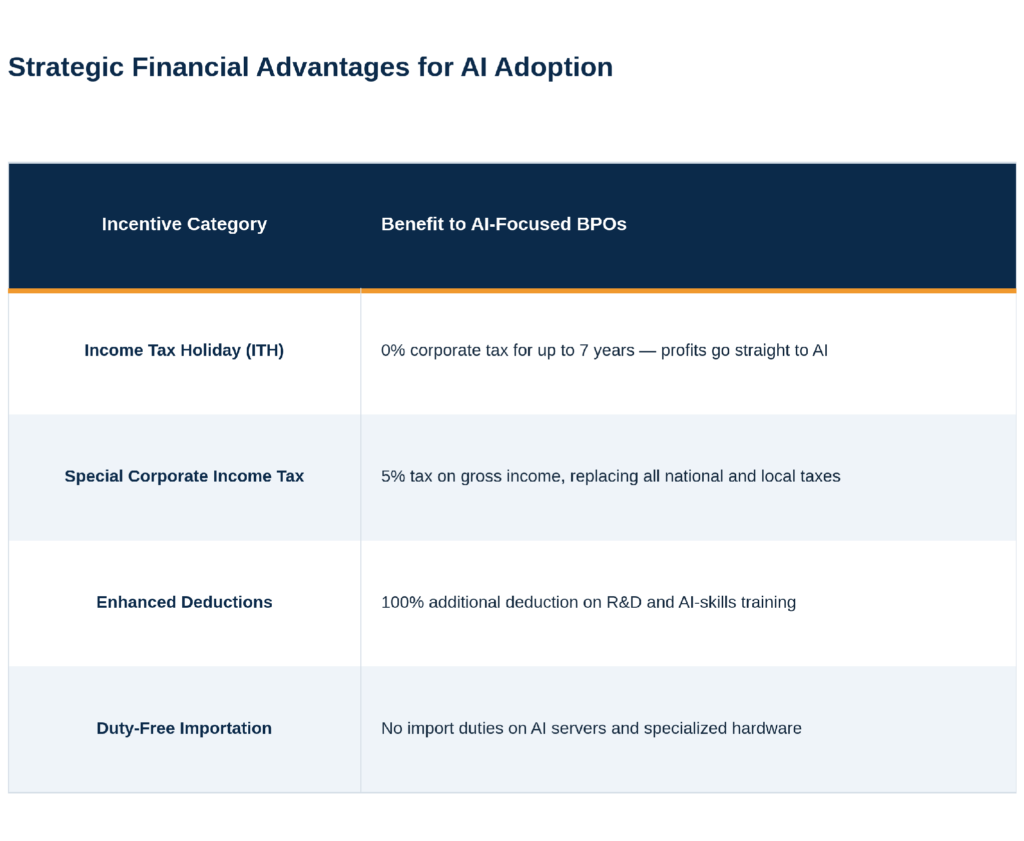
Four levers stand out: income tax holidays of up to 7 years, a preferential special corporate income tax in lieu of all national and local taxes, enhanced deductions including an additional deduction on R&D and on training, and duty-free importation of AI servers and specialized hardware. Together they convert tax savings into AI capability.
Each lever maps to a stage of an AI build. The income tax holiday protects early-stage profits so they can be reinvested in toolsets; the SCIT stabilizes long-run operating costs; the enhanced deductions directly subsidize the R&D and upskilling that AI demands; and duty-free importation lowers the hardware bill. An enterprise elects among these incentives under the rules — they are the menu the Act makes available.
Why the Enhanced Deductions Matter Most for AI
Of the four levers, the enhanced deductions are the most AI-specific. An additional deduction on R&D and on training means the government effectively co-funds the two activities an AI transition depends on: building and refining the models, and teaching staff to manage them. For a labor-rich sector retraining thousands of agents in prompt engineering and AI oversight, that subsidy turns an intimidating reskilling bill into a manageable, partially reimbursed investment.
“The Philippines is transitioning from a labor-arbitrage model to an AI-augmented value-creation model, and the CREATE MORE Act is the fuel for this engine. By lowering the tax burden on R&D and tech-heavy infrastructure, it lets our BPO partners shift capital that would otherwise be lost to taxes directly into agentic AI — a faster ROI on digital transformation and a more sophisticated customer experience.”
— John Maczynski, CEO, PITON-Global
How Does This Change the Vendor Selection Process?
Procurement can no longer stop at hourly rates. The real question is whether a partner is not just “tech-enabled” but “tax-incentivized.” A vendor that maximizes CREATE MORE incentives can offer lower contract costs while investing more in the AI tools that move your CX metrics — an edge that cheaper, non-optimizing vendors cannot match.
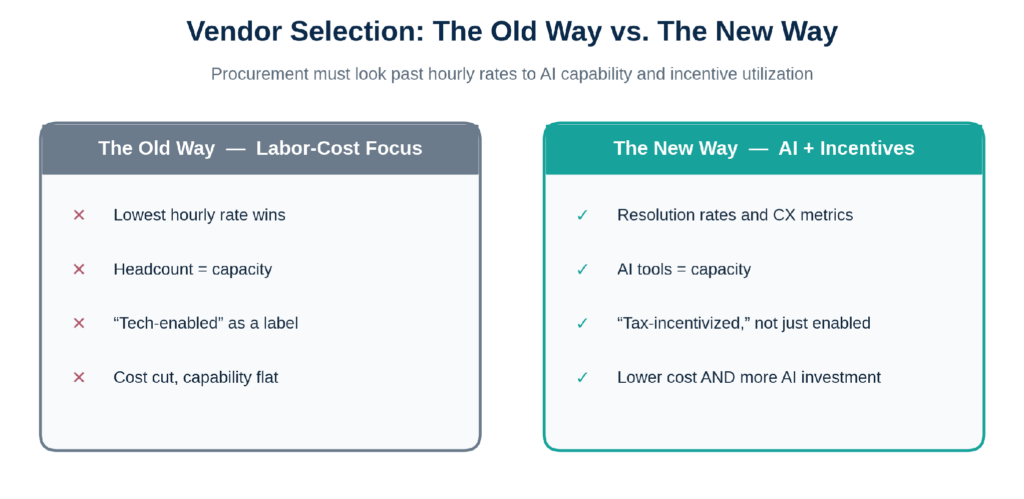
The distinction matters because the savings compound in your favor. A provider that routes tax savings back into its AI stack delivers better resolution rates and lower handling times at the same or lower price. Ask where the incentive money goes; if a vendor cannot answer, you are likely subsidizing their margin rather than your customer experience.
What Does AI-Funded Outsourcing Look Like in Practice?
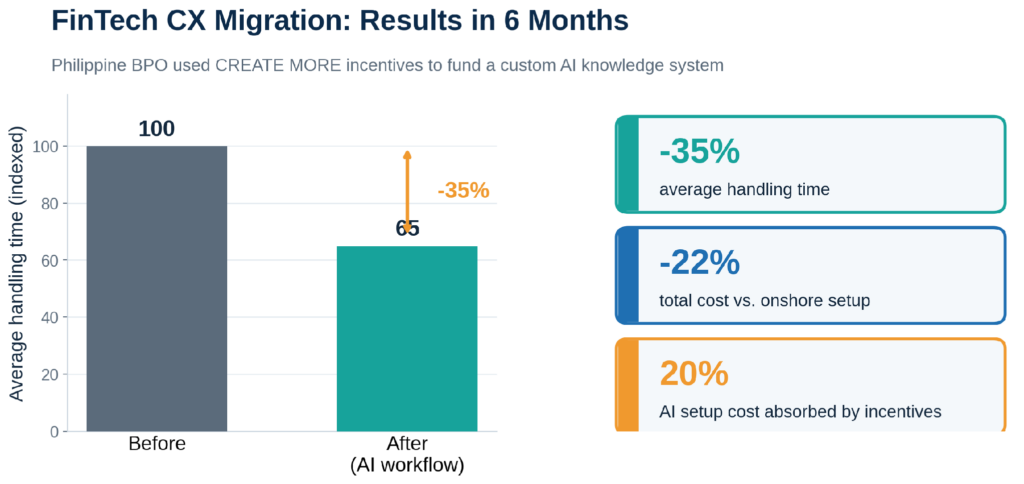
A US fintech firm migrated customer service to a hyper-specialized Philippine BPO that used CREATE MORE incentives to absorb the setup cost of a custom AI knowledge-management system. The result: a marked drop in average handling time within six months — delivered at a lower cost than the client’s previous onshore setup.
The incentives did more than trim a bill; they made a premium build viable. By offsetting the upfront cost of the AI system through the R&D and training deductions, the vendor could fund a higher service tier and still price below the onshore baseline. Agents also reported higher job satisfaction working alongside AI-assisted workflows — a quiet but real driver of retention and quality, and a pattern typical of integrated human-AI operating models.
How Should You Future-Proof Your Outsourcing Strategy?
Choose vendors that can prove how they use these incentives. Demand a roadmap showing how tax savings fund their AI stack, request upskilling metrics for the now-subsidized AI-readiness training, and prioritize partners with clear incentive documentation — a marker of an audit-ready, mature organization built for the agentic-AI era.
As AI becomes the baseline rather than the differentiator, the most credible partners will be those that can show their work. Make these three checks part of every procurement conversation:
- Transparency — request a roadmap of how the vendor turns tax incentives into AI-stack investment.
- Upskilling metrics — ask for data on AI-readiness training programs, now partially subsidized under the Act.
- Governance — prioritize partners with clear documentation of their fiscal incentives; it signals an audit-ready operation.
Aligning your outsourcing strategy with the Philippines’ legislative tailwinds is not just cost-cutting — it is future-proofing your customer experience for the era of agentic AI.