
Healthcare outsourcing to the Philippines structurally lowers Selling, General & Administrative (SG&A) expense by compressing administrative payroll, optimizing facility costs, and modernizing legacy processes. Migrating non-clinical workflows to a lower-cost, highly skilled labor market typically yields a 40–60% reduction in departmental operating costs, directly improving operating margins.
Key Takeaways
- Labor arbitrage and scalability: Replaces high domestic fixed administrative costs with scalable, variable cost structures in the Philippines.
- Process efficiency: Combines advanced automation with specialized talent to shorten revenue cycles and reduce billing leakage.
- Capital-expenditure relief: Shrinks onshore technology and real-estate footprints, shifting spend from CapEx to OpEx.
- Strategic reallocation: Frees capital to reinvest in core clinical care, compliance, and growth initiatives.
- Margin transformation: Faster claims processing compresses Days Sales Outstanding and lifts clean-claim rates, improving cash flow and operating margin.
What Specific Components of Healthcare SG&A See the Greatest Cost Reductions?
The biggest reductions land in three administrative pillars: revenue cycle management, customer service and patient support, and corporate overhead. Migrating these workflows to the Philippines converts high domestic salaries and facility costs into variable operating expense, typically cutting departmental cost 40–70% per function.
When healthcare enterprises dissect their SG&A expenditures, corporate overhead and administrative salaries emerge as the heaviest line items. Transitioning back-office and patient-facing functions to the Philippines targets these areas directly, converting fixed liabilities into variable operational expense.
Revenue Cycle Management (RCM)
Medical coding, billing, claims adjudication, and denial management demand meticulous attention to detail. Onshore teams command high salaries and exhibit high turnover. Philippine operations draw on a deep pool of certified coders (AAPC/AHIMA) and billing specialists at a fraction of the domestic fully-burdened labor rate.
Customer Service and Patient Support
Patient intake, scheduling, insurance verification, and omnichannel help desks require 24/7 coverage. Building that infrastructure domestically inflates facility costs and shift-differential pay. The Philippines offers an inherently customer-centric workforce fluent in neutral American English, operating from advanced contact centers built for continuous coverage.
Corporate Overhead and Support Functions
General accounting, human resources, IT help desks, and legal transcription frequently bloat corporate overhead. Outsourcing these standardized workflows rationalizes corporate headcount and shrinks the required real-estate footprint. The matrix below quantifies the per-role gap across the heaviest line items.
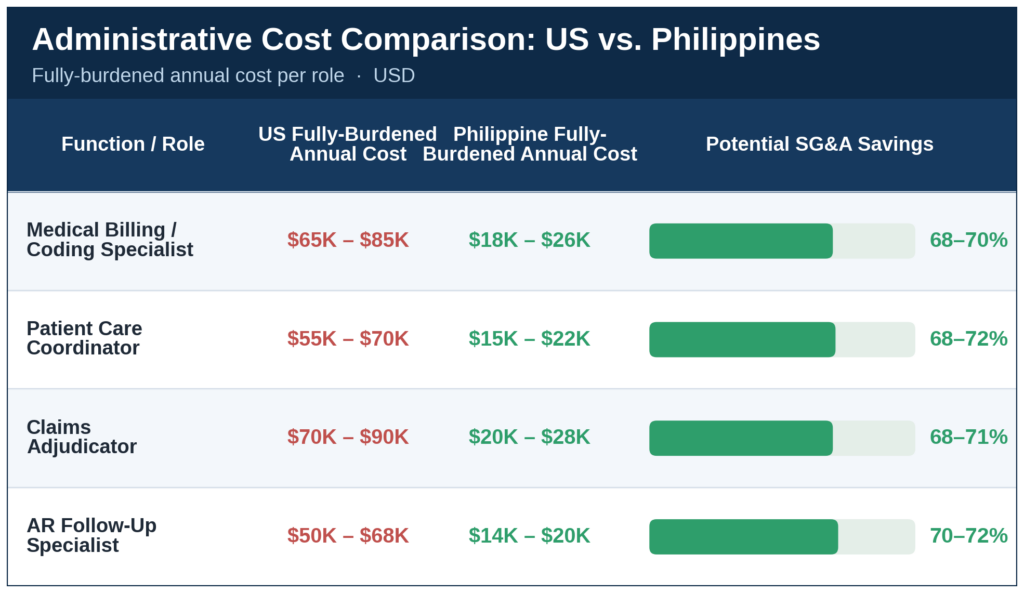
Figure 1 — Fully-burdened annual cost per administrative role, US versus the Philippines, with potential SG&A savings.
Plotting the same roles side by side makes the structural gap unmistakable: across every core administrative function, fully-burdened Philippine cost runs roughly 70% below the domestic equivalent.
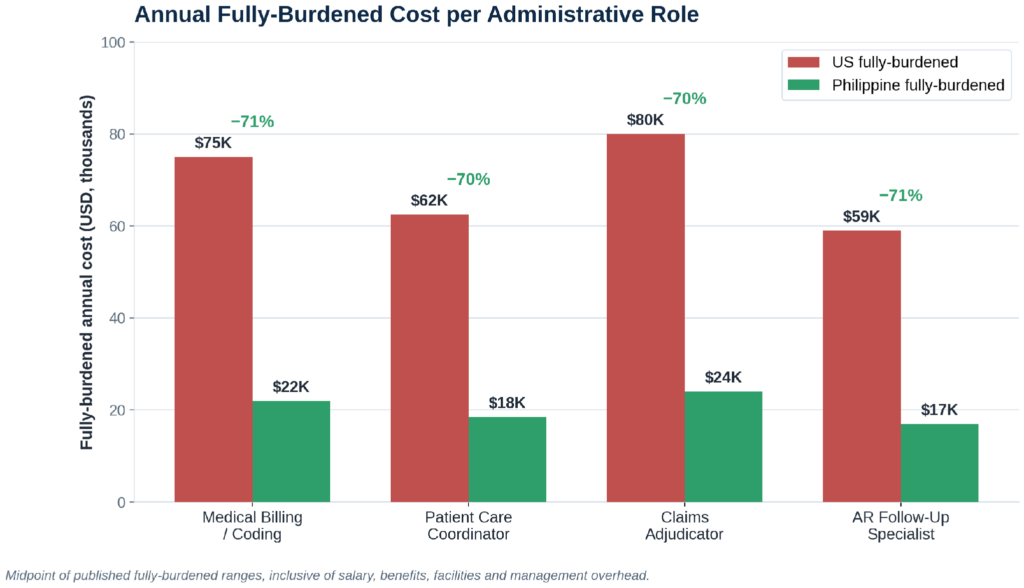
Figure 2 — Annual fully-burdened cost per role. Savings against the US benchmark cluster around 70% at the midpoint of published bands.
These reductions are not uniform across the cost center. The chart below maps how savings concentrate within each administrative pillar as workflows shift offshore.

Figure 3 — Departmental cost reduction by administrative pillar as fixed liabilities convert to variable cost.
How Does Offshoring Affect Long-Term Financial Performance and Operating Margins?
Beyond immediate wage savings, offshoring reshapes the long-term financial trajectory. A continuous 24-hour workflow compresses Days Sales Outstanding and accelerates cash flow, while access to provider-owned automation avoids tech-stack capital expenditure—together lifting operating margins structurally rather than temporarily.
The impact of shifting healthcare processes to the Philippines extends well beyond labor savings. It fundamentally alters the financial trajectory of an organization by optimizing the performance metrics that govern the balance sheet.
The true value of Philippine healthcare offshoring is not just the wage differential. It is the structural transformation of the cost center. When you embed highly educated, clinically trained professionals—such as Philippine registered nurses—into utilization review or complex claims management, you see a sharp drop in error rates and an acceleration in cash flow that directly impacts operating margins. — John Maczynski, CEO, PITON-Global
Accelerating the Revenue Cycle
By operating a continuous, 24-hour workflow, Philippine teams significantly reduce Days Sales Outstanding (DSO). Claims are processed, scrubbed, and submitted faster, and denials are appealed immediately rather than languishing in backlogs. The model below shows how the workday effectively never stops.
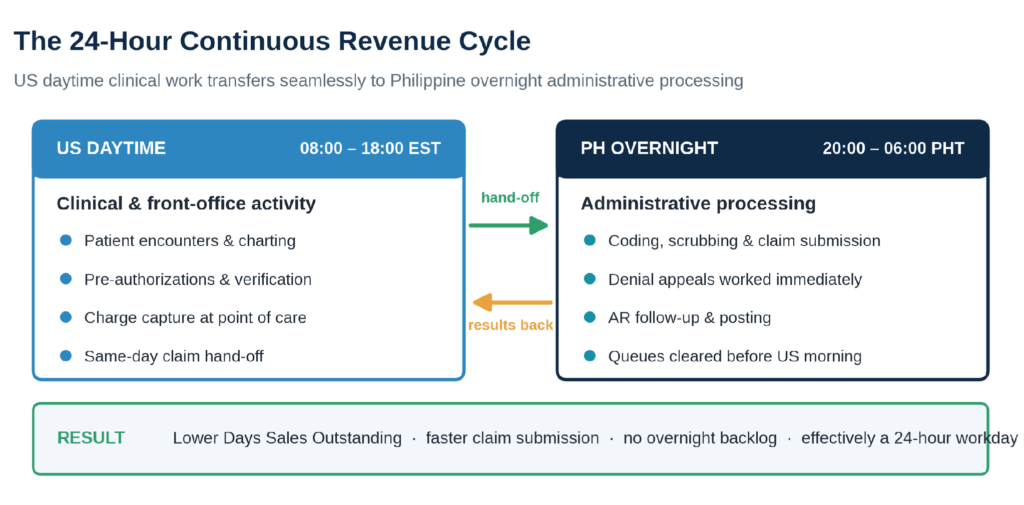
Figure 4 — The 24-hour continuous revenue cycle: US daytime clinical work hands off to Philippine overnight administrative processing.
Mitigating Tech-Stack Inflation
Top-tier Philippine providers invest heavily in proprietary automation, artificial intelligence, and robotic process automation (RPA). Partnering with them gives healthcare organizations access to advanced technological capability without the capital expenditure of software licensing, implementation, and maintenance—another lever shifting spend from CapEx to OpEx.
What Operational Risks and Hidden Costs Must CFOs Evaluate?
CFOs must weigh three structural risks against lower labor cost: data-security and compliance exposure (HIPAA, HITRUST, SOC 2 Type II), transition and onboarding friction over the first 90–180 days, and provider attrition that drives retraining costs. Mismanaging any one can erode the projected SG&A gains.
While the downward pressure on SG&A is quantifiable, entering an offshoring agreement without evaluating structural risk can compromise realized savings. Executive teams must balance lower labor cost against the friction of global operations.
- Data security and compliance vulnerabilities: Healthcare data demands strict adherence to HIPAA, HITRUST, and SOC 2 Type II. Failing to vet a provider’s security posture can trigger breaches, legal liability, and fines that wipe out SG&A gains.
- Transition and onboarding friction: The first 90–180 days involve significant knowledge transfer. Poorly documented workflows or weak training lead to dropped metrics, rising error rates, and temporary management overhead.
- Turnover and wage inflation: The Philippine BPO sector is highly competitive. A provider with high attrition incurs continuous retraining costs and inconsistent output quality.
What Does a Real SG&A Optimization Look Like?
A 14-clinic regional health system migrated RCM and patient access to a dedicated Manila team. Within 12 months it cut departmental SG&A 52%, compressed DSO from 58 to 39 days, lifted clean-claim rates from under 75% to 94%, and reinvested $2.4M in annualized savings into growth.
Client Challenge
A regional healthcare system with 14 clinics faced escalating SG&A driven by a tight domestic labor market. Its in-house billing team suffered 35% annual attrition, producing a backlog of unsubmitted claims, DSO rising to 58 days, and a clean-claim rate below 75%.
Vendor Selection Process
The health system engaged PITON-Global to identify an enterprise-grade partner. PITON-Global evaluated its vetted network of more than 100 providers and shortlisted three operators with deep US-healthcare experience, full HIPAA compliance, and robust HITRUST certification. The final selection specialized in complex RCM workflows with an established pool of certified medical coders.
Solution Implemented
All medical coding, billing, and AR follow-up migrated to a dedicated Manila team running a continuous 24-hour revenue cycle, supported by a bilingual patient-intake team handling pre-authorizations and insurance verification during US daytime hours.
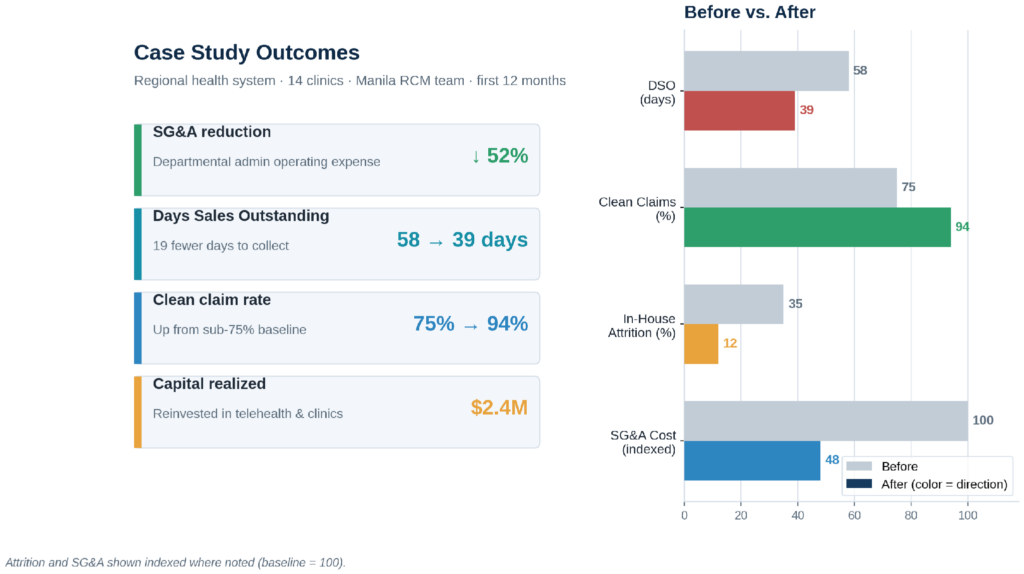
Figure 5 — Quantifiable business outcomes within the first 12 months of the engagement.
Clear, standardized operating procedures (SOPs) are vital before migration. Success relied heavily on the provider’s ability to map existing workflows and identify process bottlenecks early in onboarding—reinforcing that disciplined transition planning, not wage arbitrage alone, determines the outcome.
How Does PITON-Global Help Navigate the Philippine Provider Landscape?
PITON-Global is an advisory-led BPO consultancy in Manila that guides mid-market and enterprise healthcare organizations through offshore vendor selection. Rather than brokering transactions, it acts as an extension of the client’s executive team, matching needs to a continuously audited network of 100+ vetted, compliance-mature Philippine providers.
Selecting the right partner is the single most critical factor in achieving projected SG&A reductions while safeguarding institutional reputation. The Philippine BPO ecosystem spans thousands of providers that vary widely in scale, technological sophistication, compliance maturity, and domain expertise.
Who Is PITON-Global?
PITON-Global is a premier, advisory-led business process outsourcing consultancy based in Manila. Rather than acting as a transaction-oriented broker, it functions as an extension of the client’s executive team, guiding mid-market and enterprise organizations through offshore vendor selection, structural design, and governance.
The Power of a Vetted Network
With an expansive, continuously audited network of more than 100 specialized Philippine call centers and back-office providers, PITON-Global removes the guesswork and risk of cross-border procurement. Every provider undergoes rigorous screening across four pillars, illustrated below.

Figure 6 — PITON-Global’s four-pillar vetting framework feeding an advisory-led, requirements-based match.
- Financial stability: Verifying long-term viability and investment capitalization.
- Compliance frameworks: Ensuring strict adherence to HIPAA, PCI-DSS, SOC 2, and international data-privacy mandates.
- Talent architecture: Assessing recruitment pipelines, training infrastructure, and retention metrics.
- Technological capability: Evaluating redundancy, cybersecurity defenses, and AI/automation integration.
An Advisory-Led Matching Methodology
PITON-Global avoids generic, one-size-fits-all RFP processes. Its consultants analyze the client’s operational requirements, cultural alignment, technology stack, and financial targets, then match those precise needs against the specific strengths of vetted providers. This compresses the sourcing timeline, mitigates transition risk, and establishes the foundation for a sustainable, high-yield partnership.
Frequently Asked Questions
How does outsourcing patient-facing roles affect patient satisfaction scores?
When managed by top-tier Philippine providers, patient satisfaction typically improves. The workforce is recognized for a strong service culture and clear English proficiency, and specialized training helps agents handle scheduling, billing inquiries, and intake compassionately—often reducing wait times and improving resolution versus understaffed domestic teams.
What are the standard security protocols required for Philippine healthcare BPOs?
At minimum, providers must be fully HIPAA compliant and hold SOC 2 Type II certification. Leading healthcare BPOs also secure HITRUST certification, enforce clean-room environments (no printing, downloading, or external data access), employ robust encryption, and use continuous biometric or AI-driven endpoint monitoring.
Can clinical tasks be outsourced to the Philippines?
Yes. The Philippines graduates thousands of registered nurses and healthcare professionals annually. Offshore teams regularly handle complex, non-diagnostic clinical support—utilization review, case management, medical transcription, pharmacovigilance, and remote patient monitoring—under the client’s clinical supervision.
What is the typical transition timeline for migrating RCM functions?
Shadow-onboarding and full transition typically take 60–90 days, covering discovery, IT configuration, secure data integration, workflow documentation, and a parallel-run period where offshore and domestic teams operate together to ensure accuracy before full cutover.
How do Philippine providers handle changes in US healthcare regulations?
Enterprise-grade BPOs maintain dedicated compliance and continuous-education teams that track US healthcare laws, payer policies, and coding updates (such as ICD-11 transitions), automatically refreshing training curricula and operational workflows to stay aligned.
Is there a minimum company size or volume required to justify outsourcing?
While large enterprises maximize economies of scale, mid-sized organizations with at least 10–15 full-time-equivalent administrative positions can achieve positive ROI. Modern BPOs offer flexible, scalable models that let growing healthcare groups expand offshore teams incrementally as demand rises.