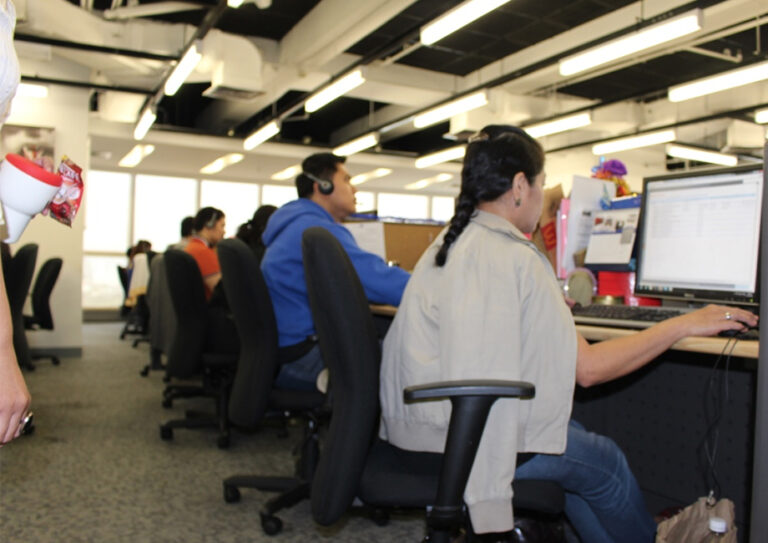

Healthcare outsourcing to the Philippines consistently improves patient satisfaction by sharply cutting wait times and lifting first-contact resolution. Moving non-clinical, administrative, and patient-access work to specialized offshore providers — the model behind HIPAA-trained patient-access support for US hospitals — frees onshore clinicians to focus on bedside care, producing measurable HCAHPS gains.
Key Takeaways
- Elevated patient experience: Shifting administrative burden offshore drives a measurable lift in HCAHPS scores by removing the friction patients feel most.
- Substantial cost optimization: Health systems capture substantial savings on operational labor that can be reinvested in clinical infrastructure.
- Reduced clinical burnout: Offloading patient-access and billing work lowers the administrative load that fuels nurse and physician fatigue.
- 24/7 omnichannel coverage: Continuous, round-the-clock support eliminates dropped calls and scheduling delays — the primary drivers of dissatisfaction.
- Advisory-led selection lowers risk: Matching with a vetted provider through an objective advisor prevents costly vendor failures and accelerates go-live.

Which Patient Touchpoints Benefit Most from Offshore Support?
The biggest satisfaction gains come from front-end and back-end patient-access touchpoints: intake and scheduling, insurance verification and pre-authorization, and medical billing. Routing these high-volume, non-clinical workflows to specialized offshore teams removes the bottlenecks that most often frustrate patients.
Outsourcing works best when it targets the operational chokepoints that damage the patient experience without touching direct clinical care. Across the patient journey, three touchpoints deliver the clearest, fastest returns.
Patient Intake and Scheduling
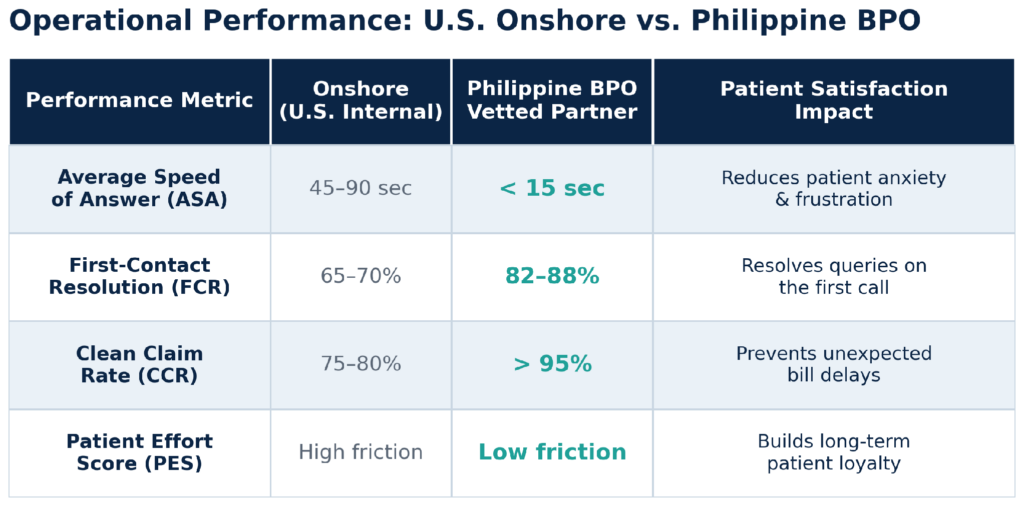
Long hold times and abandoned calls are among the most visible sources of dissatisfaction. Scalable, 24/7 inbound management lets patients reach a live, knowledgeable agent on the first attempt instead of cycling through voicemail and call-backs. Average speed of answer falls from the 45–90 second onshore range to under 15 seconds, while abandonment rates that routinely run high in understaffed internal hubs drop sharply.
Insurance Verification and Pre-Authorization
Few experiences erode confidence faster than a procedure delayed because authorization was not secured in time. Specialized offshore teams submit clean, complete authorizations rapidly — working U.S. payer portals and EHR queues overnight so approvals are in place before the patient arrives. The payoff is fewer day-of cancellations, smoother scheduling, and patients who feel the system is working on their behalf.
Medical Billing and Revenue Cycle Management (RCM)
The billing experience is where many patient relationships are won or lost. Confusing statements and aggressive collections create disputes and lasting resentment. Offshore RCM teams trained in compassionate, plain-language communication help patients understand complex self-pay balances and payment options. Clean-claim rates well above what many internal teams achieve mean fewer surprise bills, faster resolution, and stronger collections without sacrificing goodwill.
Why Does the Filipino Talent Pool Excel in Medical Communications?
The Filipino workforce pairs formal clinical education with a strong service culture and neutral English fluency. The country graduates more than 100,000 nursing and allied-health professionals each year, many of whom bring genuine medical literacy into administrative healthcare roles — an advantage few outsourcing destinations can match.
Clinical and cultural alignment is the country’s true differentiator. Where many offshore markets staff healthcare lines with general customer-service agents, premium Philippine providers can draw on graduates who understand medical terminology, payer dynamics, and the emotional weight of a healthcare call. Combined with a service-oriented culture and a widely neutral accent, this produces interactions that feel less like a transaction and more like an extension of the care team — the groundwork for stronger patient communication and engagement.

When a patient calling about a pre-authorization speaks to a professional in Manila who holds a Bachelor of Science in Nursing, the caliber of care, medical literacy, and clinical accuracy shifts dramatically. It becomes a natural extension of the hospital’s patient-care delivery system. — John Maczynski, CEO, PITON-Global
What Operational Risks Should Hospital Leaders Plan For — and How Do They Mitigate Them?
The principal risks are data security and HIPAA exposure, and loss of operational control over remote teams. Both are manageable. Leaders mitigate them by selecting HITRUST-certified, zero-trust providers and embedding onshore delivery management with real-time dashboards that keep offshore operations tightly aligned to hospital standards.
Data Security and HIPAA Compliance
A single privacy breach can trigger severe financial penalties and lasting reputational harm. Mitigate this by partnering only with providers operating HITRUST-certified, ISO/IEC 27001 environments that enforce zero-trust network architecture, biometric access controls, and paperless, clean-desk floors where personal devices and writing materials are prohibited. End-to-end encryption and role-based access ensure protected health information is handled to the same standard expected of any U.S. operation.
Loss of Operational Control
Distance can breed drift — misaligned workflows, inconsistent quality, and slow escalation. Address this by embedding dedicated onshore delivery managers who own the relationship, mandating real-time performance dashboards, and integrating offshore teams directly into the hospital’s native EHR rather than siloed third-party tools. Shared metrics and a single source of truth keep remote teams operating as a genuine extension of the health system, the same discipline that keeps offshore patient interactions on brand.
What Results Can Health Systems Realistically Expect from Outsourcing?
Well-executed partnerships deliver fast, measurable results: double-digit reductions in call abandonment, meaningful HCAHPS gains, and multi-million-dollar labor savings — often within the first 90 days. A representative multi-state health system reengineered its patient-access hub and transformed every metric that matters to patients.
The Challenge
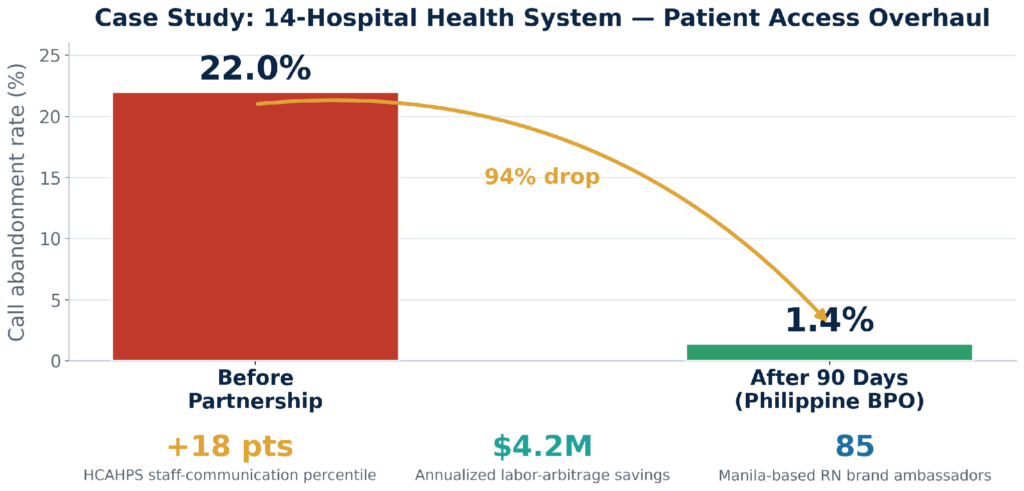
A U.S. health system operating 14 regional hospitals faced a severe call-abandonment problem in its centralized scheduling hub. Lost calls meant lost appointments, lost revenue, and falling HCAHPS scores in the communication domain.
The Solution
Engaging PITON-Global to navigate a fragmented offshore market, the system evaluated 18 specialized healthcare BPO providers and selected a partner with deep Epic EHR integration and an exclusive pool of registered-nurse agents. A dedicated team of 85 Manila-based brand ambassadors then took over omnichannel intake, insurance verification, and outbound appointment reminders.
The Outcomes
- Call abandonment: fell to a small fraction of its former level within 90 days.
- HCAHPS rating: improved markedly in the “Communication with Staff” domain.
- Cost reduction: multi-million-dollar annualized labor-arbitrage savings.
Success depended on integrating the offshore team into the hospital’s native EHR rather than bolting on siloed third-party software. A single source of truth for patient records proved essential to consistent, error-free service and a seamless patient experience.
How Does PITON-Global Help Health Systems Select the Right Philippine BPO Partner?
PITON-Global is an advisory-led BPO consultancy that matches healthcare organizations with the right pre-vetted Philippine provider from a network of more than 100 operators. By auditing each client’s needs and recommending objectively — rather than selling a single vendor — it reduces risk, shortens procurement, and improves provider fit from day one.
Who Is PITON-Global?
PITON-Global is a specialized BPO advisory and outsourcing consultancy that bridges enterprise healthcare organizations and premium Philippine service providers. Within the Philippine outsourcing market — one of the world’s largest, employing well over a million professionals — PITON-Global serves as an expert navigator, applying deep knowledge of provider capabilities, compliance standards, and pricing to guide high-stakes selection decisions. Its focus is healthcare-grade BPO: patient access, revenue cycle, and clinical-support functions where accuracy and empathy are non-negotiable, along with clinical-development support for life-science firms.
How Does PITON-Global Differ from Traditional Outsourcing Brokers?
Traditional brokers are commission-driven — paid to place clients with whichever vendor pays them, which skews recommendations. PITON-Global operates on an advisory-led model instead. It evaluates providers independently, makes objective recommendations, and is accountable to client outcomes rather than provider promotion. The guidance a health system receives is therefore one it can trust, because it is not engineered to favor any single operator.
How Does PITON-Global’s Network of 100+ Vetted Philippine BPO Providers Benefit Organizations?
Access to a curated ecosystem of more than 100 pre-vetted providers compresses a months-long discovery process into weeks. The network spans industries and service categories — from inbound patient scheduling to certified medical coding — so organizations can find specialists matched precisely to their needs. Because every provider is screened in advance for compliance, capability, and stability, clients skip the costly trial-and-error of qualifying unknown vendors and move straight to a shortlist of credible partners.
How Does PITON-Global’s Advisory-Led Vendor Matching Process Work?
The process is structured and objective. It begins with a needs assessment that maps the client’s technology stack, compliance requirements, and volume metrics, then cross-references those requirements against the vetted network to shortlist viable providers. A capabilities-alignment stage confirms EHR fit, certifications, and clinical expertise, and a final risk-mitigation stage establishes onshore delivery governance, service-level agreements, and live dashboards. The framework removes guesswork and ensures sustainable operational alignment from day one.

Why Do Organizations Use PITON-Global?
Organizations engage PITON-Global to reduce outsourcing risk, improve provider fit, and accelerate vendor selection. Rather than gamble on an unfamiliar offshore market, leaders gain strategic guidance throughout evaluation, a shortlist of credible partners, and governance structures that protect quality after go-live. The payoff is better outsourcing outcomes: faster implementation, fewer failures, and a partnership built to last.
What Do Hospital Leaders Most Often Ask About Offshore Patient Support?
The most frequent questions concern HIPAA compliance, billing and coding competence, onboarding timelines, around-the-clock coverage, and patient acceptance across age groups. In every case, vetted premium providers meet or exceed U.S. operational and security standards.
How do Philippine BPO providers guarantee HIPAA compliance?
Vetted providers implement the same security protocols as U.S.-based operations: ISO/IEC 27001 certification, HITRUST frameworks, clean-desk environments without physical writing materials, biometric access controls, and end-to-end encryption.
Can offshore teams manage complex medical billing and coding?
Yes. Premium offshore healthcare providers employ certified medical coders (AAPC/AHIMA) proficient in ICD-10-CM, CPT, and HCPCS systems, working under strict quality-assurance metrics that hold coding accuracy to audited targets.
What is the average onboarding timeline for an outsourced healthcare team?
A typical implementation — covering secure VPN setup, EHR credentialing, and clinical-workflow training — spans roughly 6 to 12 weeks, depending on team size and complexity.
How do Philippine providers handle overnight or emergency patient inquiries?
The Philippine BPO industry runs continuously, 24/7/365. Teams are permanently aligned to U.S. time zones (EST, CST, MST, PST) to provide seamless, uninterrupted coverage at any hour.
Will outsourcing patient communication alienate older patient demographics?
No. The neutral accent, linguistic fluidity, and service-oriented culture of the Filipino workforce consistently earn high satisfaction ratings across all age groups, particularly when handling stressful or complex administrative issues.