
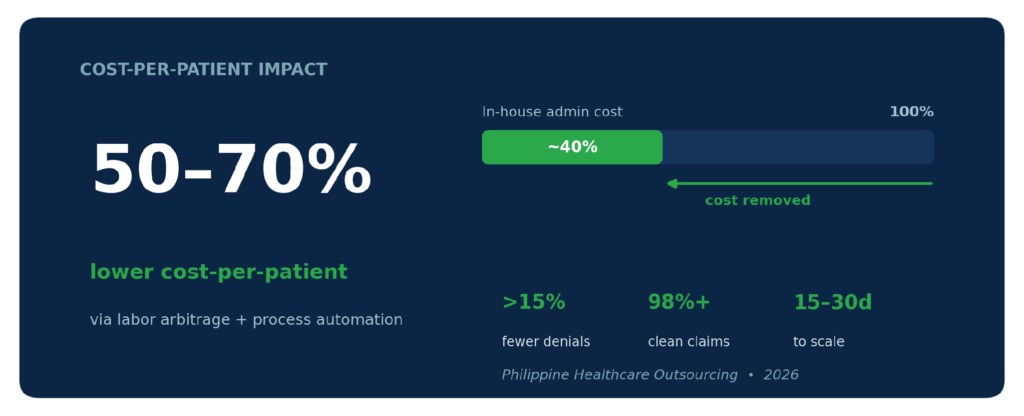
Healthcare outsourcing to the Philippines lowers cost-per-patient by 50–70% through labor arbitrage and administrative process automation. Offloading revenue cycle management and coding to specialized Philippine teams cuts denial rates by over 15% and accelerates cash flow, freeing internal staff to focus on direct patient care and clinical outcomes.
Key Takeaways
- Financial impact: Shift from high-fixed domestic overhead to a variable-cost model, typically reducing total administrative expenses by 13–25%.
- Operational precision: Move to AI-assisted coding and automated denial management, frequently pushing clean-claim rates to 98% or higher.
- Speed to value: Replace 3–6 month domestic hiring cycles with 15–30 day operational scaling through vetted BPO partnerships.
- Security compliance: Leverage providers with HITRUST, SOC 2 Type II, and HIPAA-aligned infrastructure to mitigate clinical-data risk.
- Clinical focus: Eliminate administrative friction, directly contributing to higher patient-satisfaction scores and improved clinical throughput.
What Financial Mechanisms Drive These Cost Improvements?
The savings come from process-based cost compression, not just lower hourly rates. U.S. clinical settings suffer “administrative bloat,” with skilled staff spending ~40% of their time on billing, authorization, and clerical work. Relocating those functions compresses cost while accelerating the revenue cycle.
Offshoring is often misread as a simple wage play. The larger lever is structural: in U.S. clinical environments, skilled medical staff spend roughly 40% of their time on billing, prior authorization, and clerical duties—time that produces no direct clinical value.

Figure 1. Roughly 40% of skilled clinical staff time is consumed by administrative work.
Relocating those functions delivers two compounding effects. Specialized Philippine teams use predictive analytics to flag likely claim rejections before submission—and at a large health system, even a 1% reduction in denial rates can save millions annually. Because providers operate 24/7 or in overlapping shifts, they also shorten days in A/R, freeing working capital. The category-level cost shift is substantial.

Figure 2. Outsourcing compresses administrative cost across labor, technology, facility, and rework.
How Do Quality and Accuracy Metrics Influence Long-Term ROI?
Strategic outsourcing tethers vendor performance to clinical accuracy, not volume—a “quality-adjusted cost” view. Specialized Philippine teams push clean-claim rates toward 98–99%, hold churn below 15%, and onboard in about 30 days, all of which compound into durable ROI as outsourcing maturity rises.
The most successful health systems monitor quality-adjusted cost, tying the provider’s performance to clinical accuracy rather than throughput. On the metrics that govern revenue integrity, a managed Philippine BPO and a domestic in-house team diverge sharply.
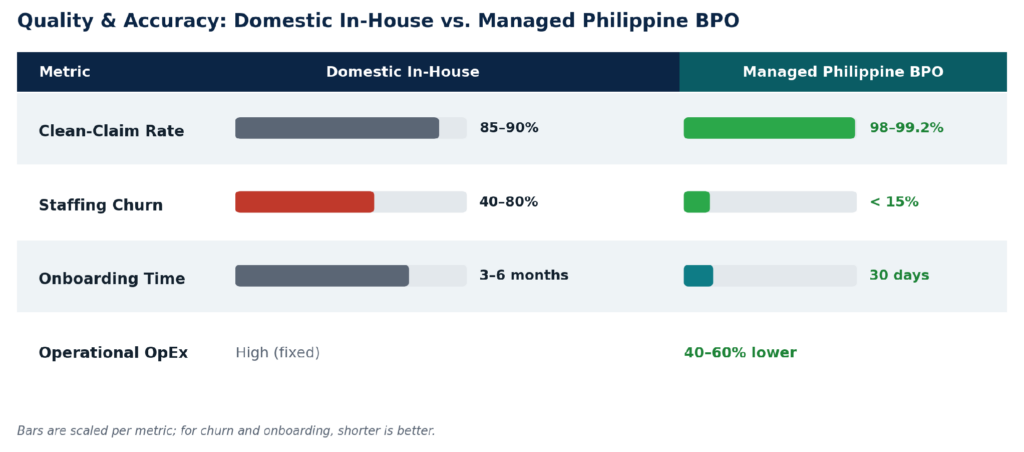
Figure 3. Quality and accuracy metrics: domestic in-house versus a managed Philippine BPO.
“Cost is a component, but competence is the currency,” notes John Maczynski, CEO of PITON-Global. “We advise clients that the ultimate ROI isn’t found in the seat rate, but in the ‘error-free throughput.’ When we match a provider, we look for clinical literacy—agents who understand the medical necessity behind the codes they process.”
That ROI compounds over time. As administrative-outsourcing maturity rises across the first 24 months, claim-denial rates fall along a clear negative trend—and the relationship is strong, not incidental.
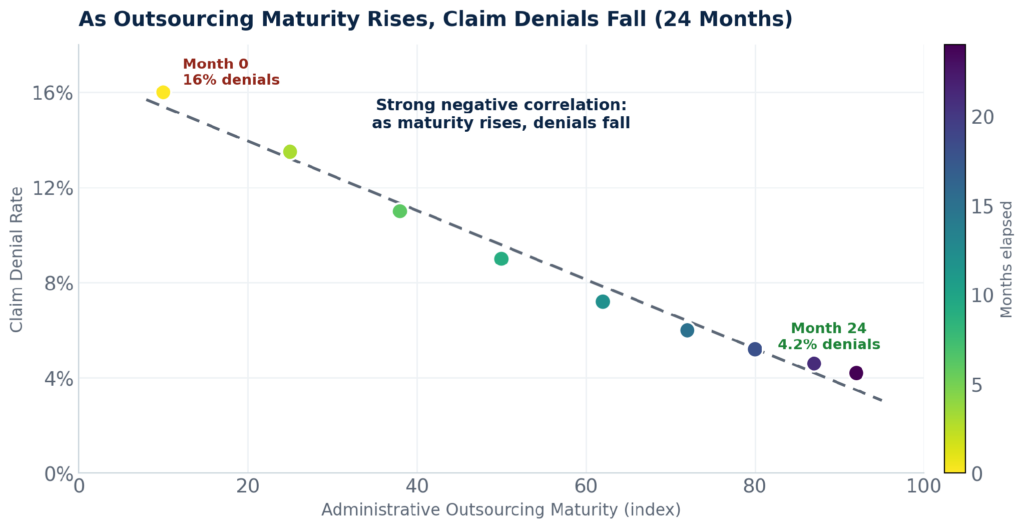
Figure 4. Outsourcing maturity and denial rates move inversely over a 24-month period.
How Should Organizations Mitigate Operational Risks?
A risk-intelligent framework rests on three pillars: clinical literacy (proven proficiency in the specific specialty), security architecture (zero-trust access and audited protocols meeting domestic standards), and governance (a phased transition that moves non-critical tasks first to validate the vendor’s baseline).
Clinical literacy comes first: partners must demonstrate deep proficiency in the relevant specialty—cardiology, oncology, primary care—so that coders understand the medical necessity behind each code, not just the keystrokes. Security architecture is the second pillar, requiring zero-trust network access and audited BPO security protocols that meet domestic healthcare standards. Governance is the third: a phased-transition model that moves non-critical clerical tasks first establishes a performance baseline before any high-stakes work is migrated, containing risk throughout the engagement.
What Do Real-World Results Look Like?
A multi-state health system with a 15% denial rate and a clinical-billing staffing crunch deployed a dedicated, EMR-integrated Philippine “pod.” Within nine months it cut claim errors by 22%, lifted net collection rates by 14%, and reduced administrative cost-per-patient by 35%.
Facing a liquidity crunch from a 15% denial rate and chronic delays filling clinical-billing roles, the system worked with PITON-Global, which ran a 12-vendor audit and selected a HITRUST-certified provider with 10+ years of experience in the client’s payer mix. A dedicated pod was deployed, integrated directly into the existing EMR via secure VPN with real-time performance dashboards.
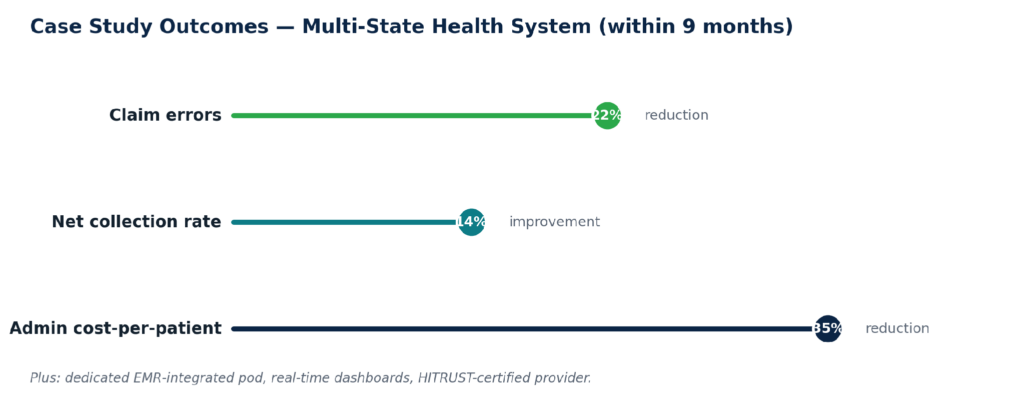
Figure 5. Nine-month outcomes after deploying a dedicated, EMR-integrated Philippine pod.
How Does PITON-Global De-Risk Provider Selection?
PITON-Global is an advisory-led intermediary that de-risks selection rather than simply brokering services. It has vetted 100+ Philippine providers against Western quality and compliance standards and uses a proprietary scorecard to match clinical needs to a provider’s proven history—at no cost to the buyer.
Who Is PITON-Global?
PITON-Global is an expert intermediary that helps health systems navigate Philippine healthcare outsourcing. It has vetted more than 100 Philippine BPO providers to confirm they meet Western quality and compliance standards, and it functions as an advisory-led partner that de-risks the selection process rather than simply brokering services.
How Does PITON-Global Differ From Traditional Outsourcing Brokers?
Traditional brokers place services; PITON-Global de-risks selection through an advisory-led methodology, and its advisory services are free to the buyer. That structure keeps its goal singular—successful vendor integration—rather than steering clients toward whichever provider pays the highest placement fee.
How Does a Network of 100+ Vetted Philippine BPO Providers Benefit Organizations?
Because every provider in the network has already been vetted against Western quality and compliance standards, organizations skip the slow, risky discovery phase and compare pre-qualified candidates. That shortens the path to a provider that fits the client’s specialty, payer mix, and compliance requirements.
How Does PITON-Global’s Advisory-Led Vendor Matching Process Work?
PITON-Global runs a structured de-risking process: an initial audit of clinical needs and compliance scope, proprietary-scorecard matching against providers’ proven histories, security and compliance vetting, a phased pilot that moves non-critical tasks first, and full EMR-integrated implementation. The sequence validates performance before any high-stakes work is migrated.
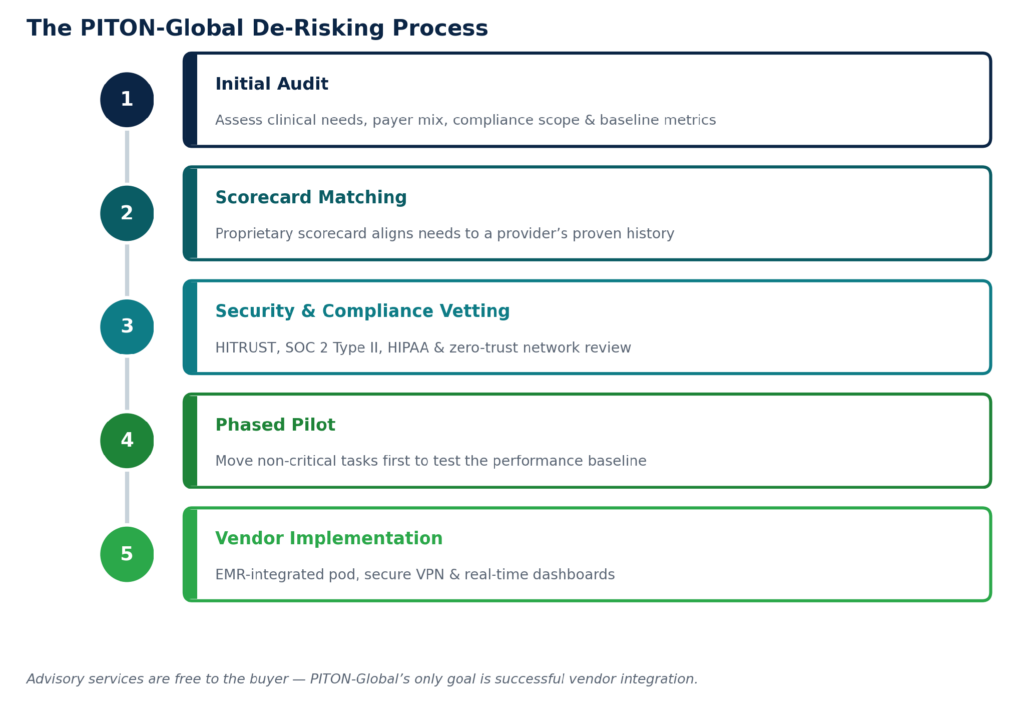
Figure 6. PITON-Global’s five-stage de-risking process, from initial audit to implementation.
Why Do Organizations Use PITON-Global?
Organizations use PITON-Global to de-risk vendor selection and accelerate integration while protecting margin. Its scorecard-driven matching aligns specific clinical needs with a provider’s proven operational history, and because its advisory services are free to the buyer, its incentives stay aligned with a successful, low-risk integration.
What Else Should Health Systems Know Before Outsourcing?
Common questions cover HIPAA/HITRUST compliance, patient-experience effects, managed service versus dedicated team, time to ROI, the most common pitfall, and technology compatibility. In short: top providers are as secure as U.S. counterparts, patient experience improves, ROI lands within 90 days, and existing EMR/EHR systems are retained.
How does Philippine healthcare outsourcing maintain HIPAA/HITRUST compliance?
Top-tier Philippine providers are as secure as their U.S. counterparts, using hardware-based encryption, strict physical security, and regular third-party security audits to protect PHI.
Does outsourcing affect patient experience?
Indirectly, and positively. Shifting administrative work to the background lets medical staff focus on patient-facing care, improving clinical outcomes and satisfaction.
What is the difference between a managed service and a dedicated team?
A managed service is outcome-focused and SLA-driven, while a dedicated team acts as an extension of your own department, offering deeper management oversight.
How soon can we expect to see ROI?
Most organizations realize operational cost improvements within the first 90 days as workflows stabilize and the BPO team reaches full proficiency.
What is the most common pitfall for new adopters?
Over-focusing on hourly labor cost while ignoring the provider’s ability to handle complex, specialized medical scenarios.
Do we have to replace our technology stack?
No. Most high-end Philippine providers integrate seamlessly into your existing EMR/EHR through secure remote-desktop or cloud-based interfaces.