
Call center outsourcing to the Philippines can cut fully burdened CX overhead by up to 70% while replacing recruitment friction with an elastic, highly scalable model. Building internally maximizes direct control and cultural oversight but leaves an organization exposed to rising payroll taxes, real-estate obligations, and continuous operational liabilities.
Key Takeaways
- Unparalleled labor arbitrage: Turnkey, enterprise-grade contact-center pricing in Manila and Cebu runs 65–70% below comparable domestic expansion.
- Rapid scale and elasticity: Shifting talent acquisition to an expansive, proficient labor market removes recruitment bottlenecks and compresses ramp from weeks to days.
- Less structural liability: Avoids capital-intensive real estate, physical telephony, and localized HR or employment-litigation risk.
- Regulatory cost insulation: CREATE MORE incentives let Tier-1 providers capture corporate tax breaks and power-cost deductions, keeping baseline rates low and stable.
- Continuous operational resilience: Premium providers build in continuity—automated dual-feed generators and multiple undersea fiber paths—for guaranteed uptime.
What Are the Core Cost Structures and Resource Tradeoffs?
Internal teams carry heavy CapEx and fixed liabilities—office space, CCaaS licensing, telephony, recruitment, benefits, and payroll taxes. Philippine BPO converts these into elastic OpEx: a turnkey Tier-1 Manila or Cebu seat costs roughly $1,300–$1,900 per month versus $4,800–$5,800 onshore, a 65–70% reduction.
When evaluating CX models, decision-makers must look past raw hourly wages to total cost of ownership. Building internally demands substantial CapEx and persistent fixed liabilities: commercial office space, CCaaS software licensing, physical telephony, localized recruitment, mandatory healthcare, and escalating payroll taxes. Outsourcing converts those rigid overheads into a fully variable, highly elastic operating expense that tracks real-time volume.
A fully loaded onshore customer-care seat generally costs $4,800–$5,800 per month once salary, healthcare, workers’ compensation, retirement matching, and facilities overhead are included. A turnkey, Tier-1 seat in Manila or Cebu runs $1,300–$1,900—an all-inclusive rate covering English-fluent talent, dedicated local management, strict QA, and fully redundant infrastructure.
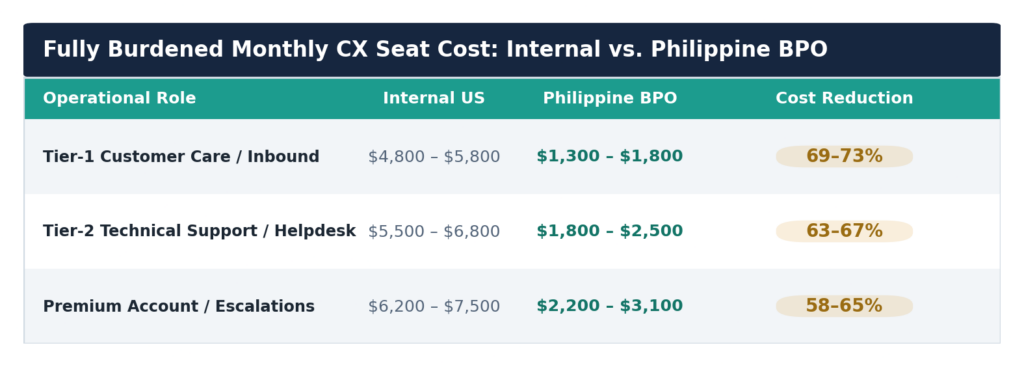
Figure 1. Fully burdened monthly CX seat cost by role: internal US expansion versus turnkey Philippine BPO.

Figure 2. An illustrative cost bridge showing where the savings on a Tier-1 seat originate.
How Do Talent Dynamics, Risk, and Compliance Align?
Internal builds give immediate cultural alignment but face domestic agent attrition that routinely clears 45%. Offshoring shifts recruitment and retention to a specialist drawing on 800,000+ annual graduates, while CREATE MORE incentives and certified, redundant facilities insulate cost and protect data.
Building internally allows immediate alignment with corporate culture, but it also introduces operational risk—especially in competitive domestic markets where annual customer-service attrition routinely clears 45%. Offshoring shifts the burdens of recruitment, training, and retention to an organization whose core competency is managing human capital. The Philippines graduates more than 800,000 university students a year, creating a vast pool of accent-neutral English speakers with deep affinity for Western business models.
The regulatory landscape further insulates enterprise capital. Under the CREATE MORE Act, registered BPOs operating under the Enhanced Deductions Regime enjoy a reduced 20% corporate income tax rate alongside a 100% deduction on power expenses and on qualifying training investments—keeping the macro-level cost of running a 24/7 omnichannel center insulated from local inflationary spikes.

Figure 3. The talent contrast: domestic attrition versus the depth of the Philippine labor market.
To protect intellectual property and brand reputation, elite delivery centers maintain strict global standards:
Physical and Data Security
Clean-desk policies enforced by biometric entry, with ISO 27001, SOC 2 Type II, PCI-DSS, and HIPAA certifications.
Infrastructure Redundancy
PEZA-registered zones with automated dual-feed generators and redundant undersea fiber backbones.
Performance Governance
Real-time visibility through continuous speech analytics, post-interaction CSAT scoring, and strict NPS tracking.
“The modern enterprise cannot afford to view the Philippines as a mere cost-cutting mechanism. It is a strategic tool for digital customer-experience transformation. The right mid-market provider marries advanced agentic-platform infrastructure with highly educated, high-empathy human talent to generate outcomes that rival or exceed domestic teams.”
— John Maczynski, CEO, PITON-Global
How Did a Specialized Match Absorb a 300% Volume Spike?
A premium consumer brand hit by a 300% seasonal spike—45% abandonment and severe agent burnout—used PITON-Global to shortlist three retail-specialized providers in 72 hours. A 60-seat Cebu omnichannel team cut average speed of answer from 12 minutes to 24 seconds and saved $2.4M annually.
Client Challenge
A premium consumer brand faced an overnight 300% spike in interaction volume during peak shopping seasons, driving 45% abandonment and severe domestic agent burnout.
Vendor Selection
PITON-Global audited the client’s multi-channel workflows and screened its network to identify three specialized mid-market providers with proven retail and high-volume chat/email experience—within 72 hours.
Solution Implemented
It deployed a blended 60-seat omnichannel team in Cebu, integrating the provider’s native CRM with automated Tier-1 triage platforms.
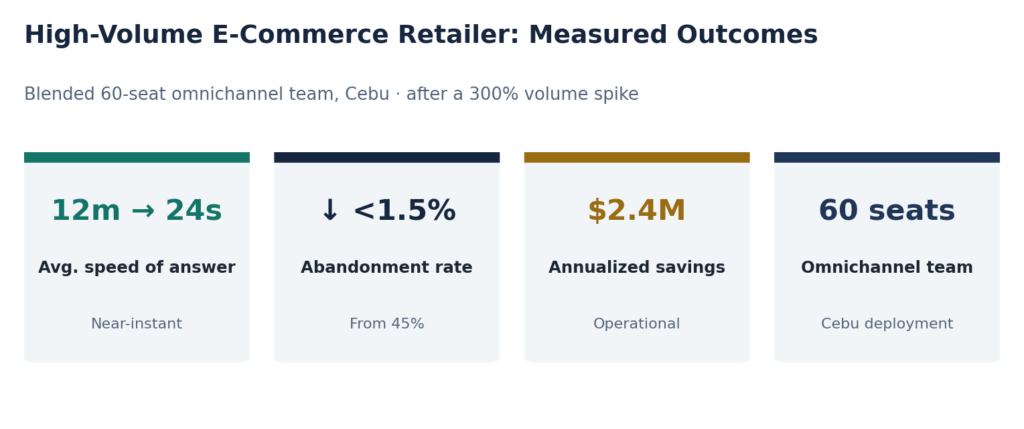
Figure 4. Measured outcomes of the high-volume retail engagement.
Lessons Learned
Avoiding operational friction requires matching specific volume profiles to specialized, agile mid-market operators rather than defaulting to massive, rigid legacy conglomerates.
What Role Does PITON-Global Play in De-Risking the Decision?
PITON-Global is a specialized BPO advisory and consultancy, distinct from traditional broker models. Led by senior contact-center operators, it acts as an objective corporate advocate—providing independent, data-driven oversight across a vetted network of 100+ premium Philippine providers.
Who Is PITON-Global?
PITON-Global is a business-process-outsourcing advisory and consultancy led by international executives with decades of hands-on contact-center governance experience. Rather than commanding a proprietary footprint, it functions as an objective corporate advocate and risk-mitigation partner—guiding enterprises through the Philippine provider landscape to the operators that genuinely fit.
How Does PITON-Global Differ from Traditional Outsourcing Brokers?
Traditional brokers drive biased, commission-based referrals; PITON-Global does not. It provides independent, data-driven oversight across a rigorously vetted network and matches buyers on objective criteria—scale, domain, compliance, and commercial terms—so recommendations serve the client’s interests rather than a referral incentive.
How Does PITON-Global’s Network of 100+ Vetted Providers Benefit Organizations?
A rigorously vetted network of more than 100 premium call-center and back-office operators removes procurement blind spots and the risk of independent sourcing. Because each provider is pre-screened, organizations reach a best-fit shortlist quickly—as in the case above, where three retail-specialized providers were identified within 72 hours.
How Does PITON-Global’s Advisory-Led Vendor Matching Process Work?
PITON-Global evaluates every provider through four objective lenses—scale and volume fit, domain expertise, compliance and security, and commercial optimization—applied across the vetted network. This advisory-led framework eliminates procurement blind spots, protects data integrity, optimizes commercial agreements, and accelerates a precise, best-fit match.

Figure 5. The four objective lenses PITON-Global applies to every provider.
Why Do Organizations Use PITON-Global?
Organizations use PITON-Global to eliminate procurement blind spots, protect data integrity, optimize commercial agreements, and accelerate long-term operational success. By staying strictly vendor-neutral and matching specific requirements to proven providers, the firm de-risks the decision and lets internal teams focus on outcomes rather than vendor hunting.
What Else Should Buyers Weigh Before Deciding?
Buyers most often ask about CSAT impact, data protection, launch timelines, complex Tier-3 capability, and operational minimums. The answers below address each.
What happens to customer-satisfaction scores when moving offshore?
With premium Tier-1 providers, CSAT and NPS typically hold flat or improve. A deep-rooted culture of hospitality, strong English literacy, and service-oriented university education support high-empathy interactions.
How do providers protect sensitive credit-card and healthcare data?
Elite providers operate under audited frameworks: PCI-DSS for payment processing, HIPAA alignment for patient data, and strict office-level controls such as thin-client architectures and paperless environments.
What is the typical timeline to launch a team?
Internal domestic setup can take 90 to 120 days. A vetted provider network can provision infrastructure, align telecom paths, complete brand training, and launch within 30 to 45 days.
Can a Philippine team handle complex Tier-3 tickets?
Yes. Specialized boutique and mid-market providers routinely build dedicated engineering and advanced technical helpdesks staffed by certified computer-science and IT professionals.
What are the operational minimums to work with a high-quality BPO?
While legacy giants enforce 50- to 100-seat minimums, PITON-Global partners with premium mid-market and boutique providers that can execute precise programs starting at 10 to 15 seats.