

Outsourcing structured data annotation to the Philippines turns legacy enterprise documents into retrieval-grade assets: teams clean and extract unstructured text, map it to a schema, link entities and relations into a knowledge graph, and prepare vector embeddings. The payoff is measured in retrieval accuracy — fewer semantic-search misses and less hallucination in RAG agents — so the deliverable is grounded, structured data, not labeled volume. It is one of the newer lines of work within annotation, evaluation and data collection for AI firms.
Key Takeaways
- Structure is the product. RAG accuracy comes from schema-mapped, entity-linked data — not from embedding raw documents at volume.
- Retrieval misses are the metric. The business outcome is fewer semantic-search misses and less hallucination, not labels delivered.
- Schema design is judgment work. Mapping messy legacy documents to a coherent ontology needs domain literacy, not box-drawing.
- Entities and relations beat chunks. A knowledge graph captures relationships naive chunking loses, which is where RAG agents fail.
- Quality is auditable. Linking accuracy and retrieval lift should be measured and reported, not asserted.
What Does an Outsourced Structured-Annotation Pipeline Actually Produce?
Direct answer: A retrieval-grade asset: cleaned and extracted text, mapped to a defined schema, with entities and relations linked into a knowledge graph and prepared for vector embedding — so RAG retrieval is accurate and grounded.
Most enterprise knowledge sits in unstructured legacy documents that a RAG system cannot use well as-is. The pipeline that fixes this is a sequence of judgment-heavy steps: cleaning and extracting text from messy sources, mapping it onto a coherent schema, linking the entities and relations that turn flat text into a knowledge graph (the discipline covered in our guide to named entity recognition at scale), and preparing embeddings so retrieval returns the right context. The output is not a pile of labels; it is a structured asset whose value shows up downstream as retrieval accuracy. The Philippine advantage is a literate, domain-trainable workforce that can hold an enterprise ontology in its head — provided the partner runs schema and linking as disciplines, not piecework.
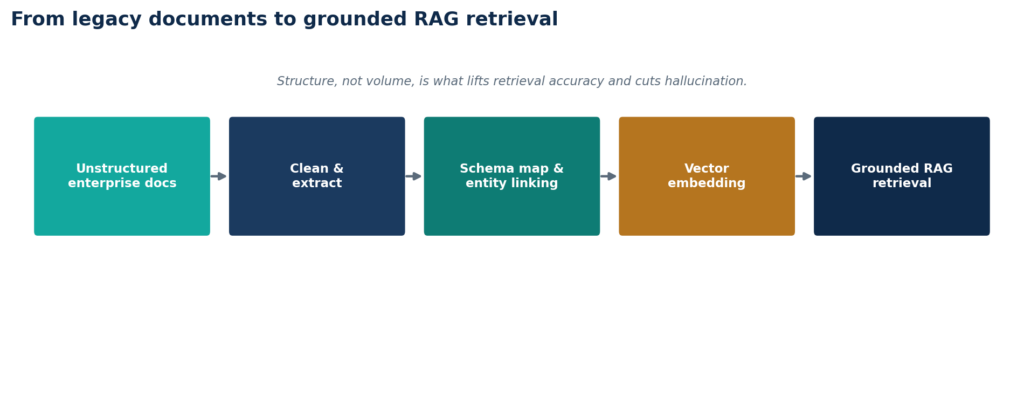
Figure 1 — Structure, not volume, is what lifts retrieval accuracy and cuts hallucination.
According to John Maczynski, CEO, PITON-Global, “Teams pour millions of documents into a vector store, get mediocre retrieval, and blame the model. The problem is upstream: garbage structure in, garbage retrieval out. The work that actually moves the needle is the unglamorous schema-mapping and entity-linking, and that is exactly the work worth outsourcing to a trained team.”
Why Does Structured Grounding Reduce Retrieval Misses and Hallucination?
Direct answer: Because schema-mapped, entity-linked data lets a RAG system retrieve by meaning and relationship rather than surface text — so it finds the right context more often and has less room to fabricate.
Naive RAG chunks documents and hopes semantic search finds the right passage; it frequently misses, and a model with thin or wrong context hallucinates. Structuring the data changes the odds: a knowledge graph encodes the entities and relationships a query actually targets, so retrieval surfaces connected, relevant context instead of lexically similar noise. Fewer misses mean less fabrication. This is why the right metric for the work is retrieval accuracy and miss rate against a benchmark set, not the count of documents processed — and why a serious partner reports that lift.
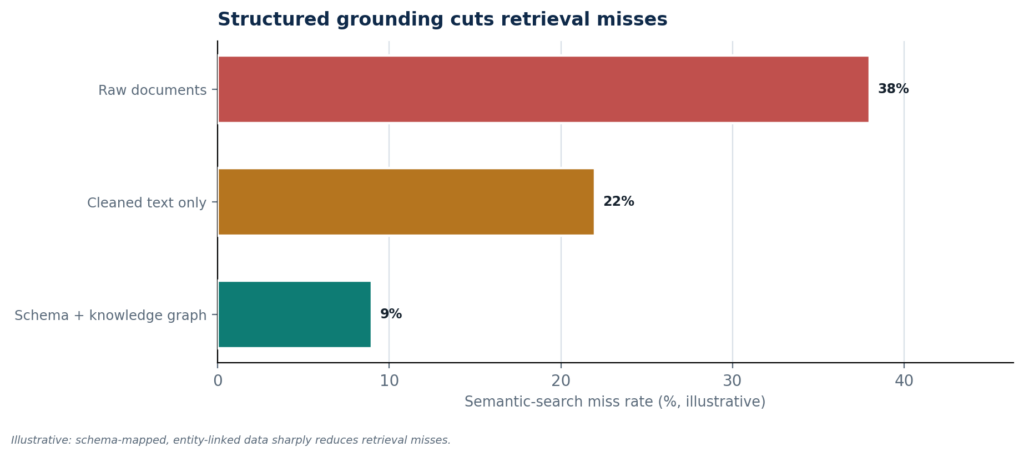
Figure 2 — Illustrative: schema-mapped, entity-linked data sharply reduces semantic-search miss rates.

“The honest test of this work is not how clean the graph looks — it is whether retrieval misses drop on a held-out question set. We hold our partners to that number, because that is the number your RAG agent lives or dies on,” said Ralf Ellspermann, CSO, PITON-Global.
How Do You Keep an Enterprise Knowledge Graph Accurate as the Corpus Grows?
Direct answer: With a standing operation: continuous extraction and linking against a governed schema, disambiguation rules, and ongoing QA against a retrieval benchmark — treating the graph as a living asset, not a one-time build.
A knowledge graph decays the moment new documents, entities, and relationships arrive, so the operation has to be continuous. That means a governed schema that evolves deliberately, disambiguation rules that keep entities from fragmenting or merging incorrectly, and QA that re-checks retrieval lift as the corpus grows. Run as a one-off project, the graph is stale within a quarter; run as a standing pod against a benchmark, it compounds in value, the same living-asset logic that governs annotation for industrial digital twins. The operator should retain ownership of the schema and what enters production, with the partner executing the linking and QA at scale.
“If your RAG agent is hallucinating, nine times out of ten the fix is upstream in the graph, not in the prompt. Pay for the structure and most of the retrieval problem quietly disappears,” noted John Maczynski, CEO, PITON-Global.
Frequently Asked Questions
Is This the Same as Generic Data Labeling?
No. It requires schema mapping, entity and relation linking, and ontology judgment to build a knowledge graph from messy legacy documents — domain-literate work, not high-volume box-drawing, and measured by retrieval accuracy rather than labels delivered. Classic labeling still has its place, for example in preparing training data for on-device edge models, but it solves a different problem.
How Does Structured Annotation Reduce Hallucination?
By letting a RAG system retrieve by meaning and relationship rather than surface text, so it surfaces the right context more often. Better-grounded context leaves the model less room to fabricate, which shows up as a lower retrieval-miss rate.
How Is the Work’s Quality Measured?
By entity- and relation-linking accuracy and, above all, retrieval lift — the drop in semantic-search misses on a held-out benchmark question set. A serious partner reports these numbers rather than asserting quality.
About PITON-Global
PITON-Global helps AI and data teams turn legacy corpora into retrieval-grade knowledge graphs by sourcing the schema- and ontology-literate pods that do it well. From a network of 100-plus leading Philippine BPOs — 20 of them AI-first front-runners — we shortlist partners measured on retrieval lift, not labels-per-hour, backed by a leadership team with 6+ decades of combined global outsourcing experience and 25+ years in the Philippines. Sourcing is free and obligation-free, funded by our provider network.