
Outsourcing driverless long-haul logistics support to the Philippines means running the back-office of autonomous freight: cross-border tracking, hub-to-hub transfer coordination, automated dispatch control, and the pre-dispatch release checklist for Class 8 autonomous trucks. Remote teams run the documented checklist — weather validation, geofencing, and systems diagnostics — and monitor the corridor, while the safety case and the release decision remain the operator’s. It is one part of the broader remote operations support for self-driving fleets.
Key Takeaways
- Outsource the middle-mile back-office. Tracking, hub-to-hub coordination, and dispatch control — not the safety decision.
- The release checklist is the artifact. Weather, geofence, and systems diagnostics gate every corridor release.
- Humans own yards and first/last mile. Autonomy runs the highway middle; people handle the complex ends.
- Monitoring is continuous. A follow-the-sun ROC watches the corridor; the operator holds the safety case.
What in Driverless Long-Haul Can Be Outsourced?
The middle-mile back-office: cross-border freight tracking, hub-to-hub transfer logistics, automated dispatch control, and pre-dispatch checklist execution and corridor monitoring — while the operator retains the safety case and the release decision.
Autonomous freight concentrates autonomy on the highway middle mile and leaves the complex ends — yards, docks, first and last mile — to people. The support that surrounds it is largely information work: tracking loads across borders, coordinating hub-to-hub transfers, running automated dispatch, and executing the pre-dispatch release checklist before a truck enters a corridor, then monitoring that corridor continuously. This back-office runs well from an offshore ROC wired into the fleet and TMS systems, much as the coordination layer for robotic last-mile delivery operations does. What stays with the operator is accountability: the safety case, the operational design domain, and the decision to release a truck onto a public highway.
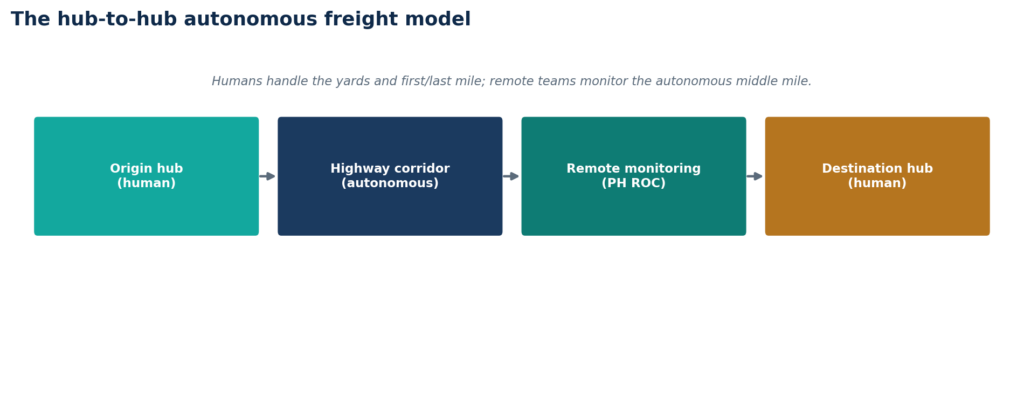
Figure 1 — Humans handle the yards and first/last mile; remote teams monitor the autonomous middle mile
According to John Maczynski, CEO, PITON-Global, “In autonomous trucking the public-road release is the moment everything hinges on, and you do not outsource that decision. What you outsource is the discipline around it — the tracking, the transfer coordination, and the checklist run the same way every time. Consistency at the back-office is what makes the front-line decision defensible.”
What Does the Pre-Dispatch Release Checklist Cover?
The gates that must clear before a corridor release: weather validation within the ODD, geofence and route confirmation, brake-and-systems diagnostic verification, and corridor clearance — executed and documented by the remote team, with the release decision retained by the operator.
Before an autonomous truck is released onto a corridor, a checklist gates the launch, and a remote team can run it rigorously and identically every time. Weather and conditions must sit inside the operational design domain; the route, geofence, and exclusion zones must be confirmed; brake, sensor, and redundancy diagnostics must verify; and the corridor must be clear of incidents, closures, or hand-off issues. The remote team executes and documents each gate, producing an auditable record. The operator — not the partner — makes the actual release decision and owns the safety case behind it, the same line drawn in the liability rules for remote-intervention hand-offs. That division keeps the speed of an offshore operation without ceding accountability.
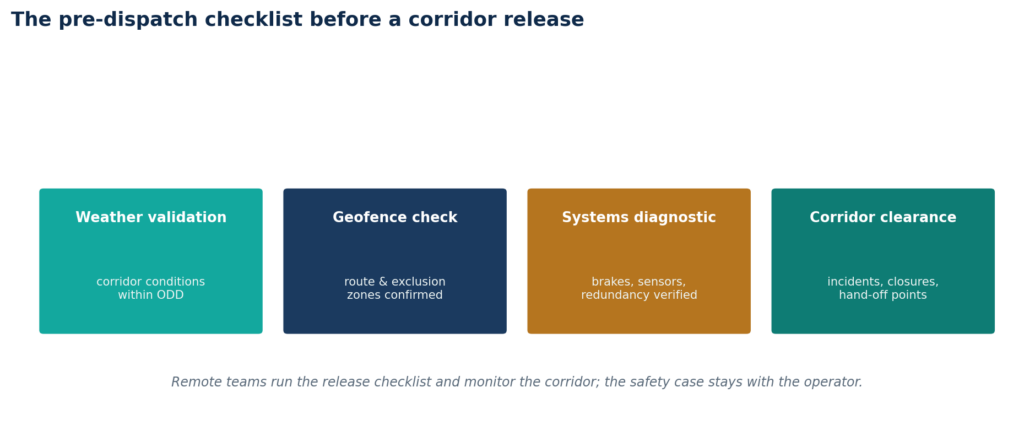
Figure 2 — Remote teams run the release checklist and monitor the corridor; the safety case stays with the operator.

“A checklist run by a tired dispatcher at 3 a.m. is exactly where things slip. A follow-the-sun team running the same documented gates with daytime focus, every release, is a genuine safety asset — and the audit trail it produces is worth as much as the check itself,” said Ralf Ellspermann, CSO, PITON-Global.
Why Does the Philippines Fit Autonomous-Freight Support?
Because the work is around-the-clock, English-language back-office and monitoring at scale — exactly the Philippine strength — delivered follow-the-sun at a fraction of onshore cost, with the safety-critical release decision still held onshore by the operator.
Long-haul autonomy runs continuously across time zones, so its support has to as well, and a single Philippine ROC can track loads, coordinate transfers, run release checklists, and monitor corridors around the clock without night-shift premiums, a saving that a per-mile unit-economics model makes explicit. The workforce has run disciplined, English-language back-office and monitoring operations at scale for decades, which is precisely what this demands, at well below onshore cost. The arrangement keeps the safety-critical release decision onshore with the operator while moving the high-volume, latency-tolerant coordination and monitoring offshore — the same boundary that governs the rest of this portfolio.
“The audit trail from a disciplined checklist is worth as much as the check itself. When a regulator asks how you released that truck, you want a record, not a recollection,” noted John Maczynski, CEO, PITON-Global.
Frequently Asked Questions
What Part of Autonomous Trucking Can Be Outsourced?
The middle-mile back-office: cross-border tracking, hub-to-hub coordination, automated dispatch, pre-dispatch checklist execution, and corridor monitoring. The safety case and the public-road release decision remain the operator’s.
What Is in the Pre-Dispatch Release Checklist?
Weather validation within the ODD, geofence and route confirmation, brake-and-systems diagnostics, and corridor clearance — executed and documented by the remote team, with the operator making the actual release decision.
Why the Philippines for This Work?
Because it is around-the-clock, English-language back-office and monitoring at scale — the Philippine strength — delivered follow-the-sun at a fraction of onshore cost, while the safety-critical release decision stays onshore with the operator.
About PITON-Global
PITON-Global helps autonomous-freight operators source the middle-mile back-office — tracking, hub-to-hub coordination, dispatch, and corridor monitoring — from a network of 100-plus leading Philippine BPOs, 20 of them AI-first front-runners. Backed by a leadership team with 6+ decades of combined global outsourcing experience and 25+ years in the Philippines, our sourcing is free and obligation-free.