
Choosing the best BPO for AI model training outsourcing in the Philippines means scoring on capability and security, not seat rate. Use a weighted scorecard led by data security and IP, then domain QA and accuracy, talent depth and retention, tooling and integration, throughput, and commercial flexibility. Require measured quality metrics, an auditable security posture, and outcome alignment — and walk from any bidder selling labels-per-hour with no accuracy or security commitment.
Key Takeaways
- Security and IP lead. Training data is your most sensitive asset; the partner’s enclave and access controls outrank price.
- Buy measured quality. A credible partner reports accuracy, agreement, and error rates — not just volume.
- Retention is a quality metric. Attrition destroys domain knowledge; a stable, trained pod compounds in accuracy.
- Align on outcomes. Where data maturity allows, tie commercials to usable output and model impact, not hours.
- Price breaks ties. Cheap labels that raise error rates and compute cost are the most expensive option.
What Should the Scorecard Weight When Choosing an AI-Training BPO?
Lead with data security and IP, then domain QA and accuracy, talent depth and retention, tooling and integration, throughput and scale, and commercial flexibility — with price as a tiebreaker, not the headline.
The selection error that costs the most is leading with rate. For model-training work, the partner is handling sensitive data and producing the ground truth your model learns from, so the dimensions that protect you — security and IP posture, measured accuracy, and the retention that preserves domain knowledge — matter far more than the hourly price. A defensible scorecard weights those first, then tooling and integration, throughput, and commercial flexibility. Set the weights to your own risk profile, but keep security and quality dominant and let price separate near-equals.
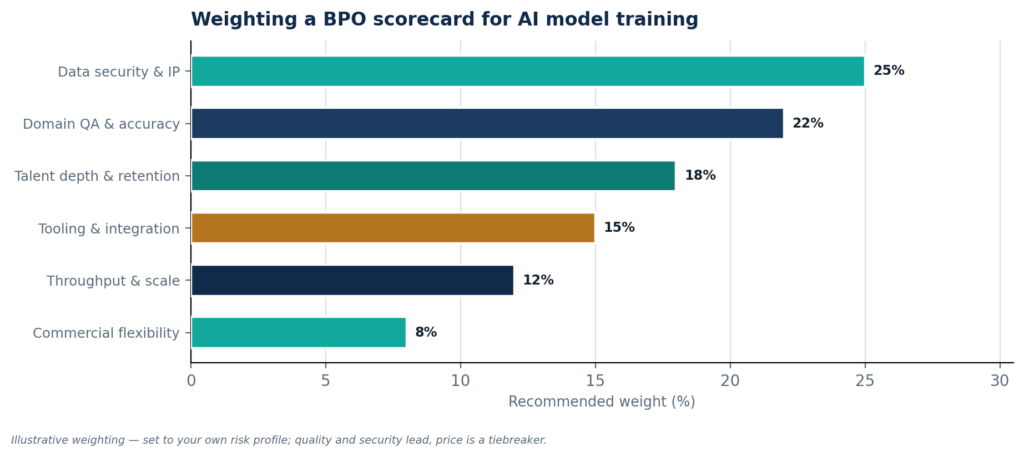
Figure 1 — Illustrative weighting; quality and security lead, price is a tiebreaker.
According to John Maczynski, CEO, PITON-Global, “The cheapest training-data bid is almost never the cheapest model. I have watched teams save fifteen percent on labels and lose it many times over in extra epochs and a security scare. Score the security posture and the measured accuracy first, then — and only then — talk about rate.”
What Must the RFP Require a Bidder to Commit To?
Concrete, auditable commitments: an enclave-based security architecture, reported quality metrics (accuracy, inter-annotator agreement, error budgets), retention figures, integration approach, and a willingness to be measured on usable output.
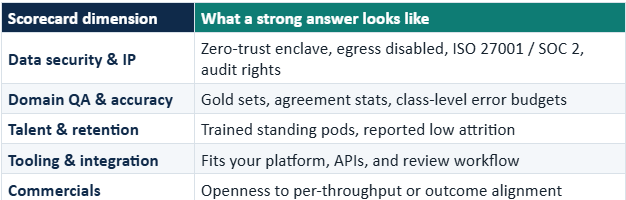
A good RFP forces specifics the weak bidders prefer to leave vague. Require a described security architecture — zero-trust enclave, no local data egress, audit logging, recognized certifications — and the right to audit it. Require the quality metrics they will commit to, with definitions: accuracy against gold sets, inter-annotator agreement, and class-level error budgets. Require attrition and retention numbers, because a churning team cannot hold your ontology. And require an integration plan and openness to outcome-aligned commercials. Asking these as hard requirements separates partners who operate to a standard from those who merely staff seats.
“Ask a provider for their inter-annotator agreement and their attrition rate. The good ones answer in numbers without flinching; the rest change the subject to price. That single exchange tells you almost everything you need to know,” said Ralf Ellspermann, CSO, PITON-Global.
What Are the Red Flags That Should End a Conversation?
Per-label pricing with no quality commitment, no reported QA metrics, refusal of a security audit, and high attrition — each signals a seat vendor, not an alignment-grade partner.
Some answers are disqualifying. A bidder who quotes only per-label rates with no accuracy commitment is selling volume, not a trustworthy dataset. One who cannot produce QA metrics is not measuring the thing that matters. One who will not open their security to audit is hiding the part of the operation that handles your IP. And one with high attrition will lose your domain knowledge faster than it builds it. Any single flag is a reason to move on — which is precisely where a vendor-neutral advisor helps, by surfacing a wider field and asking these questions for you.

Figure 2 — Any one is a reason to walk; cheap labels that degrade the model are the costliest option.
“Run a paid pilot on your own data before you sign anything. A week of real output tells you more than a year of sales decks, and it is the cheapest insurance you will ever buy,” noted John Maczynski, CEO, PITON-Global.
Frequently Asked Questions
What Matters Most When Choosing an AI-Training BPO?
Data security and IP posture and measured quality — accuracy, inter-annotator agreement, error budgets — outrank seat rate, because cheap labels that raise error rates inflate compute cost and risk your most sensitive asset.
How Do You Verify a Partner’s Quality Before Committing?
Require reported metrics with definitions (gold-set accuracy, agreement, class-level error budgets), a paid pilot scored against your benchmark, and a security audit of the enclave and access controls. Strong partners answer in numbers.
What Are the Disqualifying Red Flags?
Per-label pricing with no quality commitment, no QA metrics, refusal of a security audit, and high attrition. Each signals a seat vendor rather than an alignment-grade partner that can hold your ontology.
About PITON-Global
PITON-Global runs vendor-neutral selection for AI model-training outsourcing, building the scorecard, writing the RFP, and shortlisting from a network of 100-plus leading Philippine BPOs — 20 of them AI-first front-runners. Because we are paid by the provider network and never by you, we ask the security and accuracy questions an incumbent hopes you won’t. Our leadership brings 6+ decades of combined global outsourcing experience and 25+ years in the Philippines; advisory is free and carries no obligation.