

With a human review-and-communication layer. As volume exploded, contested outcomes did too — Polymarket logged 1,150+ disputes in 2026, surpassing all of 2025, with 230 disputed contracts and $1B+ in volume in April alone. Each dispute holds user funds and triggers a wave of contacts, while resolution mechanics (exchange-internal or oracle-based) decide outcomes. Platforms outsource the surrounding support — explanations, evidence intake, payout/withdrawal triage — to the Philippines, a choice that rests on a business case that holds up under scrutiny.
Key takeaways
- Disputes are scaling with volume. Polymarket recorded 1,150+ disputes in 2026, already past all of 2025; April 2026 alone saw 230 disputed contracts spanning $1B+ in volume.
- Resolution and support are different jobs. Deciding the outcome (exchange-internal at Kalshi; UMA’s oracle on Polymarket International) is separate from supporting the users affected by it.
- A contested outcome holds funds and floods the queue. “Why did I lose?” explanations, evidence and rule-clarification requests, and payout/withdrawal complaints all spike at once.
- Ambiguity is the root cause. Real-world events rarely fit a clean yes/no; “spirit vs. letter” interpretation drives the hardest, highest-emotion cases.
- The Philippines runs the support layer. Empathetic, accurate, 24/7 dispute communication and case preparation — while final resolution authority stays with the platform or its rules.
Why are settlement disputes becoming prediction markets’ hardest support problem?
Direct answer: Because contested outcomes are scaling with volume, and each one freezes user funds while generating a surge of emotionally charged contacts.
Settlement is where pricing meets reality — and where trust is won or lost. As trading volume exploded through 2026, so did contested resolutions. By the account of Polymarket’s trading terminal Betmoar, more than 1,150 betting disputes occurred on the platform in 2026, surpassing the total for all of 2025. One analysis found that 230 disputed contracts, with combined volume exceeding $1 billion, went through dispute resolution in April 2026 alone — up from roughly 79 contracts six months earlier. Individual cases have been enormous: a single Iran ceasefire contract involved over $280 million in volume, and a dispute over whether Strategy (formerly MicroStrategy) sold Bitcoin by a deadline drew more than $60 million.
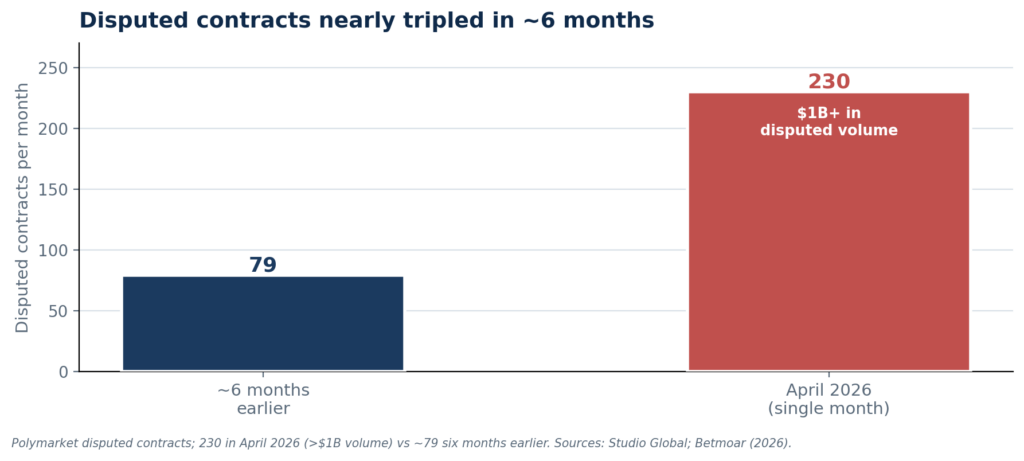
Figure 1 — Disputed contracts nearly tripled in roughly six months. Sources: Studio Global; Betmoar (2026).
Every one of those disputes is a support event before it is a resolution event. Funds are held while the outcome is contested, and affected users want answers immediately — which is precisely the moment a platform’s credibility is most exposed.
“Settlement is the moment of truth for these platforms. A user will forgive a slow page load; they will not forgive being told they lost without a clear, fast, human explanation while their money is locked up. That is a judgment-critical support workflow — it decides whether someone ever trades with you again — and it is exactly the kind of work that cannot be left to an autoresponder.” John Maczynski — CEO, PITON-Global; former Global EVP of the world’s largest BPO provider
How do prediction markets actually resolve a disputed outcome?
Direct answer: Two models dominate: the exchange decides internally (Kalshi), or a decentralized oracle vote decides it (Polymarket International via UMA).
Once a market closes, an outcome is proposed and enters a short challenge period — on Polymarket, typically a two-hour window. If no one disputes, settlement is fast and automatic. If the outcome is challenged, the paths diverge. Kalshi, as a CFTC-regulated exchange clearing through Kalshi Klear, resolves disputes internally under rules filed with a federal regulator. Polymarket’s International book settles in USDC on Polygon via UMA’s Optimistic Oracle, escalating contested cases to a token-weighted vote that typically runs 24–96 hours; its U.S. (CFTC-registered) arm resolves through its own Markets Team.
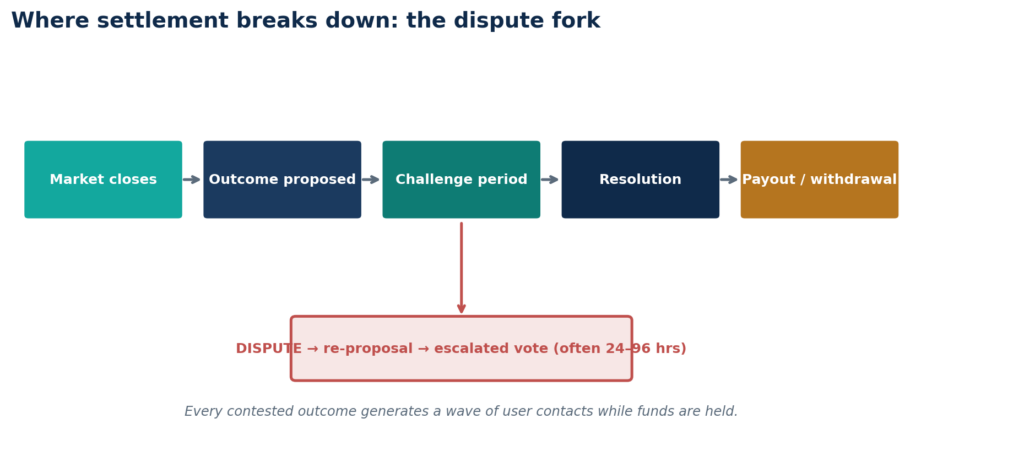
Figure 2 — The lifecycle is simple until an outcome is contested — then funds are held and the support load begins.
Both models have drawn scrutiny — the oracle approach for voting-power concentration, the internal approach for operator influence — but the operational point for support leaders is the same: regardless of who decides, the platform must communicate clearly with users throughout, and that communication burden falls outside the resolution mechanism itself.
What support workload does a single contested outcome create?
Direct answer: A burst of high-emotion contacts: loss explanations, evidence and rule-clarification requests, payout and withdrawal complaints, and repeat follow-ups until funds clear.
The resolution vote may be automated or committee-driven, but the human fallout is not. A contested outcome radiates support work in every direction at once: users asking why they lost, users submitting evidence or demanding a rule clarification, users disputing held payouts and stalled withdrawals, escalations that must be packaged for the resolution team, social-media flare-ups that need monitoring, and repeat contacts from the same users until their funds are released.
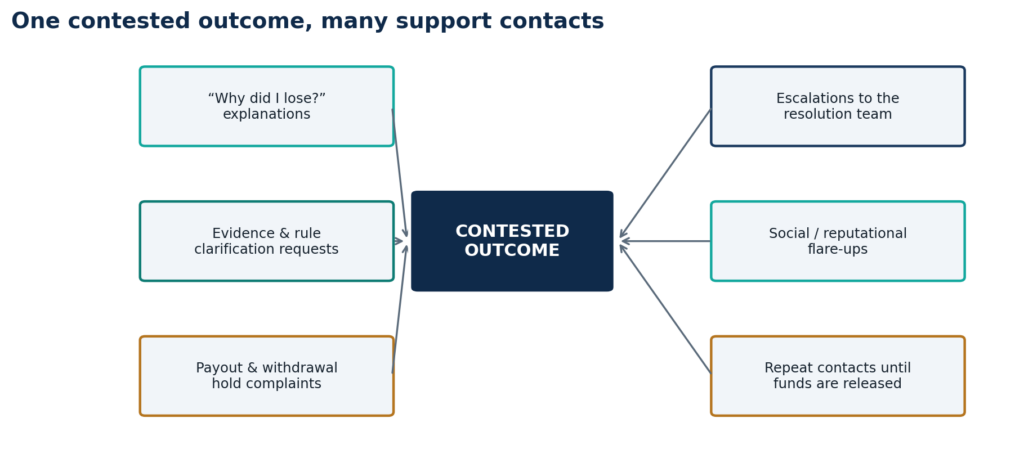
Figure 3 — One contested outcome generates many simultaneous, time-sensitive, emotionally charged contacts.
This is the work users actually judge platforms on. Independent reviewers now explicitly rate prediction markets on dispute paths, cash-out status, withdrawal tracking, and support visibility — and the CFTC reminds participants they are entitled to timely, transparent information about how settlement determinations are made and to submit complaints. Handling that volume with accuracy and empathy, around the clock, is a substantial and unpredictable staffing requirement.
Why is this work so hard to handle in-house?
Direct answer: Because it is spiky, emotionally charged, and judgment-heavy — it demands trained, empathetic reviewers exactly when volume is least predictable.
Dispute load does not arrive evenly. It clusters around the same ambiguous, high-stakes events that drive trading volume, so the support surge and the trading surge hit together. The cases are also among the hardest a contact center handles: the user has lost money, the rules may be genuinely ambiguous, and the agent must explain a decision accurately and calmly without inflaming the situation or mis-stating the outcome. Staffing a permanent in-house team large enough for the worst day means idle specialists on every other day; staffing lean means failing users at the precise moment trust is most fragile. It is also where the cultural strengths of Filipino agents matter most.
“Dispute support is the most emotionally demanding queue in the prediction-market stack — the customer has lost money and wants a human who can explain why, fast and fairly. Filipino teams are exceptional at exactly this: clear, empathetic, accurate communication under pressure, surged into the event window and flexed back down. That blend of composure and care is hard to build in-house and harder to switch on overnight.” Ralf Ellspermann — CSO, PITON-Global; 25-year Philippine BPO veteran
Why send dispute-desk work to the Philippines specifically?
Direct answer: Because it pairs deep CX and case-handling maturity with empathetic, English-fluent communication that scales 24/7 around dispute spikes.
The Philippines’ advantage in this work is the same one that built its global CX reputation: a large, English-fluent, culturally-aligned workforce that excels at high-empathy, judgment-based customer communication, backed by mature case-management and escalation discipline. Specialist teams integrate with a platform’s resolution tooling, help-center content, and rules — typically within a 10–12 week framework — and operate around the clock to match dispute spikes, with clear audit trails for every interaction. The human side of that edge is unpacked in our look at the empathy moat.
| Dispute-support need | Why the Philippines fits |
| Loss & outcome explanations | High-empathy, English-fluent communication that de-escalates rather than inflames. |
| Evidence & clarification intake | Disciplined case handling with structured, auditable documentation. |
| Payout & withdrawal triage | Mature financial-CX workflows and status-tracking communication. |
| Escalation packaging | Clean hand-offs of well-prepared cases to the platform’s resolution team. |
| 24/7 spike coverage | Large base that surges into resolution windows, then flexes down. |
| Consistency & audit | Documented, repeatable handling that supports regulatory transparency. |
Sources: PITON-Global and Philippine BPO sector reporting on CX and case-handling capabilities (2026). Confirm current scope with providers.
Who actually decides the outcome if support is outsourced?
Direct answer: The platform or its resolution mechanism — always. The outsourced team communicates, documents, and triages; it never determines who wins.
The boundary here is bright and non-negotiable. Final resolution authority stays where it belongs: with the exchange’s rules and Markets Team, or the platform’s oracle mechanism, under the governing terms of use. The Philippine support layer handles everything around that decision — explaining outcomes, collecting and structuring user evidence, triaging payout and withdrawal issues, preparing escalations, and keeping users informed during the challenge and voting windows. Done well, that support layer actually strengthens the platform’s regulatory posture, because every interaction is logged, consistent, and auditable — the kind of clean record regulators increasingly expect when they ask how settlement determinations were communicated. The same execution-versus-authority split applies when firms offshore administrative back-office work.
“The platforms that handle disputes well don’t outsource the verdict — they outsource the care around it. We help operators find Philippine partners with genuine financial-CX and case-handling depth, structured so the platform keeps full resolution authority and a clean audit trail. We make that match free of charge and with no obligation, because we earn through our partner network, not the platform.” John Maczynski — CEO, PITON-Global; former Global EVP of the world’s largest BPO provider
Frequently asked questions
How are prediction-market settlement disputes resolved?
After a market closes, an outcome is proposed and enters a challenge period. Unchallenged outcomes settle automatically; challenged ones are decided either internally by the exchange (Kalshi) or by a decentralized token-weighted vote via UMA (Polymarket International), often within 24–96 hours.
Why do disputes create so much customer-support work?
Because a contested outcome holds user funds and triggers a simultaneous surge of loss explanations, evidence and rule-clarification requests, payout and withdrawal complaints, escalations, and repeat follow-ups — all time-sensitive and emotionally charged.
Can dispute resolution itself be outsourced?
No. The outcome decision stays with the platform’s rules and resolution mechanism. What is outsourced is the support around it — communication, evidence intake, payout/withdrawal triage, and escalation packaging — with full audit trails.
Why the Philippines for dispute and settlement support?
It combines deep, English-fluent CX and financial case-handling maturity with high-empathy communication that scales 24/7 around dispute spikes — ideal for explaining losses calmly and accurately while keeping resolution authority with the platform.
About PITON-Global
PITON-Global is a vendor-neutral outsourcing advisory with 25+ years in the Philippine market, connecting high-growth and regulated platforms with industry-leading BPO providers across financial CX, trust & safety, and complex support. We help prediction-market operators source and vet the right Philippine dispute- and settlement-support partner — free of charge and with no obligation.
Editorial note: dispute figures, resolution mechanics, and platform policies are current as of mid-2026 and drawn from the sources above; they change quickly — verify against primary sources before acting. Outsourced support must be structured so final resolution authority and audit trails remain with the platform.