

With layered, scalable onboarding. As sanctions exposure and geo-circumvention drew regulatory fire in 2026 — even pseudonymous Polymarket began tightening KYC — platforms must verify identity, screen against sanctions and watchlists, enforce jurisdiction gates, and triage alerts at event-driven scale. The Philippines provides the compliance-grade, 24/7 execution layer for that work, one of the six arguments for Philippine delivery, while final decisions and filings stay with the platform.
Key takeaways
- KYC is no longer optional. Under CFTC oversight, Kalshi runs mandatory KYC; in 2026, even pseudonymous Polymarket began tightening identity verification amid sanctions and geo-circumvention pressure.
- Onboarding is a multi-gate process. Identity capture, document and liveness verification, sanctions/PEP screening, geo and age gating, and risk scoring — each a regulated checkpoint.
- Demand is spiky. New-account onboarding surges around catalyst events (elections, conflicts, the 2026 World Cup), so verification capacity must scale on demand.
- Geo-enforcement is now a core control. Bots, indirect routing, and Telegram tools attempt to bypass blocks; OFAC-sanctioned regions must be reliably excluded.
- The Philippines runs the execution layer. A recognized hub for Tier-1 KYC/AML, entity resolution, and SAR support — with final approvals and filings retained by the platform’s compliance officers.
Why has AML/KYC become unavoidable for prediction markets?
Direct answer: Because sanctions exposure, geo-circumvention, and a federal probe have made identity verification a condition of operating.
The compliance posture of the sector shifted decisively in 2026. Polymarket — long known for a pseudonymous, wallet-only model — began moving toward stricter trader identity controls amid risks tied to sanctions, AML requirements, and the circumvention of geographic blocks, with reports describing a push for government-ID verification to distinguish legitimate users from those linked to sanctioned entities or restricted regions. Regulators worldwide added pressure: Spain blocked local access to both Polymarket and Kalshi over alleged unlicensed gambling and inadequate identity and age checks, Brazil moved against dozens of platforms, and the U.S. House Oversight probe explicitly pressed both companies on how they verify domestic and foreign users and enforce geographic restrictions.
Kalshi, operating as a CFTC-regulated designated contract market, already runs mandatory KYC; the broader signal of 2026 is that pure pseudonymous trading is becoming unsustainable as global AML and sanctions enforcement intensifies. Compliance, increasingly, defines operational viability.
“In 2026, a partner’s value is measured by their ability to manage judgment-critical workflows that automation alone cannot solve — and onboarding a regulated user base is exactly that. The moment regulators ask how you verify identity and enforce sanctions, KYC stops being a signup form and becomes the control that decides whether you can operate at all.” John Maczynski — CEO, PITON-Global; former Global EVP of the world’s largest BPO provider
What does prediction-market onboarding actually involve?
Direct answer: Five regulated gates: identity capture, verification, sanctions and PEP screening, geo and eligibility checks, and risk scoring.
Compliant onboarding is not a single check but a sequence of regulated gates, each of which can reject or escalate an applicant. It begins with identity capture (government ID and a selfie), proceeds through document and liveness verification, then sanctions, politically-exposed-person, and watchlist screening, followed by jurisdiction and age gating, and finally a risk score that routes the user to approve, manual review, or deny. Manual review and denials are where human judgment, the core of the empathy moat Filipino teams offer, still matters.
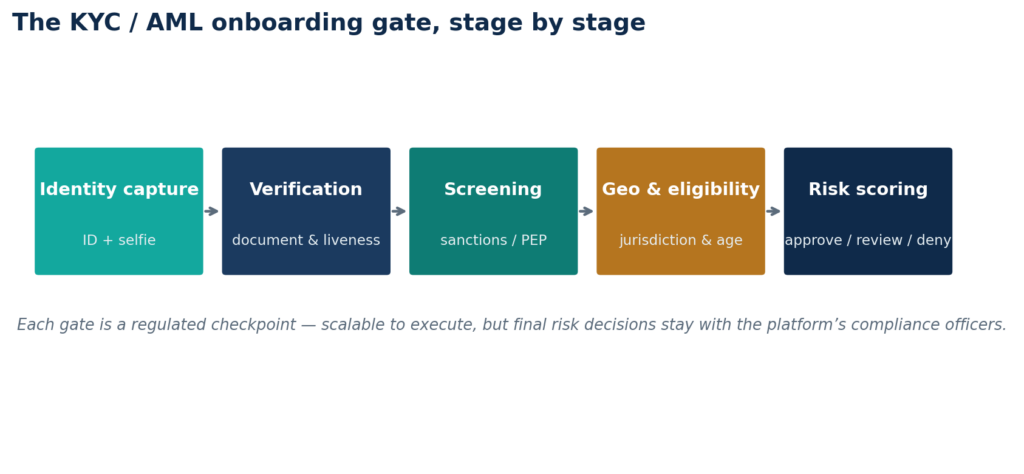
Figure 1 — Each onboarding gate is a regulated checkpoint; volume and complexity make it labor-intensive at scale.
Every gate generates work that scales with sign-ups: documents to review, liveness anomalies to adjudicate, screening hits to clear or escalate, and edge cases to investigate. Payment processors frequently require formal assurance that these controls — AML/KYC, sanctions, and data-security standards such as PCI DSS — are in place before they will service a platform, which makes onboarding quality a commercial prerequisite, not just a regulatory one.
Why does onboarding demand spike — and why does that favor outsourcing?
Direct answer: Because sign-ups cluster around catalyst events, creating verification surges a fixed in-house team cannot absorb efficiently.
Prediction-market sign-ups are event-driven. A contested election, a geopolitical flashpoint, or a marquee sporting event such as the 2026 FIFA World Cup drives waves of new users who all need verifying at once — precisely when existing users are also most active. Staffing the verification function to the peak means carrying idle reviewers between events; staffing to the baseline means slow onboarding and abandoned sign-ups at the moments that matter most.

Figure 2 — Identity-verification demand concentrates around catalyst events — a strong fit for elastic, outsourced capacity.
An elastic, outsourced onboarding layer resolves the tension: it surges reviewers into the spike and flexes back down afterward, while maintaining consistent quality and turnaround. For a regulated platform, speed-to-verified is also a growth lever — every hour a legitimate user waits is conversion at risk. The same surge pattern hits settlement-dispute support after contested outcomes.
“Onboarding is the spikiest workload in the whole prediction-market stack — a major event lands and you get a flood of new users who all need verifying in the same window. The Philippines is purpose-built for that: large, trained KYC/AML teams that scale into the surge, clear the queue, and keep quality high, then flex back down when the event passes.” Ralf Ellspermann — CSO, PITON-Global; 25-year Philippine BPO veteran
Can identity and sanctions checks be outsourced without losing control?
Direct answer: Yes — the execution scales offshore while final approvals, regulatory filings, and accountability stay with the platform.
The Philippines is now a recognized global hub for Tier-1 KYC and AML work, including complex entity resolution and the preparation of suspicious-activity report packages — with the model explicitly preserving the regulated boundary. Specialists handle identity verification, document and liveness review, initial sanctions and PEP screening, alert triage, case preparation, and draft investigation or SAR packages. The platform’s own compliance officers retain the decisions that must stay in-house: final approve/deny calls, regulatory filings, licensed sign-off, risk-appetite and policy ownership, and regulator-facing accountability. Cultural fit matters here too, as our piece on Filipino agents’ cultural competitiveness explains.
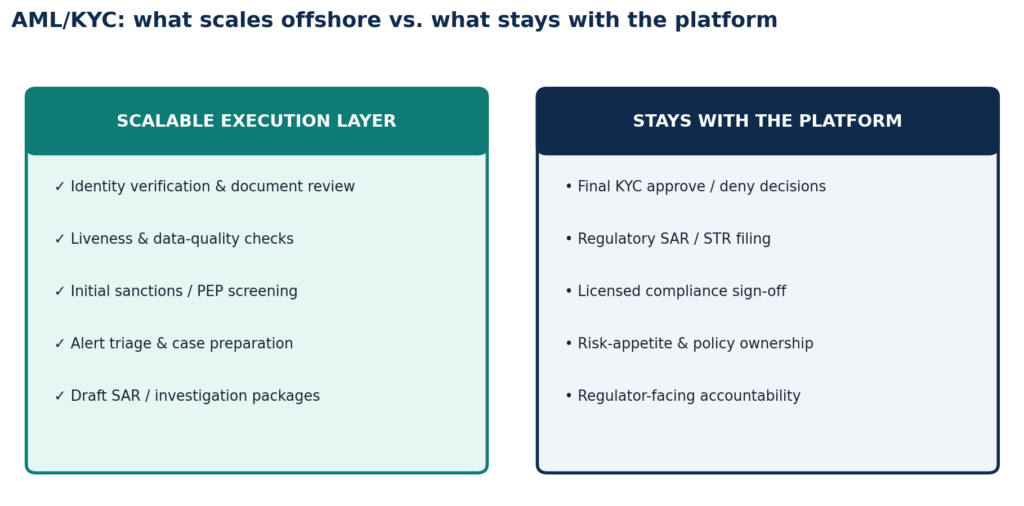
Figure 3 — The defensible split: scalable execution offshore; decision rights and filings retained by the platform.
| Onboarding need | Why the Philippines fits |
| High-volume verification | Large, trained KYC/AML workforce that surges with sign-up spikes. |
| Sanctions / PEP screening | Experienced alert triage and entity-resolution capability. |
| SAR / case support | Proven preparation of investigation and SAR packages for domestic sign-off. |
| Geo & eligibility checks | Disciplined, auditable handling of jurisdiction and age gating. |
| 24/7 turnaround | Round-the-clock coverage aligned to U.S. and ANZ hours. |
| Data security | Mature controls and governance aligned to standards such as PCI DSS. |
Sources: PITON-Global and Philippine BFSI/fintech outsourcing reporting (2026). Confirm current scope and certifications with providers.
“The mistake is thinking outsourcing KYC means outsourcing the regulator’s phone call — it doesn’t. The final decision and the filing stay with the platform; the Philippine team gives you the scalable, auditable execution layer underneath. We help operators find partners with genuine Tier-1 AML/KYC depth, matched to their jurisdictions, free of charge and with no obligation.” John Maczynski — CEO, PITON-Global; former Global EVP of the world’s largest BPO provider
Frequently asked questions
Do prediction markets require KYC?
It depends on structure. CFTC-regulated platforms such as Kalshi require mandatory KYC. Pseudonymous models historically required little, but in 2026 even Polymarket began tightening identity verification amid sanctions and geo-circumvention pressure.
What steps make up KYC/AML onboarding?
Identity capture, document and liveness verification, sanctions/PEP and watchlist screening, jurisdiction and age gating, and a final risk score routing the applicant to approve, review, or deny.
Why outsource onboarding to the Philippines?
It is a recognized hub for Tier-1 KYC/AML, entity resolution, and SAR support, with a large, English-fluent workforce that scales 24/7 around catalyst-driven sign-up surges — while final decisions remain with the platform.
What must stay in-house when KYC is outsourced?
Final approve/deny decisions, regulatory filings (such as SARs), licensed compliance sign-off, risk-appetite and policy ownership, and regulator-facing accountability. The outsourced team performs verification, screening, triage, and case preparation.
About PITON-Global
PITON-Global is a vendor-neutral outsourcing advisory with 25+ years in the Philippine market, connecting high-growth and regulated platforms with industry-leading BPO providers across KYC/AML, trust & safety, and complex CX. We help prediction-market operators source and vet the right Philippine onboarding and compliance-support partner — free of charge and with no obligation.
Editorial note: regulatory details and platform policies are current as of mid-2026 and drawn from the sources above; they change quickly — verify against primary sources before acting. Outsourcing arrangements must be structured to keep final compliance decisions and filings with the platform.