They deploy secure, private-cloud environments that act as “AI Governors,” keeping model outputs aligned with brand voice and regulation. Human-in-the-loop workflows let skilled Filipino agents fine-tune responses in real time, balancing AI efficiency with the empathy that high-stakes interactions demand. The 2026 story is no longer labor arbitrage — it is intelligence arbitrage.
For corporate service buyers, the question has shifted from the cost of an agent to the quality of the AI governance that agent provides. The sections below break down why the Philippines leads this model, how the integration works technically, and how to evaluate whether a provider can be trusted with your proprietary model.
Why Is the Philippines Becoming the Hub for AI-Governed Outsourcing?
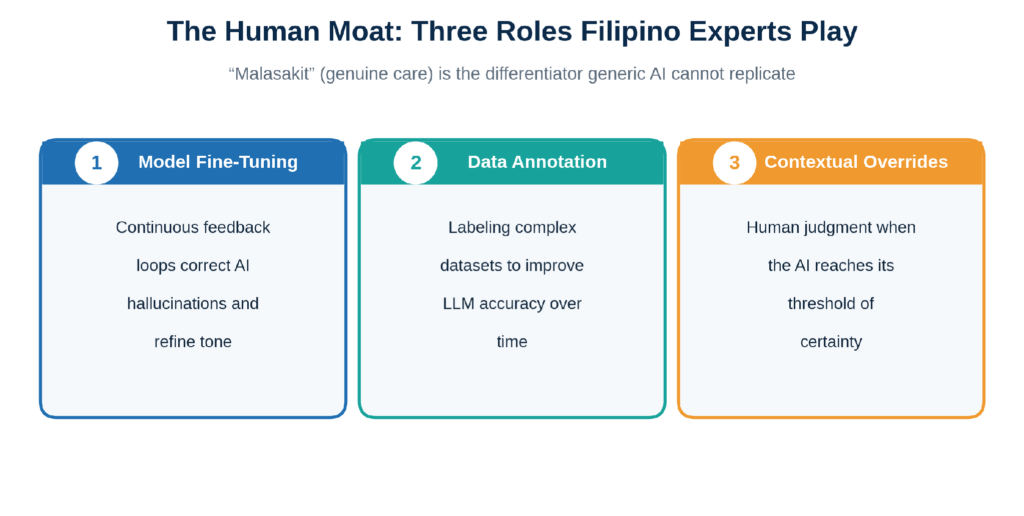
Because it pivoted from the call-center model to a high-value AI ecosystem built on “Malasakit” — genuine care. That human element forms a moat generic AI cannot cross. Bots handle password resets; they falter on complex, emotionally charged B2B interactions. Top providers now act as training grounds where local experts govern the AI.
Generic AI can resolve a password reset or a routine billing query, but it lacks the contextual judgment to navigate a frustrated enterprise customer whose contract is on the line. This is where Filipino providers have built a durable advantage: they pair model speed with human discernment. Across top-tier operators, that translates into three governing roles.
Model Fine-Tuning
Continuous feedback loops catch AI hallucinations and refine tone, so the model’s voice stays on-brand as products, policies, and customer sentiment shift over time.
Data Annotation
Experts label and structure complex datasets that steadily improve the model’s accuracy — the unglamorous work that separates a reliable assistant from an unpredictable one.
Contextual Overrides
When the AI reaches the edge of its certainty, a human steps in. That override is both an immediate save for the customer and a training signal for the next iteration of the model.
How Does the Technical Integration Actually Work?
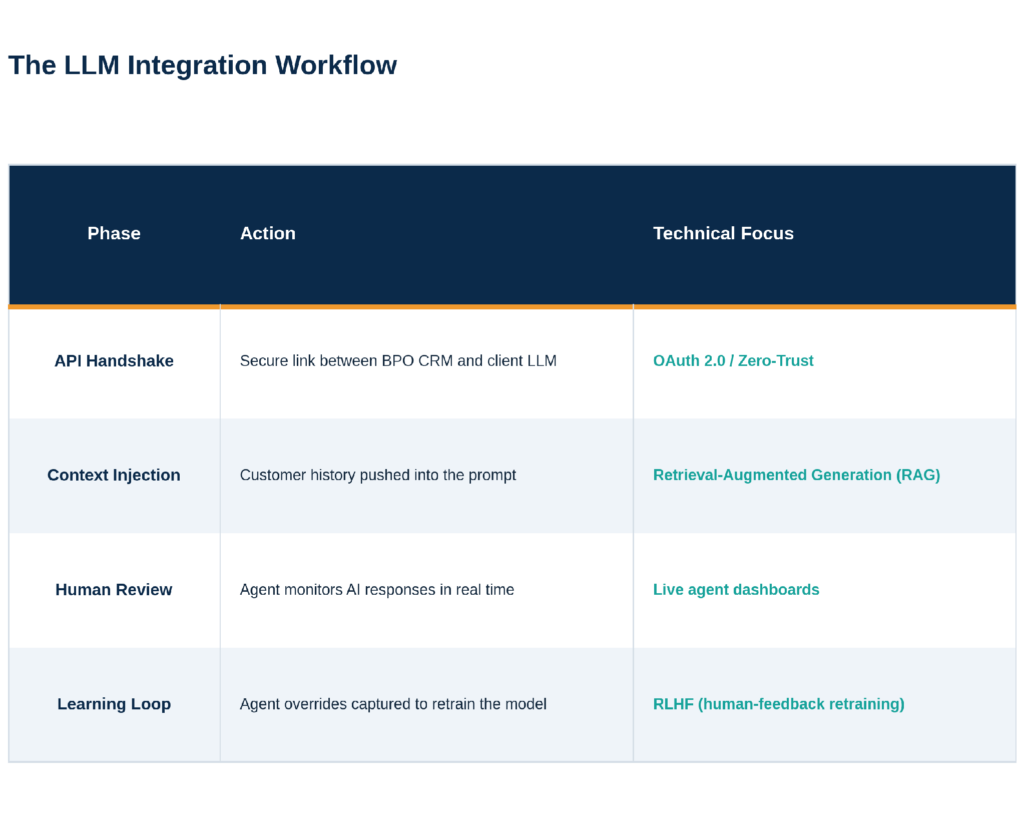
Integration runs inside secure, PEZA-accredited zones built for data sovereignty. A “hybrid-API” approach keeps the client’s private LLM in their own cloud, securely linked to the BPO’s agent desktop. Customer context is injected through retrieval-augmented generation, agents review every draft, and their overrides feed back to retrain the model.
The architecture is deliberately conservative with data. Rather than copying a sensitive model into a third-party environment, the client’s LLM stays in the client’s cloud and is reached over a hardened, zero-trust connection. The BPO’s role is to wrap that model in context, oversight, and a feedback loop — never to take custody of it. The diagram below traces a single inquiry through that loop.

Each phase has a specific technical anchor, from the secure handshake that opens the session to the reinforcement learning that closes it:
What Is the Strategic Value of the “AI Pilot” Model?
It reframes the purchase. You are not buying a cheap seat; you are buying the architectural rigor that keeps your AI from becoming a brand liability. The quality gap between median and top-tier operators is wider than most buyers assume — and the best providers lead with resolution rates, not low prices.
An “AI Pilot” is a skilled agent who supervises the model rather than competing with it — catching errors, supplying context, and steering tone before a customer ever sees a response. The economic logic is straightforward: a single mishandled, AI-generated reply can cost more in reputation than years of marginal savings on seat rates.
“The market is fragmented, and the quality gap between the median operator and the top 1% is wider than buyers assume. When a provider opens with ‘we’re the cheapest,’ that tells you exactly what they compete on — and it is not your customer experience. You aren’t just paying for an agent; you are paying for the architectural rigour that ensures your AI doesn’t become a brand liability.”
— John Maczynski, CEO, PITON-Global
What Does Successful AI-Integrated CX Look Like in Practice?
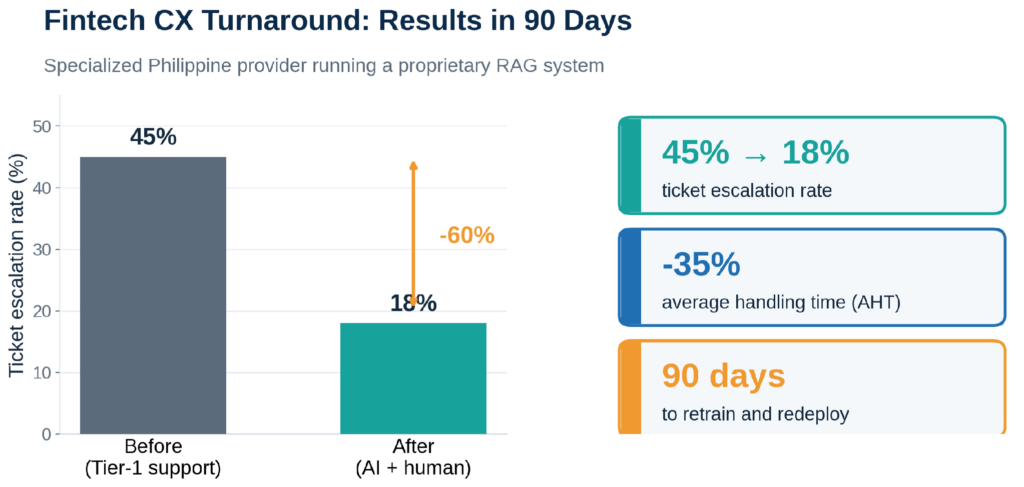
A fintech client cut a 45% Tier-1 escalation rate to 18% within 90 days by moving to a specialized Philippine provider running a proprietary RAG system. An AI workspace suggested responses from the client’s knowledge base, validated by human agents. Average handling time fell 35%, freeing staff for higher-value consulting work.
The fix was not “more AI” — it was better-governed AI. By grounding the model in the client’s own knowledge base and routing every draft through a human checkpoint, the provider turned a leaky Tier-1 queue into a reliable first line of resolution. The freed capacity did not disappear; it shifted toward consultative roles that generate more value per interaction.