

To transition a legacy BPO program to an AI-first framework, shift from a headcount-based (FTE) model to an outcome-based pricing structure, then deploy a hybrid “Human-in-the-Loop” architecture, the model behind outsourced programs rebuilt around agentic AI. Audit vendor infrastructure across your portfolio, route repetitive Tier-1 volume to specialized Agentic AI workflows, and reserve skilled Filipino agents for complex, high-empathy escalations. Sequence matters: restructure the commercial contract first, because the wrong incentive model will quietly defeat even the best technology.
Key Takeaways
- Fix the contract before the tech — FTE pricing structurally penalizes automation.
- Move to per-resolution or shared-savings pricing tied to outcomes, not hours.
- Keep humans in the loop for empathy, compliance, and edge cases.
- Migrate in controlled phases — never flip a switch on live customers.
What are the structural roadblocks of legacy BPO contracts?
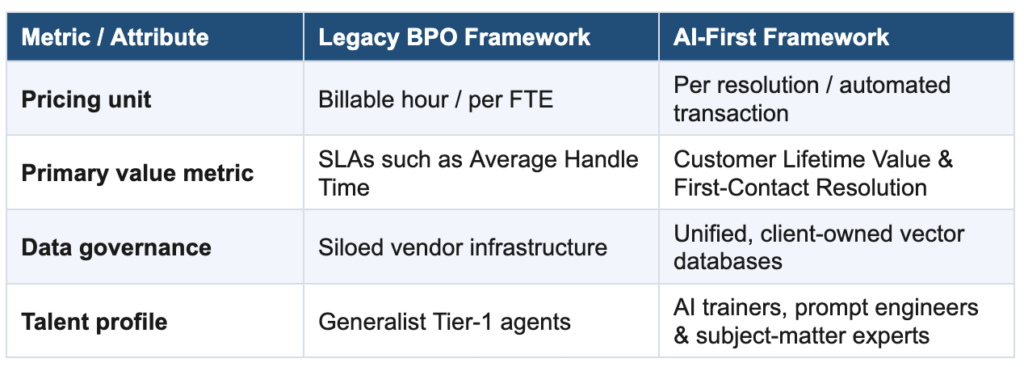
The biggest barrier to AI modernization is rarely the technology — it is the volume-driven outsourcing contract underneath it. Legacy agreements reward providers for maximizing Full-Time Equivalent (FTE) headcount, which directly contradicts the efficiency goals of automation. A vendor paid by the staffed seat has no rational reason to deflect a ticket; every automated resolution erases billable hours.
To remove that conflict of interest, enterprises must restructure agreements around outcome-based or shared-savings pricing, where the provider earns more by resolving issues faster and more accurately — not by adding bodies. In a shared-savings model, automation gains are split on a pre-agreed curve, so vendor and client are finally pulling in the same direction.
The Pricing Architecture Shift
“The billable-hour model is fundamentally dead for enterprises aiming for true digital transformation. If your BPO provider makes more money simply by putting more bodies in seats, they face a structural disincentive to automate. The path forward requires a shared-risk model where the vendor is rewarded for efficiency, data precision, and friction-free customer outcomes.” — John Maczynski, CEO, PITON-Global
How do I audit and prepare my Philippines portfolio for Agentic AI?
Transition begins with a rigorous audit of the vendor ecosystem. Across a portfolio of more than 100 vetted Philippine call centers and back-office providers, PITON-Global applies a proprietary three-tier readiness matrix that scores each vendor’s structural fitness for AI integration. Three signals separate the AI-ready from the rest, and the audit should also verify the AI credentials of vendor leadership.
The AI-Ready Vendor Checklist
Infrastructure & API maturity
Systems must support low-latency webhooks and secure, real-time data streaming into large language models.
Data security & compliance
Verified adherence to ISO 27001, SOC 2 Type II, and the Philippines Data Privacy Act of 2012.
The talent pivot
Active upskilling that converts Tier-1 agents into AI copilots and workflow-exception managers, backed by hiring from the universities producing AI and data talent.
Client-owned vector databases are the non-negotiable foundation: they keep proprietary knowledge portable and prevent the vendor lock-in that has trapped so many legacy programs. The reference architecture below reads bottom-up — a secure data core feeds an AI orchestration layer, which escalates only the hardest cases to elite human specialists — the human-in-the-loop layer that governs AI-generated support.
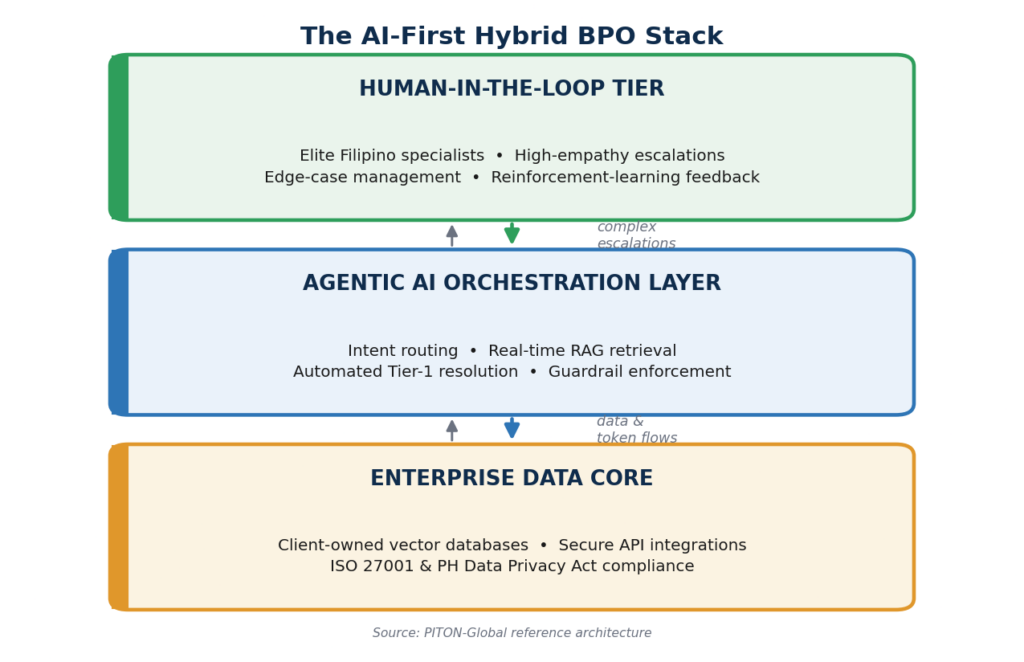
Figure 1 — The hybrid stack pairs Agentic AI for Tier-1 volume with a human-in-the-loop tier for empathy and edge cases.
What does a successful AI-first migration look like in practice?
Moving too fast triggers operational disruption and a collapse in customer satisfaction. A durable transition follows a tightly controlled, phased plan that protects the customer experience at every step — validating the AI quietly before it ever touches a live customer.
Case Study · High-Ticket Fintech Support
The challenge
A global fintech needed to modernize a legacy 350-FTE care program in Manila without degrading its high CSAT baseline.
The strategy
PITON-Global converted hourly billing into a tiered cost-per-resolution contract, deployed a fine-tuned RAG agent to deflect repetitive inquiries (balance checks, transaction disputes), and routed compliance and high-net-worth escalations to elite Filipino financial-service specialists.
The 12-Week Phased Migration
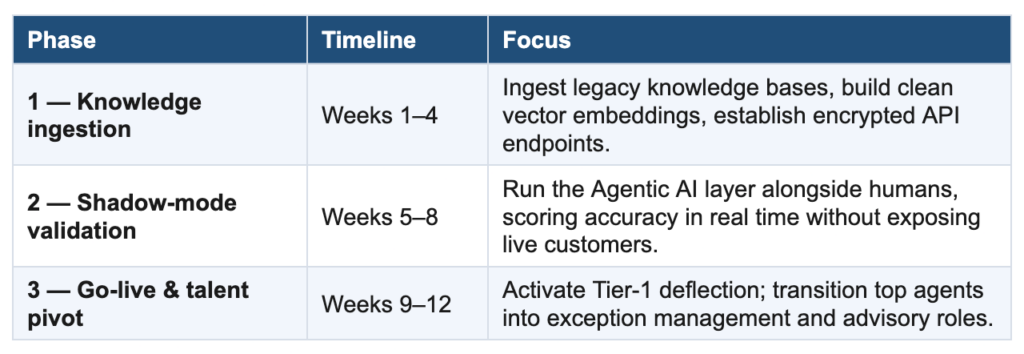
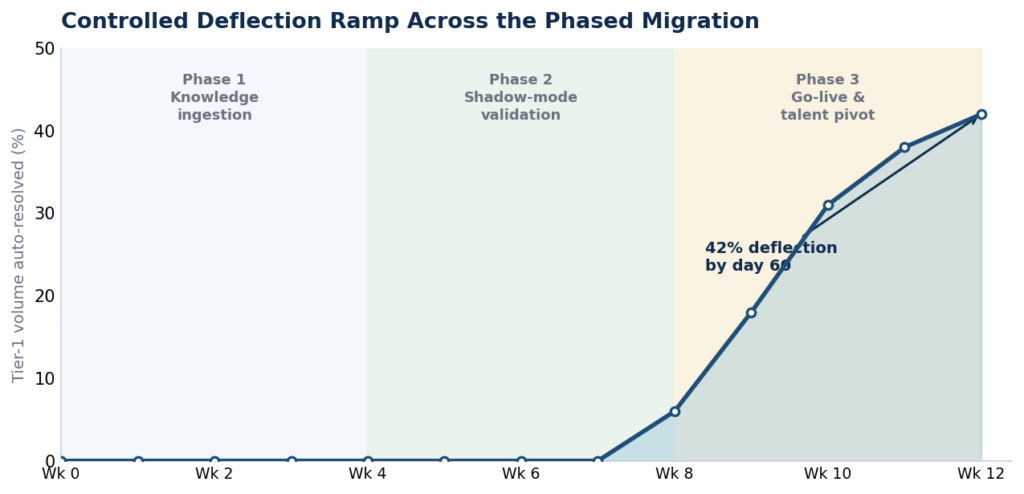
Figure 2 — Deflection stays at zero through shadow mode, then ramps to a substantial share of inbound volume by day 60.
By shifting to this hybrid model, the enterprise realized immediate, compounding efficiencies — without sacrificing its premium service baseline.
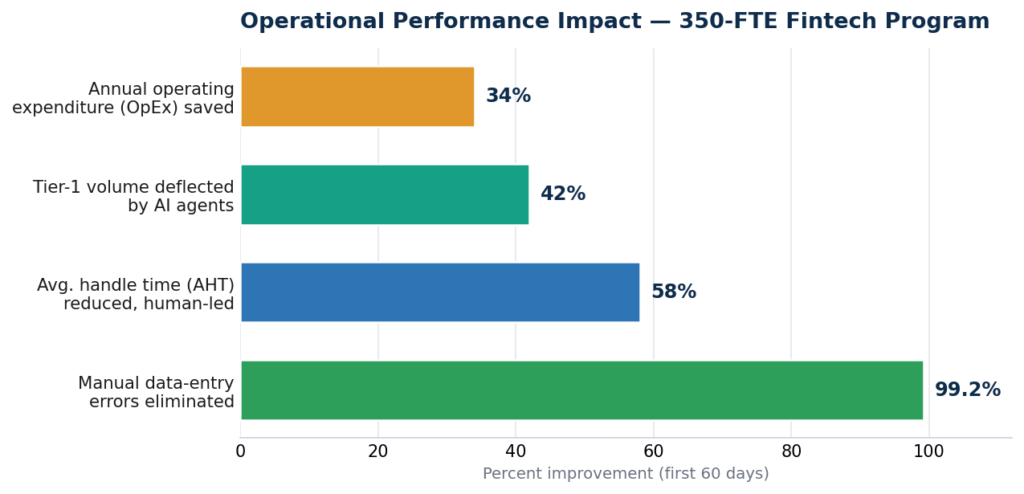
Figure 3 — Headline outcomes across the first 60 days of the hybrid AI-first program.
How will Google’s shifting algorithms view your AI-first content?
As Google Search leans deeper into AI Overviews and conversational results, the criteria for visibility have fundamentally shifted. The old model rewarded keyword volume; the new model rewards information gain and demonstrable E-E-A-T — Experience, Expertise, Authoritativeness, and Trustworthiness.
Google’s Helpful Content System prioritizes primary sources that provide unique, first-party data and highly specific operational insight that generic AI cannot reproduce. To stay visible, enterprise BPO content must move past generic definitions and publish proprietary frameworks, verified benchmarks, and concrete case studies — then structure them as clear tables, atomic answers, and labeled visuals that conversational models can confidently cite and surface.
Methodology & Sources
Performance figures are drawn from a single anonymized PITON-Global fintech engagement (350 FTEs, Manila) measured over the first 60 days post go-live; results vary by program complexity, baseline maturity, and contact mix. Compliance frameworks referenced: ISO 27001, SOC 2 Type II, and the Philippines Data Privacy Act of 2012 (Republic Act No. 10173).