

On this page
- Key Takeaways
- What Strategic Shifts Are Philippine BPOs Making to Offset Wage Inflation?
- How Does Geographic Diversification Beyond Metro Manila Control Operating Expenses?
- What Role Does Artificial Intelligence Play in Neutralizing Labor Inflation?
- How Are Contractual Structures Evolving to Protect Buyer Budgets?
- What Does Inflation-Proof Sourcing Look Like in Practice?
- Why Do Enterprise Buyers Work with PITON-Global for Strategic Sourcing?
- Frequently Asked Questions
BPO companies in the Philippines manage rising labor costs by combining provincial expansion to Tier-2 and Tier-3 hubs, AI-assisted agent co-pilots, and value-added specialized service tiers. Rather than absorbing wage increases or passing them to clients, top providers use process automation and outcome-based pricing to hold target operating margins while preserving a substantial cost advantage over Western markets. Because base pay is only one input into what goes into a loaded hourly rate, buyers should judge each of these levers by its effect on the fully loaded per-agent figure rather than on wages alone.
Key Takeaways
- Provincial diversification: Leading providers expand outside Metro Manila to cities such as Cebu, Clark, Davao, and Iloilo, lowering real estate overhead and securing materially lower baseline wage costs.
- Generative AI integration: BPOs deploy agent-assist AI tools to shorten Average Handle Time and increase First Contact Resolution, neutralizing statutory wage inflation through operational throughput.
- Shift to high-value services: Organizations pivot from transactional voice support toward complex technical, financial, and digital services that command higher hourly billing rates.
- Outcome-based contracting: Managed service agreements increasingly link provider margins to key performance indicators and business outcomes rather than pure headcounts.
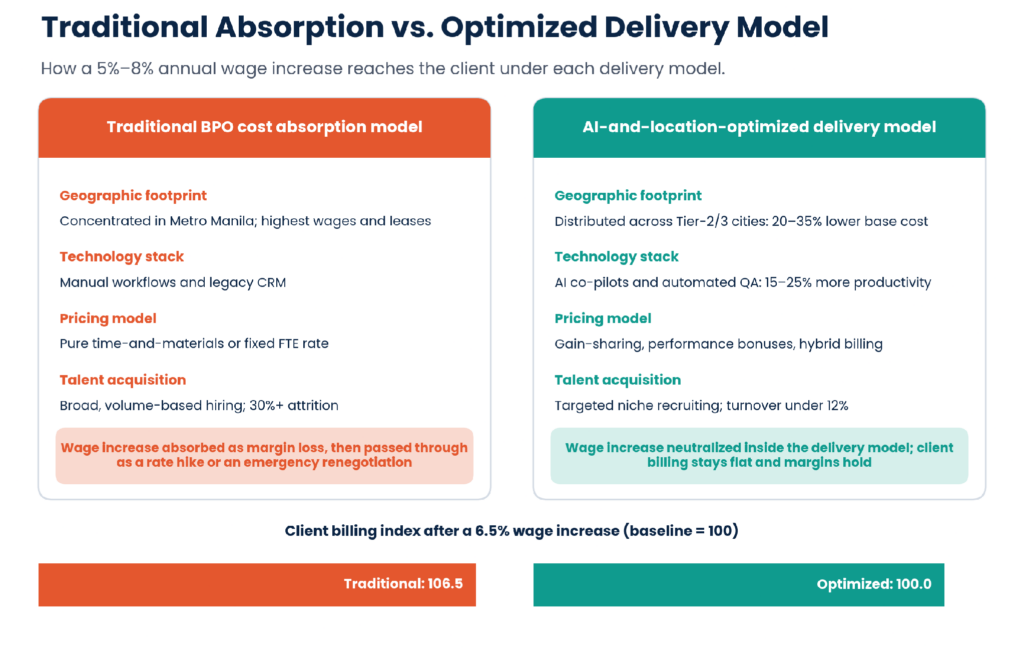
Figure 1. Traditional cost absorption versus an AI-and-location-optimized delivery model: how an annual wage increase reaches the client under each.
What Strategic Shifts Are Philippine BPOs Making to Offset Wage Inflation?
Labor costs in the Philippine BPO sector rise every year on statutory minimum wage updates, urban inflation, and competition for specialized talent. Providers counter by distributing delivery across Tier-2 and Tier-3 cities (lower base compensation and facility overhead), deploying AI co-pilots and automated QA (higher throughput per agent), moving to gain-sharing and hybrid billing, and recruiting for niche skills.
To counter margin pressure without sacrificing service quality, Philippine BPO companies are restructuring their delivery infrastructure along four dimensions—geographic footprint, technology stack, pricing model, and talent acquisition. The table below sets the traditional approach against the modern cost-management approach and quantifies the operational impact of each shift.
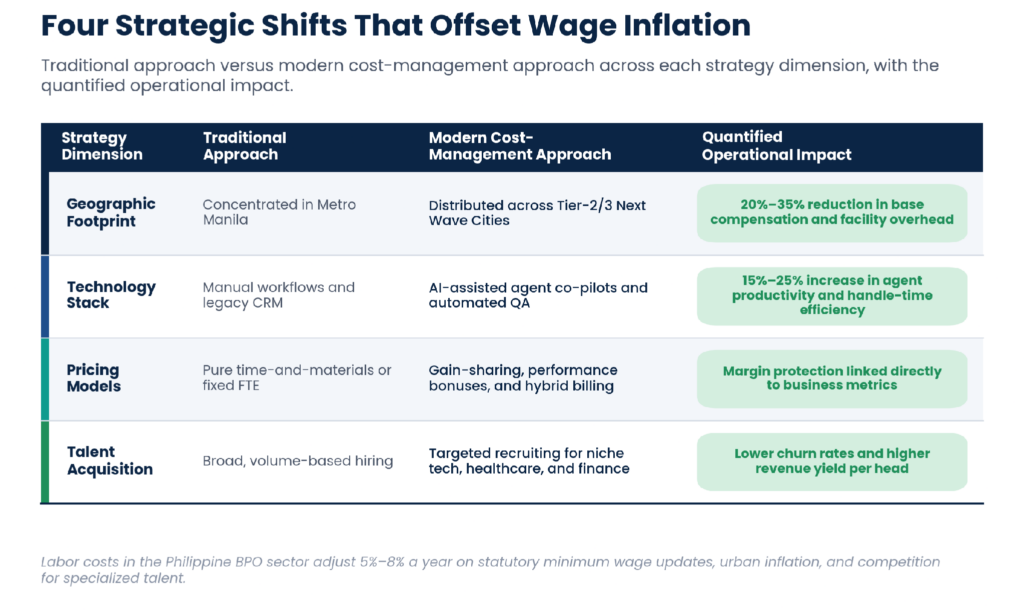
Figure 2. Four strategy dimensions: the traditional approach, the modern cost-management approach, and the quantified operational impact of each shift.
Instead of relying solely on baseline labor arbitrage, providers use technological leverage and regional real estate models to keep full-time equivalent billing rates predictable for foreign enterprise buyers. The result, shown in Figure 1, is that a wage increase which would once have been absorbed as margin loss or passed through as a rate hike is now neutralized inside the delivery model.
How Does Geographic Diversification Beyond Metro Manila Control Operating Expenses?
Expanding to Next Wave Cities like Clark, Dumaguete, Cagayan de Oro, and Bacolod is a structural lever. Provincial baseline wages run well below Metro Manila, annual turnover is a fraction of what urban centers see, and commercial leases cost notably less per square meter, so total delivery savings equal the wage and lease differentials minus the logistics infrastructure expense.
Establishing delivery centers in regional cities—the footprint pattern described in our guide to running a call center in the country—allows service providers to tap deep university graduate pools while managing cost overheads. The arithmetic is simple: total cost of delivery savings equal the provincial base wage differential plus the provincial lease differential, minus the logistics and infrastructure expense of standing up the site—and for most programs the first two terms dwarf the third. Three effects do the work.
Wage Differentials
Baseline wage requirements in provincial cities remain markedly lower than in Metro Manila’s National Capital Region, directly reducing direct payroll expense—and because regional wage boards set lower floors, the differential persists through successive wage orders rather than closing. That persistence is why regional wage dynamics belong among the financial assumptions in a BPO business case rather than in a footnote.
Attrition Containment
Provincial centers experience far lower annual turnover than urban centers, eliminating significant recruiting, onboarding, and retraining costs. Lower churn also protects the productivity gains that AI tools deliver, because tenured agents use them best.
Facility and Infrastructure Savings
Commercial real estate leases in Tier-2 and Tier-3 cities are notably less expensive per square meter, directly benefiting overall operational margins. The map below locates the principal hubs and summarizes their wage and talent profiles.
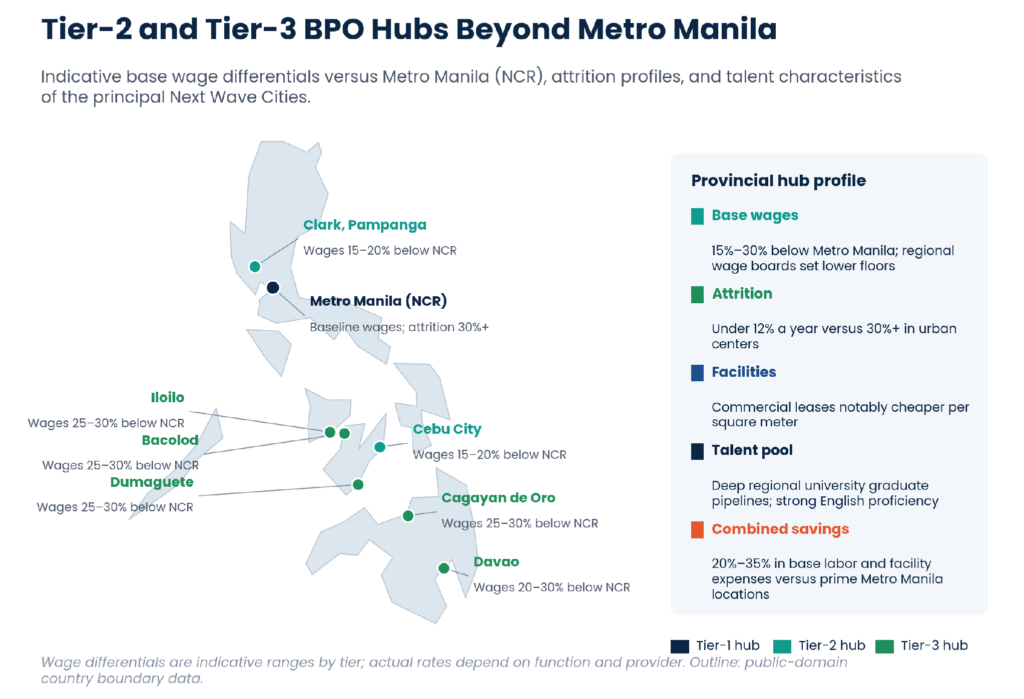
Figure 3. Tier-2 and Tier-3 Philippine BPO hubs with indicative wage differentials versus Metro Manila and regional talent characteristics.
What Role Does Artificial Intelligence Play in Neutralizing Labor Inflation?
Artificial intelligence amplifies agents rather than replacing them. Generative AI co-pilots, real-time sentiment analysis, and automated ticket tagging let agents resolve complex queries faster, so an agent handling materially higher interaction volumes with better resolution rates offsets a typical annual labor cost increase while client billing stays flat. Efficiency gain equals the AHT reduction plus the FCR increase minus AI overhead.
Artificial intelligence is not replacing human agents in top-tier Philippine contact centers; it amplifies agent capabilities to increase overall delivery efficiency. The efficiency gain is easy to state—the reduction in Average Handle Time plus the increase in First Contact Resolution, minus the AI technology overhead—and the chart below shows why it more than covers a typical wage increase.
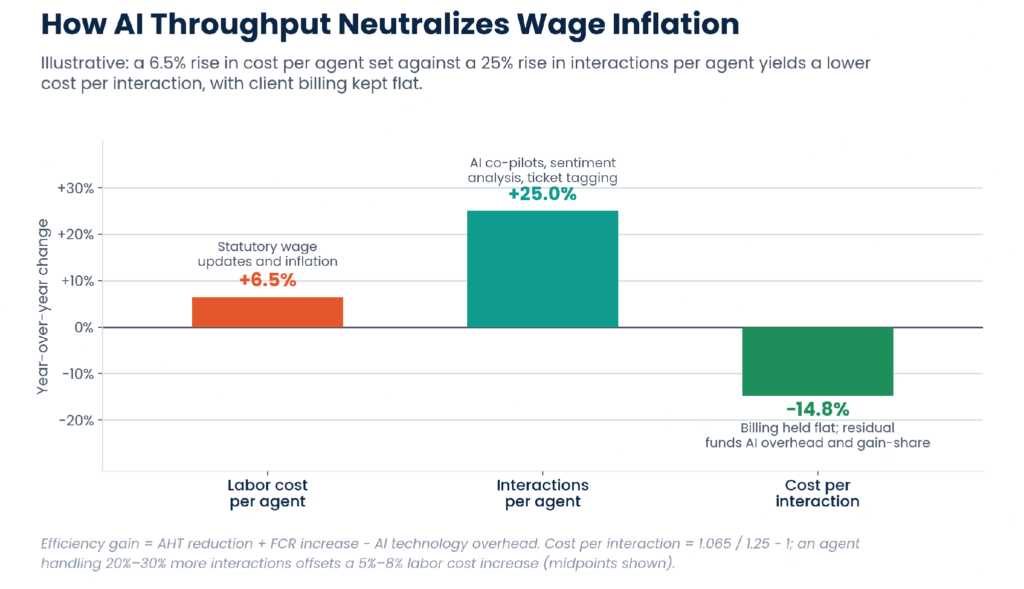
Figure 4. How AI-driven throughput neutralizes wage inflation: a modest rise in cost per agent set against a much larger rise in interactions per agent yields a lower cost per interaction (illustrative).
When an agent handles a meaningfully higher interaction volume with better resolution rates, the provider effectively offsets the year’s increase in labor costs while keeping client billing flat. The residual gain funds the AI tooling itself and, in gain-sharing contracts, is split with the client. This is also the mechanism by which offshore delivery widens a buyer’s operating margin even while local wages climb.
In today’s market, cost control isn’t about paying agents less; it’s about making each agent significantly more productive through intelligent workflow integration. The top Philippine providers aren’t racing to the bottom on price—they are engineering higher value per hour so that rising baseline wages don’t impact client ROI.
— John Maczynski, CEO, PITON-Global
How Are Contractual Structures Evolving to Protect Buyer Budgets?
Enterprise buyers and Philippine BPO partners are moving away from headcount-based billing toward outcome-based pricing tied to CSAT, sales conversions, or first-contact resolution targets; hybrid gain-sharing that rewards vendors for measurable process innovation; and capped inflation escalators that hold annual adjustments below inflation and require providers to absorb the remainder through operational gains.
To mitigate the impact of labor cost increases, contractual structures are evolving in three directions, each of which shifts the incentive to manage inflation from the buyer to the provider.
Outcome-Based Pricing
Payments are tied to concrete operational outcomes—customer satisfaction scores, sales conversions, or first-contact resolution targets—aligning vendor revenue directly with client business success. When the provider is paid per outcome, every productivity gain from AI or retention improves its own margin, and the buyer’s bill no longer moves with headcount.
Hybrid Gain-Sharing
Vendors share financial rewards when they innovate processes that yield measurable savings or operational efficiencies. Gain-sharing turns the provider’s AI roadmap into a shared asset and gives both parties a reason to keep optimizing after go-live.
Capped Inflation Escalators
Multi-year enterprise contracts routinely include contractual annual rate adjustments capped below inflation rates, requiring BPOs to absorb remaining cost variations through operational gains. The chart below shows how the two contract types behave over a five-year term.
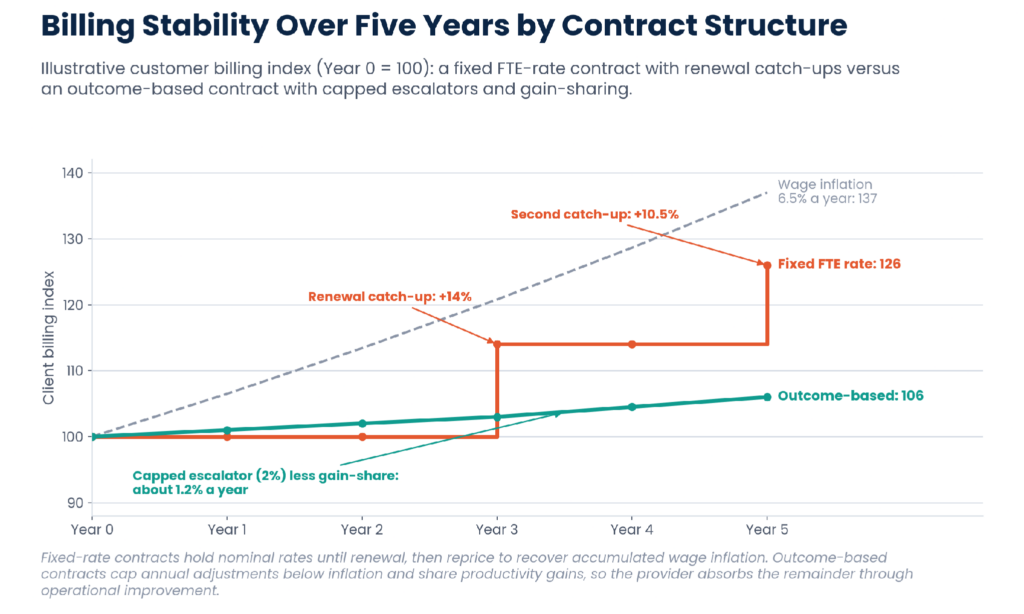
Figure 5. Customer billing over five years under a fixed FTE-rate contract with renewal catch-ups versus a dynamic outcome-based contract with capped escalators (illustrative index).
What Does Inflation-Proof Sourcing Look Like in Practice?
Inflation-proof sourcing pairs provincial talent with AI-assisted delivery and specialized selection. A mid-market US fintech facing double-digit annual cost increases moved customer support and back-office verification to a specialized provider in Clark, Pampanga, cutting total cost by more than a third, lifting First Contact Resolution sharply, and holding attrition low enough to save a six-figure sum each year in retraining.
Client Challenge
A mid-market US fintech firm faced a double-digit annual cost increase across its internal customer support and back-office verification teams while struggling with elevated attrition that kept both teams in a constant state of recruitment and ramp.
Vendor Selection
PITON-Global evaluated more than 100 Philippine providers, looking for candidates with specialized financial compliance expertise and ISO 27001 certification, provincial infrastructure, and integrated AI capabilities, rather than for the lowest headline rate.
Solution Implemented
The client was paired with a specialized mid-sized provider operating in Clark, Pampanga. The vendor deployed an AI-assisted support framework for Tier-1 inquiries while routing complex compliance workflows to dedicated regional agents, under a contract with capped escalators and outcome-linked incentives.
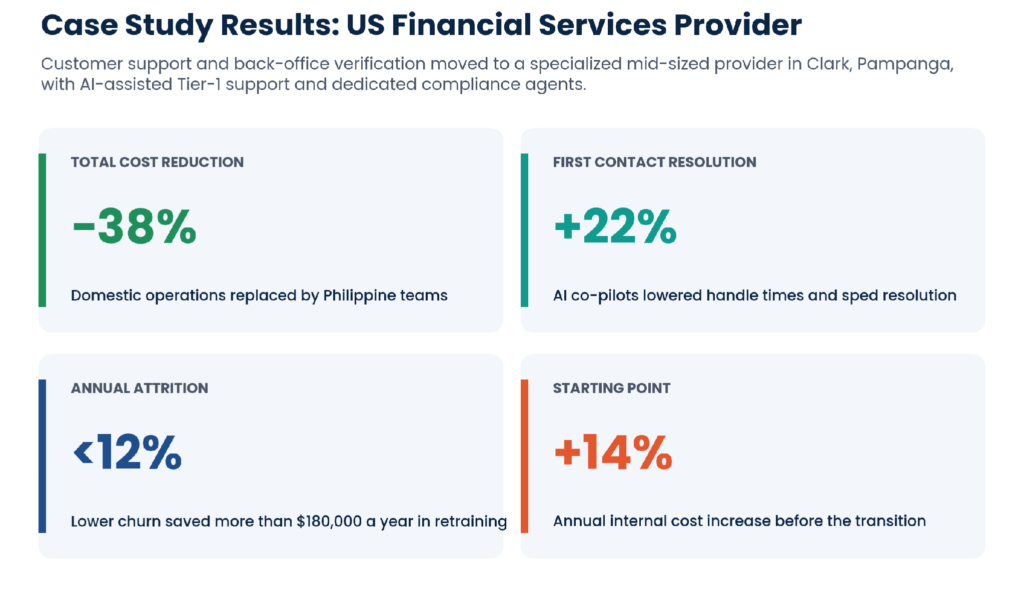
Figure 6. Quantifiable outcomes of the fintech firm’s move to an AI-assisted provincial delivery model.
Outcomes and Lessons
Total cost fell by more than a third as high-cost domestic operations were replaced by high-performing Philippine teams; AI co-pilots lowered handle times and lifted First Contact Resolution markedly; and annual attrition stayed low, saving the client a six-figure sum each year in retraining expense. The lesson: combining provincial talent pools with specialized advisory selection prevents wage inflation from reaching long-term BPO budgets.
Why Do Enterprise Buyers Work with PITON-Global for Strategic Sourcing?
PITON-Global is an executive-level BPO advisory firm that simplifies vendor selection across the Philippines. Unlike traditional brokers that focus on superficial rate matches, it provides advisory-led guidance on partner selection, pricing structures, and risk mitigation, drawing on a network of more than 100 vetted mid-sized and enterprise providers across Metro Manila and the provinces to secure stable, inflation-resistant delivery models.
Who Is PITON-Global?
PITON-Global is an executive-level, vendor-neutral BPO advisory firm headquartered in Manila, led by senior operators with more than 65 combined years of global outsourcing governance. It simplifies vendor selection for enterprise buyers navigating a Philippine market of more than 1,000 providers, with deep, advisory-led guidance on partner selection, pricing structures, and risk mitigation strategies.
How Does PITON-Global Differ from Traditional Outsourcing Brokers?
Traditional BPO brokers focus on superficial rate matches and earn commissions on placement. PITON-Global provides independent analysis that pairs buyer requirements with vendor operational strengths, culture, and technical maturity, audits provider fee structures to eliminate hidden markups, recommends on the buyer’s outcomes rather than provider promotion, and stays engaged through contract structuring and transition.
How Does PITON-Global’s Network of 100+ Vetted Philippine BPO Providers Benefit Organizations?
Access to more than 100 pre-vetted mid-sized and enterprise BPO providers across Metro Manila and provincial regions—Cebu, Clark, Davao, Iloilo, Bacolod, and beyond—lets buyers compare providers on the levers that manage inflation: delivery footprint, AI maturity, retention performance, and pricing transparency. Buyers see which providers engineer value per hour rather than compete on starting rate.
How Does PITON-Global’s Advisory-Led Vendor Matching Process Work?
The process runs from requirements assessment to selection support: mapping program requirements, compliance mandates, and the wage-inflation exposure of the current model; filtering the vetted network for provincial infrastructure, integrated AI capabilities, and specialization; delivering a shortlist within 48–72 hours with rates normalized to fully loaded cost; auditing fee structures for hidden markups; then structuring contracts with capped escalators, outcome-linked pricing, and protected multi-year terms.
Why Do Organizations Use PITON-Global?
Enterprise buyers work with PITON-Global to secure stable, high-value delivery models in the Philippines while protecting operations from inflationary pressures, hidden fees, and sudden service disruptions. Because the advisory service carries no fee for the buyer, it adds an experienced operator’s judgment at the point where a rate-only decision is most tempting.
Frequently Asked Questions
Will rising Philippine labor costs make other offshoring destinations more competitive?
While regions such as India or Latin America offer low baseline rates, the Philippines maintains a dominant edge in voice customer experience, cultural affinity, and English proficiency, keeping its overall value proposition high.
How much lower are BPO costs in Philippine provincial hubs compared to Metro Manila?
Operating in provincial hubs such as Cebu, Davao, or Clark typically delivers substantial savings in base labor and facility expenses compared with prime Metro Manila locations, and the gap persists because regional wage boards set lower floors.
Are Philippine BPO agents trained to work alongside artificial intelligence platforms?
Yes. Leading Philippine providers invest in continuous upskilling programs, training agents to leverage generative AI assistants, automated knowledge bases, and real-time guidance software.
How do BPO providers maintain service quality during rapid inflation periods?
Top providers focus on employee engagement, career path development, performance incentives, and modern hybrid work models to retain top talent and preserve service consistency.
How does PITON-Global ensure pricing transparency when matching clients with providers?
PITON-Global audits provider fee structures to eliminate hidden markups, ensuring contracts feature transparent base wages, overhead margins, and protected multi-year rate terms.