
On this page
- Key Takeaways
- Which Operational Functions Yield the Highest Administrative Relief When Offshored?
- How Do Philippine Providers Absorb Management Overhead Without Creating Communication Friction?
- What Does Administrative Optimization Look Like in Practice?
- Why Is PITON-Global the Preferred Advisory Partner for Enterprise BPO Selection?
- What Are the Most Common Questions About Reducing Administrative Burden Through Philippine Outsourcing?
Outsourcing mid- and back-office tasks to specialized Philippine providers lowers administrative overhead by absorbing high-volume workflows, standardizing transaction-heavy processes, and deploying turnkey management layers. This decouples local headcount growth from rising transaction volumes, freeing onshore core teams to redirect their focus toward higher-value strategic growth.
Key Takeaways
- Operational decoupling: Reallocating administrative tasks breaks the linear link between revenue growth and the domestic overhead of specialized support staff.
- Immediate efficiency gains: Transitioning to structured Philippine operations lowers direct transaction-processing costs by 30–50%, accelerating cycles and lowering error rates.
- Turnkey management layer: Elite providers assume full operational ownership, supplying built-in Team Leads, QA frameworks, and Workforce Management infrastructure.
- Industry-specific advantage: Deploying highly localized, industry-specific workflows provides an analytical and operational edge over generalized internal approaches.
- Risk mitigation (ISO / SOC 2): Tier-1 Philippine infrastructure reduces structural risk through secure networks, strict data governance, and business-continuity compliance.
Which Operational Functions Yield the Highest Administrative Relief When Offshored?
The highest relief comes from three domains: finance and accounting (AP/AR, expense management), human resources (payroll, recruitment operations), and data and master-record integrity (CRM/ERP maintenance, procurement tracking). These are high-volume, repetitive workflows that drain onshore focus.
Enterprise administrative strain rarely stems from a single core workflow; it accumulates through thousands of repeating back-office micro-transactions. When domestic personnel spend their hours resolving basic billing queries, cross-checking vendor invoices, or cleansing data, core business strategy stalls. This is also where decoupling delivers its clearest benefit—transaction volume can climb without a matching rise in domestic administrative headcount.
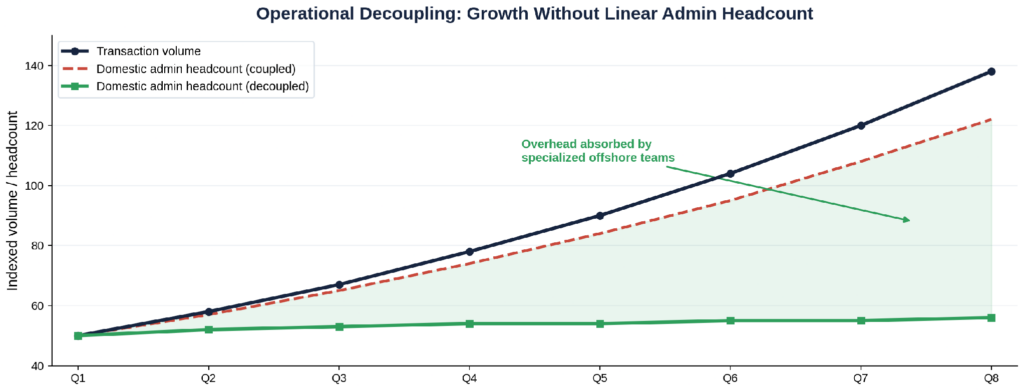
Figure 1. Offshoring decouples growth from administrative headcount: volume rises while domestic admin staff stays flat.
1. Finance and Accounting (F&A) Support
Managing high-volume transactional workflows in-house requires significant oversight. Shifting repetitive accounting tasks addresses this drain directly: accounts payable and receivable (invoice processing, purchase-order matching, collection queues, multi-currency reconciliation) and expense management (receipt verification, policy auditing, cross-border adjustments).
2. Human Resources and Talent Operations
Internal HR departments are frequently bottlenecked by administrative tasks rather than strategic organizational development. Offshoring stabilizes these resource-heavy pipelines: payroll processing (complex calculations, localized tax deductions, wage and attendance inquiries) and recruitment-operations support (resume screening, background checks, ATS updates, multi-stage interview scheduling across time zones).
3. Data Management and Master-Record Integrity
Clean data is vital to corporate health, yet manual entry introduces error and consumes time. Philippine BPO teams bring rigorous process discipline to CRM and ERP maintenance (auditing master data, de-duplicating records, updating renewals and contacts) and to inventory and procurement tracking (logging fulfillment documents, tracking bills of lading, synchronizing supply-chain ledgers in real time). The table below summarizes the relief across all three domains.

Figure 2. Each functional domain, its offshored workflows, annual hours reclaimed, and primary efficiency metric.

Figure 3. Annual internal hours reclaimed by domain, with Data and CRM Ops yielding the widest range.
How Do Philippine Providers Absorb Management Overhead Without Creating Communication Friction?
Premium providers use a fully managed governance model rather than supplying unmanaged assistants. A built-in leadership hierarchy—account manager, team leads, QA, and SMEs—handles daily operations internally, so onshore leadership interacts mainly with one dedicated Account Manager via dashboards and weekly check-ins.
A common concern is that outsourcing might exchange an administrative burden for a vendor-management burden. A poorly selected partner can create communication friction, forcing onshore management into hours of clarifying meetings. To prevent this, premium providers deploy structured teams with an integrated leadership hierarchy rather than unmanaged virtual assistants.
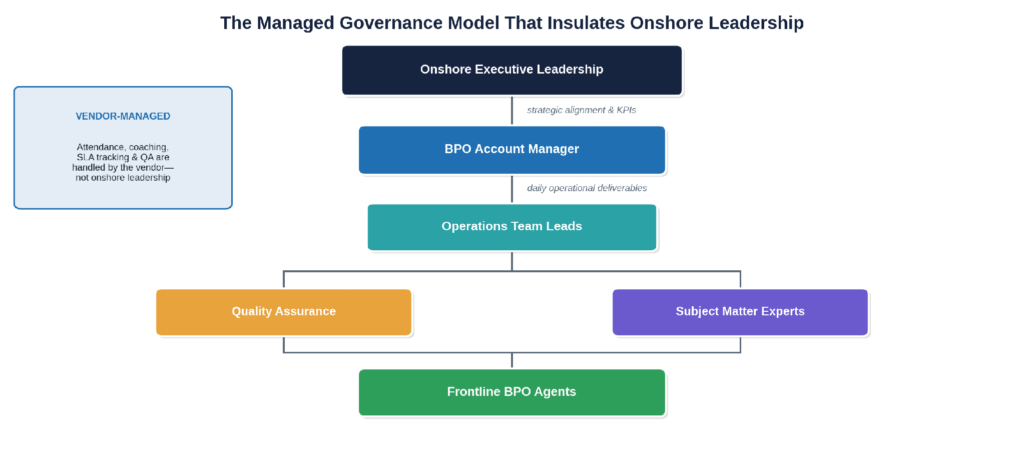
Figure 4. The managed governance hierarchy: vendor-side leads handle daily operations, insulating onshore leadership.
Under this framework, day-to-day operations—attendance monitoring, skills coaching, SLA-adherence tracking, and QA auditing—are handled internally by the vendor’s team leads. Onshore management interacts primarily with a dedicated BPO Account Manager via asynchronous dashboards and high-level weekly check-ins.
The primary goal of a sophisticated outsourcing framework is to offload operational management alongside the task itself. Enterprise leadership shouldn’t be managing individual offshore line items. A top-tier provider serves as a self-sustaining extension of your business operations, executing documented processes under clear SLA constraints.
— John Maczynski, CEO, PITON-Global
What Does Administrative Optimization Look Like in Practice?
In practice, a dedicated specialist team takes over repetitive workflows under a vendor-run Team Lead and QA structure. One healthcare-tech provider reclaimed 180+ executive hours monthly, cut credentialing backlogs 68% in 90 days, sustained 99.4% billing accuracy, and saved over $320,000 annually.
Client Challenge
A high-growth healthcare-technology provider struggled with severe administrative backlogs in billing and credentialing. Onshore operations teams were losing over 45 hours per week to manual paperwork verification, delaying revenue recognition and driving employee burnout.
Vendor Selection and Solution
Partnering with PITON-Global, the company avoided standard web-search procurement in favor of targeted matching, and was paired with a specialized Manila back-office provider with deep healthcare administrative expertise. A dedicated team of 12 Philippine healthcare administrative specialists took over verification, credentialing updates, and billing reconciliations, with a dedicated Team Lead and QA Specialist running all daily workflows under strict data-privacy protocols.

Figure 5. Quantifiable outcomes within 90 days of the administrative-optimization engagement.
Outcomes and Lessons
The engagement reclaimed 180+ hours of monthly capacity for onshore executives, reduced credentialing backlogs 68% within 90 days, sustained 99.4% billing-data accuracy, and saved over $320,000 in annualized overhead. The lesson: successful outsourcing relies on clear standard operating procedures and selecting a partner with a proven track record in your specific industry vertical rather than a generalist.
Why Is PITON-Global the Preferred Advisory Partner for Enterprise BPO Selection?
PITON-Global is an independent, advisory-led firm that de-risks selection across a Philippine market of nearly 800 providers. Drawing on decades of contact-center leadership and a curated network of 100+ vetted providers, it analyzes requirements, defines SLAs, and matches the ideal vendor—shortening selection from months to days.
Who Is PITON-Global?
PITON-Global is an independent advisory firm with deep operational expertise that changes how organizations approach offshore procurement. With decades of hands-on leadership experience evaluating and running global contact centers, its executive team brings a disciplined approach to vendor selection rather than acting as a broker that forwards leads to the highest bidder.
How Does PITON-Global Differ from Traditional Outsourcing Brokers?
Navigating a Philippine landscape of nearly 800 providers carries built-in execution risk, where misalignments in scale, technology, or cultural fit cost time and fracture internal trust. Unlike a traditional broker, PITON-Global applies operational expertise to analyze process requirements, define SLAs, and identify the ideal match—eliminating standard procurement risk.
How Does PITON-Global’s Network of 100+ Vetted Providers Benefit Organizations?
PITON-Global maintains a highly curated network of more than 100 vetted, high-performing BPO providers across the Philippines. Because each is assessed for scale, technology, and cultural fit, mid-market and enterprise buyers can quickly reach a partner genuinely suited to their administrative workflows instead of gambling on an open-market search.
How Does PITON-Global’s Advisory Process Work?
PITON-Global analyzes process requirements, defines SLAs and KPIs, matches against its vetted network, verifies scale, technology, and cultural fit, and establishes a stable long-term partnership—shortening selection timelines from months to days while removing procurement risk.

Figure 6. PITON-Global’s advisory process bridges buyers to the right vetted provider in days, not months.
Why Do Organizations Use PITON-Global?
Organizations use PITON-Global to eliminate procurement risk, shorten selection timelines, and establish stable, long-term operational partnerships. By replacing guesswork with a disciplined, advisory-led match, the firm helps enterprises reduce administrative burden through the right provider rather than a costly mismatch.
What Are the Most Common Questions About Reducing Administrative Burden Through Philippine Outsourcing?
How do we maintain process accuracy and data quality when transitioning tasks to the Philippines?
Accuracy is maintained through structured SOPs, comprehensive KPIs, and independent QA oversight. Premium providers operate within secure, audit-ready environments certified in ISO 27001 and SOC 2 Type II, ensuring strict adherence to data-protection standards.
Will outsourcing administrative tasks cause internal friction or cultural resistance within our domestic team?
Friction typically happens when a transition is poorly communicated. When internal teams understand the offshore team is taking over tedious, repetitive tasks—freeing them for high-value strategic work—the transition is usually met with relief rather than resistance.
What is the typical timeline required to transition back-office administrative processes to a Philippine provider?
A standard back-office transition takes 4 to 8 weeks, including secure network setup, workflow mapping, SOP documentation, pilot testing with a small batch of tasks, and scaling up to full production.
How do Philippine outsourcing companies handle language, scheduling, and time-zone differences?
The industry operates continuously around the clock, aligning fully with your local operating hours—night shifts, weekends, or holidays. English is the primary language of instruction and business in the Philippines, ensuring smooth communication with your home office.
What happens if our administrative volumes fluctuate seasonally?
Established providers offer flexible staffing models built into their master service agreements. Teams scale up or down with seasonal demand, protecting your business from the cost of carrying unneeded internal overhead during slow periods.