
Healthcare outsourcing companies in the Philippines reduce administrative burden by migrating non-clinical workflows to clinically trained back-office teams. By managing revenue cycle processes, utilization management, and EHR documentation, these providers let onshore clinicians practice at the top of their licenses — directly mitigating burnout and optimizing operational throughput.
Key Takeaways
- Clinical resource reclamation: offshoring repetitive documentation returns up to 2.5 hours of daily charting time to onshore physicians, easing burnout.
- Cost-structure transformation: labor arbitrage plus process optimization yields immediate 50%–70% reductions in administrative labor cost.
- Accelerated cash flow: continuously operating billing teams push the Clean Claim Rate above 98%, structurally lowering Days Sales Outstanding.
- Mitigated compliance risk: Tier-1 providers maintain rigorous HIPAA, HITRUST, and SOC 2 Type II protocols around protected health information.
What Specific Workflows Yield the Highest Administrative Relief When Offshored?
The greatest relief comes from non-clinical work that requires clinical literacy yet consumes disproportionate domestic hours: revenue cycle management and prior authorization, real-time clinical documentation and scribing, and care coordination. The Philippines’ deep pool of licensed allied health professionals executes these tasks at a fraction of onshore cost.
Health systems hit their hardest bottlenecks in workflows that demand clinical understanding but are not direct patient care. The structural advantage of the Philippine workforce is its large, deep pool of licensed professionals — registered nurses, pharmacists, and medical technologists — who handle complex clinical-administrative tasks accurately and affordably.
Revenue Cycle Management and Prior Authorization
Front-end tasks such as insurance verification, complex prior-authorization filing, and multi-tier ICD-10/CPT coding routinely delay care. Philippine specialists who understand payor policy matrices intervene early, cutting prior-authorization turnaround from days to hours and removing friction before it reaches the patient.
Clinical Documentation and Scribed Services
Real-time scribing — synchronous or asynchronous — directly resolves the industry’s EHR-fatigue epidemic. Clinicians dictate encounters naturally during or just after a visit, and specialized Philippine scribes populate the EHR remotely, producing structured, compliant, and immediately accessible records.
Care Coordination and the Patient Support Lifecycle
Post-discharge follow-ups, chronic care management enrollment, and inbound scheduling require empathetic, fluent communication. Strong cultural alignment and native-level English proficiency among Philippine agents sustain high patient-satisfaction scores and steady retention.
The comparison below shows where the hourly cost gap and efficiency gains concentrate across the most-offshored workflows.

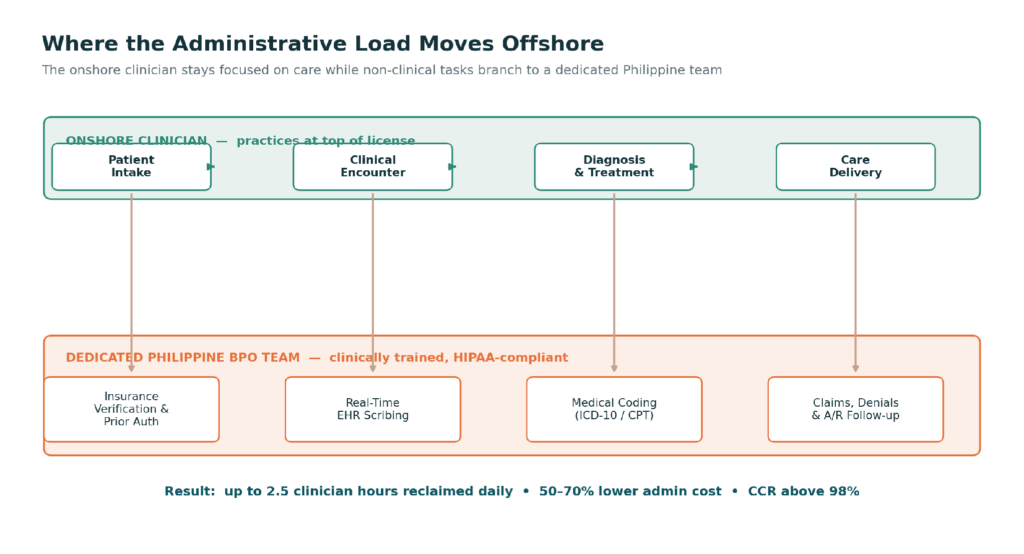
Mapped against a single patient encounter, the design becomes clear: the clinician stays on care while clinically trained offshore teams absorb the administrative tasks branching off at each stage.
What Metrics and Operational Benchmarks Define Success in a Philippine Healthcare BPO Partnership?
Success is measured by hard operational KPIs, not labor savings alone: a Clean Claim Rate above 97.5%, prior-authorization turnaround under 4 hours for urgent cases, coding accuracy above 98% against CMS guidelines, and average A/R days reduced below 35. These belong in the service-level agreement.
Evaluating a Philippine partner means looking well beyond basic labor arbitrage. Enterprise buyers should hold providers to concrete performance indicators that move the health system’s bottom line and clinical satisfaction — and write those targets directly into the contract.
The true value of Philippine healthcare offshoring isn’t just saving 60% on labor; it’s the operational resilience it injects into the enterprise. When a health system deploys Philippine registered nurses to handle complex utilization reviews, they aren’t just cutting costs — they are inserting institutional scale that eliminates payor friction and prevents structural revenue leakage.
— John Maczynski, CEO of PITON-Global
To enforce accountability, high-performance BPO contracts should target the following baseline SLA metrics.

How Did One Hospital Network Eliminate a $14M Claims Backlog?
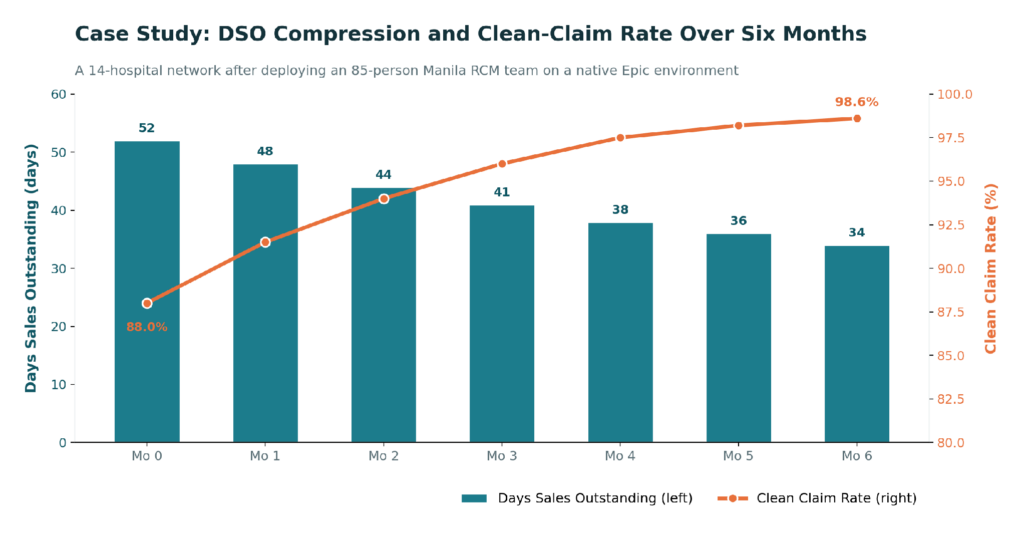
A 14-hospital network facing a 22% RCM vacancy rate and a $14M unbilled-claims backlog cleared it within six months. Deploying an 85-person Manila team on its native Epic environment dropped DSO from 52 to 34 days and stabilized the Clean Claim Rate at 98.6%.
The Challenge
A US health system with 14 regional hospitals carried a critical 22% staff-vacancy rate in its internal RCM department. The shortfall drove a $14 million backlog of unbilled claims and a spike in preventable payor denials.
Selection and Solution
PITON-Global ran an exhaustive, advisory-led assessment and matched the network with a Tier-1 Philippine provider specializing in high-complexity enterprise RCM and native Epic environments. A dedicated team of 85 certified coders and billing specialists deployed in Manila within 45 days, establishing a continuous 24/7 accounts-receivable follow-up cycle and optimized claims scrubbers.
The Outcomes
Within six months, the $14M backlog was fully eliminated, DSO fell from 52 to 34 days, and the Clean Claim Rate stabilized at an industry-leading 98.6%.
Lessons Learned
Integration succeeds when buyers choose partners with native fluency and documented credentials in the exact EHR architecture used onshore — not generic data-entry vendors.
How Should Executives Navigate the Risks and Compliance Realities of Offshoring Health Data?
Executives should vet providers through an uncompromising compliance lens. Top-tier Philippine BPOs operate from secure economic zones with redundant infrastructure, biometric access, clean-desk controls, and AI-driven data-loss prevention — and a dedicated-team delivery model keeps offshore staff working entirely under the client’s workflows.
Data security and regulatory compliance remain the primary barriers to entry for healthcare offshoring. A single lapse can trigger a catastrophic breach and multi-million-dollar penalties, so the diligence bar must be high before any workflow moves.
Regulatory Safeguards and Infrastructure Standards
Leading Philippine BPOs operate from specialized economic zones with redundant power grids and enterprise fiber connectivity. Physical and logical controls include biometric access, strictly enforced clean-desk environments with no recording devices, and advanced AI-driven data-loss-prevention software on every endpoint.
The Trade-off: Operational Control vs. Scale
Third-party providers offer rapid scale but introduce a layer of operational separation. To manage that risk, buyers should avoid shared-resource pools and insist on a dedicated-team model, in which Philippine staff operate exclusively under the client’s internal workflows, proprietary training, and organizational culture.
How Does PITON-Global Mitigate Provider-Selection Risk?
PITON-Global is a premier Philippine BPO advisory and outsourcing consultancy that partners with 100+ vetted providers. Rather than brokering transactions, it audits a health system’s technical, operational, and compliance needs and maps them against its pre-vetted network to identify the ideal provider — accelerating time-to-value.
PITON-Global acts as an institutional guide rather than a transaction broker, working with more than 100 carefully vetted call-center and back-office providers across the Philippines. Its advisory-led vendor-matching process systematically removes the risk of provider selection.
By auditing a health system’s specific technical, operational, and compliance requirements and mapping them against its pre-vetted network, PITON-Global identifies the ideal high-performing provider — accelerating time-to-value and supporting long-term contractual success.
What Do Executives Most Often Ask Before Offshoring Healthcare Operations?
The most common questions cover HIPAA compliance, time-zone alignment, onboarding timelines, direct EHR access, and staff turnover. The concise answers below address each before a deeper engagement begins.
How do Philippine providers handle HIPAA compliance?
Reputable healthcare BPOs mirror US security architectures: end-to-end encrypted transmission, secure VPNs, annual SOC 2 Type II audits, HITRUST certification, and ongoing workforce compliance training under certified privacy officers.
Do Philippine teams work in the same time zones as US health systems?
Yes. Most operate 24/7, aligning shifts precisely to Eastern, Central, Mountain, or Pacific time to support real-time workflows and synchronous patient-care coordination.
What is the typical onboarding timeline for a documentation team?
A standard mid-to-large enterprise deployment — covering security integration, secure EHR credentialing, and clinical workflow training — typically takes 30 to 60 days from final contract execution.
Can teams work directly inside our existing Epic or Cerner systems?
Yes. Remote teams access internal EHR instances securely via Citrix, virtual desktop infrastructure, or secure cloud endpoints, keeping all PHI within the health system’s domestic firewall.
What is the average turnover rate for healthcare BPO staff?
Specialized healthcare BPO teams see lower attrition than the generic sector — typically under 12%–15% annually — driven by higher compensation tiers, clinical career tracks, and professional fulfillment for licensed staff.