

On this page
- Key Takeaways
- What Structural Labor Dynamics Are Driving Onshore Support Bottlenecks?
- How Does the Philippine Talent Ecosystem Resolve These Constraints?
- What Operational Risks and Tradeoffs Must Decision-Makers Manage?
- What Does Stabilizing Scale Look Like in Practice?
- How Does PITON-Global De-Risk the Vendor Selection Process?
- What Are the Most Common Questions About Reducing Hiring Challenges Through Philippine Outsourcing?
Onshore support faces high annual attrition, rising wages, and a shrinking tier-one talent pool. Outsourcing to the Philippines addresses these bottlenecks by giving companies a fully staffed offshore customer support team drawn from an enterprise-grade, English-fluent workforce—delivering substantial labor cost savings while stabilizing talent pipelines and lifting customer satisfaction.
Key Takeaways
- Immediate talent abundance: Bypasses local talent shortages by leveraging a massive, scalable workforce optimized for customer experience and technical workflows.
- Radical cost compression: Reduces overall customer-service expenditure to a fraction of equivalent onshore personnel cost, freeing capital for core initiatives.
- Attrition mitigation: Replaces the disruptive cycle of high domestic turnover with stable, career-oriented retention models.
- Operational flexibility: Offers seamless 24/7/365 multi-channel coverage across phone, email, chat, and digital workflows without onshore night-shift penalties.
What Structural Labor Dynamics Are Driving Onshore Support Bottlenecks?
Western frontline roles are seen as transitional, triggering chronic attrition and an endless recruit-screen-onboard loop. The consequences are severe: thousands of dollars in sunk training capital lost per agent within a few months, eroded service continuity, and wage inflation without quality gains.
Enterprises operating domestic contact centers confront an increasingly unsustainable talent-acquisition environment. Frontline roles in Western economies are frequently viewed as transitional, short-term positions, triggering high annual attrition and forcing HR into a costly, endless loop of recruitment, screening, and onboarding. The consequences compound over time.
Sunk Training Capital
Companies spend thousands of dollars to source and train a single domestic agent, only to lose that knowledge within a few months.
Deficient Service Continuity
Constant turnover dilutes institutional knowledge, driving up Average Handle Times and eroding First Contact Resolution — the opposite of what disciplined call center workforce optimization is meant to deliver.
Wage Inflation Pressure
Escalating minimum-wage mandates and talent poaching force premium salaries for introductory support without a corresponding quality gain.

Figure 1. Over 36 months, onshore churn keeps re-spending training capital while offshore cost stays stable.
How Does the Philippine Talent Ecosystem Resolve These Constraints?
The Philippine market positions customer care as a respected, long-term career, backed by 500,000+ annual graduates. This keeps attrition far below onshore levels, cuts sourcing lead time to a matter of weeks, reduces hourly cost substantially, and brings top-tier English and Western-cultural alignment.
The Philippine outsourcing market directly counteracts onshore hiring friction by positioning customer care as a highly respected, long-term career path. Backed by an educational system producing over 500,000 college graduates annually, the local market treats technical support and CX roles as coveted, premium employment. The structural differences are stark, and they explain why Filipino talent anchors global customer service delivery for so many enterprises.
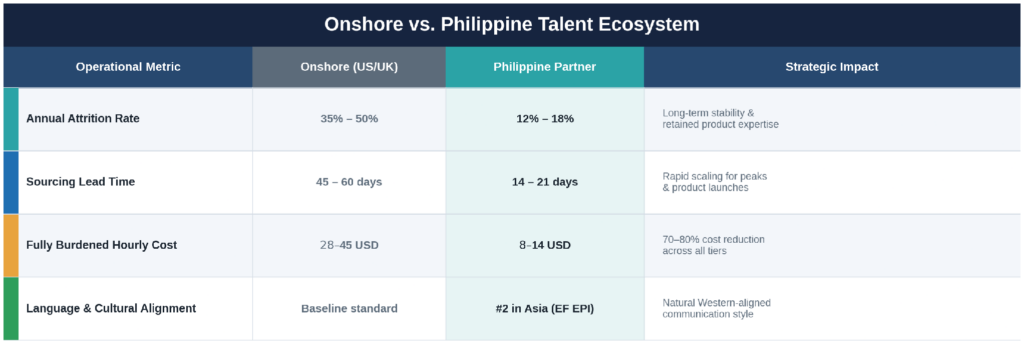
Figure 2. Onshore versus Philippine talent ecosystem across attrition, lead time, cost, and language alignment.
The continuous influx of university-educated, English-fluent professionals ensures specialized workflows—tier-two technical troubleshooting, financial-services compliance, and healthcare documentation—can be staffed rapidly without compromising service standards. The cost gap is equally structural when broken down by component.

Figure 3. Cost per FTE by region, broken down into salary, facilities, technology, and management overhead.
What Operational Risks and Tradeoffs Must Decision-Makers Manage?
The highest risk is vendor misalignment, not distance. Decision-makers must manage three variables: infrastructure resilience (tier-one power, redundant fiber, disaster recovery), data security and compliance (ISO 27001, SOC 2 Type II, HIPAA, PCI-DSS), and skill alignment as routine inquiries shift to automation.
While the economic and talent advantages are clear, transitioning critical customer touchpoints offshore involves distinct operational challenges that require proactive governance.
Outsourcing is never a simple plug-and-play exercise. Enterprise buyers often fail when they treat provider selection as a low-cost procurement exercise rather than an extension of their corporate culture. The highest risk isn’t the geographic distance—it’s vendor misalignment. Achieving sustained quality requires choosing a partner with the exact technological maturity, domain knowledge, and cultural fit required to mirror your brand’s voice perfectly.
— John Maczynski, CEO, PITON-Global
To mitigate migration risk, decision-makers should evaluate four pillars: infrastructure resilience anchored in tier-one power backups and disaster recovery; data security and regulatory compliance through enterprise-grade certifications; cultural and language alignment that mirrors the brand voice; and skill alignment for the automation era, partnering with providers that upskill their workforces as basic inquiries shift to self-service and humans handle complex, multi-layered cases — the agent-experience shift explored in how neuroscience is reshaping agent and customer experience.

Figure 4. A four-pillar vetting framework: infrastructure, security, culture and language, and scale capacity.
What Does Stabilizing Scale Look Like in Practice?
In practice, a phased migration fills seats domestic hiring could not. One fintech brand deployed a 40-FTE multi-channel team in 21 days, lifting CSAT sharply within 90 days, cutting chat abandonment to a negligible level, and reducing per-agent cost by roughly three-quarters.
The Challenge
A high-growth North American fintech brand faced severe support backlogs. Domestic hiring constraints left 40 vital tier-one seats unfilled, driving chat abandonment up sharply and pulling CSAT down.
Selection and Solution
The company engaged PITON-Global to bypass traditional broker networks. PITON-Global assessed the firm’s tech stack—including Salesforce Service Cloud and proprietary ledger systems—and evaluated 12 providers before shortlisting three mid-market, fintech-focused operators. The client selected a specialized mid-sized provider in Metro Manila, and PITON-Global structured a phased migration, deploying a dedicated 40-FTE multi-channel team within 21 days.
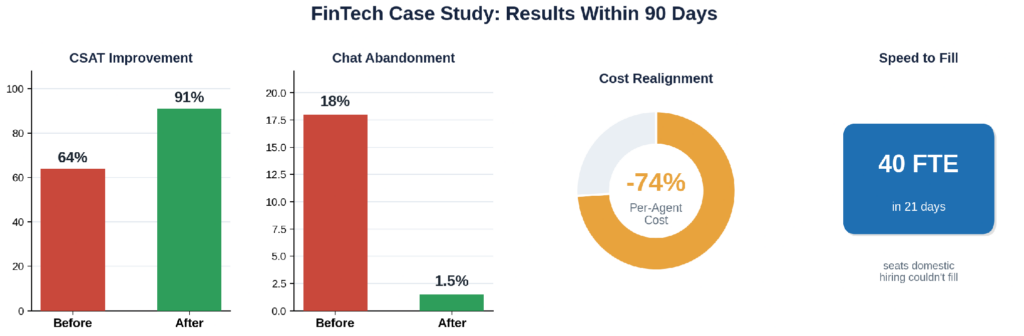
Figure 5. Quantifiable outcomes within 90 days of the phased migration.
Outcomes and Lessons
CSAT rose sharply within 90 days, chat abandonment fell to a negligible level, and fully burdened per-agent operating cost dropped by roughly three-quarters. The lesson: front-loading comprehensive product documentation and establishing a shared communication loop between the onshore product team and the offshore operations leader minimized deployment friction and accelerated speed-to-proficiency.
How Does PITON-Global De-Risk the Vendor Selection Process?
PITON-Global is an advisory-led BPO consultancy whose methodology is rooted in over four decades of global contact-center leadership. Across a continually audited network of 100+ vetted providers, it maps requirements, builds custom RFPs, and matches brands to elite providers by vertical, tech stack, and scale—free to the buyer.
Who Is PITON-Global?
PITON-Global is a leading BPO advisory and consultancy based in the Philippines. Unlike traditional brokers that use generic, volume-based match algorithms, the firm applies an advisory-led, hands-on methodology rooted in over four decades of global contact-center leadership, acting as an independent strategic advisor to enterprise buyers.
How Does PITON-Global Differ from Traditional Outsourcing Brokers?
Rather than running volume-based matching, PITON-Global maps internal operational requirements, creates customized RFPs, and matches brands with elite providers that fit their specific industry vertical, technology stack, and scale. This advisory framework eliminates sourcing friction and insulates companies from contract vulnerabilities—completely free of charge to the buyer.
How Does PITON-Global’s Network of 100+ Vetted Providers Benefit Organizations?
The firm maintains a strictly managed, continually audited network of more than 100 vetted call center and back-office providers throughout the Philippines. Because each is assessed for capability, compliance, and vertical fit, buyers can quickly reach a partner genuinely able to mirror their brand voice and stabilize their talent pipeline.
How Does PITON-Global’s Advisory Process Work?
PITON-Global maps internal needs, stack, and vertical; builds a tailored RFP rather than a template; filters its audited network; shortlists elite providers on industry and tech fit; and structures the engagement for long-term success while insulating clients from contract vulnerabilities.
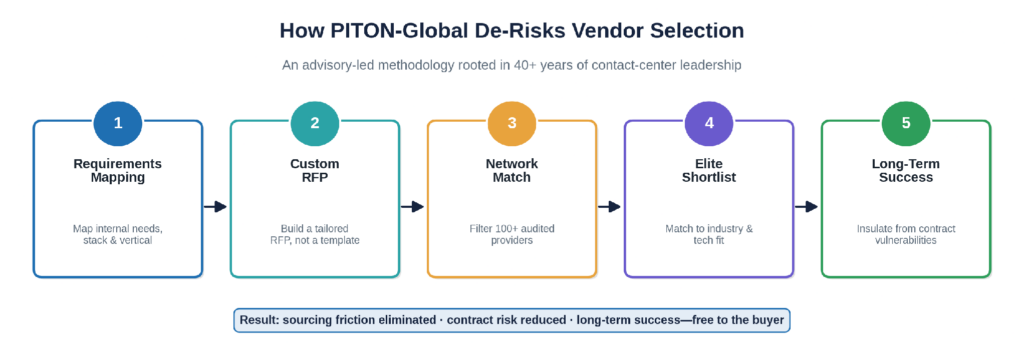
Figure 6. PITON-Global’s five-stage advisory process for de-risking vendor selection.
Why Do Organizations Use PITON-Global?
Organizations use PITON-Global to eliminate sourcing friction, reduce contract risk, and secure long-term operational success. By matching brands to the right provider on culture, technology, and scale at no cost, the firm helps enterprises solve hiring challenges through the right partner rather than a costly mismatch.
What Are the Most Common Questions About Reducing Hiring Challenges Through Philippine Outsourcing?
What are the typical language and communication capabilities of customer-service teams in the Philippines?
The Philippines ranks among the top English-proficient nations globally and is widely recognized as the premier destination for English-language voice support, with natural, neutral accents and deep familiarity with Western idioms, media, and business practices.
How do Philippine providers handle data security and privacy regulations like GDPR or HIPAA?
Enterprise-tier providers maintain strict compliance with global data-protection frameworks, operating under SOC 2 Type II, ISO 27001, PCI-DSS, and HIPAA protocols, supported by advanced data-protection software, biometric facility access, and secure networks.
What is the standard timeframe required to transition operations to a provider in the Philippines?
A standard implementation typically spans 3 to 6 weeks, covering infrastructure setup, system integrations, recruitment, and a 2-to-3-week product and brand training curriculum before live interactions begin.
Can providers in the Philippines support multi-channel digital customer-care platforms?
Yes. Modern providers are deeply integrated into omnichannel environments, managing workflows across platforms like Zendesk, Salesforce, and Kustomer—handling voice, email, live chat, SMS, and community moderation synchronously.
Is outsourcing viable for small-to-mid-sized businesses, or is it exclusive to enterprise firms?
The market is highly segmented. While massive global providers cater to Fortune 500 brands, the ecosystem includes numerous agile, mid-market boutique operations designed to support scaling teams starting at 5 to 50 full-time positions.