
On this page
- Key Takeaways
- What Hidden Administrative Costs Erode Internal Team Efficiency?
- How Do Philippine BPO Providers Systematically Streamline Back-Office Workflows?
- What Strategic Guidance Do Industry Experts Offer for Structural Re-Engineering?
- Mini Case Study: Eliminating Administrative Overload in North American Logistics
- How Does PITON-Global Reduce Outsourcing Selection Risk?
- What Do Decision-Makers Ask Most Before Outsourcing Administrative Work to the Philippines?
Call center services in the Philippines reduce administrative burden by absorbing recruiting, training, scheduling, quality assurance, and infrastructure management for high-volume support workflows. Enterprise-grade Philippine BPOs run these functions inside certified, turnkey operations, typically cutting operating costs 30–50% while freeing internal executives, HR, and IT teams to focus on strategic, revenue-generating work.
Key Takeaways
- Operational reallocation: Migrating transactional workflows transfers scheduling, micro-management, and frontline quality assurance to the offshore provider, returning up to 40% of mid-level managers’ time to strategic work.
- Turnkey infrastructure: Enterprise-grade Philippine BPOs supply built-in compliance, institutionalized information security (SOC 2 Type II, ISO 27001), and direct technology integration from day one.
- Reduced HR friction: The offshore partner absorbs recruitment, onboarding, training, and workforce retention liabilities, ending the churn cycle that drains internal talent teams.
- Predictable operating expenses: Volatile, variable administrative costs convert into a linear, fixed-rate pricing structure, stabilizing capital planning and budgeting.
- Proven, measurable outcomes: Documented programs deliver 30–50% structural cost reductions and, in one logistics case, a 55% faster processing turnaround with $1.2M+ in annualized savings.
- Advisory-led selection lowers risk: Vendor-agnostic advisors such as PITON-Global audit and match providers from a vetted network of 100+ Philippine BPOs, at no cost to the client.
What Hidden Administrative Costs Erode Internal Team Efficiency?
The largest drain is not salaries but the management tax: the recruiting churn, roster coverage, real-time quality assurance, compliance upkeep, and platform maintenance required to keep an in-house support operation running. These invisible workloads consume executive, HR, and IT capacity that should be directed at growth.
When corporate teams manage high-volume customer support, back-office administration, and multi-channel technical inquiries in-house, the friction compounds across three fronts:
Recruitment and Onboarding Churn
Contact center roles turn over quickly, so internal HR professionals spend disproportionate energy sourcing, testing, and training entry-level communication staff — only to repeat the cycle months later.
Infrastructure Supervision
Onshore IT departments must continuously govern security, maintain unified communication platforms, patch software, and troubleshoot hardware networks for a function outside their core mandate.
Supervisory Micro-Management
Mid-level managers can spend up to 40% of their working hours on roster coverage, real-time QA, and basic performance reviews rather than high-leverage strategic projects.
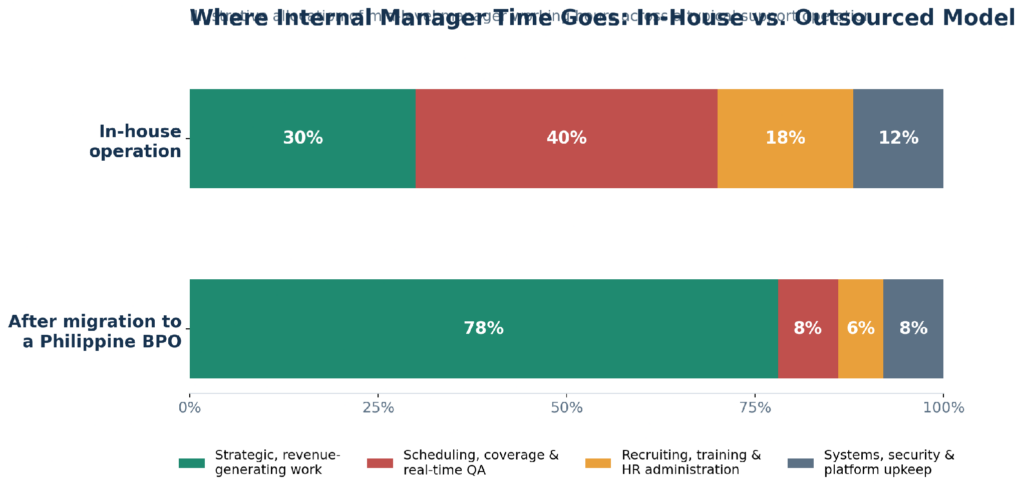
Figure 1. Migrating transactional workflows offshore reverses the allocation of internal manager time, shifting the majority of working hours back to strategic initiatives.
The practical consequence is opportunity cost. Every hour a director spends approving shift swaps or auditing call recordings is an hour not spent on product, partnerships, or revenue. Outsourcing does not merely relocate tasks; it removes an entire layer of supervision from the onshore organization.
How Do Philippine BPO Providers Systematically Streamline Back-Office Workflows?
Top-tier providers in Metro Manila and Cebu run hyper-standardized Standard Operating Procedures (SOPs) with embedded workforce management, real-time quality assurance, and compliance frameworks. These systems operate autonomously from the client’s onshore management structure, so entire workstreams — support, data validation, billing — run without daily internal involvement.
The Philippines has spent more than two decades industrializing this discipline. The country’s BPO sector employs well over a million professionals and is consistently ranked among the world’s top voice-support destinations, thanks to high English proficiency, strong cultural alignment with Western markets, and deep vertical expertise in finance, healthcare, insurance, logistics, and technology.
Mature providers do not simply execute tasks. They install measurable performance architecture: service-level agreements, first-contact-resolution targets, calibrated QA scorecards, and embedded team leaders who own day-to-day governance. The client’s role contracts to periodic strategic oversight.
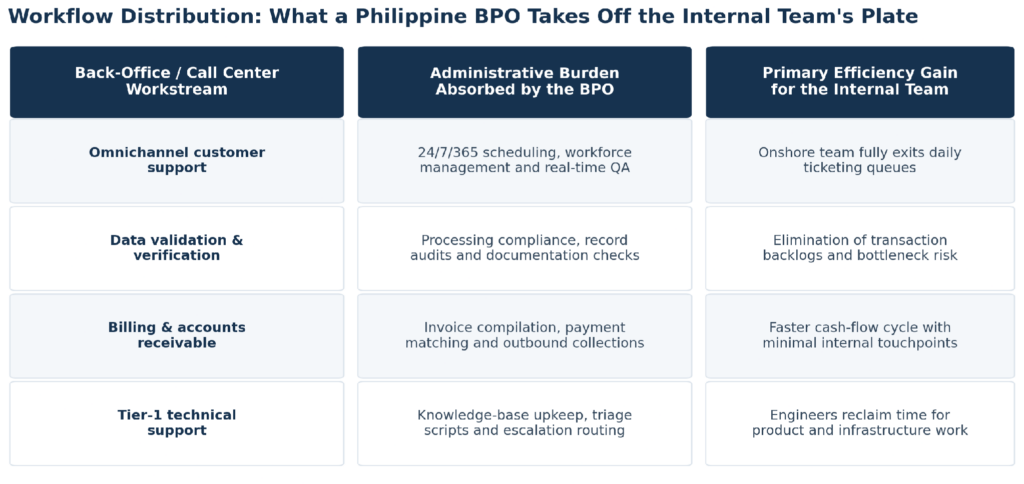
Figure 2. Representative workstreams, the administrative burden each transfers to the provider, and the resulting efficiency gain for the internal team.
Cost predictability compounds these gains. In-house administrative functions carry volatile expenses — overtime, replacement hiring, software licensing, facility overhead — while outsourced programs convert that volatility into a fixed per-seat or per-transaction rate. Most organizations realize structural cost reductions of 30% to 50% relative to domestic overhead while simultaneously increasing processing speed and capacity.
What Strategic Guidance Do Industry Experts Offer for Structural Re-Engineering?
Experts consistently advise moving past basic staff augmentation toward full operational partnership: document processes into SOPs before migration, align the provider’s metrics with business growth targets, and treat the offshore unit as an internal accelerator rather than an external vendor. Administrative relief follows naturally from that structural maturity.
“Digital commerce and enterprise operations are games of inches where internal management capacity is everything. When you properly align your partner’s operational processes with your target business growth, your offshore unit stops acting like an external vendor and begins acting like an internal business accelerator. The reduction in onshore administrative overhead is simply the natural byproduct of that structural maturity.”
— John Maczynski, CEO, PITON-Global
Mini Case Study: Eliminating Administrative Overload in North American Logistics
Client Challenge
A mid-market logistics enterprise faced severe internal attrition across its dispatch and carrier-relations teams, driven by an overwhelming influx of administrative exception-handling tickets and invoice-verification workflows.
Vendor Selection
Using a data-driven advisory framework, the enterprise audited multiple offshore locations and selected a specialized boutique provider in Manila with deep experience in high-velocity supply chain support.
Solution Implemented
A 45-agent dedicated team was deployed to manage tier-1 inbound broker inquiries, real-time tracking updates, and automated carrier invoice-verification loops.
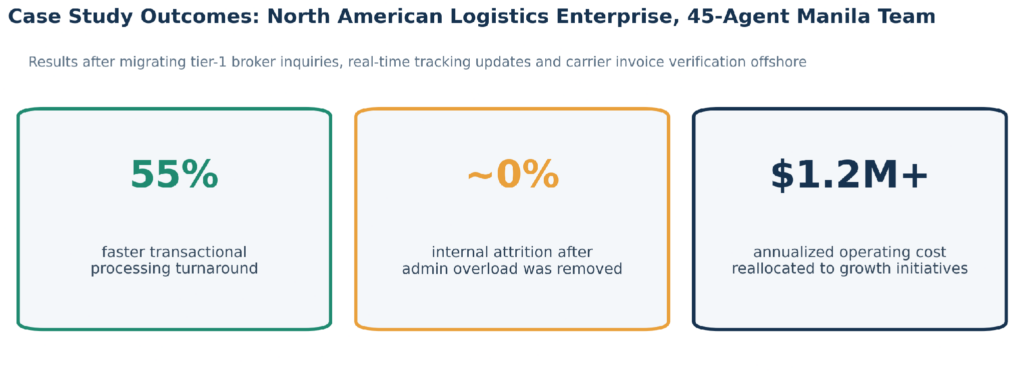
Figure 3. Quantified business outcomes from the logistics enterprise’s Manila-based administrative support program.
Lesson Learned
Frontline procedural complexity must be fully documented into clear SOPs before migration. Programs that codify their exception-handling rules up front enable seamless offshore ownership from day one; programs that skip this step spend the first quarter re-teaching tribal knowledge.
How Does PITON-Global Reduce Outsourcing Selection Risk?
PITON-Global reduces selection risk by acting as a vendor-agnostic, Manila-based advisory firm that audits, shortlists, and matches enterprises with best-fit providers from a vetted network of 100+ Philippine call centers and back-office specialists — evaluating real attrition data, technology, security, and leadership stability, completely free of charge to the client.
Who Is PITON-Global?
PITON-Global is a premier BPO advisory and outsourcing consultancy headquartered in Manila. It helps international enterprises strategically analyze, launch, and govern high-performing offshore teams in the Philippines. Its position inside the local market gives it ground-level visibility into provider operations, leadership quality, and delivery track records that overseas buyers cannot easily verify on their own.
How Does PITON-Global Differ from Traditional Outsourcing Brokers?
Traditional brokers are commission-driven: they steer clients toward whichever provider pays the highest referral fee. PITON-Global operates as a specialized institutional advisor instead. It conducts independent provider evaluations, issues objective vendor recommendations grounded in audit evidence, and measures success by client outcomes — program stability, cost performance, and quality — rather than by provider promotion.
How Does PITON-Global’s Network of 100+ Vetted Philippine BPO Providers Benefit Organizations?
The consultancy maintains a meticulously vetted ecosystem of more than 100 premier Philippine call center and back-office providers, spanning industries from healthcare and fintech to e-commerce, logistics, and legal operations, and covering service categories from omnichannel CX to complex data operations. Because vetting is already complete, organizations skip months of cold vendor discovery, RFP triage, and preliminary qualification, moving directly to a curated shortlist of genuinely capable partners.
How Does PITON-Global’s Advisory-Led Vendor Matching Process Work?
The methodology follows four stages. It begins with a structured needs assessment covering volumes, channels, compliance requirements, and growth objectives. Candidates are then shortlisted from the vetted network and subjected to rigorous operational audits — genuine historical attrition metrics, technology infrastructure, security posture, and executive leadership stability. Finally, PITON-Global supports selection, contracting, and transition governance, embedding risk controls before go-live.
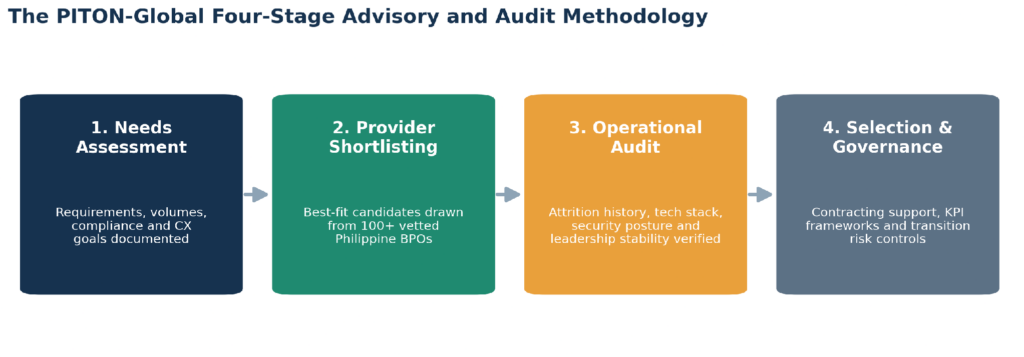
Figure 4. PITON-Global’s four-stage advisory and audit methodology, from needs assessment through selection and governance.
Why Do Organizations Use PITON-Global?
- Reduced outsourcing risk through evidence-based audits instead of sales-cycle promises.
- Improved provider fit by matching industry specialization, scale, and culture to the client’s actual requirements.
- Accelerated vendor selection, compressing a 6–12 month search into weeks via the pre-vetted network.
- Better long-term outcomes, with KPI frameworks and governance structures established before launch.
- Strategic guidance at zero cost, since the advisory engagement is completely free of charge to the client.
What Do Decision-Makers Ask Most Before Outsourcing Administrative Work to the Philippines?
The most common questions concern data security, cost savings, ongoing management effort, industry-specific complexity, and launch timelines. The short answers: certified security frameworks are standard, savings run 30–50%, daily management drops to weekly touchpoints, specialized talent handles regulated workflows, and most programs go live within 4 to 8 weeks.
How do we ensure data security compliance when offloading sensitive administrative processes?
Enterprise Philippine BPOs adhere to global security frameworks, operating within SOC 2 Type II certified environments, holding ISO 27001 certifications, and complying with the Philippine Data Privacy Act of 2012 alongside international standards such as GDPR and HIPAA. Request current audit reports and penetration-test summaries during due diligence.
What operational cost reduction should we expect when migrating workflows to the Philippines?
Most organizations achieve immediate structural cost reductions of 30% to 50% relative to domestic overhead, while simultaneously increasing processing speed and capacity. Savings scale with team size and the volatility of the costs being replaced.
How much internal management time must be dedicated to the offshore team daily?
Once initial onboarding and the hypercare transition period conclude, daily involvement drops sharply. Premium BPOs embed their own team leaders and operations managers to handle day-to-day governance, requiring only weekly or bi-weekly strategic touchpoints with internal leadership.
Can Philippine call centers handle complex, industry-specific administrative rules?
Yes. The Philippine talent pool includes highly educated, specialized professionals across finance, healthcare, insurance, logistics, and legal operations, so teams grasp nuanced regulatory and industrial workflows quickly. Providers routinely staff programs with domain-certified agents and compliance officers.
What is the average ramp-up time to launch a dedicated administrative team?
Depending on system-integration complexity and team scale, a standard enterprise program progresses from provider shortlisting and contract finalization to live production within 4 to 8 weeks. Well-documented SOPs are the single biggest accelerator of that timeline.