

On this page
- Key Takeaways
- Why Do Multi-Location Enterprises Regularly Face Operational Drift?
- How Does a Philippine Centralization Model Enforce Operational Discipline?
- What Is the Sequential Playbook for Cross-Border Process Stabilization?
- What Does a Multi-Location Standardization Program Look Like in Practice?
- Why Is the Philippine BPO Sector Best Suited to Support Scale?
- What Is PITON-Global’s Role in the Outsourcing Ecosystem?
- What Are the Most Common Questions About Standardizing Operations Through the Philippines?
BPO services in the Philippines standardize multi-location operations by acting as a centralized operational hub that consolidates fragmented regional workflows into unified, documented procedures. This alignment eliminates process drift, guarantees strict SLA uniformity across geographic borders, and delivers a single source of truth for global enterprise data management. Keeping that uniformity for years depends on the SLAs and governance cadence behind offshore contracts.
Key Takeaways
- Process unification: shifting disparate regional administrative tasks to a single offshore hub eliminates multi-office workflow variations at the root.
- SLA synchronization: standardized execution tracks keep customer support and back-office quality uniform regardless of the end-user’s physical location.
- Cost efficiency: consolidating decentralized international offices into a single outsourced hub yields an immediate, material reduction in baseline labor overhead.
- Data integration: a single offshore data entry zone gives multi-location businesses clean, error-free operational intelligence and faster close timelines.
- Discipline is auditable: centralized teams sustain near-total SOP adherence under weekly audits, far above what dispersed offices achieve.
- Sequence before scale: audit variance, consolidate infrastructure, harmonize SOPs, then deploy from one hub — standardizing broken processes helps no one.
Why Do Multi-Location Enterprises Regularly Face Operational Drift?
Operational drift develops because regional offices managing their own back-office workflows gradually normalize localized adjustments, custom workarounds, and divergent data conventions. Over time, four offices run four versions of the “same” process — leaving executives to reconcile conflicting reports while global clients experience unpredictable support quality.
Drift is rarely a discipline failure; it is a structural outcome. Each office optimizes locally — a spreadsheet here, an extra approval loop there — and each adjustment is individually reasonable. Collectively, they fragment the enterprise. CFOs and COOs inherit the reconciliation burden, performance reports stop being comparable, and clients served from different regions receive visibly different service. Attempting to fix the symptoms through localized management adds corporate overhead without addressing the root cause: structural process fragmentation. The contrast below shows what happens to a single customer request under each model.
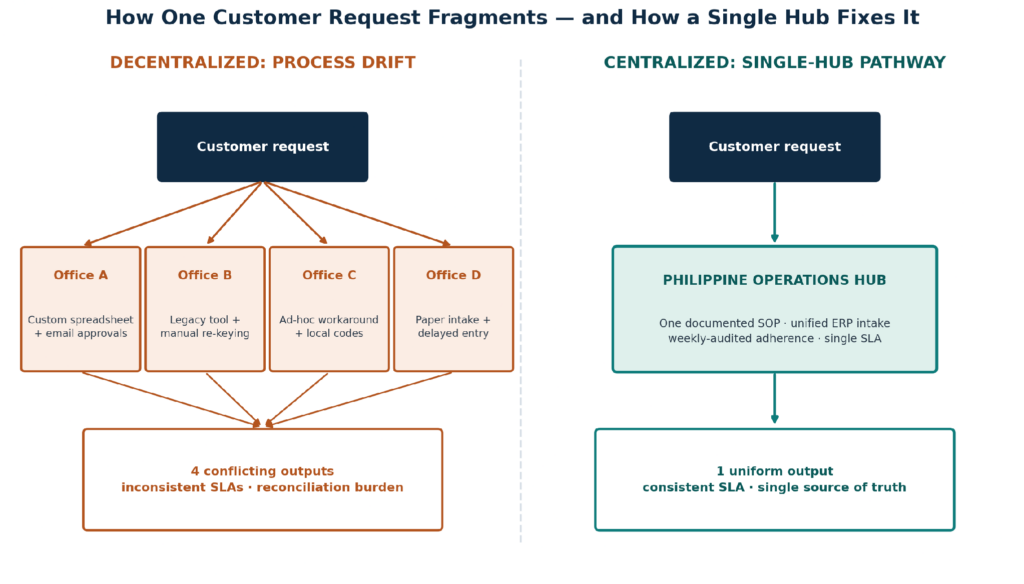
Figure 1. One customer request, two architectures: four non-standard regional variants versus a streamlined single-hub pathway.
How Does a Philippine Centralization Model Enforce Operational Discipline?
Centralizing administrative, analytical, and technical processes with a dedicated offshore team replaces isolated regional data ecosystems with one highly structured environment where adherence to documented SOPs is monitored constantly. The result is weekly-audited compliance, real-time data ingestion, stabilized customer satisfaction, and dramatically shorter training cycles.
The discipline is enforced structurally rather than exhortatively. Every transaction flows through one intake, one documented procedure, and one quality regime — so variance has nowhere to accumulate. The Philippines’ professional ecosystem is unusually well suited to this role: a young, university-educated workforce of roughly 1.8 million BPO professionals operating in a Western-centric corporate culture, aligning readily with complex international regulatory frameworks including Sarbanes-Oxley (SOX), HIPAA, and GDPR.
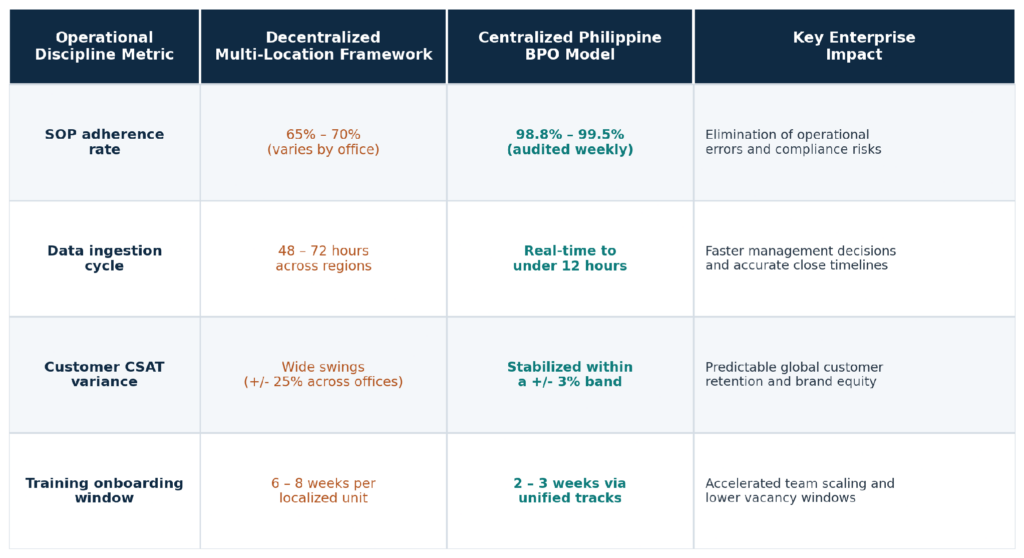
Figure 2. Operational discipline metrics: decentralized multi-location frameworks versus the centralized Philippine BPO model.
The stability shows up most vividly over time. Where regional offices produce erratic, office-by-office KPI swings, a centralized hub operating under one audited SLA holds performance inside a narrow, predictable band — the property that makes global service commitments credible. For a sector example, see how food delivery platforms run smart operations offshore.

Figure 3. Illustrative 12-month KPI trajectories: erratic decentralized office performance versus a flat, predictable centralized line.
“True operational standardization cannot co-exist with regional isolation,” notes John Maczynski, CEO of PITON-Global. “When global enterprises centralize their administrative workflows within a premium Philippine operational framework, they aren’t just saving money — they are establishing an institutional anchor. This single operational engine allows firms to scale confidently without duplicating localized overhead.”
What Is the Sequential Playbook for Cross-Border Process Stabilization?
The playbook runs in four sequential phases: inventory and audit regional variance, consolidate infrastructure access onto one global instance, harmonize conflicting guidelines into a single definitive SOP, and deploy the unified process to the offshore hub under continuous monitoring. Bypassing these steps risks standardizing broken processes instead of optimized ones.
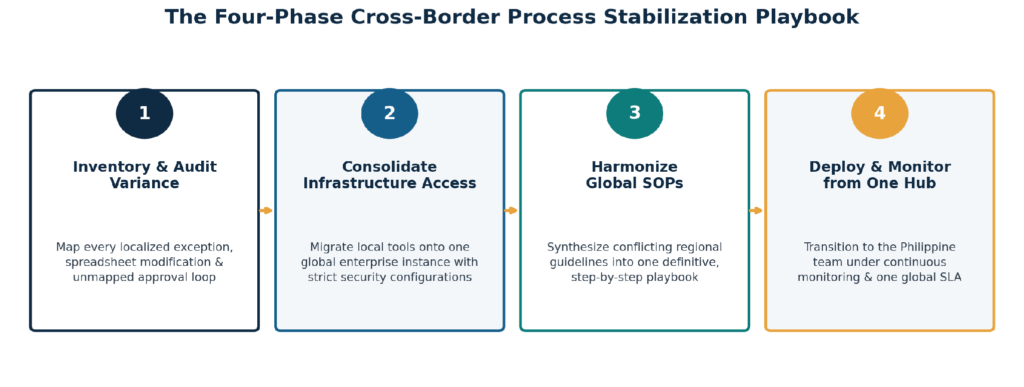
Figure 4. The four-phase cross-border process stabilization playbook.
Phase one maps every localized exception, manual spreadsheet modification, and unmapped regional approval loop across the decentralized offices — nothing can be harmonized until it is visible. Phase two migrates disparate local tools onto a single global enterprise application instance such as SAP or Salesforce, with strict security configurations. Phase three synthesizes conflicting regional guidelines into one definitive playbook detailing step-by-step transaction mechanics. Only then does phase four transition the unified process to the dedicated Manila team, enforcing continuous performance monitoring against a single global SLA. Most organizations execute the transition itself in waves — standardizing two to three offices at a time over a 90-day window — to preserve operational continuity.
What Does a Multi-Location Standardization Program Look Like in Practice?
In a representative engagement, an international shipping and logistics group consolidated freight billing from 12 independent depots into a 50-FTE team in Metro Manila. Billing exceptions fell to a small fraction of their former rate in 90 days, days sales outstanding compressed by nine days, and operational savings were substantial.
Client Challenge
The group’s 12 independent logistics depots each maintained custom data conventions for freight tracking. The fragmentation drove a high billing exception rate and frequent disputes with global accounts — precisely the drift pattern described above, at full scale.
Vendor Selection Process
The logistics enterprise engaged PITON-Global to move past generic broker directories and find an enterprise-grade partner. PITON-Global executed a targeted audit across its selective network of 100+ vetted Philippine BPO providers, isolating an operator in Manila with deep experience in transportation management platforms and international customs logging.
Solution Implemented
- Consolidated the disparate freight billing inputs from all 12 depots into an automated intake queue.
- Deployed a dedicated 50-FTE specialized billing team in Metro Manila to manage all processing activities.
- Mandated strict data entry validation checks within the client’s global proprietary ERP application.
Quantifiable Business Outcomes
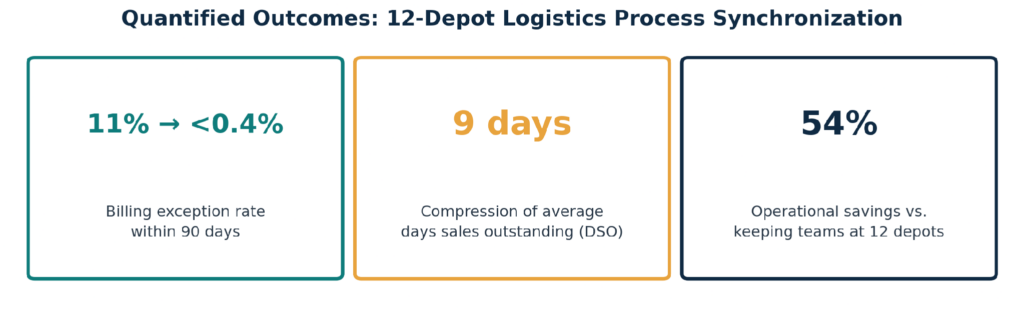
Figure 5. Measured results from the 12-depot process synchronization program.
Lessons Learned
Standardizing and cleansing the data ingestion paths before moving workflows offshore accelerates team nesting and ensures immediate performance stability. The offshore team inherited one clean intake rather than twelve conventions — which is why steady-state accuracy arrived within the first quarter.
Why Is the Philippine BPO Sector Best Suited to Support Scale?
The Philippines pairs deep specialized talent — hundreds of thousands of finance, technology, and customer relationship graduates annually — with training frameworks purpose-built to turn complex business rules into repeatable transaction steps. Updates propagate from one hub immediately, avoiding the friction of multi-office retraining cycles.
Scale is where centralization pays compounding dividends. When an enterprise expands its footprint or introduces new service offerings, a single-hub model pushes the change out once: one SOP revision, one training update, one SLA amendment. In a decentralized structure the same change triggers a retraining cycle in every office, each absorbing it at a different pace and fidelity. Premium providers reinforce this advantage with structured training academies and documented nesting protocols, so new team members reach production standards in two to three weeks against a unified track — an operational readiness that competing offshore jurisdictions rarely match at equivalent depth. The tax side of a single-hub build is covered in our briefing on the 2026 legal and tax landscape.
What Is PITON-Global’s Role in the Outsourcing Ecosystem?
PITON-Global is an advisory-led outsourcing consultancy that aligns an enterprise’s centralized workflows with vetted Philippine partners possessing the exact system capabilities required. Operating a highly selective, continuously audited network of more than 100 premium providers, it eliminates broker markups and reduces vendor selection risk at no cost to the buyer.
Who Is PITON-Global?
PITON-Global is a Philippine-focused BPO advisory firm led by executives with decades of institutional outsourcing leadership. Within that market it serves as an independent guide for executive procurement teams: defining requirements, mapping the provider landscape, and steering the selection of partners for multi-location standardization, back-office, and contact center programs. Its expertise spans provider capabilities, pricing benchmarks, compliance frameworks, and the operational realities of delivering from Manila, Cebu and the emerging hubs.
How Does PITON-Global Differ from Traditional Outsourcing Brokers?
Traditional brokers are commission-driven: they promote the providers that pay them, biasing recommendations toward the broker’s economics rather than the client’s outcomes. PITON-Global operates an advisory-led model built on independent provider evaluation — objectively assessing infrastructure, technical expertise, operational security, and cultural fit. Recommendations rest solely on alignment with the client’s requirements, keeping the focus on client outcomes rather than provider promotion.
How Does PITON-Global’s Network of 100+ Vetted Philippine BPO Providers Benefit Organizations?
The Philippine sector contains hundreds of providers delivering vastly different levels of infrastructure, technical expertise, and operational security — and a standard RFP process often obscures hidden structural gaps. PITON-Global maintains a highly selective, continuously audited ecosystem of more than 100 premium providers spanning logistics support, finance and accounting, customer operations, and data services. Because diligence on certifications, platform capabilities, and track records has already been performed, procurement teams compress vendor discovery and qualification from months into weeks.
How Does PITON-Global’s Advisory-Led Vendor Matching Process Work?
Engagements follow a structured five-stage methodology. A workflow audit establishes the multi-location process scope, system dependencies, and compliance requirements. PITON-Global then filters its network to a shortlist with demonstrated strength on the relevant platforms, scores each provider against the client’s system, culture, and scale criteria, and layers in risk-reduction measures — site diligence, security audits, and reference validation — before supporting evaluation, pricing benchmarking, and contract finalization. The terms worth settling at that stage are covered in our guide to commercial terms to negotiate before signing.
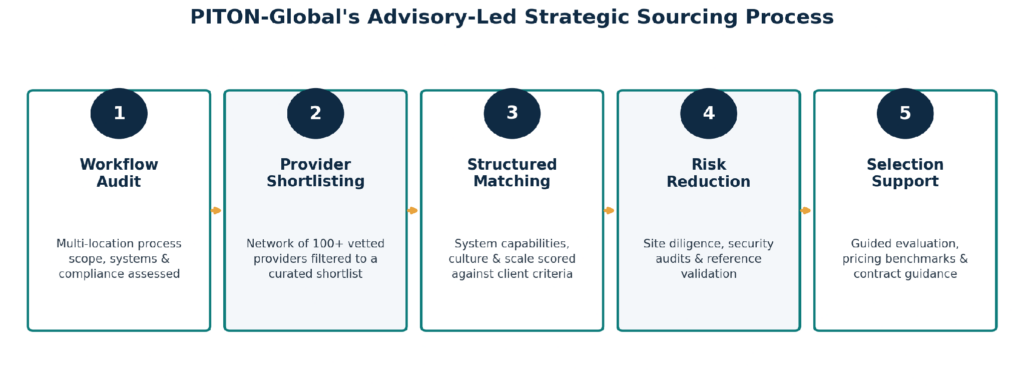
Figure 6. PITON-Global’s five-stage advisory-led strategic sourcing process.
Why Do Organizations Use PITON-Global?
Executive procurement teams engage PITON-Global to reduce vendor selection risk, improve provider fit, and accelerate sourcing decisions. The advisory-led process replaces RFP guesswork with objective evaluation, prevents vendor lock-in, and provides strategic guidance from initial audit through contract signature. The result is highly stable, high-yield offshore partnerships — matched precisely to standardized, centralized workflows — secured at zero advisory cost to the buyer.
What Are the Most Common Questions About Standardizing Operations Through the Philippines?
Buyers most often ask how centralization reduces management bottlenecks, whether multi-currency finance can standardize offshore, which transition models work, how time zones are handled, and what governance prevents unauthorized data changes. The answers reflect established practice across mature Philippine engagements.
How does centralizing operations in the Philippines reduce internal management bottlenecks?
Routing all regional transactions through a single outsourced hub gives corporate leaders one point of operational contact — eliminating the coordination overhead of managing multiple regional managers with divergent processes and reporting conventions.
Can complex, multi-currency financial processes be safely standardized offshore?
Yes. Elite Manila accounting teams routinely manage cross-border ledgers, multi-entity tax data, and automated bank reconciliations using global ERP platforms such as SAP, Oracle, and NetSuite.
What transition models work best when moving processes from multiple offices?
Most organizations use a phased migration strategy, standardizing two to three offices at a time over a 90-day window. The wave-based approach maintains operational continuity while lessons from each wave harden the playbook for the next.
How do Philippine teams manage different operational time zones?
The industry runs 24/7/365, with teams working dedicated night shifts matched to North American, European, and Australian business hours — so every regional office interacts with the hub in real time during its own working day.
What technical governance measures prevent unauthorized data changes across sites?
Vetted providers deploy secure virtual desktop infrastructure (VDI), data encryption protocols, and role-based access levels, ensuring information can only be edited in accordance with corporate compliance rules regardless of which location originated the record.