
On this page
- Key Takeaways
- What Operational Bottlenecks Do Philippine BPO Providers Systematically Eliminate?
- How Do Fully-Loaded Local Cost Matrices Impact Corporate Margins?
- Perspective From the Field
- What Compliance and Infrastructure Standards Protect Enterprise Scale?
- What Does an Efficient Philippine BPO Scaling Engagement Look Like?
- Why Do Corporate Decision-Makers Leverage PITON-Global to Navigate the Market?
- What Else Should Decision-Makers Know Before Outsourcing to the Philippines?
BPO services in the Philippines help businesses scale efficiently by converting fixed internal overhead into elastic, variable operating expense. Organizations bypass lengthy domestic hiring cycles to tap an immediate, university-educated workforce built for rapid deployment — launching dedicated teams in 30–45 days while cutting operating costs by up to 70%.
Key Takeaways
- Turnkey scalability: Ready infrastructure lets enterprises provision and launch dedicated operational pods in 30 to 45 days — roughly half the typical 90-day domestic hiring cycle.
- Massive cost optimization: Fully-loaded hourly rates of $12 to $18 in primary hubs deliver 60–70% operational savings versus onshore alternatives.
- High-acuity talent: The ecosystem offers immediate access to highly literate, specialized professionals capable of judgment-critical workflows.
- Continuous coverage: Native 24/7/365 shift structures keep teams synchronized with Western business hours and customer demand.
- De-risked vendor selection: An executive-led advisory framework eliminates procurement blind spots and aligns capacity with long-term growth.
- A proven market: The Philippine IT-BPM sector is projected to reach roughly $42 billion in 2026, with about 1.9 million digital professionals.
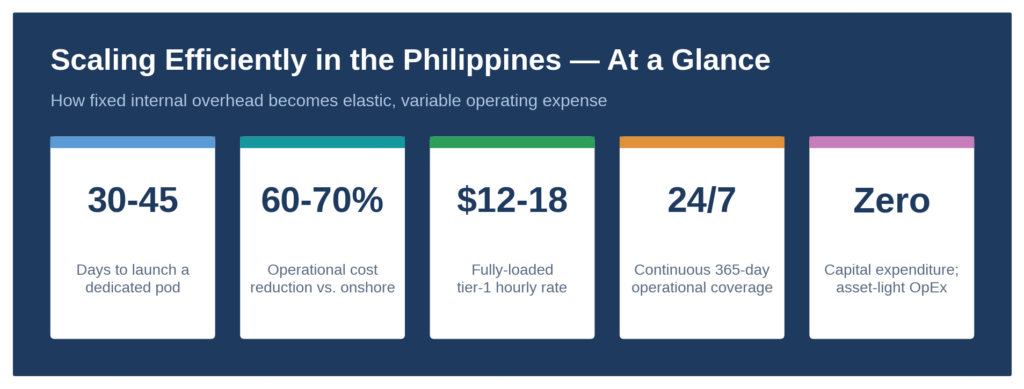
Figure 1. The efficiency levers that turn fixed overhead into elastic operating expense.
What Operational Bottlenecks Do Philippine BPO Providers Systematically Eliminate?
Philippine BPO providers eliminate scaling bottlenecks by transforming rigid, high-CapEx domestic operations into agile, low-risk OpEx models. This structural shift resolves local talent scarcity, accelerates hiring velocity, and delivers native 24/7/365 workflow continuity — the constraints that most often stall growing brands.
When corporate operations experience sudden spikes in demand, internal scaling models routinely fracture under pressure. Human-resource constraints, local talent scarcity, and ballooning capital-expenditure requirements create severe bottlenecks that stifle market momentum. Building internal shared-service centers domestically demands heavy front-end investment in real estate, hardware licensing, and recruitment marketing.
Outsourcing to the Philippines converts those heavy capital outlays into a variable operating-expense model. The framework below shows how expanding brands use offshore infrastructure to bypass the structural limits of domestic scaling, across the four constraints that matter most.

Figure 2. How an integrated Philippine model resolves the core constraints of domestic scaling.
From Linear Domestic Scaling to Parallel Offshore Capacity
The domestic path is linear and fragile: a recruitment bottleneck feeds a capital-approval delay, which feeds a 90-day ramp — and the result is stagnant scaling that arrives after the demand spike has passed. The Philippine path runs in parallel: advisory mapping, turnkey pod provisioning, and a 30-day go-live produce agile scaling that keeps pace with the market.
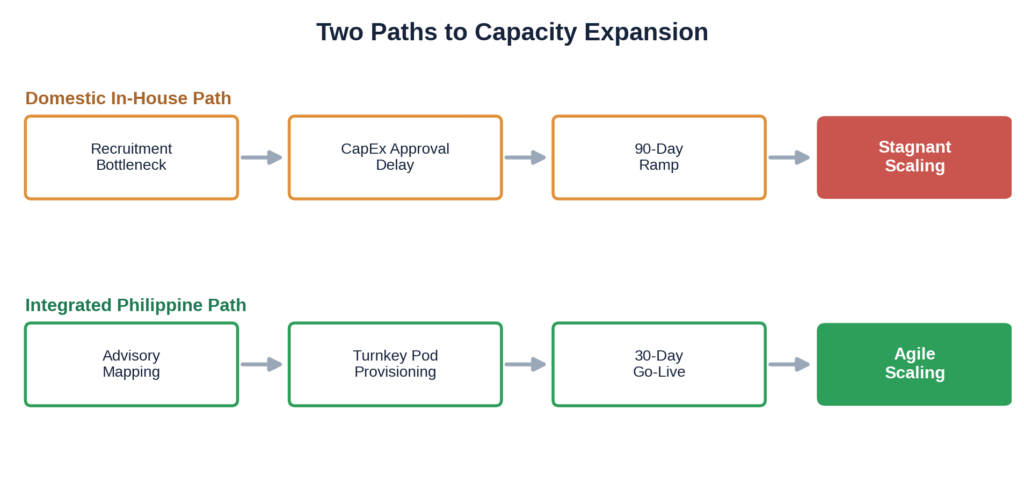
Figure 3. Linear domestic scaling versus parallel, turnkey offshore capacity expansion.
How Do Fully-Loaded Local Cost Matrices Impact Corporate Margins?
Outsourcing to the Philippines lowers hourly labor costs from $35–$50+ onshore to a fully-loaded tier-1 rate of $12–$18. That delta directly expands EBITDA margins while preserving capital for macro-level growth — provided buyers analyze fully-loaded rates rather than base-salary arbitrage.
Evaluating an offshoring initiative requires looking past basic salary arbitrage to fully-loaded hourly rates. In premium delivery hubs like Metro Manila and Cebu, a comprehensive tier-1 seat rate typically runs $12 to $18 per hour, depending on technical specialization and required toolsets. Crucially, that rate is all-inclusive.
- Enterprise-grade security architecture and endpoints.
- Redundant telecom backbones and high-speed fiber loops.
- Grade-A office facilities and workstations.
- Local statutory benefits, healthcare, and payroll taxes.
- Middle management, QA compliance, and continuous training.
Against domestic scaling costs — which routinely exceed $35 to $50 per hour once full corporate overhead is included — the financial delta becomes an immediate catalyst for margin expansion.
Perspective From the Field
Enterprise buyers often misinterpret efficiency as simply buying cheaper hours. True operational efficiency is about buying back your onshore leadership’s focus. By deploying highly capable, process-driven teams in the Philippines, you insulate your core executives from day-to-day administrative churn, allowing them to focus entirely on macro-level market growth.
— John Maczynski, CEO, PITON-Global
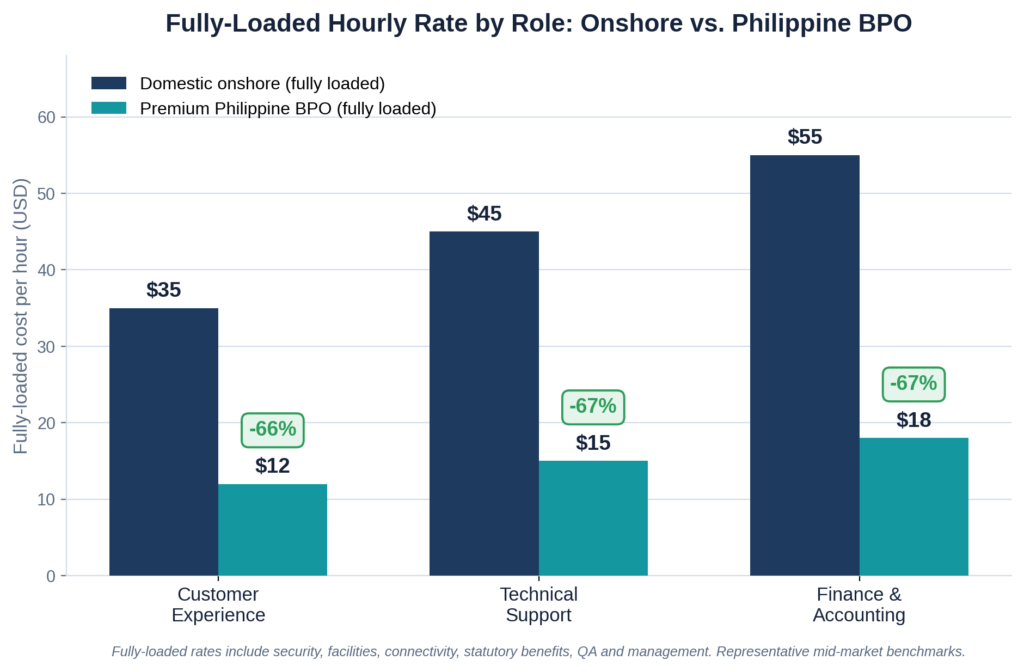
Figure 4. Representative fully-loaded hourly rates by role, onshore versus Philippine BPO.
What Compliance and Infrastructure Standards Protect Enterprise Scale?
Leading Philippine providers protect scale through zero-trust data architectures, premier global certifications (SOC 2 Type II, ISO 27001, HIPAA, GDPR), and dual-feed utility infrastructure guaranteeing a 99.99% uptime baseline. Rapid scaling without this governance introduces unacceptable enterprise risk.
To safely maintain operational integrity across borders, leading delivery centers use sophisticated business-continuity plans and security architectures aligned with Western regulatory environments. Enterprise decision-makers should audit potential partners against three primary operational vectors before committing.

Figure 5. The three operational vectors and certifications enterprise buyers should audit.
Data Privacy Guardrails
Top-tier vendors enforce zero-trust network access (ZTNA), multi-factor authentication (MFA), and secure thin-client virtual desktop environments (VDI) in which sensitive customer data never resides locally on an agent’s terminal.
Regulatory Attestations
High-acuity providers maintain active, third-party-audited compliance frameworks — including SOC 2 Type II, ISO 27001, HIPAA, and GDPR — protecting international data processing and financial workflows.
Physical Redundancy
Premium facilities use dual-feed power grids backed by industrial, immediate-switch generators, alongside automated, redundant subsea fiber-optic loops, to sustain a 99.99% operational uptime baseline.
What Does an Efficient Philippine BPO Scaling Engagement Look Like?
A hyper-growth e-commerce brand facing a 200% peak-season ticket surge deployed a dedicated 25-agent multichannel support pod in 30 days via advisory-led matching. The backlog cleared within 14 days, First Contact Resolution rose 22%, and customer-experience operating costs fell 61%.
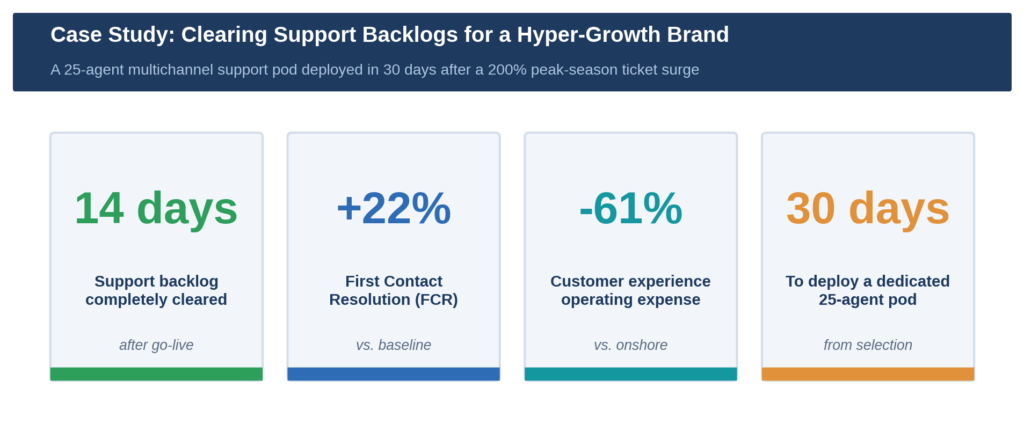
Figure 6. Quantifiable outcomes from an agile, mid-market e-commerce support engagement.
The Challenge
A rapidly growing e-commerce platform faced severe customer churn during a peak holiday season. A 200% surge in support tickets stretched response times past 48 hours and completely overwhelmed its domestic internal staff.
The Vendor Selection Process
To avoid the friction of vetting hundreds of look-alike suppliers, the brand engaged an independent advisory consultancy. The consultancy analyzed the platform’s specific ticketing tools, security baselines, and volume curves, shortlisting three specialized mid-market providers within 72 hours.
The Solution Implemented
The brand selected an agile Philippine partner that provisioned a dedicated 25-agent multichannel support pod within 30 days. The team operated on a cloud-native customer-service platform using standardized resolution playbooks developed synchronously with the client’s onshore leads.
The Quantifiable Outcomes
- The support queue cleared completely within 14 days of go-live.
- First Contact Resolution (FCR) rates increased by 22%.
- Ongoing customer-experience operating expenditures fell by 61%.
Lessons Learned
Scaling efficiently means moving away from massive, legacy BPO conglomerates that treat mid-market brands as low-priority accounts. True operational agility comes from specialized, mid-sized operators that offer direct executive attention and customized talent sourcing.
Why Do Corporate Decision-Makers Leverage PITON-Global to Navigate the Market?
Decision-makers use PITON-Global because the Philippine market contains thousands of providers, making independent procurement risky. As an independent, advisory-led consultancy with a curated network of 100+ vetted mid-market providers, it matches technical, volume, and compliance needs to verified partners — shortening selection from months to days at zero cost to the buyer.
The Philippine BPO sector contains thousands of service providers, which makes independent vendor procurement a complex, risk-heavy endeavor for international companies. Traditional transactional brokers often worsen this by operating on hidden incentive models that favor the highest-bidding vendor rather than the client’s actual technical or cultural needs.
Who Is PITON-Global?
PITON-Global is an independent, advisory-led BPO consultancy that acts as an objective advocate for buying enterprises. Led by international contact-center executives with decades of global operations experience, it specializes in BPO advisory and provider selection — guiding companies through a fragmented market rather than operating its own call centers.
How Does PITON-Global Differ from Traditional Outsourcing Brokers?
Traditional brokers run on hidden incentive models that steer clients toward the highest-bidding vendor. PITON-Global redefines the paradigm with a vendor-agnostic methodology: it evaluates providers objectively, recommends on verified capability rather than referral fees, and stays aligned to the buyer’s technical and cultural needs — compressing a 90-day cycle into 15–30 days.

Figure 7. A traditional 90+ day procurement cycle versus PITON-Global’s 15–30 day path.
How Does PITON-Global’s Network of 100+ Vetted Philippine BPO Providers Benefit Organizations?
A curated, continuously audited network of more than 100 premium mid-market providers gives organizations broad, pre-qualified optionality across service categories — from multichannel CX and technical support to finance, KPO, and compliance. Ongoing auditing means buyers gain faster discovery and assurance that candidates already meet capability, security, and compliance baselines.
How Does PITON-Global’s Advisory-Led Vendor Matching Process Work?
The methodology is structured and vendor-agnostic. PITON-Global audits an organization’s technical requirements, volume realities, and compliance standards, then screens those against its curated network to surface three verified fits — chosen on capability, not broker incentives. It then optimizes commercial terms and supports an optimized launch in 15 to 30 days.

Figure 8. The five stages of PITON-Global’s vendor-agnostic selection methodology.
Why Do Organizations Use PITON-Global?
Organizations use PITON-Global to eliminate procurement blind spots, improve provider fit, and shorten vendor selection from months to days — all at zero cost to the enterprise buyer. By optimizing commercial terms and aligning capacity with long-term growth, the consultancy de-risks scaling decisions at exactly the moment speed and fit matter most.
What Else Should Decision-Makers Know Before Outsourcing to the Philippines?
Frequent questions cover minimum team size, communication and culture, back-office safety, time-zone management, choosing legacy versus mid-market providers, and contract terms. In short: pods can start at 5–10 agents, English proficiency is high, complex KPO is well supported, 24/7 coverage is standard, mid-market offers more agility, and MSAs include flexible exit clauses.
What is the Standard Minimum Team Size Required to Outsource to the Philippines?
While massive tier-1 providers typically demand initial commitments of 50 to 100 full-time roles, premium mid-market providers can efficiently architect and scale specialized pods starting at 5 to 10 agents.
How Do Philippine Teams Manage Communication Barriers or Cultural Differences?
The Philippines features an exceptionally high English-proficiency rate paired with a deep affinity for Western business culture. Professionals undergo intensive brand-voice and product-specific training during onboarding to ensure seamless, natural interactions with global customers.
Can Specialized Back-Office Processes Like Financial Accounting Be Outsourced Safely?
Yes. The Philippine IT-BPM sector has evolved into a sophisticated global hub for Knowledge Process Outsourcing (KPO), delivering accurate solutions for judgment-driven workflows including forensic accounting, legal support, medical coding, and AI data annotation.
How Are Time-Zone Differences Managed for Companies Operating in the US or Europe?
The entire outsourcing infrastructure is purpose-built for continuous 24/7/365 operations. Dedicated night shifts (graveyard operations) are standard, allowing offshore teams to work in perfect synchronicity with your domestic business hours.
What Parameters Should Dictate Our Choice Between a Large Legacy BPO and a Mid-Market Provider?
Large legacy BPOs excel at massive, multi-thousand-seat voice contracts but often lack flexibility or executive oversight for growing brands. Mid-market providers offer significantly higher agility, customized technical integrations, and direct C-level attention.
What Are the Standard Contract Durations and Exit Provisions for These Agreements?
Most premium mid-market providers offer flexible Master Services Agreements (MSAs). Standard terms typically run 12 to 24 months to protect initial training investments, but routinely include 30 to 60-day termination-for-convenience clauses to preserve scaling agility.