
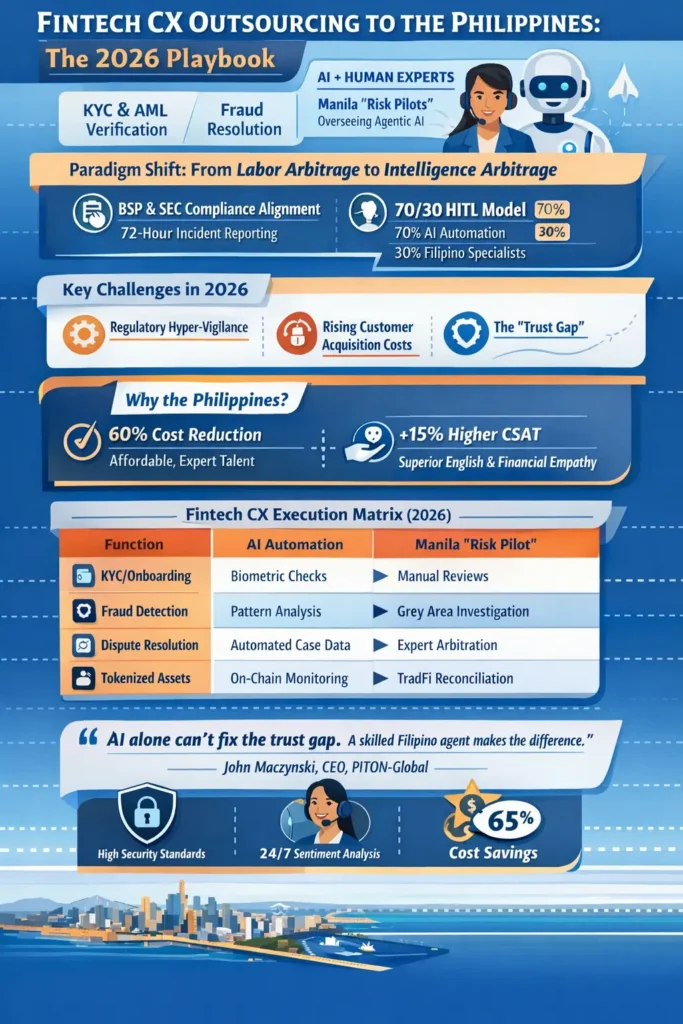
Fintech customer experience management outsourcing to the Philippines is the strategic delegation of high-stakes financial support, KYC/AML verification, and dispute resolution to specialized offshore teams. In 2026, the model focuses on Human-in-the-Loop (HITL) systems where Filipino “Risk Pilots” oversee Agentic AI workflows, ensuring regulatory compliance and empathetic resolution in complex neo-banking, tokenized assets, and cross-border payment scenarios.
30-Second Executive Briefing
- The Paradigm Shift: Transitioning from “Labor Arbitrage” to “Intelligence Arbitrage,” where the Philippines serves as a global “Governance Perimeter” for financial brands.
- Regulatory Alignment: Direct integration with BSP Circular 1137 and the 2026 SEC Cyber Resilience Framework for 72-hour incident disclosure mandates.
- The HITL Ratio: A 70/30 split—AI automates rote data; Filipino experts manage high-stakes financial exceptions and “Grey Area” fraud.
- Bottom Line: Specialized Manila hubs reduce operating costs by 60% while increasing CSAT by 15% through superior “English Purity” and financial empathy.
“Fintech isn’t losing to banks because of product innovation—it loses when trust, risk, and compliance can’t scale fast enough. AI-powered Philippine BPO closes that gap faster than any internal build we’ve seen.” — John Maczynski, CEO, PITON-Global
The 2026 Fintech CX Landscape: Why “Digital Only” is Failing
The promise of 2022 was that AI would replace the contact center. The reality of 2026 is that as financial products become more automated, the “Trust Gap” has widened. When a user’s account is frozen by an algorithm or a cross-border remittance vanishes into a blockchain “void,” a chatbot is no longer sufficient.
Fintechs are currently facing a triple threat:
- Regulatory Hyper-Vigilance: New 2026 global standards require instant human intervention for significant financial disputes.
- CAC Explosion: Traditional digital marketing costs have soared; retention through superior CX is now the only path to profitability.
- The Empathy Deficit: AI can process a transaction, but it cannot “save” a customer relationship during a fraudulent account takeover.
Intelligence Velocity: Moving Beyond Basic Support
In 2026, outsourcing is no longer about clearing tickets; it is about accessing specialized talent that is too expensive to scale onshore. Under the CREATE MORE Act (RA 12066), the Philippines has institutionalized a high-value cognitive service model that PITON-Global refers to as “Intelligence Arbitrage.”
Table 1: The Fintech CX Execution Matrix (2026 Standards)
| Function | Role of Agentic AI (Scale) | The Manila “Risk Pilot” (Trust) | Strategic Impact |
| KYC/Onboarding | Biometric OCR & liveness checks. | Manual triage of UBO & PEP alerts. | Sub-hour onboarding; 99% accuracy. |
| Dispute Mgmt | Automated data gathering. | Expert representation in arbitration. | 22% increase in fund recovery. |
| Fraud Detection | Real-time pattern flagging. | Proactive outreach for “Grey Area” spend. | Reduced false-positives by 40%. |
| Tokenized Assets | On-chain ledger monitoring. | Reconciliation with TradFi systems. | Near real-time asset transparency. |
The “Clean Room” Revolution: Security & Compliance
In the Fintech sector, Trust is the primary currency. Top-tier Philippine BPOs now operate under Zero-Trust Architecture to ensure data integrity.
- PII Masking: Personally Identifiable Information is masked at the edge; agents see only what is necessary to resolve the specific ticket.
- Cryptographic Device Binding: Every action taken by an offshore agent is tied to a unique transaction token, satisfying the 2026 SEC Cyber Resilience Framework.
- Circular 1137 Adherence: The Bangko Sentral ng Pilipinas (BSP) mandates that outsourcing partners meet the same cybersecurity standards as the banks themselves.
The Hidden ROI of Proactive CX
Successful Fintechs view CX as a Feedback Loop. By outsourcing to the Philippines, companies can afford 24/7 “Sentiment Analysts” who mine every interaction for product friction.
As John Maczynski notes, “In 2026, the ‘Gold Standard’ is an Agentic KYC model. You need an offshore engine in the Philippines that can handle unstructured data—like complex corporate ownership structures—without slowing down the customer journey.”
Integrating AI and Human Expertise (The HITL Model)
The most successful Fintechs in 2026 utilize a 70/30 split. This “Agentic Hybrid” model ensures the user never feels “stuck.” When the AI detects high-arousal keywords, it triggers an instant warm-transfer to a Manila-based specialist with the authority to override automated blocks.
Table 2: Comparative 2026 Cost-Efficiency Index
| Metric | Onshore (US/EU) | Philippines (Specialized) | Efficiency Leader |
| Fully Loaded Rate | $35 – $45/hr | $12 – $16/hr | Philippines (65% Savings) |
| English Proficiency | Native | 92%+ (Neutral/Purity) | Philippines (Lower Friction) |
| CSAT Score (Voice) | Baseline | +12% vs. Onshore | Philippines (Empathy focus) |
| Compliance TCO | High (Regulatory Tax) | Low (Pre-built frameworks) | Philippines (Audit-Ready) |
Training the “Risk Pilots”: Socio-Financial Engineering
The curriculum for a Philippine Fintech agent has shifted to Socio-Financial Engineering. This includes:
- Vulnerability Detection: Identifying victims of “Deepfake Audio” scams.
- Regulatory Fluency: Understanding subtle differences between EBA (Europe) and SEC (US) reporting.
- Escalation Logic: Knowing exactly when an AI’s decision-making threshold has been crossed.
The Future: Embedded Finance and the Philippines
As we look toward 2027, “Embedded Finance” will be the dominant model. The Philippines has transitioned from a “back office” to the Front Office of Global Finance, managing everything from BNPL disputes to reserve transparency for stablecoins under post-GENIUS Act requirements.
Summary of Strategic Recommendations
- Prioritize Security: Ensure your partner uses biometric access and MFA-universal standards.
- Invest in Training: Transition agents from “Support” to “Risk Pilots” with ACAMS certifications.
- Close the Feedback Loop: Use CX data to drive your 2026 product roadmap.
- Embrace the Hybrid: Let AI handle the velocity; let Manila handle the meaning.
Frequently Asked Questions (FAQs)
Q: Is outsourcing fintech CX to the Philippines compliant with 2026 SEC regulations?
A: Yes. Top providers adhere to the 2026 SEC Cyber Resilience Framework, which mandates material incident disclosure within 36–72 hours. Philippine centers are now built as “clean rooms,” where biometric access is standard for every agent.
Q: How does the Philippines compare to Nearshore (LATAM) for Fintech support?
A: While LATAM offers time-zone proximity, the Philippines maintains a 12–18% higher CSAT for complex voice interactions due to “English Purity” and the cultural concept of Malasakit (genuine care), which significantly reduces ticket re-work.
Q: Can offshore agents handle AML (Anti-Money Laundering) for tokenized assets?
A: Absolutely. In 2026, Manila is a hub for ACAMS-certified professionals who manage the “back office of the blockchain,” reconciling on-chain ledgers with traditional banking systems under GENIUS Act mandates.
Q: What is the average “Fully Loaded” rate for a specialized Fintech agent in 2026?
A: For a governance-level “Risk Pilot” in the Philippines, expect a rate of $12–$16/hour. Compared to the US onshore rate of $35–$45/hour, this represents a massive operational advantage without compromising on specialized technical skill or compliance.