

TL;DR: The Key Takeaway
The practice of facial recognition training is moving beyond simple data labeling to a paradigm of Ethical AI Stewardship, where Filipino specialists provide the critical human judgment needed to eliminate bias and ensure model accuracy. This strategic shift makes the archipelago the premier destination for building trustworthy and secure identity AI, and it mirrors the wider rise of hybrid human-and-AI teams in outsourced work.
In an era where algorithmic fairness is a regulatory mandate, facial recognition training in the Philippines provides the essential “Ethical AI Stewardship.” By moving beyond simple labeling to sophisticated bias mitigation and demographic parity, Filipino specialists ensure identity AI is both accurate and inclusive, protecting brands from the legal and moral risks of biased facial analysis.
Executive Briefing
- The Shift to Ethical Necessity: The primary driver for facial recognition training is no longer just speed, but the proactive elimination of demographic bias.
- Accuracy Through Parity: Expert Filipino teams specialize in “Bias Reduction,” ensuring identity models perform reliably across all ethnicities and lighting conditions.
- Cognitive Stewardship: Specialists act as human-in-the-loop auditors, identifying subtle prejudices in datasets before they are encoded into the model’s logic.
- Mission-Critical Security: The Philippine BPO sector provides military-grade data governance for sensitive biometric information, meeting strict global privacy standards.
- Strategic Alignment: PITON-Global links AI pioneers with elite Philippine partners who treat responsible AI development as a core technical requirement.
Beyond the Bounding Box: The Moral Imperative in Facial Recognition
The first generation of facial recognition technology was a technical marvel built on a shaky ethical foundation. Many early systems inherited the invisible biases of their creators, resulting in significant accuracy gaps for women and people of color. These were not just bugs; they were systemic failures with real-world consequences, from flawed law enforcement matches to exclusionary financial services. The industry has since realized that high-performance identity AI requires more than just volume—it requires a profound commitment to human-centered governance.
This is why the Philippines has become the strategic epicenter for this work. Training a modern model is no longer a task of drawing millions of boxes; it is a meticulous process of dataset curation led by specialists who exercise deep cognitive judgment. These experts flag lighting discrepancies that might impact darker skin tones and validate AI conclusions in ambiguous cases. This is a “cognitive apprenticeship,” where human intelligence guides the algorithm toward a more equitable understanding of human identity.
“Our clients are no longer asking for data annotators; they are asking for ethical guardians for their AI. They need partners who can critically analyze data and identify potential sources of bias before they are encoded into the model. This is the new frontier, and the Philippines is leading the charge.” — John Maczynski, CEO, PITON-Global
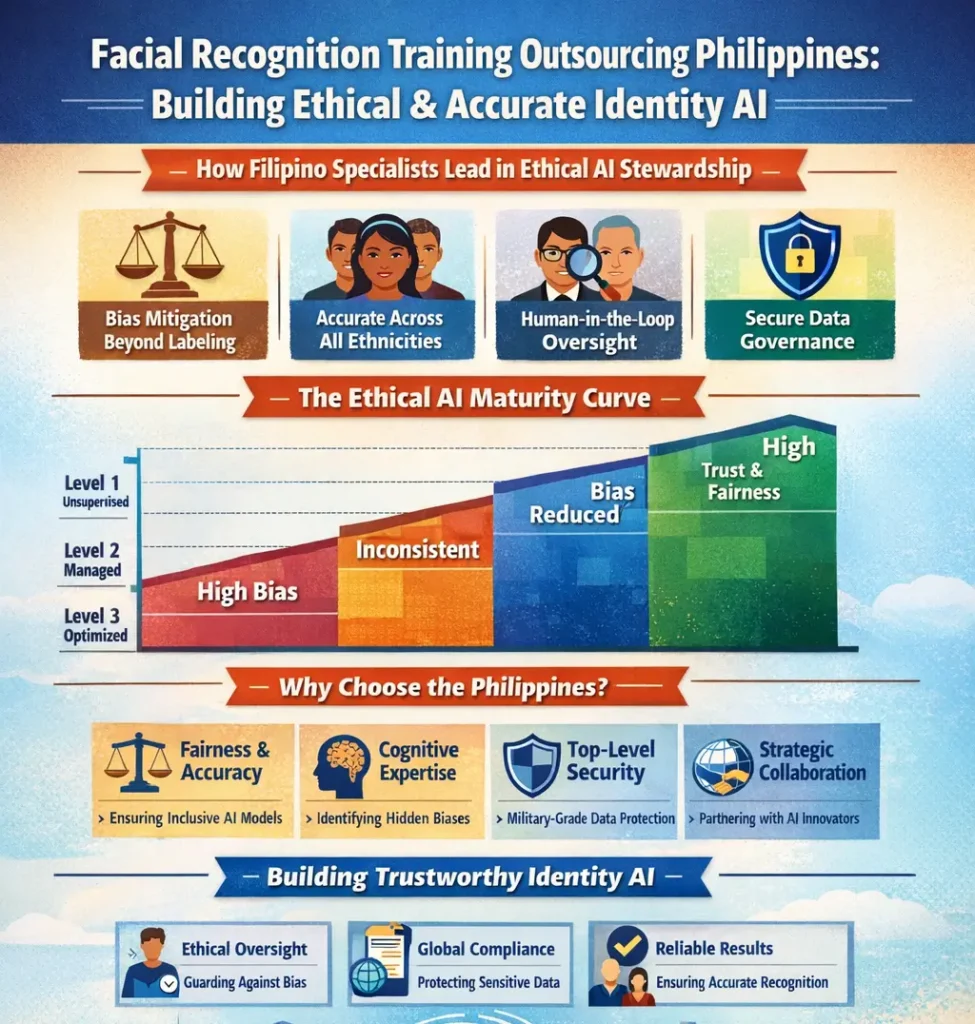
The Ethical AI Maturity Curve: From Automated Bias to Human-Led Fairness
The transition toward responsible facial recognition can be measured through a maturity framework. Understanding this progression is vital for any organization seeking a social license to deploy identity-based technology.
| Maturity Level | Primary Methodology | Key Metric | Ethical Outcome |
| Level 1: Unsupervised | Automated labeling | Overall Accuracy | High risk of demographic bias |
| Level 2: Managed | Basic human annotation | Cost Per Annotation | Inconsistent bias reduction |
| Level 3: Optimized | Expert-led annotation | Demographic Parity | Significant bias reduction |
| Level 4: Governed | Continuous oversight | Trust & Safety Score | High reliability and public trust |
As championed by PITON-Global, the industry standard is moving decisively toward Level 4, where human experts provide adversarial testing and continuous logic validation.
Intelligence Arbitrage in Identity AI: The Value of Nuance
In the field of identity, “Intelligence Arbitrage” is the practice of leveraging human discernment to solve problems that software cannot perceive. An AI can recognize a pattern, but it cannot understand the cultural context of an expression or the ethical weight of a misidentification. That gap is at the heart of the return on an AI-human hybrid model.
Expert Filipino teams bring this irreplaceable nuance to the table. They can distinguish between a genuine emotional response and a “mask,” which is critical for mental health or high-security applications. In security contexts, they identify when a face is intentionally obscured, preventing the “false negatives” that plague automated systems. This ability to interpret the underlying context transforms a basic model into a sophisticated tool for identity intelligence.
The Governance Framework: Building Trust by Design
Trust must be an architectural feature, not an afterthought. The Philippines’ top providers have invested heavily in governance frameworks that exceed standard privacy compliance. These involve:
- Multi-Layered Security: Protocols to protect biometric data as highly sensitive assets.
- Independent Validation: A secondary, independent expert reviews every annotation to ensure zero-defect accuracy.
- Active Overrides: Clear protocols that allow human specialists to intervene when the AI displays low-confidence or potentially biased results.
Facial Recognition Use-Case Suitability Score
| Use Case | Bias Risk Factor | Security Level | Outsourcing Suitability (1-10) |
| Consumer Device Access | Low | High | 9 |
| Retail Analytics | Moderate | High | 8 |
| Financial Services (KYC) | High | Very High | 9 |
| Public Safety | Very High | Mission-Critical | 6 (Requires elite governance) |
The Future of Identity: Proactive and Trustworthy
The next generation of identity AI will be seamless and predictive, integrated into everything from smart homes to autonomous transit. However, this vision is only viable if the technology is rooted in public trust. By providing the essential human oversight to ensure fairness and security, the Philippines is not just a destination for task execution—it is the control center for an equitable digital future.
Expert FAQs
Q: Why is human-in-the-loop (HITL) mandatory for facial recognition?
AI models left to their own devices tend to amplify existing societal prejudices. Human specialists curate representative data and catch subtle biases—like “shadow-based misidentification”—that algorithms often overlook.
Q: What skills do Filipino teams have that automated tools lack?
They possess a unique blend of critical thinking and cultural fluency, alongside the AI literacy the local BPO workforce is building. This allows them to identify nuances in expression and intent, ensuring the AI behaves ethically according to Western social norms and legal standards.
Q: How does PITON-Global vet its Philippine partners?
We evaluate partners on the robustness of their “Bias Detection” protocols and their data security architecture. We only link clients with providers who treat ethical AI as a technical requirement, not a checkbox.
Q: Can a model ever be completely free of bias?
While “zero bias” is statistically difficult, human-governed training achieves significantly higher fairness scores than automated alternatives. The goal is continuous refinement through human judgment.