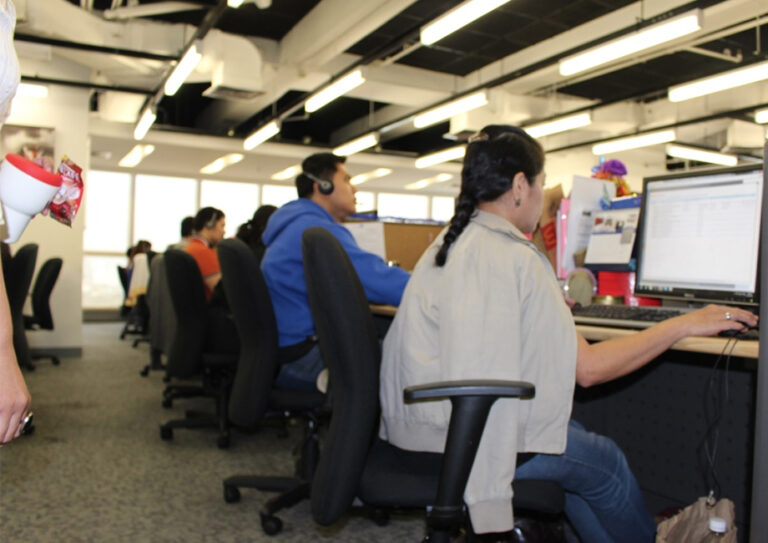

Software now answers many of the predictable questions an online store receives, and that has changed what the human half of e-commerce customer support is for. For brands that buy customer care built for online retailers from Manila or Cebu, the decision is no longer whether to use AI. It is how to split the work between automation and Filipino agents so that fewer orders, refunds and repeat buyers slip away between the two.
The old model treated technology as a way to cut headcount. The model that works for North American retailers, DTC brands and marketplace sellers staffing support in the Philippines treats it as a way to route each contact to whoever resolves it best: a bot for the lookup, a person for the judgment call. This guide walks through what each side handles, the tools an offshore desk runs on, how the handoff should be designed, and what to ask a provider before signing.
What AI now handles in e-commerce customer support
AI handles the high-volume, low-judgment contacts: where is my order, how do I start a return, has my refund posted, which size should I pick. Those questions have a single correct answer that lives in a system, so a well-connected bot can answer them instantly at 3 a.m. on a holiday weekend.
Self-service for order status and returns
The most valuable automation is a bot that reads the order management system rather than a static FAQ. When it can see the carrier scan, the promised delivery date and the return window, it can answer the “where is my order” question without a ticket and open a return label inside the chat. The quality of that answer depends on the quality of the data behind it; a bot reading a stale feed will confidently give the wrong date.
Agent assist inside the ticket
The second layer runs beside the human agent. Machine learning models tag and route incoming tickets, surface the customer’s order history, draft a suggested reply from the knowledge base, and summarize long email threads. Every resolved ticket becomes training material, so the suggestions improve as the team corrects them. The agent still decides what to send.
Predictive and proactive outreach
Predictive analytics uses order history and carrier data to spot trouble before the customer does. A delayed shipment, a failed payment retry or a back-ordered item can trigger a message with options before anyone writes in. Proactive contact reduces inbound volume and, more importantly, reduces the angry second contact that often ends in a refund.
Visual tools and augmented reality
Augmented reality try-on and “view in your room” features remain niche, but where a store uses them they cut fit and scale questions before purchase. Support agents need to know how these tools work so they can walk a customer through them rather than defaulting to a return.
Where Filipino agents still outperform the bots
People win any contact where money, emotion or an exception is involved. A damaged anniversary gift, a suspected fraudulent order, a customer who wants an exception to the return policy, or a shopper deciding between two expensive items all need judgment, tone and the authority to offer something.
That is where the Philippine workforce earns its place. The Philippines scored 569 and ranked 28th in the 2025 EF English Proficiency Index, and the industry is deep: IBPAP reported 1.9 million IT-BPM workers and export revenue above $40 billion in 2025, according to the Philippine Star in January 2026. For a retailer, depth means a provider can hire for a specific brand voice and still staff a holiday ramp.
Language is only part of it. Filipino agents are familiar with North American retail habits: holiday gifting deadlines, generous return expectations, the tone of a brand’s social channels. The cultural value of malasakit, genuine concern for the person on the other side, shows up in how agents handle a customer who is upset rather than merely curious. That matters most on returns, where a patient conversation can turn a refund into an exchange.
The contacts to keep human
- Returns where an exchange, repair or partial credit could keep the sale.
- Damaged, lost or late orders tied to a date that matters to the customer.
- Fraud, chargeback and account-takeover cases that need investigation.
- High-value pre-purchase questions where confidence decides the checkout.
- Any complaint that has already failed once in self-service.
The tools behind a modern offshore help desk
A Philippine desk should work inside your stack, not a parallel one. Cloud help desks, shared knowledge bases and scoped admin access let agents in Manila see exactly what your in-house team sees, which keeps answers consistent across channels and shifts.
A typical setup includes the help desk or CRM, read access (and limited write access) to the storefront admin and order management system, the carrier and third-party logistics portals, the payment processor dashboard for refund and dispute status, and a quality tool that scores conversations. Order handling is its own discipline; our guide to how offshore teams run e-commerce order management covers edits, cancellations and exception queues in detail.
Access has to be governed. Agents should get least-privilege roles, refund limits by tier, and no view of full card numbers. PITON’s shortlisted providers are governed under standards including PCI DSS, SOC 2 Type II and ISO 27001, and those controls should be written into the contract, not assumed.
Refunds, disputes and payouts also sit where support meets finance. When the same provider reconciles marketplace payouts and chargebacks, the two teams need a shared view of every refund; see how bookkeeping support for multi-channel sellers fits alongside the customer desk.
How the AI-and-agent handoff should work
A good handoff passes the customer and the full context to a person the moment the bot is out of its depth. A bad one makes the customer repeat everything, which is where most automation projects lose the goodwill they were meant to protect.
- Define the bot’s scope in writing: which intents it resolves, which it only collects details for, and which go straight to a person.
- Set escalation triggers: low confidence, negative sentiment, a second failed attempt, or any order above a value threshold.
- Hand over with context: order number, what the bot already said, and the customer’s own words, visible to the agent before they reply.
- Give agents clear authority: refund caps, exchange options and goodwill credits by tier, so they can resolve without a supervisor.
- Feed corrections back: agents flag wrong bot answers weekly, and someone owns updating the content.
- Review outcomes monthly: containment, recontact, refund-versus-exchange mix and satisfaction after automated contacts.
Containment on its own is a misleading goal. A bot that “contains” a return request by issuing an instant refund has closed a ticket and lost a sale. Measure what happened to the order, not only whether a human was involved.
Technical troubleshooting and continuous training
Technical questions make up a growing share of storefront contacts. Login loops, failed discount codes, payment declines, subscription portal errors and app bugs all look like “support” to the customer, and they need agents who can reproduce a problem and write a clean bug report.
Retailers with a heavy app or subscription component often split this into a dedicated tier; our piece on technical support for online storefronts explains how that tier is staffed and escalated. The general desk in the Philippines still needs enough product knowledge to rule out the common causes before escalating.
Training has to keep pace with the stack, whether the team sits in Manila, Cebu or another Philippine delivery city. Each new app, checkout change or bot release should come with a short brief, a knowledge-base update and a calibration session so that agents and automation give the same answer. Providers that run this as a routine, rather than a one-off onboarding, keep quality stable through platform changes.
What to ask a provider before you sign
Ask to see the model working, not the slide describing it. The right questions expose whether a vendor has run AI and human agents together on a live retail account or is promising it for the first time.
- Which help desk, storefront and automation platforms are your agents working in today, for which kinds of retailers?
- How do you measure a bot-to-agent handoff, and what happens when the bot is wrong?
- What refund and exchange authority do front-line agents get, and who approves exceptions?
- How do you staff peak season without diluting quality on the core team?
- Which access controls and audits apply to our customer and payment data?
Choosing well matters because the market is large and uneven. As of 2026, of roughly 1,000 BPO providers operating in the Philippines, 110 top mid-sized providers made it through PITON’s seven-step vendor vetting framework, about one in ten. The shortlist is free and carries no obligation.
Frequently asked questions
Will AI replace Philippine agents for my online store?
No. AI removes the repetitive lookups, which shrinks the queue but raises the share of contacts that need judgment. Most retailers end up with a smaller, more skilled human team handling returns, exceptions and high-value sales conversations.
Which contacts should we automate first?
Start with order status, return initiation and refund status, provided the bot can read live order data. Leave anything involving policy exceptions, damaged goods or payments with a person until the bot has proven accurate.
Can Filipino agents work inside our own help desk and storefront admin?
Yes, and they should. Agents in the Philippines work in your existing tools under role-based access, which keeps reporting in one place and lets you audit every action.
How long does it take to launch?
Vetted providers in the Philippines can typically launch operations in under 8–10 weeks, per the PITON vetting framework, covering hiring, system access, training and a parallel run before cutover.