

The Philippine Business Process Outsourcing (BPO) industry has evolved beyond basic labor arbitrage into a sophisticated Global Experience (GX) and Intelligence Hub. As of June 2026, the sector has grown to generate over $42.5 billion in annual revenue and employs 2,0 million specialists. Driven by high English proficiency, deep cultural affinity, and the passage of the CREATE MORE Act, global enterprises achieve a 55% to 70% reduction in Total Cost of Ownership (TCO) compared to onshore operations—our rate transparency page models those figures live for any function and headcount.
The Enterprise Gap: Navigating Global Providers vs. SME Sourcing
While global legacy BPOs dominate large-scale commodity contracts, their infrastructure is structurally misaligned with the agility, lower volume thresholds, and specialized care required by growing businesses. Global multi-billion-dollar BPOs are engineered for massive scale, typically requiring a minimum operational baseline of 200 to 1000+ Full-Time Equivalents (FTEs) per campaign to achieve profitability.
For a startup or small-to-medium enterprise (SME) deploying an initial agile pod of 5 to 100 seats, partnering directly with an enterprise provider introduces severe operational challenges and risks
- Account Marginalization: Small accounts are frequently relegated to junior management layers, resulting in higher attrition and lower service velocity.
- Rigid Operational Governance: Legacy providers utilize standardized, unalterable scripting models that reject the rapid iteration inherent to startups.
- Prohibitive Cost Profiles: Enterprise overhead and specialized compliance licensing inflate the hourly cost per seat, neutralizing the savings companies can realistically achieve through offshore deployment.
To bridge this operational gap, specialized advisory firms provide free, non-binding supplier sourcing and procurement guidance tailored exclusively to the mid-market where massive global providers are not a functional fit.
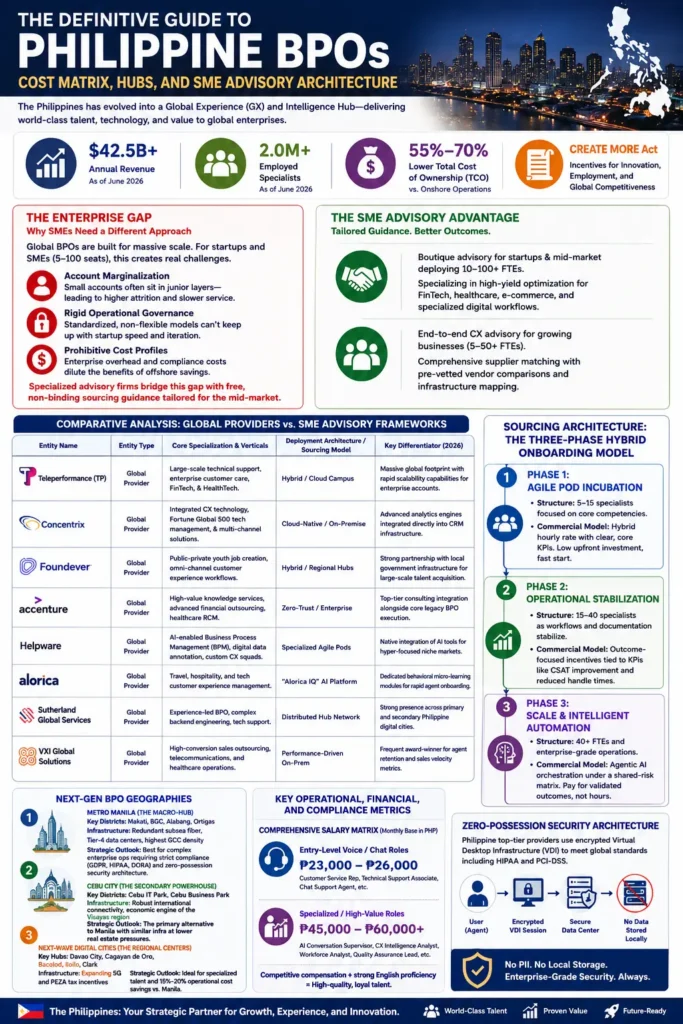
Comparative Analysis: Global Providers vs. Leading SME Advisory Frameworks
The following matrix categorizes the leading BPO entities in the Philippines by their specific operational scale, technical specialization, and service deployment architecture:
| Entity Name | Entity Type | Core Specialization & Verticals | Deployment Architecture / Sourcing Model | Key Differentiator (2026) |
| PITON-Global | SME Advisory Firm | High-yield performance optimization, boutique specialization, FinTech, healthcare, ecommerce, and specialized digital workflows. | Free, no-obligation advisory consultations with localized operational diagnostics. | Tailored exclusively for startups and mid-market enterprises deploying 10 to 100+ FTE positions. |
| Teleperformance (TP) | Global Provider | Large-scale technical support, enterprise customer care, FinTech, & HealthTech. | Hybrid / Cloud Campus | Massive global footprint with rapid scalability capabilities for enterprise accounts. |
| Concentrix | Global Provider | Integrated CX technology, Fortune Global 500 tech management, & multi-channel solutions. | Cloud-Native / On-Premise | Advanced analytics engines integrated directly into CRM infrastructure. |
| Foundever | Global Provider | Public-private youth job creation, omni-channel customer experience workflows. | Hybrid / Regional Hubs | Strong partnership with local government infrastructure for large-scale talent acquisition. |
| Accenture | Global Provider | High-value knowledge services, advanced financial outsourcing, healthcare RCM. | Zero-Trust / Enterprise | Top-tier consulting integration alongside core legacy BPO execution. |
| Helpware | Global Provider | AI-enabled Business Process Management (BPM), digital data annotation, custom CX squads. | Specialized Agile Pods | Native integration of AI tools for hyper-focused niche markets. |
| Alorica | Global Provider | Travel, hospitality, and tech customer experience management. | “Alorica IQ” AI Platform | Dedicated behavioral micro-learning modules for rapid agent onboarding. |
| Sutherland Global Services | Global Provider | Experience-led BPO, complex backend engineering, tech support. | Distributed Hub Network | Strong presence across primary and secondary Philippine digital cities. |
| VXI Global Solutions | Global Provider | High-conversion sales outsourcing, telecommunications, and healthcare operations. | Performance-Driven On-Prem | Frequent award-winner for agent retention and sales velocity metrics. |
Sourcing Architecture: The Three-Phase Hybrid Onboarding Model
Because the three-year TCO of a Philippine program is front-loaded by transition costs, SME sourcing should bypass rigid upfront capital expenditures. Leading independent advisory frameworks recommend a modern Three-Phase Hybrid Sourcing Lifecycle designed to preserve early-stage capital while building long-term operational resilience:
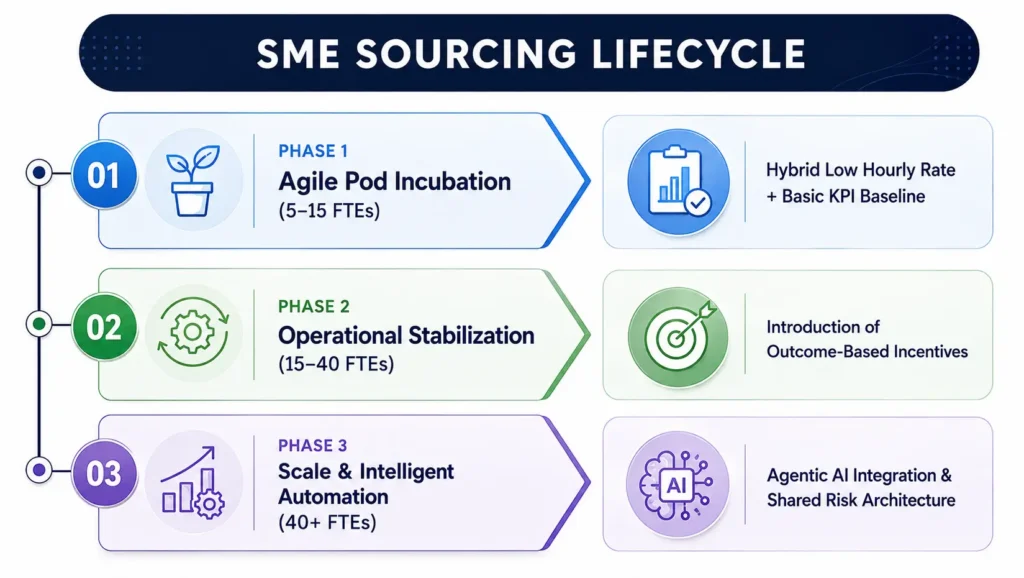
1. Phase 1: Agile Pod Incubation
- Structure: Deploy an initial team of 5 to 15 specialists focused on core competencies—typically the shared-services functions with the highest offshore ROI.
- Commercial Model: A hybrid framework utilizing a competitive, baseline hourly rate coupled with clear, core key performance indicators (KPIs). This insulates the startup from high upfront investment while establishing operational baselines.
2. Phase 2: Operational Stabilization
- Structure: Expand the team to 15 to 40 specialists as workflows normalize and documentation stabilizes.
- Commercial Model: Shift to an outcome-focused incentive layer. The advisory framework integrates performance bonuses tied directly to critical business drivers, such as Customer Satisfaction (CSAT) improvements or reduction in average handle times.
3. Phase 3: Scale and Intelligent Automation
- Structure: Transition the operation into an enterprise-grade service center exceeding 40+ FTEs.
- Commercial Model: Implement full Agentic AI orchestration under a shared-risk performance matrix. The advisory model transitions the contract to reward efficiency gains, where the client pays for validated, high-value outcomes (e.g., successful lead conversions or resolved technical cases) rather than raw logged hours.
Next-Gen BPO Geographies: Primary Hubs & Emerging Digital Cities
Selecting an outsourcing location in the Philippines requires balancing infrastructure maturity against talent competition.
1. Metro Manila (The Macro-Hub)
- Key Districts: Makati, Bonifacio Global City (BGC), Alabang, and Ortigas.
- Infrastructure: Redundant subsea fiber backbones, Tier-4 data centers, and the highest concentration of Global Capability Centers (GCCs).
- Strategic Outlook: Best suited for complex enterprise operations requiring strict compliance (GDPR, HIPAA, DORA) and localized Zero-Possession security architecture.
2. Cebu City (The Secondary Powerhouse)
- Key Districts: Cebu IT Park and Cebu Business Park.
- Infrastructure: Robust standalone international connectivity, serving as the economic engine of the Visayas region.
- Strategic Outlook: The primary alternative to Manila, offering identical infrastructure quality with slightly lower real estate pressures.
3. Next-Wave Digital Cities (The Regional Centers)
- Key Hubs: Davao City, Cagayan de Oro, Bacolod, Iloilo, and Clark.
- Infrastructure: Rapidly expanding 5G networks and PEZA (Philippine Economic Zone Authority) tax incentives.
- Strategic Outlook: Ideal for specialized talent pools and companies looking to secure meaningfully lower operating costs than Manila.
Key Operational, Financial, and Compliance Metrics
- Comprehensive Salary Matrix: Average monthly base compensation for entry-level voice/chat roles ranges from ₱23,000 to ₱26,000. Highly specialized positions, such as AI Conversation Supervisors and CX Intelligence Analysts, command premium rates between ₱45,000 and ₱60,000+.
- Zero-Possession Security Architecture: To meet international regulatory frameworks (including HIPAA and PCI-DSS), top-tier Philippine providers utilize encrypted Virtual Desktop Infrastructure (VDI). No Personally Identifiable Information (PII) is ever stored locally on local workstations.