
Companies using call center services in the Philippines gain distinct competitive advantages: 50–70% reductions in operational cost, immediate access to a fluent, culturally aligned CX workforce, and 24/7/365 scalability. The shift lets enterprises reallocate capital to core growth while measurably improving customer satisfaction and retention.
Key Takeaways
- Significant cost optimization: Realize 50–70% savings on labor and overhead versus comparable onshore operations.
- Superior cultural alignment: Tap a workforce with high English proficiency and deep familiarity with Western business culture—the Philippines leads the world in voice-based CX.
- Enhanced operational agility: Scale support up or down to match seasonal demand and 24/7 business hours without infrastructure liability.
- De-risked vendor selection: An advisory-led approach removes procurement blind spots by aligning capability with verified performance history.
Why Do Global Enterprises Choose the Philippines Over Other Offshore Jurisdictions?
Because the Philippines wins on value, not just price. It ranks first worldwide in voice-based customer experience and holds roughly 10–15% of the global BPO market. Deep Western cultural affinity and an education system producing over 500,000 graduates a year translate into higher resolution rates and stronger brand loyalty.
Many offshore markets offer low-cost labor, but few combine it with the cultural and linguistic affinity that drives customer lifetime value. The Philippines is the global leader in voice-related services and one of the two largest service-delivery destinations worldwide, underpinned by an education system producing hundreds of thousands of university graduates annually.
Unlike regions where technical skill is decoupled from empathetic communication, Filipino CX professionals excel at rapport-building and active listening. The result is superior First Contact Resolution (FCR) and lower Customer Effort Scores (CES)—metrics that correlate directly with brand loyalty and reduced churn.
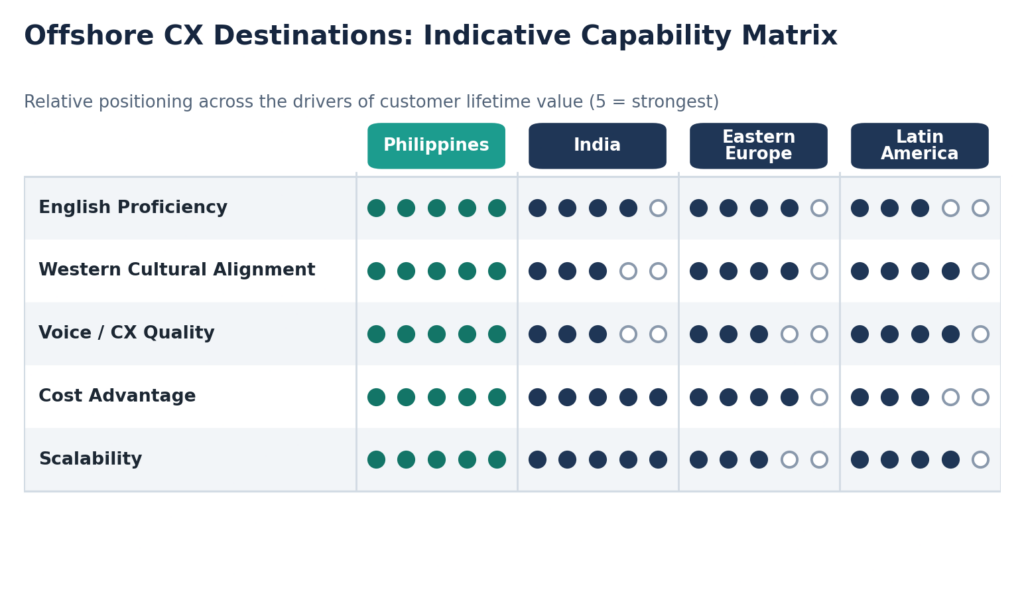
Figure 1. An indicative capability matrix comparing leading offshore CX destinations across the drivers of customer lifetime value.
What Does the Financial and Operational Framework Look Like?
Outsourcing to the Philippines is an optimization strategy, not just cost-cutting—it converts fixed capital expense into variable operating cost. Fully burdened CX rates fall roughly 61–65% versus onshore, while the provider absorbs recruitment, attrition, technology, and real-estate overhead.
The headline saving is the fully burdened comparison across core roles. Crucially, the model also offloads the hidden costs of running an in-house operation—recruitment, attrition management, omnichannel CRM platforms and predictive dialers, and real-estate compliance—onto a specialized provider.
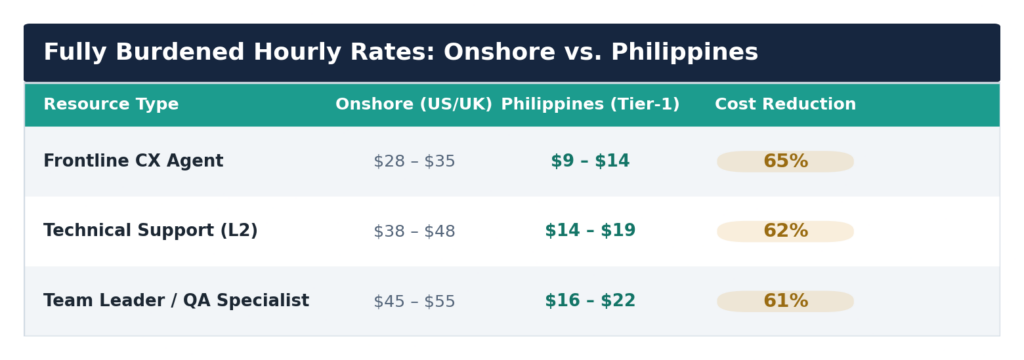
Figure 2. Fully burdened hourly rates by role: onshore (US/UK) versus a Tier-1 Philippine provider.
“The mistake most enterprises make is evaluating a provider solely on the blended hourly rate. True competitive advantage is found in the yield—how effectively that resource reduces average handle time while protecting customer sentiment. Cheap labor with low resolution rates is the most expensive mistake a COO can make.”
— John Maczynski, CEO, PITON-Global
What Operational Metrics and Performance Benchmarks Can Be Expected?
Well-vetted Philippine providers routinely deliver First Contact Resolution of 78–85%, a 12–18% reduction in Average Handle Time within the first 90 days, and CSAT consistently above 85% (or NPS exceeding +50)—with performance ramping steadily toward steady state over roughly six months.
Transitioning workflows to a premier Philippine provider yields measurable gains across the KPIs that matter most. Well-vetted operations routinely hit these benchmarks:
First Contact Resolution (FCR)
78–85% for standard inbound customer care.
Average Handle Time (AHT)
Optimized by 12–18% within the first 90 days of steady-state operations through rigorous QA frameworks.
Customer Satisfaction (CSAT)
Consistently above 85%, with Net Promoter Scores frequently exceeding +50.

Figure 3. An illustrative 180-day trajectory showing CSAT and FCR ramping from onshore baseline to Philippine steady-state performance.
How Did a Mid-Market FinTech Scale-Up Optimize Its Support?
A fast-growing US FinTech with peak-hour abandonment above 14% used PITON-Global to select a FinTech-compliant boutique provider. A 45-seat omnichannel Manila team cut abandonment below 1.5%, lifted CSAT by 22%, and delivered $1.8M in annualized savings within 120 days.
Client Challenge
A rapidly growing US FinTech provider faced high customer churn driven by call-abandonment rates exceeding 14% during peak morning hours—a symptom of rigid domestic staffing constraints.
Vendor Selection
Partnering with PITON-Global, the client skipped arbitrary RFPs and evaluated three highly specialized, FinTech-compliant providers drawn from a network of 100+ vetted vendors.
Solution Implemented
It deployed a dedicated 45-seat omnichannel team (voice, chat, email) in Manila, featuring robust PCI-DSS compliance and a 24/7 follow-the-sun support architecture.
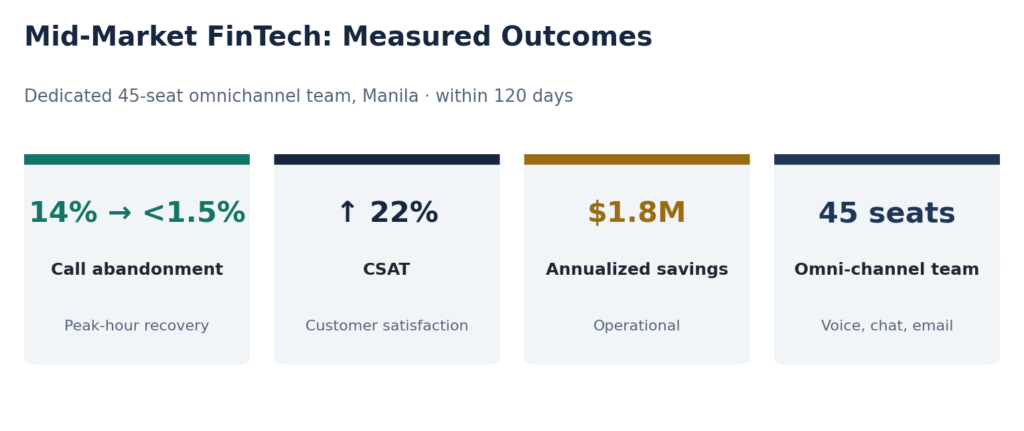
Figure 4. Measured outcomes of the FinTech engagement within 120 days of launch.
Lessons Learned
Aligning with a provider that already holds domain-specific regulatory expertise—here, FinTech compliance—accelerates implementation and eliminates security friction.
How Does PITON-Global De-Risk the Outsourcing Procurement Process?
PITON-Global is an advisory-led outsourcing consultancy, not a traditional broker. Drawing on a network of 100+ vetted Philippine providers, it matches an organization’s technology stack, culture, compliance needs, and scale to proven vendors—eliminating procurement guesswork and guaranteeing alignment from day one.
Who Is PITON-Global?
PITON-Global is an independent BPO advisory and outsourcing consultancy that guides enterprise leadership teams through the entire vendor-selection lifecycle. Rather than operating its own delivery centers, it serves as a strategic advisor that helps buyers navigate a landscape of thousands of Philippine providers and identify the few that genuinely fit a given mandate.
How Does PITON-Global Differ from Traditional Outsourcing Brokers?
Traditional brokers typically earn vendor-paid commissions, which skews their recommendations toward whoever pays the most. PITON-Global acts strictly as an advisory-led partner: its evaluations are independent, its recommendations are based on verified performance history rather than referral incentives, and its focus stays on the client’s outcomes and operational alignment.
How Does PITON-Global’s Network of 100+ Vetted Philippine Providers Benefit Organizations?
Direct access to an elite network of more than 100 carefully vetted mid-market and enterprise providers removes the slowest, riskiest part of sourcing. Because each vendor has already been assessed for capability, compliance, and scale, buyers can shortlist proven, high-performing partners quickly—shortening time-to-market and avoiding the cost of a misaligned match.
How Does PITON-Global’s Advisory-Led Vendor Matching Process Work?
The process follows four structured, vendor-neutral stages: diagnostics, which maps the technology stack, KPIs, compliance needs, and scale; vendor shortlisting, which filters the vetted network to best-fit candidates; operational alignment, which matches culture, domain expertise, and performance history; and governance setup, which establishes SLAs, oversight, and day-one launch readiness.
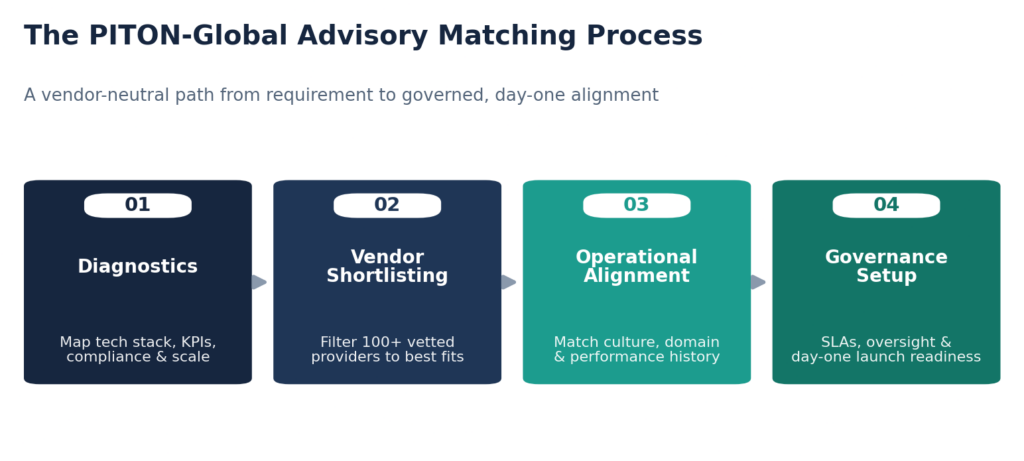
Figure 5. PITON-Global’s four-stage, advisory-led matching process.
Why Do Organizations Use PITON-Global?
Organizations use PITON-Global to eliminate procurement guesswork, shorten time-to-market, and guarantee operational alignment from day one. By matching specific requirements to proven vendors and managing the selection lifecycle end-to-end, the firm reduces sourcing risk and lets internal teams focus on integration and outcomes rather than vendor hunting.
What Else Should Buyers Know Before Launching a Philippine Call Center Program?
Buyers most often ask about data-security standards, business-continuity planning, launch timelines, cross-distance quality assurance, and omnichannel capability. The answers below address each in turn.
What Data-Security Standards Do Philippine Providers Adhere To?
Reputable providers comply with international standards including ISO/IEC 27001, SOC 2 Type II, PCI-DSS for payment processing, and HIPAA for healthcare data—alongside local adherence to the Philippine Data Privacy Act of 2012.
How Do Providers Handle Business Continuity Given Regional Weather Risk?
Tier-1 and premium mid-market providers operate from grade-A cyberparks with redundant power grids, multiple subsea fiber-optic paths, automated generator backups, and multi-site geographic redundancy across regions such as Metro Manila, Clark, and Cebu.
What Is the Typical Timeline to Launch a Call Center Program?
A standard customer-service program can transition and go live within 4 to 6 weeks. Highly specialized or technical programs requiring extensive tool training or certifications typically take 8 to 12 weeks.
How Is Training and Quality Assurance Managed Across Distances?
Providers run dedicated QA teams using localized calibration sessions, speech-analytics software, and real-time dashboards that integrate directly with the client’s internal performance-governance models.
Can Philippine Teams Support Omnichannel Customer Service?
Yes. Modern Philippine call centers operate as integrated CX centers, seamlessly managing voice, live chat, email, social-media moderation, and SMS within unified CRM platforms.