The build-versus-outsource decision for AI and autonomy support turns on cost structure, speed, and control. Building in-house buys full control and context at a high fixed cost and a slow ramp; outsourcing to a Philippine BPO converts that to variable cost, compresses time-to-scale, and provides specialized pods on demand. The pragmatic answer for most operators is a hybrid: keep the core safety case and IP-critical judgment in-house, and outsource the scalable execution.
Key Takeaways
- Three axes decide it. Cost structure, time-to-scale, and control — weighed against your stage and strategy.
- Build buys control, costs time. Full context and ownership at a high fixed cost and a slow ramp.
- Outsource buys speed and flexibility. Variable cost, faster scale, and specialized pods on demand.
- Hybrid usually wins. Keep the safety case and IP-critical judgment in-house; outsource scalable execution.
What Actually Drives the Build-Versus-Outsource Decision?
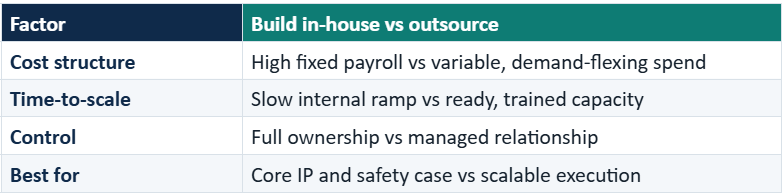
Three factors: cost structure (fixed in-house payroll versus variable outsourced spend), time-to-scale (slow internal hiring versus an established partner’s ready capacity), and control (full ownership versus a managed relationship) — weighed against your stage and what is genuinely core.
The decision is not ideological; it is a weighing of three axes against your situation. Cost structure: building means a high fixed payroll, while outsourcing converts that to spend that flexes with demand. Time-to-scale: internal hiring and training is slow, while an established partner brings ready capacity and process. Control: in-house gives full context and ownership, while outsourcing trades some of that for flexibility under a managed relationship. The right answer depends on your stage, how variable your volume is, and — critically — which capabilities are genuinely core to your advantage versus which are scalable execution that others do well.
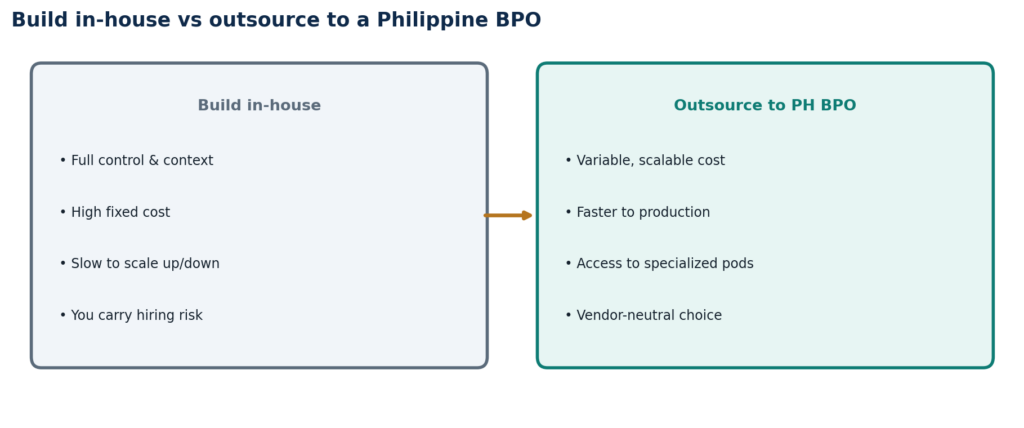
Figure 1 — The decision weighs control against cost structure, speed, and flexibility.
According to John Maczynski, CEO, PITON-Global, “The build-versus-buy debate gets framed as control versus cost, but the sharper question is what is actually core. Your autonomy stack and safety case are core — build those. A 24/7 exception-handling queue is scalable execution someone else has already perfected. Spending your scarce engineers on the second is how you lose the race on the first.”
Why Does Outsourcing Usually Win on Cost and Speed?
Because an established Philippine partner converts fixed payroll into variable cost at 50–70% lower labor and brings ready, trained capacity — compressing time-to-production-scale from many months of internal hiring to a fraction of that.
Building an operation in-house means recruiting, training, tooling, and managing a team before it produces — a long, fixed-cost ramp during which the meter runs regardless of volume. An established partner has already absorbed that build: the people, processes, and tooling exist, so capacity comes online far faster and the cost flexes with your demand at materially lower labor rates. For operations whose volume is variable or whose timeline is urgent — most early and scaling AI and autonomy deployments — that combination of speed and variable cost is decisive. The fixed-versus-variable difference also protects you when volume dips, which a fixed in-house team does not.
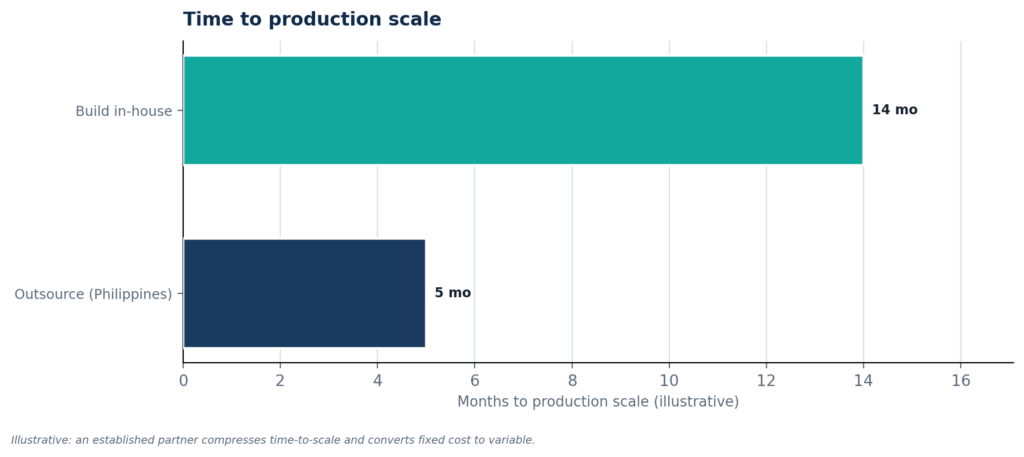
Figure 2 — Illustrative: an established partner compresses time-to-scale and converts fixed cost to variable.
“We rarely advise pure build or pure outsource — the answer is almost always a line drawn through the operation. Keep what defines your safety case and your IP inside; let a partner run the scalable execution around it. Drawing that line well is the actual decision, and it is the one worth getting right,” said Ralf Ellspermann, CSO, PITON-Global.
What Is the Right Hybrid Model?
Keep the genuinely core in-house — the autonomy stack, the safety case, IP-critical judgment, and policy ownership — and outsource the scalable execution around it: monitoring, exception handling, annotation, and moderation, run by a partner under your governance.
For most operators the answer is neither pole but a deliberate line. What is core — the autonomy or model stack, the safety case, the IP-critical judgment, and ownership of policy — stays in-house, where control and context matter most. What is scalable execution — 24/7 monitoring, exception handling, data annotation, content moderation — goes to a partner that runs it as a discipline, under your governance and inside your security architecture. This hybrid keeps your scarce engineering and leadership focused on advantage while converting the operational load to flexible, lower-cost capacity. Drawing that line well, rather than choosing a side, is the real decision — and it is where a vendor-neutral advisor helps most.
“Spend your own engineers on what only you can build and rent the rest. The fastest teams I know are ruthless about that line: they outsource the scalable and guard the strategic,” noted John Maczynski, CEO, PITON-Global.
Frequently Asked Questions
What Factors Decide Build Versus Outsource?
Cost structure (fixed vs variable), time-to-scale (slow internal ramp vs ready capacity), and control (full ownership vs managed relationship) — weighed against your stage, volume variability, and what is genuinely core versus scalable execution.
Why Does Outsourcing Usually Win on Cost and Speed?
An established Philippine partner converts fixed payroll to variable spend at 50–70% lower labor and brings ready, trained capacity, compressing time-to-production-scale from many months of internal hiring to a fraction of that.
What Does the Right Hybrid Model Look Like?
Keep the core in-house — autonomy stack, safety case, IP-critical judgment, policy ownership — and outsource scalable execution (monitoring, exception handling, annotation, moderation) to a partner under your governance and security architecture.
About PITON-Global
PITON-Global helps AI and autonomy operators draw the build-versus-outsource line — keeping the core in-house and sourcing scalable execution from a network of 100-plus leading Philippine BPOs, 20 of them AI-first front-runners. Because we are paid by the provider network and never by you, our advice on what to outsource is unbiased. Our leadership brings 6+ decades of combined global outsourcing experience and 25+ years in the Philippines; advisory is free and carries no obligation.