

The Medicare IEP is not a calendar event. It is a rolling, individualized 365-day flow triggered by 10,000 Americans turning 65 every day. Staffing IEP agents requires a fundamentally different architecture than AEP surge deployment — and most L&H operations are still running the wrong model. Getting this right is a core design question for any team delivering policy servicing and member care from the Philippines.
Key IEP Workforce Metrics
| Metric | Value | Description / Source |
| Americans Turning 65 Daily | 10,000 | Americans turn 65 every day, each triggering an individualized 7-month Initial Enrollment Period (IEP) independent of any enrollment calendar. (U.S. Census Bureau · Pew Research Center) |
| IEP Eligibility Window | 7 months | IEP includes the 3 months before a beneficiary’s 65th birthday, the birthday month, and the 3 months after. (CMS / Medicare.gov · Federal enrollment rule) |
| Annual IEP Flow | 365 days | IEP demand flows continuously throughout the year with no off-peak quarter, low-season buffer, or emergency bench stand-up option. (PITON-Global Advisory 2026) |
A critical operational vulnerability in health insurance distribution is treating all enrollment volume as uniform. Seasonal open enrollment periods — the ACA OEP and the Medicare AEP — are calendar events. They arrive on a known date, peak predictably, and close on a fixed deadline. The planning architecture is linear.
The Medicare Initial Enrollment Period operates on an entirely different logic. Because each consumer’s IEP is triggered by their 65th birthday, the aggregate IEP flow across a national carrier or large brokerage is continuous. With approximately 10,000 Americans turning 65 every day, there is no month, no quarter, and no week in which IEP volume drops to zero. The operation that builds a temporary emergency bench for IEP management is building the wrong tool for a permanent job.
365 Days vs. 45 Days: Why IEP Staffing Requires a Fundamentally Different Architecture Than AEP
IEP staffing requires a steady-state, year-round advisory workforce — not a seasonal emergency bench. While AEP creates a 45-day visible spike that can be planned, staffed, and stood down on a fixed calendar, the IEP creates a continuous daily volume of aging-in consumers, each in a different phase of their individualized 7-month window, each requiring complex advisory support rather than transactional script execution.
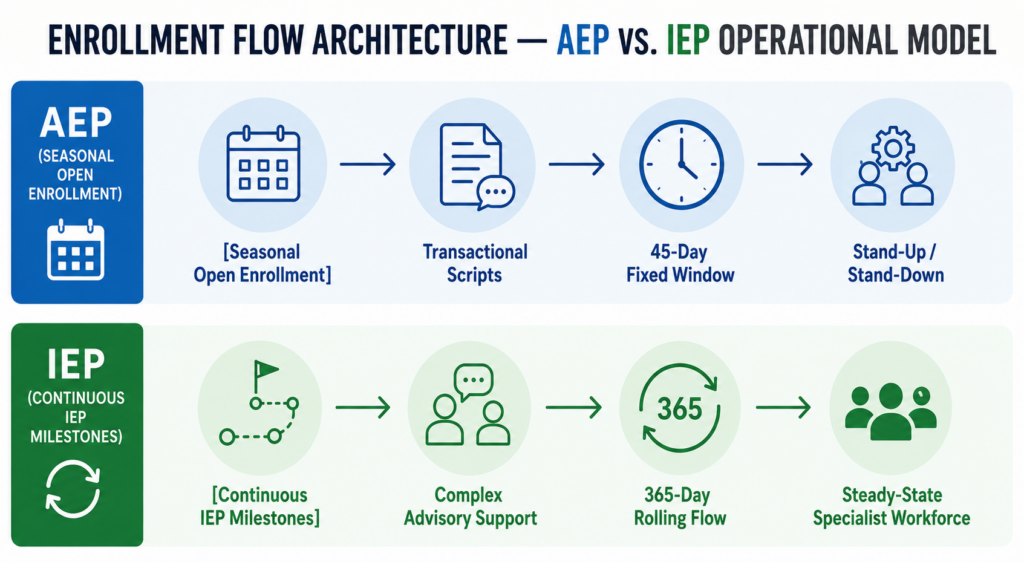
The advisory complexity of IEP interactions amplifies this structural distinction further. An aging-in consumer navigating Medicare for the first time is making a foundational coverage decision — selecting between Original Medicare and Medicare Advantage, evaluating supplemental plan options, understanding formulary implications for existing prescriptions, and managing coverage timing relative to their birthday month. A late enrollment penalty is permanent. A coverage gap is consequential. The interaction requires a licensed, knowledgeable L&H agent functioning as an advisory asset, not a transactional script executor.
According to John Maczynski, CEO of PITON-Global and a 40-year insurance operations veteran, “The ongoing evolution toward advanced AI workflows and automated back-office tasks means that the traditional role of the insurance call center agent is obsolete. Human capital is no longer being utilized for basic data entry — your human workforce must function as high-value, advisory assets. This reality is amplified when handling IEP consumers, who are guiding aging-in individuals through the highly complex, foundational transition into Medicare Advantage and supplemental plans. You cannot automate that advisory relationship. You can only staff it correctly.”
The Permanent Penalty: Why First-Time Medicare Enrollees Need Advisory-Grade L&H Specialists, Not Script Readers
IEP interactions are more complex than AEP enrollment calls because the consumer is making a first-time, irreversible foundational coverage decision. A Part B late enrollment penalty incurred during an IEP grows with every full year of delay — and is added permanently to the monthly premium. A missed IEP window cannot be reopened without a qualifying special enrollment event. The L&H agent guiding this interaction must be a licensed specialist, not a trained temporary script reader.
During AEP, existing Medicare beneficiaries evaluate plan changes within a framework they already understand. During IEP, the consumer is crossing into Medicare for the first time — evaluating Part A, Part B, Medicare Advantage versus Original Medicare, supplemental plan options, and Part D prescription coverage, often simultaneously and without prior familiarity with the system.
An AEP consumer who makes a suboptimal plan choice can correct it at the next AEP. An IEP consumer who misses their enrollment window faces a permanent penalty. A consumer who enrolls in the wrong tier of coverage during IEP may lose Medigap guaranteed issue rights outside their initial window. These are consequential, high-stakes decisions that require the institutional knowledge of a career L&H specialist.
| Category | AEP Interaction Profile | IEP Interaction Profile |
| Consumer Experience | Existing Medicare beneficiary conducting an annual plan review. | First-time Medicare enrollee making a foundational coverage decision. |
| Interaction Complexity | Plan comparison within a familiar framework. | Multi-product evaluation with long-term and potentially permanent penalty implications. |
| Error Consequence | Errors can generally be corrected during the next AEP (October 15–December 7). | Errors may result in permanent late-enrollment penalties or loss of Medigap guaranteed issue rights. |
| Volume Pattern | 45-day enrollment surge with a predictable, fixed calendar. | Continuous 365-day enrollment flow with no off-peak quarter. |
| Agent Profile Required | Licensed, product-trained temporary Life & Health (L&H) agent. | Senior, career-oriented L&H specialist with deep Medicare advisory expertise. |
| Staffing Model | Elastic surge capacity designed to scale up and down seasonally. | Steady-state specialist workforce requiring year-round retention and continuity. |
Sources: CMS Medicare enrollment rules · Medicare.gov late enrollment penalty guidelines · PITON-Global Advisory 2026
Hourly Billing vs. Hybrid Outcomes: Why Legacy Pricing Models Fail Year-Round Enrollment Staffing in 2026
Legacy hourly billing is structurally incompatible with IEP agent staffing because it rewards vendors for time consumed rather than outcomes delivered. A hybrid model — combining a stable baseline hourly rate with performance incentives tied to conversion velocity, application accuracy, and consumer NPS — aligns vendor behavior with the advisory quality that IEP interactions require.
Standard hourly frameworks reward the talent vendor for total billable hours logged, regardless of policy binding efficiency or lead-to-conversion performance. For complex, advisory IEP interactions where quality and conversion accuracy determine whether a consumer secures the right foundational coverage — and whether the carrier retains them — hourly billing actively works against the outcome the operation needs.
The hybrid model deploys a stable baseline hourly rate that secures dedicated infrastructure and workforce retention, augmented by performance-linked incentives tied directly to conversion velocity, clean application processing, and consumer NPS scores. When a vendor earns more per successfully bound, accurately submitted, high-NPS enrollment, they have every incentive to hire the advisory-grade L&H agents who deliver those outcomes.
| Category | Legacy Fixed Hourly Only | Hybrid Outcome-Based Framework |
| Vendor Strategic Focus | Maximizing total headcount and billable phone hours. | Maximizing conversion percentages and application accuracy. |
| Budget Predictability | High financial variance relative to seasonal volume shifts. | Scales directly alongside actual bound premium revenue. |
| Talent Pool Retained | Standardized, high-turnover Tier-1 support profiles. | Senior, career-oriented Life & Health (L&H) agents motivated by performance metrics. |
| AI Investment Incentive | AI reduces billable hours, creating a financial disincentive for vendor investment. | AI increases velocity and accuracy, encouraging continuous vendor investment. |
| IEP Advisory Quality | Script execution focused on call completion rather than consumer guidance. | Advisory-led engagement focused on enrollment accuracy, retention, and NPS improvement. |
Source: PITON-Global Advisory 2026 · Industry BPS Analysis 2026
Ralf Ellspermann, CSO of PITON-Global and a 25-year insurance operations veteran:
“The hourly billing model made sense when the agent’s job was to fill out forms and transfer data. IEP advisory work is not that. When a 64-year-old consumer calls three months before their birthday to understand whether Medicare Advantage or Original Medicare is the right foundation for their retirement healthcare, they need an L&H specialist who understands their situation and can guide them to the right decision. You cannot hire that advisor on an hourly rate optimized for headcount. You attract and retain them with a model that rewards the quality of what they deliver.”
Case Study · U.S. D2C Health Insurance Brokerage · IEP Workflow Optimization · 2025–2026
Reducing Off-Peak Margin Compression Through IEP Workflow Restructuring
A scaling U.S. direct-to-consumer health insurance brokerage experienced severe margin compression during off-peak quarters by maintaining an expensive, underutilized domestic workforce to manage rolling IEP milestones. The workforce had been dimensioned for AEP surge capacity — the wrong model for a continuous, steady-state workflow requiring year-round advisory depth.
The brokerage migrated its IEP workflow to a specialized mid-sized provider under a hybrid pricing matrix: a stable foundation rate securing dedicated infrastructure, augmented by a performance bonus tied to consumer NPS scores and clean application submissions. The vendor’s financial incentive was explicitly aligned with enrollment quality objectives — not headcount or hours logged.
| Metric | Result | Business Impact |
| Operational Expenditure Reduction | -41% | Reduction in total baseline operational expenditure within 180 days of IEP workflow migration. |
| Lead-to-Conversion Improvement | +19% | Increase in lead-to-conversion efficiency driven by an outcome-aligned vendor incentive structure. |
| Optimization Timeline | 180 Days | Time required to achieve full steady-state operational optimization under the hybrid pricing model. |
10,000 Americans Turn 65 Daily: What Is the Correct L&H Workforce Architecture for Year-Round Aging-In Volume?
The correct IEP staffing architecture is a year-round, steady-state specialist workforce of senior L&H agents, dimensioned against the continuous daily aging-in consumer flow, governed by a hybrid outcome-based pricing model, and supported by AI-assisted back-office processing (the same automation now modernizing insurance claims workflows) that frees advisory time for the high-complexity interactions IEP consumers require.
The staffing error most L&H operations make is carrying AEP surge capacity into Q1 and Q2 as IEP coverage, then cutting headcount in Q3 as AEP budget pressure builds. The result is a year-round workforce simultaneously overbuilt for transactional volume and underbuilt for advisory depth — optimized for neither.
The correct model separates the two workforces entirely. The AEP team is elastic: built on temporary licensed agents, dimensioned for the 45-day spike covered in our analysis of the 2026 open enrollment surge, and stood down when the window closes. The IEP team is permanent: a stable core of senior L&H specialists who handle the continuous aging-in flow year-round, compensated under a hybrid model that rewards the advisory quality their consumer segment demands. AI handles eligibility lookups, application pre-population, and CMS database queries, much as it already does in back-office claims adjudication. The L&H agent handles the advisory relationship. Neither replaces the other.
The Operational Verdict
The IEP is not a smaller version of AEP. It is a fundamentally different operational challenge requiring a fundamentally different staffing architecture. With 10,000 Americans turning 65 every day, the IEP represents the most consistent, highest-consequence enrollment flow in the U.S. health insurance market. The operations that staff it correctly — with permanent, advisory-grade L&H specialists under a hybrid outcome-based model — will capture and retain the aging-in consumer segment. The operations that staff it with repurposed AEP surge capacity will lose those consumers to the competitors that did not.