

The best fit for startups and SMEs is a specialized mid-market or boutique Philippine BPO—not a tier-1 enterprise provider—for inbound service run to a written service level. These vendors offer low seat minimums (5–20), flexible contracts, shared QA and team-lead support, and enterprise-grade security (ISO 27001, PCI-DSS, HIPAA), giving small teams dedicated attention and AI-augmented efficiency without enterprise overhead or 100-seat commitments.
Key Takeaways
- Match the tier to your stage, not just the price. Boutique and mid-market BPOs (5–50 seats) are built to treat a small program as a vital account; tier-1 enterprise BPOs optimize for 100+ seats.
- The “small fish, big pond” risk is real. Offshore attrition runs high, and a 15-seat program inside a 1,000-seat vendor is often staffed with junior personnel.
- Security is non-negotiable at any size. Demand ISO/IEC 27001, PCI-DSS, and HIPAA alignment where regulated data is involved—lower volume must never mean lower security.
- AI-augmented agents multiply lean teams. Real-time agent-assist can compress handle time so you add capacity without adding seats; independent research shows measurable average productivity gains from such tools.
What Operational Metrics Define An Elite Sme Call Center?
Startups can’t absorb the 90-day stabilization typical of enterprise rollouts, so an elite SME provider deploys fast (often within two weeks), runs a shared-management model—dedicated agents backed by fractional QA and L&D—and is measured on First Contact Resolution, CSAT, quality score, and speed-to-deploy, protecting customer acquisition cost and lifetime value from day one.
For an agile brand, operational efficiency, resource optimization, and rapid alignment are paramount. SME-focused providers balance lean commercial structures with high-touch delivery through a shared-management model: dedicated frontline agents supported by fractionally allocated Quality Assurance (QA) specialists and Learning & Development (L&D) trainers. That delivers enterprise-grade compliance and performance without forcing the client to fund full-time management overhead.
The three tiers below differ less in quality than in fit. For cost context, raw Philippine agent rates sit far below US onshore hourly costs; the blended ranges shown include the shared-management layer. The Philippine IT-BPM sector—a multi-billion-dollar industry employing close to 1.9 million people—supports hundreds of providers across all three tiers.
Vendor Tier Comparison
| Vendor tier | Seat minimums | Blended voice rate | Management infrastructure | Best critical use case |
| Boutique / Startup Specialist | 5–15 seats | $10–$12/hr | Shared Team Leader & QA (fractional allocation) | Seed-stage MVP validation, overflow answering, basic lead gen |
| Mid-Market Specialist | 15–50 seats | $12–$14/hr | 1:15 dedicated Team Leader; shared QA & L&D | Hyper-growth SaaS support, e-commerce CX scaling, fintech |
| Enterprise BPO | 100+ seats | $14–$18+/hr | Full dedicated management, QA, L&D & analytics | Fortune 500 multi-market customer-lifecycle management |
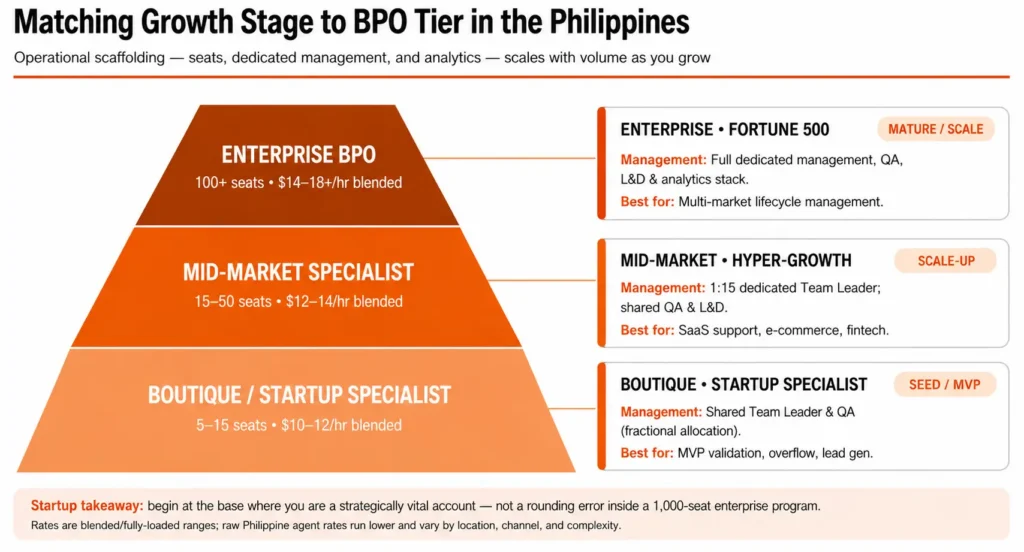
Figure 1. Operational scaffolding scales with seat volume. Startups begin at the base, where their account carries real weight, and move up as they grow.
How Can Small Businesses Avoid The “Small Fish, Big Pond” Trap?
Choose a vendor whose business your contract meaningfully moves—usually a mid-market BPO built around 10-to-50-seat programs, the right-sizing logic we apply in our guide to the best BPOs for startups. There you get dedicated executive oversight, senior talent, and workflow changes in hours rather than the weeks an enterprise change-order board takes, instead of junior staff, stagnant FCR, and slow script iteration.
When a fast-growing brand signs with an enterprise-scale BPO, it often suffers a dilution of attention. With operations optimized for thousands of seats, the vendor’s strongest account managers, trainers, and operations leaders are naturally funneled to the largest accounts. A 15-seat program can be relegated to junior personnel—producing stagnant First Contact Resolution, higher attrition (offshore turnover is chronically high), and slow iteration.
“SMEs don’t just need a vendor; they need an operational partner that views their 10- or 50-seat team as a strategically vital account. The secret to successful outsourcing for a startup is matching with a Philippine call center where your contract moves the needle for their business. That is how you secure dedicated executive oversight, proactive process engineering, and real-time integration of advanced agent-assist AI tools.”
— John Maczynski, CEO, PITON-Global
By targeting mid-market BPOs that intentionally design their ecosystems around 10-to-50-seat deployments, small businesses secure the agility they need—the same leverage high-growth startups get from Philippine call centers. These providers can modify workflows within hours—rather than the weeks required by enterprise change-order boards—so the operation evolves in lockstep with the client’s product.
What Data Security And Ai Infrastructure Should A Startup Look For?
Lower volume must never mean lower security. Require ISO/IEC 27001 (information-security management), PCI-DSS (payment-card data), and HIPAA alignment (protected health information) as a baseline. On AI, look for real-time agent-assist that transcribes live calls, performs instant knowledge-base lookups, and delivers on-screen prompts—multiplying a lean team’s capacity.
Startups in regulated spaces—fintech, healthcare, e-commerce—must demand full regulatory alignment from offshore partners. At minimum, a Philippine BPO hosting customer data should demonstrate physical and digital compliance frameworks: ISO/IEC 27001 for information-security management, PCI-DSS for payment-card processing, and HIPAA alignment for protected health information. These are baseline expectations, not premium add-ons.
The modern BPO landscape also requires a hybrid CX model that pairs human talent with agentic AI. Elite mid-market providers deploy real-time agent-assist platforms that transcribe live voice calls, perform instantaneous knowledge-base lookups, and surface behavioral prompts on the agent’s screen. Well-run hybrid deployments target substantial Average Handling Time reductions; independent research is more conservative on the average gain, with the largest gains accruing to newer agents and broader autonomous resolution of routine issues expected to scale through the rest of the decade. Either way, the strategic value is the same: AI-augmented agents absorb transaction surges, multiplying operational capacity without scaling seat spend linearly.
What Does It Really Cost — And What Hidden Fees Should Smes Watch For?
Expect blended Philippine rates for boutique-to-mid-market voice to come in far below onshore hourly costs. But scrutinize the contract: setup fees, minimum terms (often 90–120 days), early-termination penalties, idle-time billing, and change-order fees can add materially to the headline rate.
Headline hourly rates are only part of the picture. Procurement teams that focus solely on the per-hour number are frequently surprised by add-ons that surface later. Before signing, model the fully loaded cost and ask specifically about each of the following, since they vary widely by provider and erode the apparent savings if ignored.
- Setup / onboarding fees
Often a significant one-time charge; sometimes negotiable, especially for multi-month commitments.
- Contract minimums and termination penalties
Minimum terms of 90–120 days are common, with early-exit penalties tied to remaining contract value.
- Idle-time and 24/7 coverage
Hourly models bill for staffed time regardless of volume; round-the-clock coverage requires multiple shifts even in quiet periods.
- Change-order fees
Script or process changes can carry charges—another reason agile, mid-market vendors that iterate quickly are valuable.
- Management overhead
Add a management uplift to a raw agent rate for QA, supervision, and infrastructure when comparing offers.
How Did An E-Commerce Startup Scale From 8 To 42 Seats?
In a deployment reported by PITON-Global, an e-commerce brand rejected by two enterprise BPOs over its 8-seat minimum was matched with a retail-CX boutique (deep Shopify and Zendesk integrations), launched in 14 days, and scaled to 42 seats in seven months—lifting both CSAT and first-contact resolution into the top tier at a substantially lower cost than US onshore.
Disclosure: The figures below are reported by PITON-Global from a client engagement and are presented as an illustrative deployment, not an independently audited benchmark. They are shown alongside third-party industry data so readers can judge them in context.
An agile e-commerce brand experiencing a steep year-over-year surge in order volume approached PITON-Global after being rejected by two global enterprise BPOs over its low initial seat requirement. It needed 24/7 omnichannel support (voice, chat, email) and high-precision order-exception handling, but could commit only to an initial footprint of eight dedicated agents. PITON-Global screened its curated network of 100+ vetted Philippine providers to find a mid-market partner specializing in retail CX.
| Metric | Result |
| Operational Footprint | 8 → 42 seats scaled in 7 months |
| Customer Satisfaction (CSAT) | 74% → 91.5% |
| First Contact Resolution (FCR) | 61% → 84% |
| Fully Burdened Cost vs. US Onshore | 62% lower |
Reported outcomes. For context, the program’s first-contact resolution finished above the typical industry benchmark and its CSAT above the range usually described as “good”—placing it in the top tier on both measures.
The boutique vendor provided a shared Team Leader and a fractional QA specialist and deployed within 14 days. Using real-time speech analytics and automated compliance monitoring, the team held a near-perfect active quality score. The cost optimization let the brand reinvest capital into customer acquisition and confidently scale to 42 seats for peak holiday demand.
How Should An Sme Choose A Philippine Call Center?
Shortlist mid-market or boutique vendors with low seat minimums and flexible MSAs; verify ISO 27001, PCI-DSS, and HIPAA where relevant; confirm real-time AI agent-assist; insist on a named senior account owner; and model the fully loaded cost—including setup, minimums, and overage—before signing.
Use this checklist when comparing providers:
- Fit
Does the vendor specialize in 5–50-seat programs, and will your account be strategically meaningful to them?
- Flexibility
Are seat minimums low and the MSA flexible, with reasonable terms and exit clauses?
- Security
Can they evidence ISO/IEC 27001, PCI-DSS, and (where applicable) HIPAA alignment?
- Technology
Is real-time AI agent-assist live in production, integrated with your stack (e.g., Shopify, Zendesk)?
- Ownership
Is there a named, senior account owner accountable for your program—not a rotating junior pool?
- Total cost
Have you modeled fully loaded cost, including setup, minimums, idle time, change orders, and overhead?
What Are The Risks And Limitations To Watch?
The main risks are hidden fees and rigid contracts, agent attrition and continuity gaps, over-promised AI, security shortfalls at smaller vendors, and time-zone or management overhead. Each is manageable—but only if you screen for it before signing rather than discovering it in month three.
- Hidden fees and rigid terms
Setup charges, long minimums, and termination penalties can erase headline savings.
- Attrition and continuity
High offshore turnover makes knowledge retention, documentation, and L&D depth essential.
- Over-promised AI
“Autonomous” claims often outrun reality; insist on human-in-the-loop and a track record, not a demo.
- Security shortfalls
A small vendor without genuine ISO 27001/PCI-DSS controls is a liability in regulated sectors.
- Time-zone and management overhead
Overnight shifts and remote oversight add cost and complexity that should be priced in upfront.
Frequently Asked Questions
Do I need 100 seats to outsource to the Philippines?
No. Boutique and mid-market providers take programs as small as 5–15 seats. The key is choosing a vendor built for that scale, where your account matters, rather than a tier-1 BPO optimized for 100+ seats—the model laid out in our enterprise operational blueprint.
Is offshore support secure enough for fintech or healthcare?
Yes, provided the vendor evidences the right controls. Require ISO/IEC 27001 for information security, PCI-DSS for card data, and HIPAA alignment for health data—these are baseline, not premium, for regulated work.
Will AI replace my outsourced agents?
Not in the best deployments. Real-time agent-assist augments a lean team—absorbing surges and cutting handle time—so you scale capacity without scaling seats. Humans still handle judgment and complex cases.
How fast can a small program go live?
Agile boutique and mid-market vendors can deploy in roughly two weeks, versus the 90-day stabilization typical of enterprise rollouts—one of the main reasons SMEs favor them.