

The best BPOs in the Philippines for startups are rarely the biggest names—they’re right-sized specialists that take small teams (even 1–20 seats), ramp in weeks, avoid long lock-ins, and give you direct senior attention. Startups are the smallest accounts, so they get deprioritized at Tier-1 giants; our guide to outsourcing call handling explains how that vendor landscape is tiered. Match the partner to your stage, and use a vendor-agnostic advisor to shortlist best-fit providers at zero cost.
Key Takeaways
- Right-sized beats big. A startup’s 1–20-seat program is a rounding error at a Tier-1 giant; a mid-sized specialist gives it real attention and agility.
- Demand startup-friendly terms. Low or no seat minimums, fast ramp (~4–6 weeks), month-to-month or short pilots, and no rigid 12-month lock-in.
- Know the real price. English voice is quoted per hour fully loaded or per month per dedicated agent—always compare all-in, not base.
- Match the model to your stage. Pay-as-you-go or a shared team pre-PMF; a small dedicated team at early traction; a scalable team once you’re growing fast.
Who Is the “Best” BPO for a Startup—and Why Isn’t It the Biggest One?
The best BPO for a startup is a right-sized specialist whose smallest clients look like you: one that accepts small teams, ramps in weeks, works month-to-month or on a short pilot, and gives you direct access to leadership. The largest global providers are built for thousands of seats, so a startup’s small program competes with enterprise accounts for attention—and loses.
The Philippines is the natural first stop for startup outsourcing: a mature, multi-billion-dollar industry approaching two million workers, with high English proficiency and strong cultural alignment to Western markets. But “best” is not a fixed leaderboard—any list that names “the top 10” without saying who it’s best for is marketing, not guidance. For a startup, the decisive variable is fit: a small, fast-moving account needs a partner that treats it as important.
This is where many founders go wrong. A Tier-1 giant looks reassuring, but inside a facility running tens of thousands of seats, a 5- or 15-seat startup program is deprioritized for executive attention, engineering, and top agent talent. The better fit is usually a mid-sized specialist—agile, attentive, and structured to grow with you, which is why high-growth companies lean on Philippine call centers. PITON-Global’s role is to match each startup to the specific best-fit providers in a vetted network and run a competitive process, rather than push a one-size-fits-all name.
What Should a Startup Actually Look for in a BPO?
Six things: low or no seat minimums; a fast ramp (around 4–6 weeks); flexible terms (month-to-month or a short pilot, not a 12-month lock-in); direct senior or founder-level attention; compatibility with your existing tech stack; and transparent, fully-loaded pricing. Above all, the freedom to scale both up and down as your volume changes.
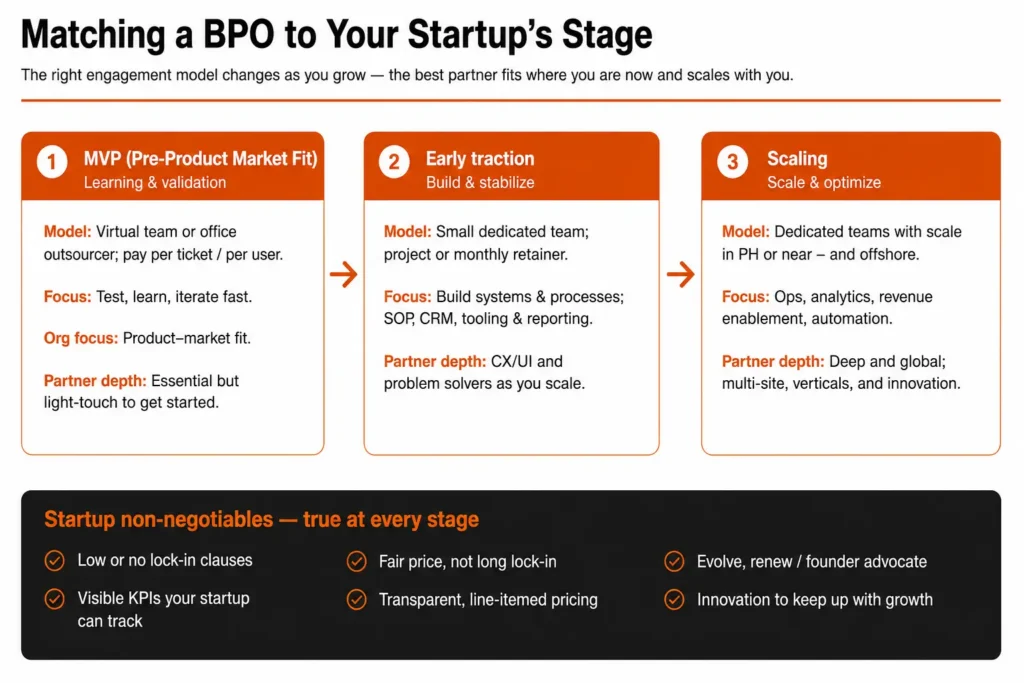
These criteria matter more for a startup than for an enterprise because a startup’s needs change fast and its budget is finite. A mid-sized provider can typically deploy a trained team in about four to six weeks (versus eight to twelve for a large enterprise BPO), offer a six-month pilot for 10–20 seats instead of a rigid annual minimum, give you weekly access to the account director and operations manager, and plug into your existing CRM and contact-center software rather than forcing a proprietary stack. Setup fees are common but are often waived for a longer commitment.
How Does the Right BPO Change as a Startup Grows?
Pre-product-market-fit (1–3 agents), favor a shared team or virtual assistant on pay-as-you-go terms and avoid lock-ins. At early traction (3–15 agents), move to a small dedicated team on a month-to-month or pilot basis, prioritizing quality and fast ramp. When scaling (15–50+ agents), use a dedicated team with the flexibility to scale up and down, and shift focus to retention and cost per resolved interaction.
Stage-matching protects both cash and quality. Early on, you are still discovering your support playbook, so flexibility beats commitment—pay-as-you-go or a shared team lets you learn without locking in. As real volume arrives, a small dedicated team that learns your product produces the consistency customers feel. Once you are scaling, the priorities flip toward sustained low attrition and AI-assisted efficiency, where the question is no longer the hourly rate but the cost per resolved interaction. The best partner is one you will not outgrow in a year.
How Much Does It Cost a Startup?
For English-language voice, a fully loaded dedicated agent costs a fraction of a comparable U.S. hire; routine back-office work is priced lower still, and specialized work costs more. For very small or spiky volumes, per-task, per-ticket, or per-resolution pricing can beat paying for idle seat-time.
Startup Pricing Models
| Engagement Model | Typical 2026 Cost | Best for a Startup When… |
| Pay-as-you-go / per task | Per task or per ticket (~$2–$6/call) | Volume is low or unpredictable (pre-PMF) |
| Shared team | Lower than dedicated; cost shared | You need a few hours of coverage, not an FTE |
| Dedicated agent (FTE) | ~$1,200–$2,500/agent/month | Volume is steady and you want consistency |
| Hourly (voice) | ~$8–$18/hr fully loaded (English) | You’re ramping and volumes vary |
| Per resolution (AI-assisted) | ~$1–$2 per resolved interaction | High-volume, repeatable tier-1 support |
Whatever the model, compare the fully-loaded number, not a headline “base” rate. A fully-loaded seat is only about half direct salary; the rest covers statutory benefits, facilities and technology, and management and margin. A low base quote simply means the other half reappears later—so always ask what is included.
What Mistakes Do Startups Make When Choosing a BPO?
The big five: defaulting to the biggest brand; signing long lock-ins before product-market-fit; choosing on base rate instead of fully-loaded cost and quality; ignoring attrition; and skipping security and data-privacy basics. Each is avoidable with the right questions up front, and our companion piece on call centers for startups and SMEs adds the hidden-fee checklist.
- Going Big by Default
A marquee logo won’t prioritize your 10-seat account; right-sized attention will.
- Locking In Too Early
Pre-PMF, insist on month-to-month or a short pilot so you can pivot without penalty.
- Buying on Base Rate
Compare fully-loaded cost and quality—cheap-but-volatile usually costs more once attrition and rework are counted.
- Ignoring Attrition
Sustained low attrition is the best proxy for stable quality; ask for monthly figures by program.
- Skipping Security
Even early, confirm data-privacy practices, access controls, and relevant standards (e.g., ISO 27001, PCI/HIPAA if applicable).
How Does PITON-Global Help a Startup Find the Right BPO?
It runs a vendor-agnostic, provider-funded process: a complimentary requirements review, a match against a vetted provider network, a shortlist of the best-fit, startup-friendly providers for your stage and use case, a rigorous RFP, and a competitive bid. The audit, RFP, and introductions are free to the buyer, and the decision stays yours.
For a founder with limited time, the value is a qualified shortlist instead of 800-plus unverified options—providers that actually take small teams, offer flexible terms, and have done comparable work. Because the advisor is paid by its provider network rather than the startup, the service is free and without obligation; because the process is competitive, providers earn the business on fit, service, and price. It does not replace your own due diligence—you should still check references and terms—but it removes most of the sourcing risk and time.
Frequently Asked Questions
Can a Startup Outsource Just One or Two Agents?
Yes. Many Philippine providers take very small teams—even one or two agents—often via shared-team or virtual-assistant models, and let you scale up as you grow. Avoid providers that require large seat minimums at this stage.
How Fast Can a Startup Get a Team Running?
A mid-sized specialist can typically onboard a trained team in about four to six weeks, versus eight to twelve for a large enterprise BPO. Short pilots for 10–20 seats are common.
Should a Startup Avoid the Big-Name BPOs?
Not always—but be realistic. Tier-1 giants excel at high-volume enterprise programs—the operating model described in our 2026 enterprise operational blueprint—but a small startup account is easily deprioritized there. For most early-stage companies, a right-sized specialist delivers more attention and flexibility.
What’s the Cheapest Way to Start?
For low or unpredictable volume, per-task, per-ticket, or shared-team models avoid paying for idle seat-time. As volume stabilizes, a dedicated agent on a monthly rate usually delivers better consistency.
How Do I Avoid Getting Locked In?
Negotiate month-to-month or a short pilot rather than a 12-month minimum, and confirm scale-down terms. Get setup fees, minimums, and exit terms in writing before signing.