

TL;DR: The Key Takeaway
AI chatbot training outsourcing in the Philippines has matured beyond simple script-following to a sophisticated process of nuanced conversational data generation, essential for creating AI agents that deliver genuine human-like understanding and interaction. This evolution is powered by the archipelago’s cognitive workforce, and it is one of the services covered in our guide to where AI labs source dialogue data and RLHF.
AI chatbot training outsourcing in the Philippines bridges the gap between mechanical scripts and genuine conversational understanding. By utilizing a workforce skilled in “AI Conversation Design,” enterprises can develop agents that grasp context, sentiment, and multi-turn logic. This strategic collaboration ensures that large language models (LLMs) are grounded in high-fidelity, brand-aligned data, resulting in empathetic and trustworthy digital ambassadors.
Executive Briefing
- From Scripted to Smart: Transition from rigid, keyword-based bots to fluid conversational agents that handle complex, non-linear human interactions.
- Cognitive Empathy: Leverage the Philippines’ unique cultural alignment to train AI that recognizes user frustration, intent, and subtle emotional cues.
- Brand-Aligned Personas: Deploy expert “Conversation Designers” to infuse your chatbot with a specific voice, tone, and set of ethical guardrails.
- C-Suite Impact: Elevate chatbot quality from a technical metric to a strategic asset that drives customer lifetime value and brand loyalty.
- Governance & Safety: Implement “Agentic Governance” to ensure autonomous AI agents remain secure, unbiased, and helpful.
From Keywords to Conversations: The New Frontier of Chatbot Training
The first generation of chatbots often felt like a digital “dead end.” Relying on fragile keyword matching and static decision trees, these systems were frequently baffled by basic synonyms or natural speech variations. The result was a frustrating user experience that invariably ended with a plea for a human agent. This “automated disappointment” highlighted a fundamental truth: machines cannot fake understanding without high-quality, human-curated data.
Today’s conversational AI, powered by sophisticated Large Language Models (LLMs), represents a quantum leap in capability. These modern agents don’t just scan for words; they synthesize context and intent. However, this intelligence is not innate—it is earned through exhaustive training on nuanced, multi-turn dialogue. This is where the human element is irreplaceable. Building a chatbot that truly understands requires the cognitive labor of experts who can generate and validate the complex data structures that teach an AI how to “think” during a conversation, work that increasingly overlaps with crafting the prompts that steer generative models.
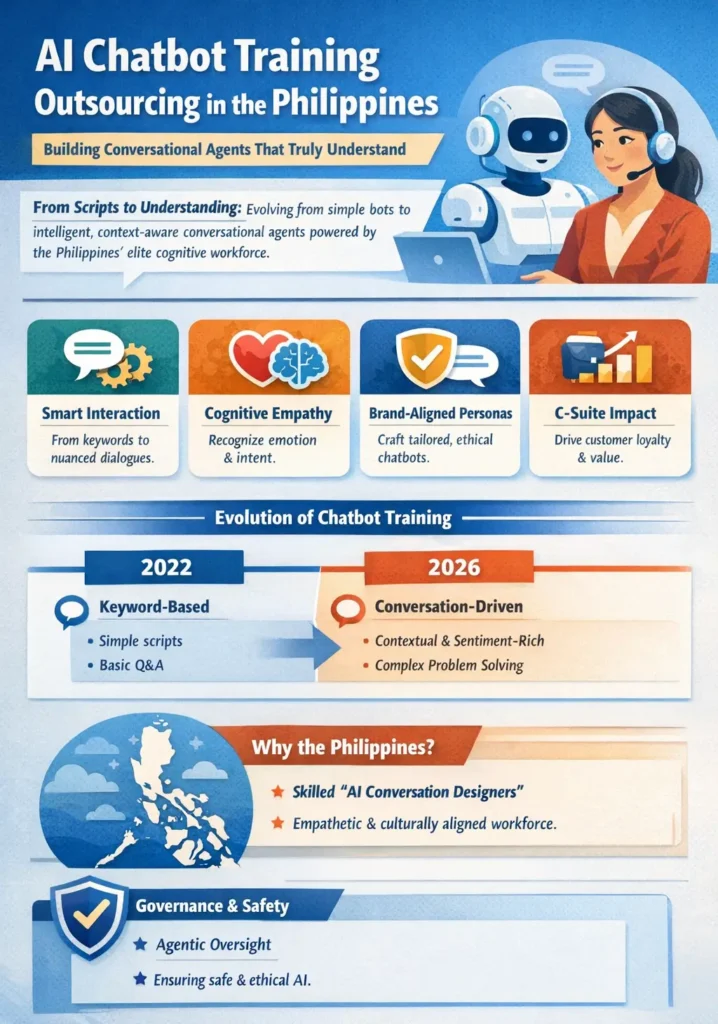
The Paradigm Shift: 2022 vs. 2026
The evolution of the sector is defined by a shift from simple rule-setting to the architectural design of machine intelligence.
| Aspect | 2022 State (Keyword-Driven) | 2026 State (Conversation-Driven) |
| Primary Goal | Fact retrieval and simple Q&A. | Fluid, multi-turn problem solving. |
| Core Technology | If/Then logic, decision trees. | LLMs and deep learning. |
| Training Data | Static FAQ pairs. | Contextual, sentiment-rich dialogues. |
| Human Role | Content writer/scripter. | AI Conversation Designer. |
| Success Metric | Deflection rate. | CSAT, engagement, and trust scores. |
| Value Prop | Pure cost reduction. | Brand differentiation & loyalty. |
Intelligence Arbitrage: The Human Element in Conversational AI
The emergence of Intelligence Arbitrage has redefined the value proposition of the Philippines. It is no longer about finding the lowest-cost labor to perform repetitive tasks; it is about accessing a pool of elite specialists who provide the “mental scaffolding” for AI.
Filipino professionals are uniquely suited for this role due to their high degree of “Cognitive Empathy”—the ability to understand and predict human needs across cultural boundaries. They are not merely generating data; they are act as “AI Character Architects,” ensuring that a brand’s digital voice is empathetic, culturally sensitive, and logically sound.
“We have moved past the age of programming bots with rigid scripts. The modern challenge is cultivating an AI that genuinely connects with a human being. Our clients aren’t just looking for automation; they want digital brand ambassadors. We bridge that gap by connecting them with Philippine teams who possess the nuanced communication skills required to build trust.”— John Maczynski, CEO, PITON-Global
The Strategic Imperative: Why Chatbot Quality is a C-Suite Concern
In 2026, the chatbot is frequently a customer’s primary interface with a brand. Consequently, the quality of these interactions has moved from the IT basement to the boardroom. A world-class conversational agent provides personalized, 24/7 engagement that human teams cannot match in scale. However, a poorly trained bot can cause irreparable brand damage. Investing in high-fidelity “human-in-the-loop” training is no longer an optional expense; it is a defensive and offensive necessity in a competitive digital economy.
Conversational AI Capability Tiers
PITON-Global categorizes chatbot intelligence into four tiers to help organizations align their outsourcing strategy with their operational needs.
| Capability Tier | Description | Key Use Cases |
| Tier 1: Foundational | Keyword matching; answers simple facts. | Basic FAQs, info retrieval. |
| Tier 2: Context-Aware | Tracks history across multiple turns. | Lead gen, tech support. |
| Tier 3: Personalized | Initiates actions based on user history. | E-commerce, targeted marketing. |
| Tier 4: Agentic | Understands emotion; acts on user behalf. | Problem-solving, health companions. |
Agentic Governance: The Human Touch in an Automated World
As AI agents become “agentic”—meaning they can perform tasks like booking flights or accessing accounts—the need for Agentic Governance is paramount. This discipline involves “AI Behavior Analysts” in the Philippines who monitor model outputs to ensure they remain safe, ethical, and secure. These experts act as the ultimate backstop, much like the human checkpoint that verifies generative output, intervening when a model encounters a situation that falls outside its ethical guardrails. This partnership between human intuition and machine speed is the cornerstone of a trustworthy AI ecosystem.
Expert FAQs
Why is the Philippines the global hub for chatbot training? The archipelago offers a rare mix of high English fluency, a service-oriented culture, and a deep understanding of Western social nuances. This allows Filipino trainers to create dialogue data that feels natural and helpful, rather than robotic or confusing.
What is the fundamental difference between a chatbot and a “Conversational Agent”? A chatbot is typically a reactive tool that waits for a keyword. A conversational agent is a proactive, AI-powered system that uses historical context and sentiment analysis to guide a user toward a solution, learning from every interaction. Building one depends on deliberate dialogue design rather than keyword lists.
How does “Human-in-the-loop” prevent AI hallucinations? Trainers in the Philippines perform “fact-checking” and “grounding.” When an AI generates a false response, the human trainer corrects the logic and reinforces the factual path, effectively “pruning” the model’s tendency to invent information.
What is the future of conversational AI? The horizon is “empathetic automation.” We are moving toward agents that don’t just solve problems but do so with a personality and emotional intelligence that makes the interaction indistinguishable from a high-quality human service experience.