

On this page
- Key Takeaways
- What Drivers Fuel Baseline Wage Escalations in the Philippine BPO Sector?
- How Does Agent Attrition Exacerbate Wage Inflation Dynamics?
- How Do Regional Geographic Spreads Influence Wage Stability?
- What Financial Frameworks Protect Contracts Against Arbitrary Rate Hikes?
- What Does Stabilizing Escalating BPO Costs Look Like in Practice?
- What Role Does PITON-Global Play in Mitigating Outsourcing Pricing Risks?
- Frequently Asked Questions
CFOs evaluating Philippine BPO expansion must account for structured wage inflation driven by statutory minimum wage orders, localized talent competition, and compounding night differential requirements. Long-term cost control depends on weighing fully loaded hourly rates against regional wage board trajectories, agent turnover friction, and contract indexing mechanisms, and on aligning expansion with secondary delivery hubs and transparent open-book models. Wage dynamics are one strand of the market’s size, talent and cost picture.
Key Takeaways
- Statutory escalations and fully loaded multipliers: Regional wage board orders and legislative wage hikes create periodic mandatory baseline adjustments, and top-line hourly rates obscure substantial statutory additions, including night differential premiums, 13th-month pay, and SSS, PhilHealth, and Pag-IBIG contributions.
- Wage compression risks: Mandatory minimum wage floor increases compress salary gaps between entry-level and experienced staff, driving off-cycle compensation adjustments under Article 124 of the Philippine Labor Code.
- Regional inflation spreads: Metro Manila experiences faster annual wage growth because of high vendor density, while emerging regional hubs offer lower turnover and more subdued wage escalation.
- Contractual indexing: Tying annual rate adjustments to official Philippine Statistics Authority CPI metrics and currency corridors protects operating margins against arbitrary rate increases.
What Drivers Fuel Baseline Wage Escalations in the Philippine BPO Sector?
Baseline wage escalation stems primarily from Regional Tripartite Wages and Productivity Boards, which issue periodic wage orders adjusting regional minimum daily rates to localized inflation and CPI. Each order compounds through the fully loaded equation—base rate plus the statutory night differential, 13th-month accrual, statutory benefits, and margin overhead—and triggers Article 124 wage distortion adjustments across adjacent pay grades.
Evaluating long-term BPO financial models requires a clear understanding of the macro-economic and statutory mechanisms driving wage growth across the Philippine outsourcing landscape. While the region maintains significant cost advantages over Western markets, localized legislative and economic forces create dynamic baseline adjustments. They do not undermine the long-term outlook for the country’s call centers, but they must be modeled. The structural map below organizes the drivers a CFO must model.
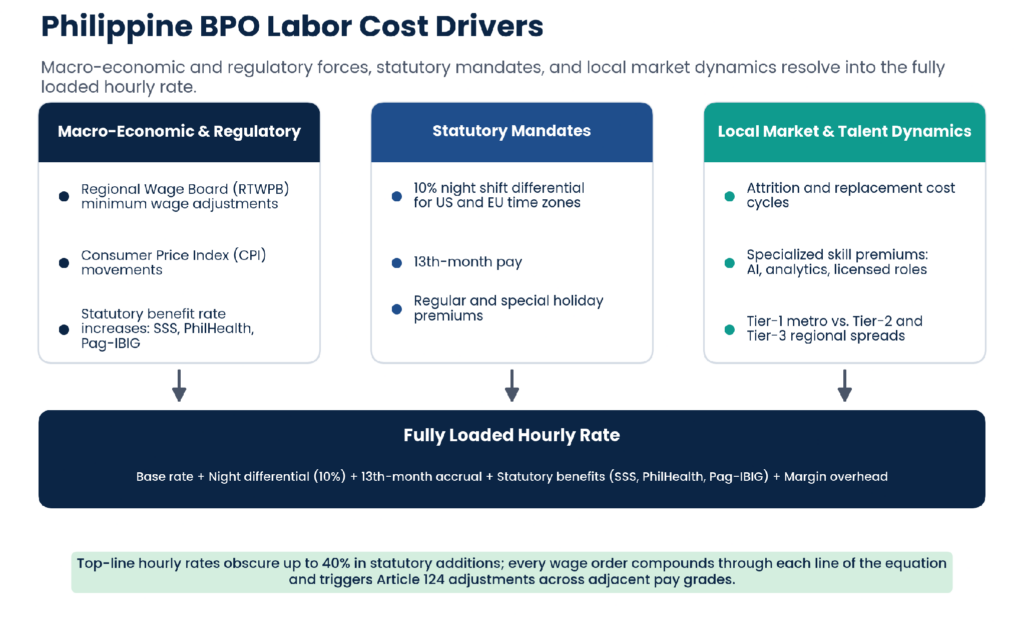
Figure 1. Structural map of Philippine BPO labor cost drivers—macro-economic and regulatory factors, statutory mandates, and local market dynamics—resolving into the fully loaded hourly rate.
The primary driver of baseline wage shifts is the Regional Tripartite Wages and Productivity Boards (RTWPB), which issue periodic wage orders adjusting regional minimum daily rates based on localized inflation and consumer price indexes. In major outsourcing centers these statutory adjustments create immediate upward movement across entry-level compensation bands, and the fully loaded labor equation shows how each increase compounds: the base rate is grossed up by the statutory night differential, the 13th-month accrual, statutory benefits, and margin overhead, so a peso added at the floor arrives on the invoice as considerably more.
Under Article 124 of the Philippine Labor Code, mandatory baseline wage increases frequently trigger “wage distortion”—a structural friction in which the salary gap between entry-level workers and tenured staff is compressed. To maintain organizational equity and prevent turnover, BPO operators must implement secondary salary adjustments across adjacent pay grades, elevating overall payroll overhead well beyond the headline increase in the minimum wage, as the chart below illustrates.
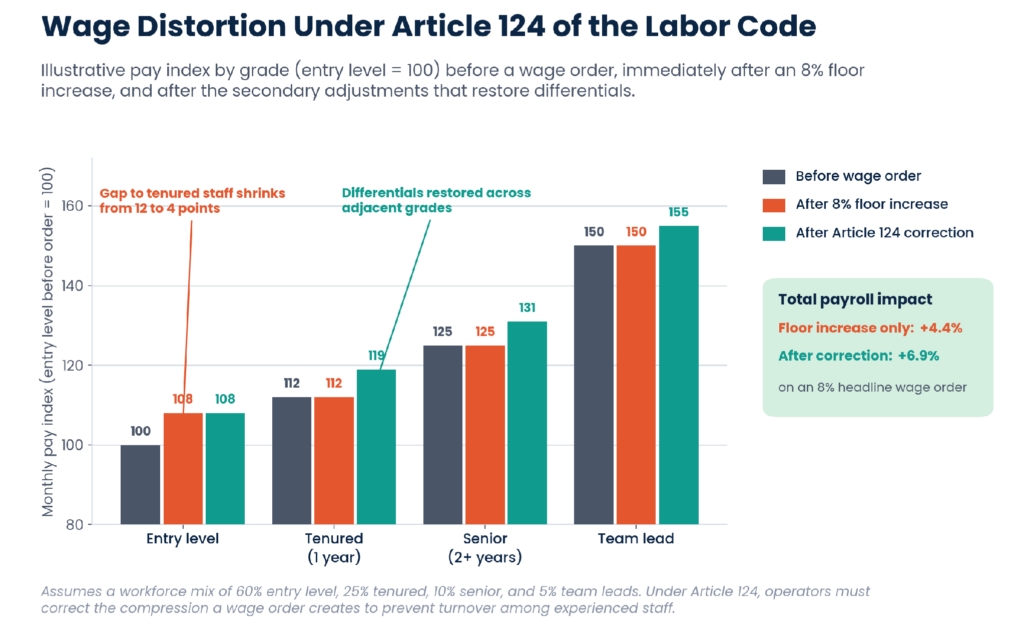
Figure 2. Wage distortion under Article 124: a minimum wage order compresses pay gaps, and the secondary adjustments that restore them lift total payroll by more than the order itself (illustrative index).
How Does Agent Attrition Exacerbate Wage Inflation Dynamics?
High agent turnover amplifies wage inflation by converting variable recruitment and training expenses into fixed burdens: recruitment costs for every replacement hire, new agents working well below full efficiency for their first weeks, non-billable trainers and nesting floors, and off-cycle retention bonuses that distort compensation brackets. A low rate with heavy turnover costs more over 36 months than a higher rate with low turnover.
When a vendor experiences elevated annual attrition, the indirect financial consequences erode initial contract savings, and because they recur with every departure they behave like fixed costs rather than one-time events. The table below itemizes the four factors and their financial consequence.
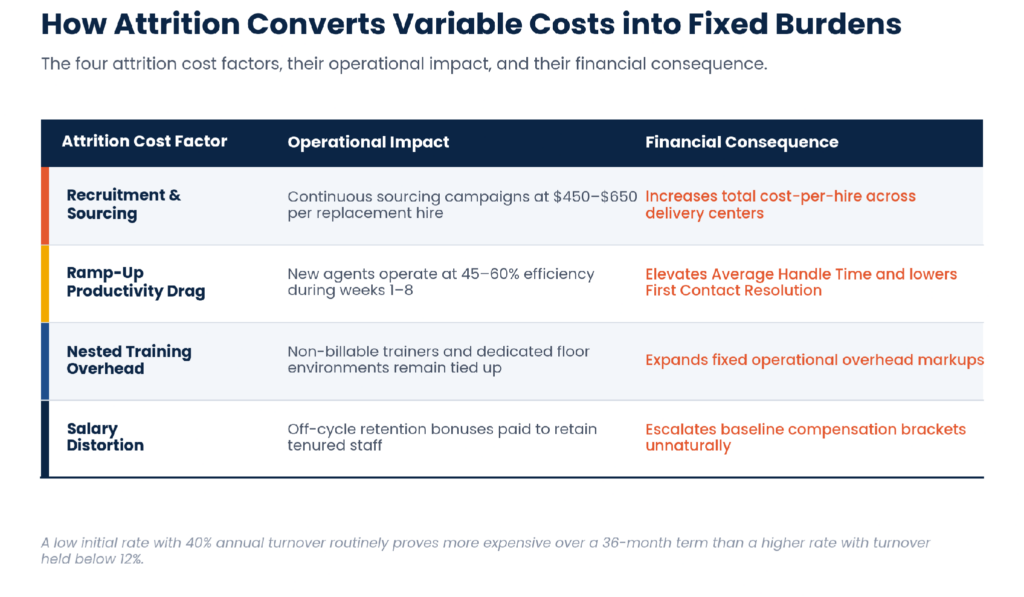
Figure 3. Attrition cost factors, their operational impact, and their financial consequences.
When evaluating vendor proposals, financial decision-makers must examine historical retention metrics alongside top-line seat rates. A vendor offering a low initial hourly rate but operating with high annual turnover routinely proves more expensive over a 36-month term than a provider charging a higher baseline rate with turnover kept low, because every departure re-triggers recruitment, ramp-up drag, and the wage distortion adjustments that precede emergency rate increases. Retention levers such as flexible and remote work arrangements help break that cycle.
CFOs who evaluate Philippine BPO expansion purely through top-line hourly rates miss the systemic financial drag caused by unmanaged attrition. When a vendor relies on low starting wages to win contracts, they create a churn engine that erodes delivery quality and triggers emergency rate adjustments. Long-term budget stability is built on sustainable compensation structures that keep skilled agents at the desk.
— John Maczynski, CEO, PITON-Global
How Do Regional Geographic Spreads Influence Wage Stability?
Geographic placement across the Philippine archipelago shapes wage inflation and talent availability. Metro Manila’s dense talent pools come with intense vendor competition, higher attrition, and the fastest annual wage escalation; Cebu City and Clark offer deep pipelines with moderate attrition and living costs well below NCR; next-wave cities Iloilo, Bacolod, Davao, and Dumaguete pair the lowest turnover with the slowest wage growth.
Evaluating delivery locations allows financial planners to align program needs with regional cost dynamics. Over a three-year term the escalation gap between hubs compounds, as the chart below shows, and it often outweighs the initial rate differential between competing proposals. Connectivity rarely limits the choice now, thanks to the country’s infrastructure build-out.
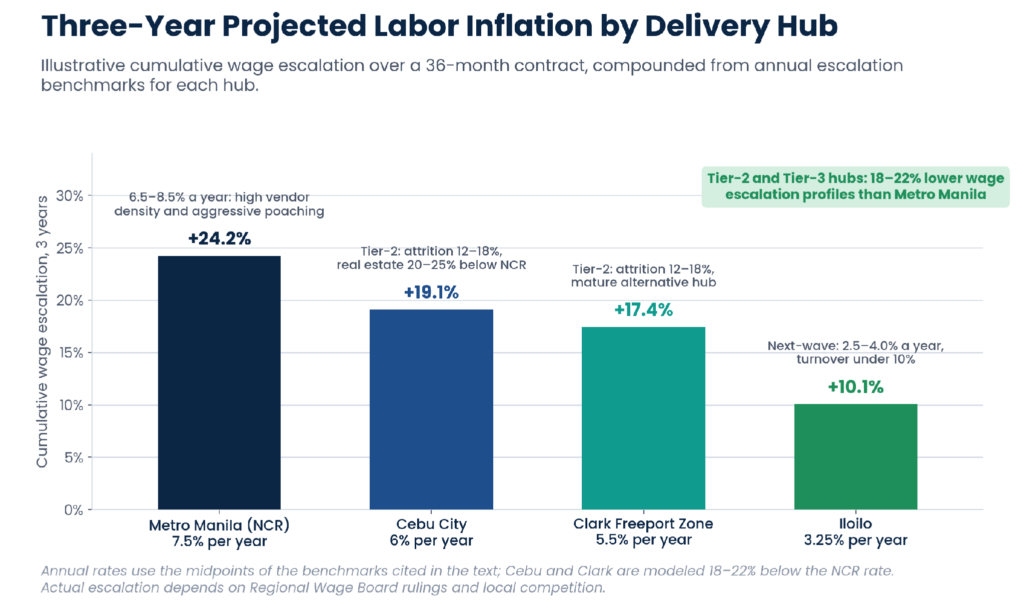
Figure 4. Three-year projected labor inflation across Metro Manila, Cebu City, Clark, and Iloilo (illustrative, compounded from annual escalation benchmarks).
Metro Manila (NCR)
As the primary BPO hub, the National Capital Region—Makati, BGC, Ortigas, and Quezon City—contains dense talent pools for specialized back-office, financial, and complex customer support functions. However, intense vendor competition drives higher attrition and the steepest annual wage escalation of any hub.
Primary Alternative Hubs (Cebu City and Clark Freeport Zone)
These mature markets offer deep talent pipelines with lower attrition rates than NCR. Real estate expenses and baseline living costs remain well below NCR levels, providing price stability for mid-to-large programs.
Next-Wave Digital Cities (Iloilo, Bacolod, Davao, Dumaguete)
Emerging regional hubs feature loyal labor pools with low annual turnover. Lower regional cost-of-living indices translate to predictable, steady wage growth over multi-year horizons.
What Financial Frameworks Protect Contracts Against Arbitrary Rate Hikes?
Enterprise buyers insulate budgets from unmanaged wage inflation with four index-linked mechanisms: CPI-indexed rate caps tied to official Philippine Statistics Authority benchmarks rather than fixed percentage increases; symmetrical FX corridors that absorb minor currency movements; open-book cost structures that separate statutory adjustments from discretionary margin expansion; and productivity gainsharing that lets automation gains offset natural wage inflation.
Fixed-rate contracts look predictable until a wage order squeezes the vendor’s margin and forces a renegotiation. Index-linked mechanisms replace that brittleness with rules both parties can audit, and the four below work as a system: each closes a gap the others leave open.
CPI-Indexed Rate Caps
Cap annual rate adjustments at the official Philippine Consumer Price Index benchmarks published by the Philippine Statistics Authority rather than accepting fixed percentage increases. A vendor whose costs genuinely rise faster than CPI must show why in the open-book review rather than simply invoicing it.
Symmetrical FX Corridors
Establish currency risk-sharing bands—for example, fixed USD/PHP boundaries—to absorb minor exchange rate movements without triggering sudden contract renegotiations. Symmetry matters: when the peso weakens the buyer should benefit as readily as the vendor does when it strengthens.
Open-Book Cost Structures
Require vendors to itemize base wages, statutory benefits, and administrative markups to isolate genuine statutory wage adjustments from discretionary margin expansion. Open-book terms also expose the wage compression that precedes emergency rate increases before it becomes the buyer’s problem.
Productivity Gainsharing
Tie contract terms to process automation gains. When vendor AI tools improve agent transaction speed—agent-assist typically adds meaningful capacity—the resulting labor savings offset natural wage inflation rather than accruing solely to the provider. The framework below shows how the four controls combine in an annual review.
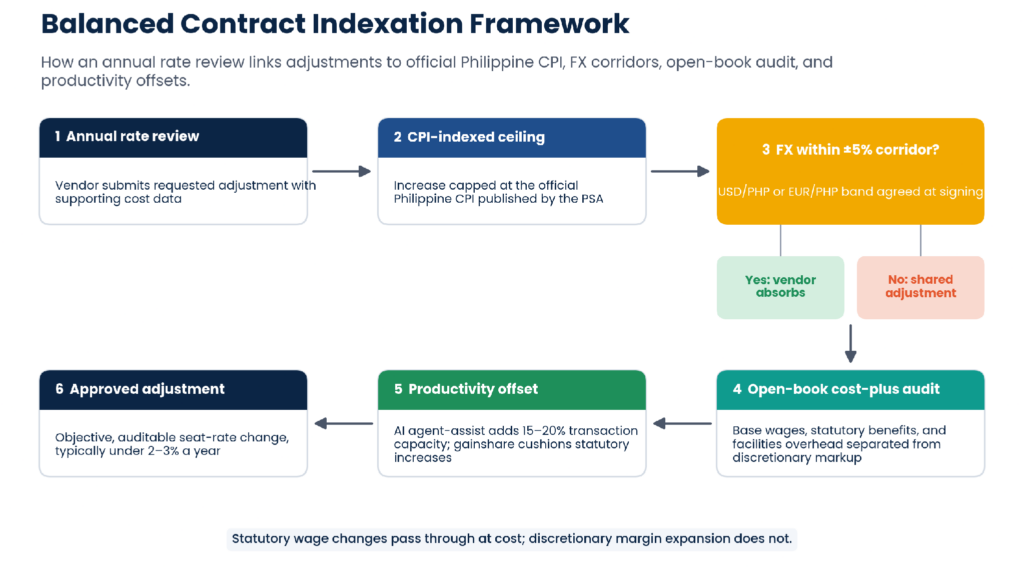
Figure 5. A balanced contract indexation framework linking annual rate adjustments to official Philippine CPI, FX corridors, open-book audit, and productivity offsets.
What Does Stabilizing Escalating BPO Costs Look Like in Practice?
Stabilizing escalating costs means relocating to a high-retention operator under index-linked terms. A North American logistics firm moved a 150-FTE Metro Manila support program with high attrition and steep annual rate increases to a specialized mid-market Cebu provider on a CPI-indexed open-book contract, cutting attrition sharply within six months, saving substantially every year, and holding rate increases to a fraction of their former level.
Client Challenge
A North American logistics firm experienced steep annual contract rate increases across a 150-FTE customer support program in Metro Manila, driven by uncurbed annual agent attrition that kept the program in permanent ramp and pushed the provider into repeated wage catch-up.
Vendor Selection
PITON-Global audited the program’s cost structures and evaluated its network of more than 100 Philippine BPO providers to identify high-retention operators outside high-density zones, scoring candidates on compensation stability and retention history rather than headline rate.
Solution Implemented
The client transitioned the 150-FTE operation to a specialized mid-market provider in Cebu operating under a transparent, CPI-indexed open-book pricing structure with a currency corridor, so that statutory wage orders passed through at cost while discretionary markups could not.
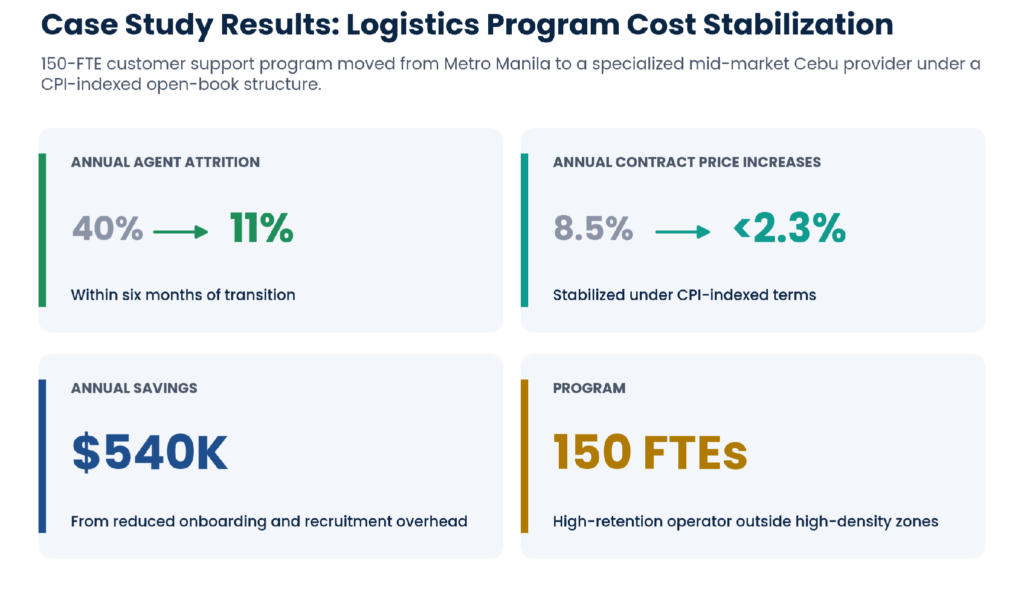
Figure 6. Quantifiable outcomes of the logistics firm’s transition to a CPI-indexed Cebu delivery center.
Outcomes and Lessons
Annual agent attrition fell sharply within six months. The reduction in continuous onboarding and recruitment overhead produced substantial annual savings, while contract price increases stabilized at a fraction of their former rate. The lesson: initial hourly rates are secondary to retention stability, and aligning with a provider that manages compensation effectively delivers far greater long-term financial control.
What Role Does PITON-Global Play in Mitigating Outsourcing Pricing Risks?
PITON-Global is an independent, advisory-led outsourcing consultancy headquartered in Manila with more than two decades of embedded operational experience in the Philippine market. It maintains operational oversight of more than 100 enterprise-grade providers, evaluating them continuously on performance, compensation stability, and financial health, and identifies the top three to five partners for long-term alignment within 48–72 hours.
Who Is PITON-Global?
PITON-Global is an independent, advisory-led outsourcing consultancy headquartered in Manila, with more than two decades of embedded operational experience in the Philippine market and senior leadership with more than 65 combined years of global outsourcing governance. Rather than acting as a traditional broker, it operates as a specialized advisory partner for enterprise leadership teams, with a particular focus on the compensation and contract variables that determine pricing stability.
How Does PITON-Global Differ from Traditional Outsourcing Brokers?
Traditional brokers earn placement commissions and have no stake in whether a rate holds in Year 2. PITON-Global maintains operational oversight of its provider network, evaluating each operator on operational performance, compensation stability, and financial health, recommends on the buyer’s long-term alignment rather than provider promotion, and represents the buyer through contract structuring so that CPI indexation, FX corridors, and open-book terms are in place before signing.
How Does PITON-Global’s Network of 100+ Vetted Philippine BPO Providers Benefit Organizations?
A network of more than 100 enterprise-grade Philippine BPO providers across Metro Manila, Cebu, Clark, and next-wave cities—continuously evaluated rather than listed once—lets enterprises compare providers on the metrics that predict wage stability: retention, compensation structure, financial health, and delivery location. Buyers see which providers keep skilled agents at the desk, not just which quote the lowest starting rate.
How Does PITON-Global’s Advisory-Led Vendor Matching Process Work?
The advisory matching methodology runs from program assessment to selection support: analyzing program requirements, skill profiles, compliance mandates, and budget parameters; screening the network for retention performance, compensation stability, and hub inflation profile; identifying the top three to five delivery partners genuinely equipped for long-term alignment within 48–72 hours; verifying financial health and hidden pricing markups; then representing the buyer through negotiation of indexation, corridor, and open-book terms.
Why Do Organizations Use PITON-Global?
Organizations use PITON-Global to accelerate partner selection to 48–72 hours while protecting themselves from hidden pricing markups and operational risk. Because the firm represents enterprise buyers throughout the selection process and carries no advisory fee, it delivers the budget predictability that a low starting rate can only promise.
Frequently Asked Questions
What is the average fully loaded hourly rate for Philippine BPO services?
In 2026, fully loaded hourly rates for customer experience roles typically range between $10.50 and $16.50 per hour. Complex back-office processing, financial management, IT, and technical support roles generally range from $13.00 to $22.00 per hour, depending on technical specialization and location.
How do minimum wage increases impact BPO contract pricing?
Minimum wage orders set by Regional Tripartite Wages and Productivity Boards directly adjust the floor for entry-level compensation. Open-book contracts account for these statutory adjustments transparently, whereas fixed-rate contracts may face sudden renegotiation if vendor margins are squeezed.
How do currency fluctuations affect USD-denominated BPO contracts?
When the Philippine peso depreciates against the U.S. dollar, vendors experience local margin relief; when the peso strengthens, vendor operating costs rise. Currency corridors establish clear boundaries, such as fixed percentage bands, to distribute FX volatility risk fairly between both parties.
Why do mid-sized BPO providers often offer greater cost predictability than mega-vendors?
Mid-sized providers of 200–2,000 seats typically operate with lower corporate overhead and treat 50–200 FTE client programs as core, high-priority accounts, resulting in dedicated executive oversight and stable retention strategies.
How does process automation help offset wage inflation in call centers?
Integrating AI-assisted tools measurably increases agent transaction capacity and handling efficiency. These throughput gains help absorb statutory wage inflation without requiring proportional increases in billable headcount.