
On this page
- Key Takeaways
- What Is the Operational Impact of Low Workforce Utilization on Enterprise Margins?
- How Do Philippine BPOs Systematically Lower Operational Shrinkage?
- How Does AI-Driven Workflow Automation Boost Agent Utilization?
- What Does Optimizing Capacity Utilization Look Like in Practice?
- Why Do Enterprise Buyers Partner with PITON-Global for Strategic BPO Sourcing?
- Frequently Asked Questions
Outsourcing to the Philippines improves workforce utilization by converting fixed internal overhead into elastic, demand-aligned capacity, optimizing Schedule Adherence to 88%–92%, and lowering shrinkage to 12%–15%. Specialized offshore teams supported by automated Workforce Management and agentic AI tools systematically eliminate non-productive downtime, raising billable FTE utilization above 85% against domestic baselines that often hover around 60%–65%.
Key Takeaways
- Occupancy and utilization optimization: Offshore Philippine BPO teams achieve billable utilization rates of 85%–90%, compared with domestic in-house baselines that often hover around 60%–65%.
- Shrinkage reduction frameworks: Rigorous operational governance and real-time WFM tracking lower uncontrollable shrinkage—absenteeism, tardiness, unproductive idle time—to 12%–15%.
- Follow-the-sun elasticity and AI-assisted idle time eradication: Time zone alignment enables continuous queue clearing through seasonal and intra-day spikes without domestic overtime premiums, while agentic AI handles after-call work and CRM updates in real time, saving 45 to 90 seconds per transaction.
- Risk-mitigated sourcing: Partnering with an independent advisory firm eliminates vendor selection friction, connecting buyers directly to the top 1% of Philippine BPOs equipped for maximum operational yield.
What Is the Operational Impact of Low Workforce Utilization on Enterprise Margins?
Low utilization is a primary driver of margin erosion: when domestic teams run at 55%–65% utilization, organizations pay fully loaded salaries of $28–$42 per hour for hours lost to downtime. Utilization equals direct productive hours divided by total paid hours; Philippine benchmarks of 84%–89% utilization, 82%–88% occupancy, 12%–15% shrinkage, and 88%–93% adherence add 25%–31% productive capacity per paid hour.
In domestic contact centers and back-office operations, low workforce utilization is a primary driver of margin erosion. Utilization measures the percentage of paid time an employee spends actively performing billable or value-generating work versus sitting idle, attending unscheduled meetings, or handling administrative tasks—direct productive hours divided by total paid hours, multiplied by 100. When domestic teams operate at 55%–65%, organizations pay full fully loaded salaries of $28–$42 per hour in Western markets for hours lost to non-productive downtime. The table below sets the four utilization metrics against Philippine BPO targets.
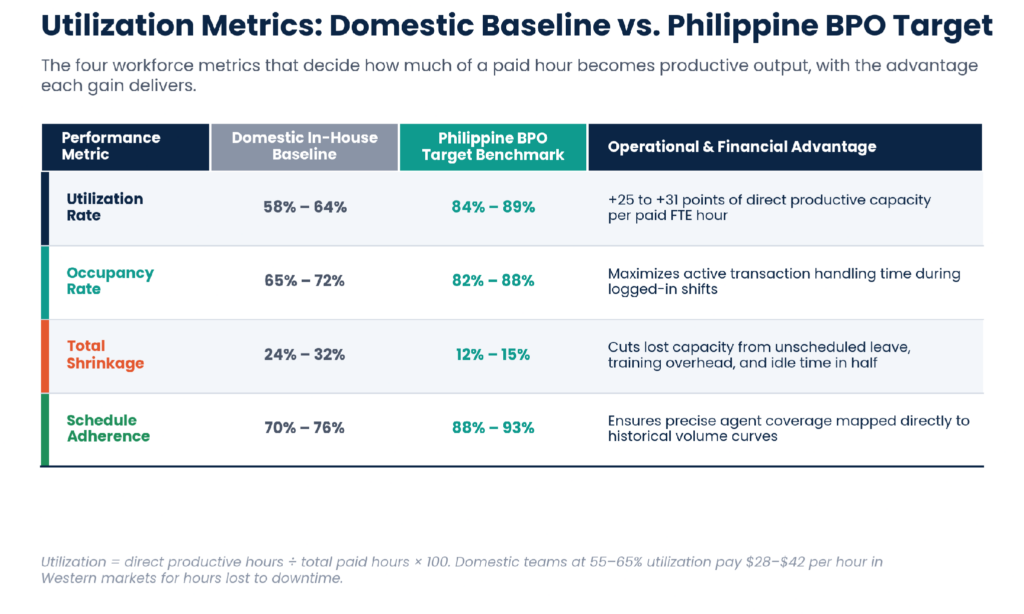
Figure 1. Utilization, occupancy, shrinkage, and schedule adherence: domestic in-house baselines versus Philippine BPO target benchmarks.
Transitioning operations to specialized Philippine service providers allows enterprises to restructure workforce costs. Rather than paying for idle capacity during low-volume intervals, buyers leverage managed staffing models that align paid hours directly with real-time transactional demand. The comparison below shows where 100 paid hours go in each environment.
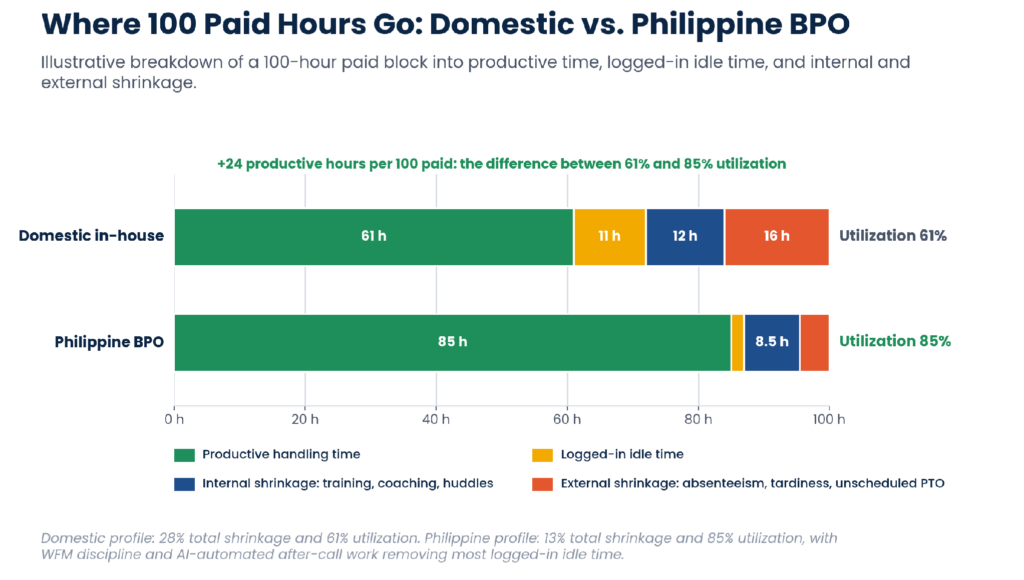
Figure 2. Side-by-side breakdown of 100 paid hours: domestic shrinkage and idle losses versus optimized Philippine BPO productive output (illustrative).
How Do Philippine BPOs Systematically Lower Operational Shrinkage?
Shrinkage—paid time when an employee cannot process interactions—divides into internal shrinkage (scheduled training, one-on-one coaching, team huddles) and external shrinkage (absenteeism, tardiness, unscheduled PTO), measured as both divided by scheduled hours. Top-tier Philippine operators hold utilization above 85% with real-time adherence monitoring, 15-minute Erlang-C interval scheduling, and attendance governance built on incentives, shift-swap portals, and floater pools.
Shrinkage represents any paid time during which an employee is unavailable to process customer interactions or complete back-office transactions. It falls into two primary categories—internal shrinkage (scheduled training, one-on-one coaching, team huddles) and external shrinkage (absenteeism, tardiness, unscheduled PTO)—and total shrinkage equals internal plus external shrinkage hours divided by total scheduled work hours. To maintain utilization above 85%, top-tier Philippine BPO operators execute three structured Workforce Management protocols.
Real-Time Adherence (RTA) Monitoring
Centralized WFM desks track agent state changes second by second using automated desktop telemetry, alerting supervisors the moment an agent strays from scheduled activity.
Flexible Interval Scheduling
Workloads are modeled in 15-minute intervals using Erlang-C algorithms, matching shift starts and meal breaks precisely to forecasted queue arrival patterns, so that coverage follows the volume curve instead of the clock.
Dedicated Attendance Governance
Standardized attendance incentives, shift-swap portals, and reserve floater talent pools mitigate the impact of sudden unscheduled absences.
By tightening control over both internal and external shrinkage variables, Philippine delivery centers prevent the capacity leaks that typically degrade internal operations. The chart below shows how the protocols compress a domestic shrinkage profile down to the 12% target.
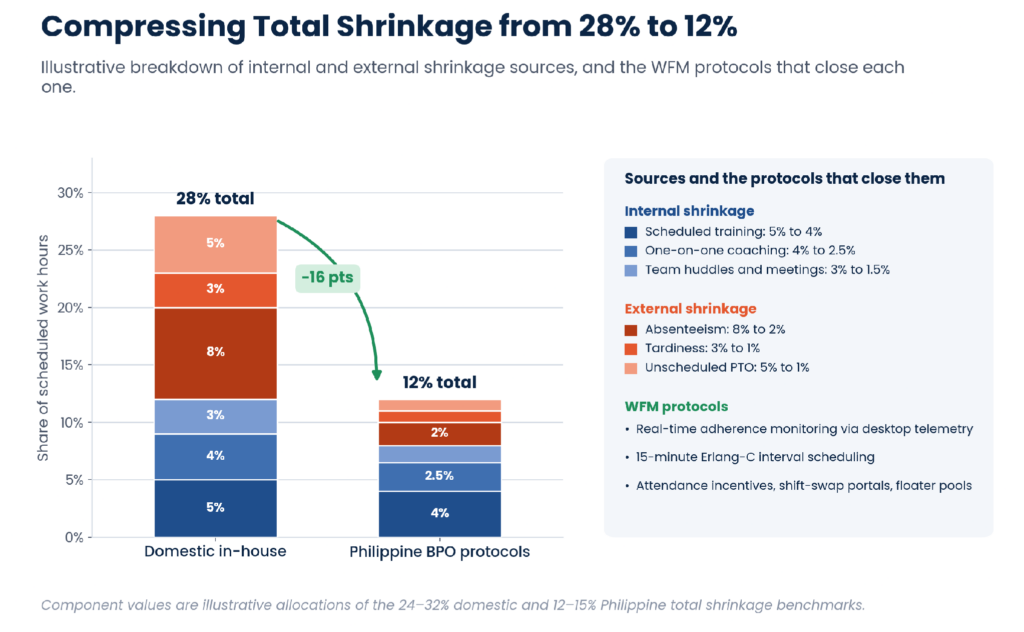
Figure 3. Internal versus external shrinkage sources, and how Philippine BPO protocols compress total shrinkage from 28% to 12% (illustrative).
How Does AI-Driven Workflow Automation Boost Agent Utilization?
Agentic AI—real-time automated copilots working alongside human specialists—has reshaped workforce yield. In legacy environments, specialists spend 20%–25% of a shift on After-Call Work: typing notes, tagging dispositions, updating CRM records. AI tools automate those tasks during the call, so the agent moves immediately to the next queued item, increasing active handling time without increasing exhaustion or burnout.
The integration of agentic AI—real-time automated copilots working alongside human specialists—has reshaped workforce yield across call center and back-office operations in the Philippines. Post-call work reduction is simply baseline after-call work time minus AI summarization time, and in legacy environments that baseline is large: specialists spend up to 20%–25% of their shift on After-Call Work, manually typing interaction notes, tagging disposition codes, and updating CRM records.
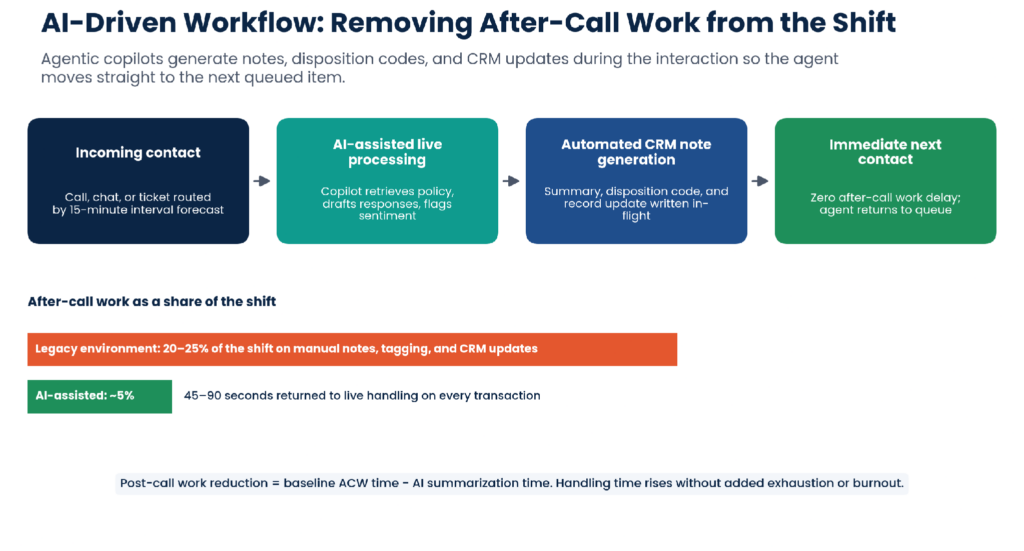
Figure 4. The AI-assisted contact workflow—live processing, automated CRM note generation, immediate next contact—and the after-call work it removes from the shift.
Agentic AI tools automate these tasks during the call, enabling immediate transition to the next queued item. By removing administrative friction from the agent’s workflow, AI integration increases active handling time without increasing workforce exhaustion or burnout.
Productivity and utilization in 2026 aren’t about driving agents to work faster or cut corners; it’s about eliminating structural idle time. When you combine real-time AI desktop automation with the operational discipline of the Filipino workforce, you don’t just reduce operating costs by 60%—you unlock a level of workforce efficiency that internal teams simply aren’t built to achieve.
— John Maczynski, CEO, PITON-Global
What Does Optimizing Capacity Utilization Look Like in Practice?
Optimizing capacity utilization pairs interval-based WFM with AI automation. A North American on-demand logistics platform running at 56% utilization, with 28% shrinkage and 14% queue abandonment, transitioned 110 FTE roles to a Manila BPO under a Pilot and Wingman model, lifting utilization to 87% within 90 days, cutting shrinkage to 11.5% and abandonment to 1.8%, and saving $3.4M annually.
Client Challenge
A fast-growing North American logistics and delivery platform faced severe workforce underutilization across its domestic support teams. High volume volatility caused severe staffing mismatches: agents sat idle during morning lulls while afternoon spikes pushed queue abandonment above 14%, and overall workforce utilization averaged just 56%.
Vendor Selection
The logistics platform engaged PITON-Global to redesign its customer support architecture. PITON-Global evaluated the program requirements against its proprietary database of more than 100 vetted Philippine BPOs, identifying three specialized mid-market providers with deep experience in real-time dispatch management and dynamic workforce scheduling.
Solution Implemented
The client transitioned 110 FTE roles to a Manila-based BPO partner. The provider deployed a hybrid Pilot and Wingman operational model, pairing real-time WFM interval scheduling with AI-driven automated ticketing tools, and expanded coverage to 24/7. The map below traces the transition from 56% to 87% utilization.
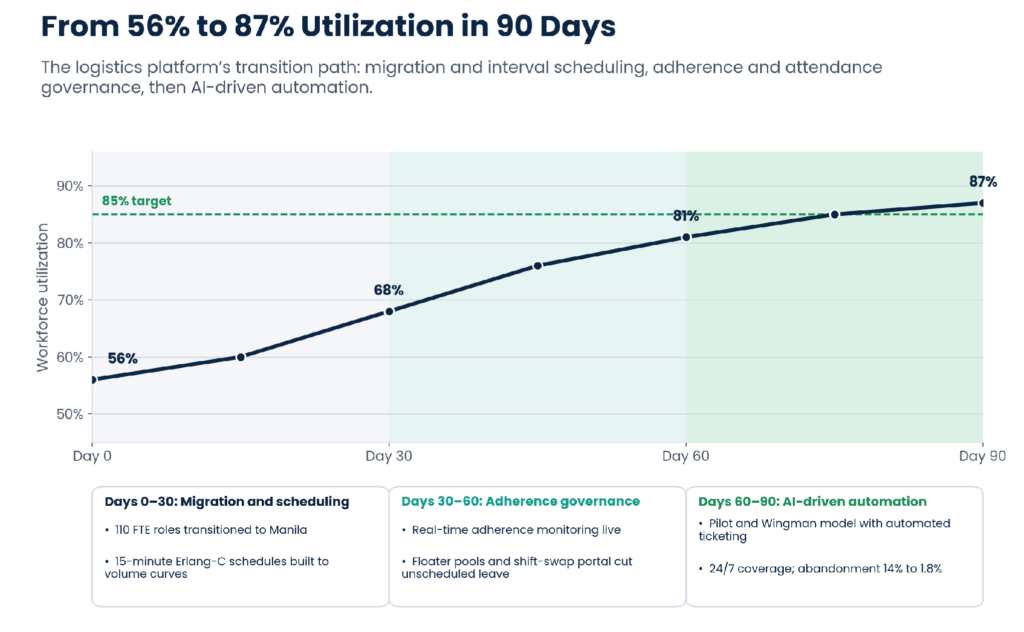
Figure 5. Transition map from 56% domestic utilization to 87% offshore utilization over 90 days, with the protocols introduced in each phase.
Outcomes and Lessons
Utilization increased to 87%—direct productive time up 31 percentage points within 90 days of launch. Shrinkage fell from 28% to 11.5% as strict schedule adherence protocols eliminated chronic idle time and unscheduled leave; queue abandonment dropped to 1.8% as dynamic interval-based routing cleared volume spikes instantly; and operating expenses decreased 62%, an annualized $3.4M saving, while service coverage expanded to 24/7. The key lesson: achieving high utilization requires combining advanced WFM forecasting technology with disciplined, hands-on operational leadership—a framework core to top-tier Philippine BPO operators.
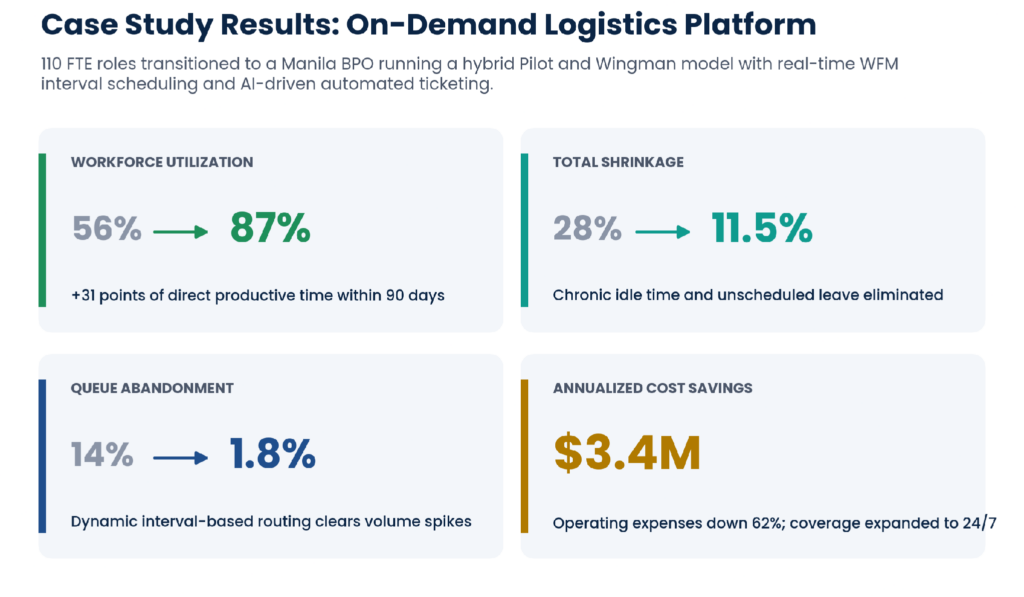
Figure 6. Quantifiable outcomes of the logistics platform’s capacity utilization restructuring.
Why Do Enterprise Buyers Partner with PITON-Global for Strategic BPO Sourcing?
Out of more than 1,000 call centers in the Philippines, only a fraction maintain the WFM infrastructure, technology stacks, and low attrition needed to deliver 85%-plus utilization. PITON-Global, an independent sourcing advisory led by CEO John Maczynski and CSO Ralf Ellspermann, evaluates candidates against benchmarks across more than 100 vetted providers, narrowing the field to one partner within 48–72 hours.
Who Is PITON-Global?
PITON-Global is an independent, founder-led BPO sourcing advisory firm headquartered in Manila. Led by CEO John Maczynski and Founder and Chief Strategy Officer Ralf Ellspermann, who bring a combined 65-plus years of hands-on global BPO executive experience, the firm offers buyer-side advisory grounded in deep operational authority.
How Does PITON-Global Differ from Traditional Outsourcing Brokers?
Selecting a provider on pitch decks or low hourly rates exposes buyers to operational risk, and commission-driven brokers steer them toward generic high-volume centers. PITON-Global evaluates candidate BPOs against proprietary operational benchmarks—utilization, occupancy, shrinkage, adherence, attrition—recommends on the buyer’s yield rather than provider promotion, and stays engaged through pricing and governance terms.
How Does PITON-Global’s Network of 100+ Vetted Philippine BPO Providers Benefit Organizations?
A network of more than 100 vetted Philippine service providers, benchmarked on WFM sophistication, technology stack, and attrition, is what turns 1,000-plus providers into six to ten qualified candidates and one optimal partner. Buyers are matched with specialized, mid-sized BPOs where their account represents leadership-level focus—the environment in which 85%-plus utilization is sustained.
How Does PITON-Global’s Advisory-Led Vendor Matching Process Work?
The process runs from utilization baseline to contract terms: measuring current utilization, occupancy, shrinkage, and adherence; matching program requirements against the vetted network on WFM infrastructure, real-time reporting, and domain fit; delivering six to ten qualified candidates and a shortlist within 48–72 hours; verifying benchmarks on site; then securing optimal pricing with utilization and adherence commitments written into the agreement.
Why Do Organizations Use PITON-Global?
Enterprise buyers partner with PITON-Global to eliminate vendor selection risk, accelerate procurement cycles to 48–72 hours, and secure optimal pricing terms. Because the advisory carries no cost to the buyer, it connects them directly to the top 1% of Philippine BPOs equipped for maximum operational yield.
Frequently Asked Questions
What is a realistic workforce utilization target for outsourced operations in the Philippines?
Top-performing Philippine BPOs achieve steady-state workforce utilization rates between 84% and 89%, while maintaining agent occupancy between 82% and 88% to prevent burnout.
How does workforce utilization differ from workforce occupancy?
Utilization measures the percentage of total paid time spent on direct productive work, including handling time and necessary administrative tasks. Occupancy measures the percentage of logged-in, available time that an agent spends actively handling live customer interactions or back-office transactions.
What is the typical fully loaded hourly cost for a high-utilization BPO agent in the Philippines?
Standard voice customer experience roles range between $10 and $16 per hour fully loaded, while back-office processing specialists range from $7 to $12 per hour. These rates include management overhead, WFM technology, facility costs, and operational governance.
How do Philippine BPOs prevent agent fatigue when running at 85%+ utilization?
Leading providers use intelligent workload design, building micro-recovery intervals into agent shifts following high-intensity interactions, and deploy AI copilots to eliminate repetitive administrative tasks.
How long does it take to achieve target utilization rates after migrating operations to the Philippines?
Initial operational migration typically requires 30 to 60 days for training and baseline stabilization. Full optimization—where schedule adherence reaches 90% or more and utilization stabilizes at 85% or more—is generally achieved between days 60 and 90.